

Surprising turnaround: Foreign capital is flowing back to Germany
Xpert Pre-Release

Available in 27 languages 📢
Prefer Xpert.Digital on GoogleⓘPublished on: September 6, 2026 / Updated on: September 6, 2026 – Author: Konrad Wolfenstein
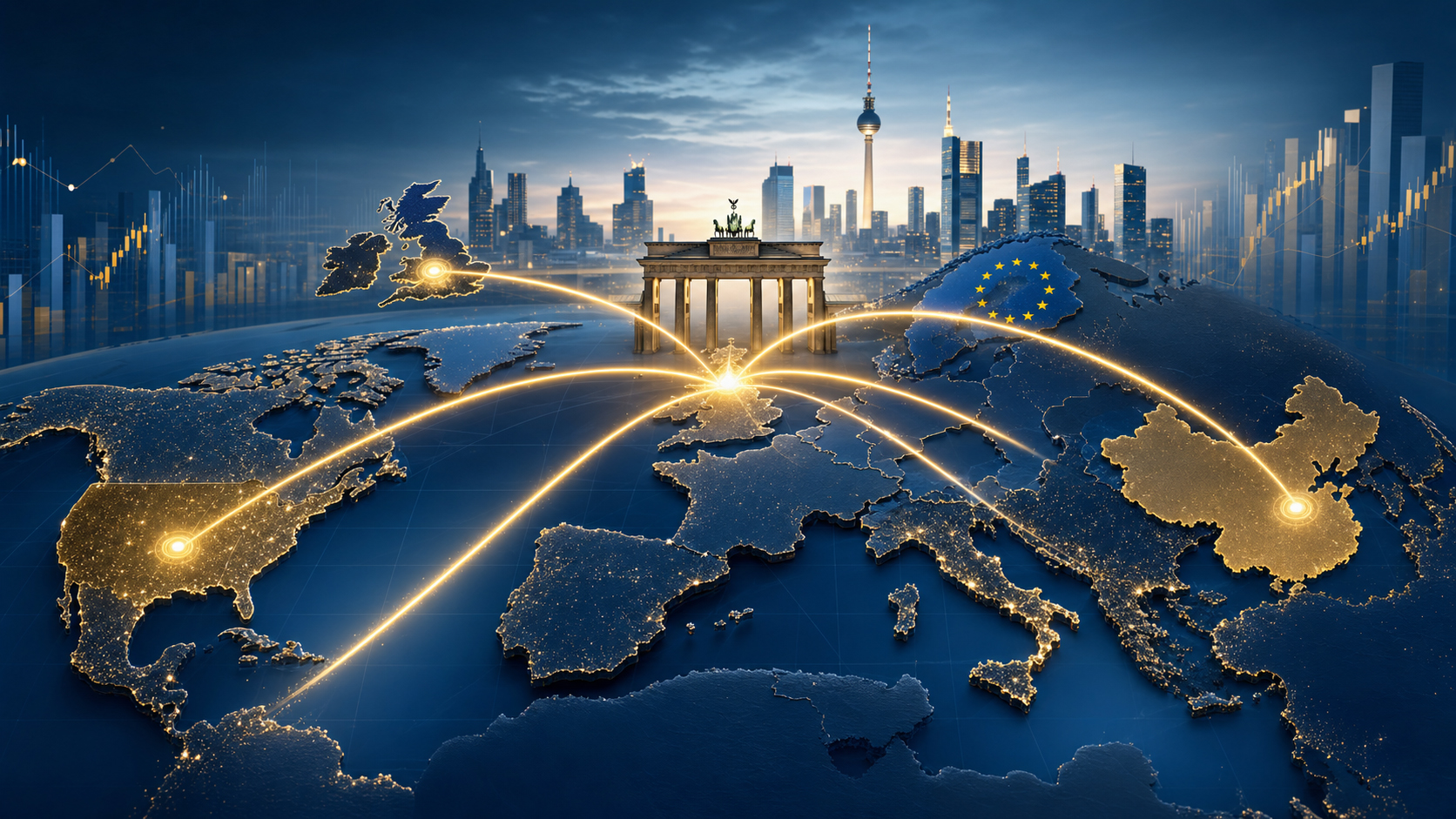
Surprising turnaround: Foreign capital is flowing back to Germany – Image: Xpert.Digital
86 billion for Germany: Why the sudden investment boom is deceptive
Trump shock hits the economy: US investors suddenly withdraw billions
Mega-deal distorts statistics: The truth about Germany's new investors
In 2025, around €86 billion in foreign direct investment flowed into Germany – a substantial increase of 50 percent, which at first glance appears to be a long-awaited breakthrough for the crisis-ridden economy. After years of gradual decline, the confidence of international investors seems to have suddenly returned. But a closer look reveals that this suddensegen of money is deceptive. While Great Britain has become the most important investor thanks to a gigantic corporate acquisition, capital flows from the USA have plummeted as a result of the erratic tariff policies under US President Trump. Behind these impressive billions lies less an industrial jobs miracle than a profound geopolitical realignment of capital, in which Germany scores points primarily as a legally secure haven within Europe. A detailed analysis of the current figures reveals why the supposed investment boom is creating hardly any new jobs and what dangers this development poses for the future.
Capital returns: Germany's new role in the global investment landscape
When money speaks while politics remains silent
Foreign companies invested around €86 billion in Germany in 2025. This represents an increase of approximately 50 percent compared to the previous year, according to calculations by the Cologne Institute for Economic Research (IW) based on data from the Deutsche Bundesbank. Following a slump of almost 32 percent in 2024, this reverses a trend that had been interpreted for years as a symptom of a gradual erosion of Germany's attractiveness as a business location. IW economist Samina Sultan classifies this development as a stabilization, but cautions against interpreting the sheer sum as cause for celebration. Behind this figure lies a profound geographical realignment of investors. With a value roughly eleven percent above the median for the years 2015 to 2024, Germany is even slightly exceeding its long-term investment level, which, given the economic policy conditions of recent years, was by no means a given.
Why international capital is considered a thermometer of location quality
Foreign direct investment (FDI) is considered one of the most significant indicators of a country's attractiveness in economic analysis because, unlike short-term portfolio investments, it requires a long-term entrepreneurial commitment to a country. Anyone building a factory, acquiring a company, or channeling intra-group loans into a local subsidiary over several years is making a commitment that cannot be reversed within weeks. This binding effect makes FDI a signal of confidence in legal certainty, political predictability, and long-term market opportunities, whereas speculative capital can flow out much more quickly as soon as the general conditions change. It is also noteworthy that in 2025, for the first time in many years, foreign inflows exceeded German FDI abroad – a situation that, apart from the exceptional circumstances of the first year of the COVID-19 pandemic, was last observed in 2003. Economists interpret this as an indication of increased confidence among international investors in the legal certainty and relative predictability of Germany as a business location, especially during a period when other major economies are characterized by considerable political uncertainty.
The special case of London: How a single takeover shifts an entire statistic
The most striking single finding of the IW analysis is the dramatic increase in British investment by around 284 percent to approximately €26 billion, which, with a share of almost 31 percent, propelled the United Kingdom to the top spot among countries of origin for the first time, clearly ahead of the USA. A key driver of this surge was the multi-billion-euro majority takeover of the pharmaceutical company Stada by the British private equity investor CapVest, which alone explains a significant portion of the British increase. A closer look at the Bundesbank figures further puts the picture into perspective: Of the approximately €26 billion, almost €17 billion came from intra-group direct investment loans, and only a smaller portion from actually reinvested profits or new equity capital. This means that a considerable part of the apparent investment boom is less attributable to the construction of new plants or the creation of new jobs, but rather to financial capital shifts within global corporate structures, which limits the significance of the sheer headcount for industrial policy.
🎯🎯🎯 Data-driven B2B industry hub as a quasi-in-house solution

The quasi-in-house solution: How Xpert.Digital closes operational gaps in B2B marketing and sales – Smart Content-Driven Business - Image: Xpert.Digital
Xpert.Digital is a data-driven B2B industry hub led by Konrad Wolfenstein . The company acts as an external, quasi-in-house solution for industrial partners, closing operational gaps in marketing, content, and sales – without requiring additional resources on the client side.
More information here:
Investment turnaround in Germany: Why US capital is fleeing and Europe is becoming an anchor
America's retreat: Tariffs, unpredictability, and a dwindling dollar
While Europe as a whole gained in importance, investments from the USA plummeted by almost 44 percent to just €11.8 billion. As a result, the American share of all foreign direct investment in Germany fell from more than 36 percent the previous year to around 14 percent. The main cause is considered to be the economic and tariff policies of President Trump's second term, which since January 2025 have been characterized by frequent policy shifts, threatened and actually imposed import tariffs, and an overall erratic trade diplomacy. For companies that typically have to plan over several years, this unpredictability is even more damaging than the tariffs themselves, because planning assumptions can change fundamentally within a matter of weeks. The trend intensified even further in 2026: In the first half of 2026, German direct investment in the US fell by approximately 65 percent compared to the same period of the previous year, and was thus almost 80 percent below the level of the first half of 2024. Accompanying company surveys impressively confirm this picture. Around 30 percent of German companies with US plans postponed their investments, and another 15 percent completely canceled planned projects in the United States. The weaker performance of the US dollar, which itself reflects a decline in international confidence in the stability of American economic policy, also contributed to this capital shift.
Europe's quiet strength as a reliable capital anchor
Despite shifts in the origin of investment, the European continent remains by far the most important source of foreign capital for Germany. In 2025, the other EU member states invested a total of around €43 billion in Germany, representing just over 50 percent of all foreign direct investment, a figure that declined only slightly by 2.7 percent compared to the previous year. Including the United Kingdom, more than 80 percent of all foreign investment capital originates from Europe, underscoring Germany's exceptionally close and crisis-resistant economic ties with its European neighbors. This concentration can be interpreted as a kind of regional risk mitigation mechanism: while transatlantic relations are changing under political pressure, the European single market remains a comparatively stable and legally predictable investment area for companies. At the same time, surveys of German SMEs reveal a clear strategic realignment, with many companies increasingly refocusing on their domestic market and Europe in light of the unpredictable conditions in the US, in order to reduce dependence on individual major powers and diversify their risk more broadly.
China, Chile and Saudi Arabia: Growth at a low level
While Chinese direct investment in Germany increased by around 51 percent in 2025, at just €199 million and a share of a mere 0.2 percent – as the institute itself puts it – it remained a marginal phenomenon. This vanishingly small absolute figure significantly puts the seemingly impressive growth rate into perspective and demonstrates how misleading percentage changes can be when the starting point is extremely low. A similar situation exists with investments from Chile and Saudi Arabia, which each increased by more than 40 percent, without, however, gaining any noticeable impact on the overall structure of foreign capital inflows. The small Chinese share is surprising insofar as China has repeatedly been discussed in recent years as an emerging investor in key European technologies and infrastructure. However, no corresponding breakthrough has yet materialized in actual capital flows, which can also be attributed to stricter investment screening and political caution on the German and European sides.
Between the magic of numbers and economic substance
A critical look at the composition of the investment sum significantly puts the euphoric interpretation of the headlines into perspective. The 86 billion euros are derived from balance of payments statistics and also include pure company acquisitions that do not create a single new job or production facility. At the same time, other surveys, such as project counts by the German government, even show a decline in the number of concrete business development projects for the same year, so that behind the impressive total figure lies a considerably more sobering reality of newly created jobs. For 104 brokered projects, the German government cites a total of around 3,500 new jobs with an investment volume of 5.8 billion euros, which, mathematically, corresponds to about 600 jobs per billion euros invested, thus highlighting the discrepancy between financial statistics and the real economic impact. This observation cautions against the political interpretation of the figures: An increase in capital flows alone says little about whether it actually generates new value creation, innovation, or employment in Germany, or whether it is primarily accounting effects within the context of international corporate financing.
A fragile balance with an uncertain future
The shift in capital flows from the US to Europe ultimately reflects a deeper geopolitical reality in which economic decisions increasingly depend on political predictability rather than purely profitability considerations. In 2025, Germany benefits in the short term from appearing more predictable than the US. However, structural problems such as high energy costs, skills shortages, and bureaucratic burdens remain unaffected and could weaken Germany's attractiveness again in the medium term. The sharp decline in American investment is also a warning sign for the German export sector, as a dwindling mutual investment activity between the two economies could negatively impact trade and technology transfer in the long run. Whether the stabilization observed for 2025 proves to be a sustainable trend or merely a snapshot distorted by individual large transactions such as the Stada takeover will only become clear from the figures of the coming years, when the special effect from the British investment business expires and the actual substance of the capital inflows becomes more apparent.
📈🚀 From visibility to trust 👀🤝 Your scalable path with Xpert.Digital

From visibility to trust: Your scalable path with Xpert.Digital - Image: Xpert.Digital
In industrial B2B, sustainable business relationships rarely emerge overnight. They develop step by step – through visibility, professional relevance, recurring touchpoints, and growing trust. Xpert.Digital's 4-stage model addresses precisely this: It offers a structured path that begins with a manageable entry point and can evolve into deeper collaboration in business development if needed.
Instead of relying on loud marketing promises, this model puts the relationship at the forefront. Companies start with clearly defined, easily calculable measures and then decide, based on their own experience, how far they want to expand the collaboration. A key factor for this undisturbed trust-building process: The platform completely avoids annoying advertising ads, so the editorial focus remains solely on the companies' expertise.
More information here:
Your global marketing and business development partner
☑️ Our business language is English or German
☑️ NEW: Correspondence in your native language!

Konrad Wolfenstein
I and my team are happy to be available to you as your personal advisor.
You can contact me by filling out the contact form here [email protected]:or simply call me at +49 7348 4088 965. My email address is
I'm looking forward to our joint project.










