
Energy Efficiency Act | A bureaucratic project on a collision course – or: How Berlin is destroying its own industry with budget cuts
Xpert Pre-Release

Available in 27 languages 📢
Prefer Xpert.Digital on GoogleⓘPublished on: June 1, 2026 / Updated on: June 1, 2026 – Author: Konrad Wolfenstein
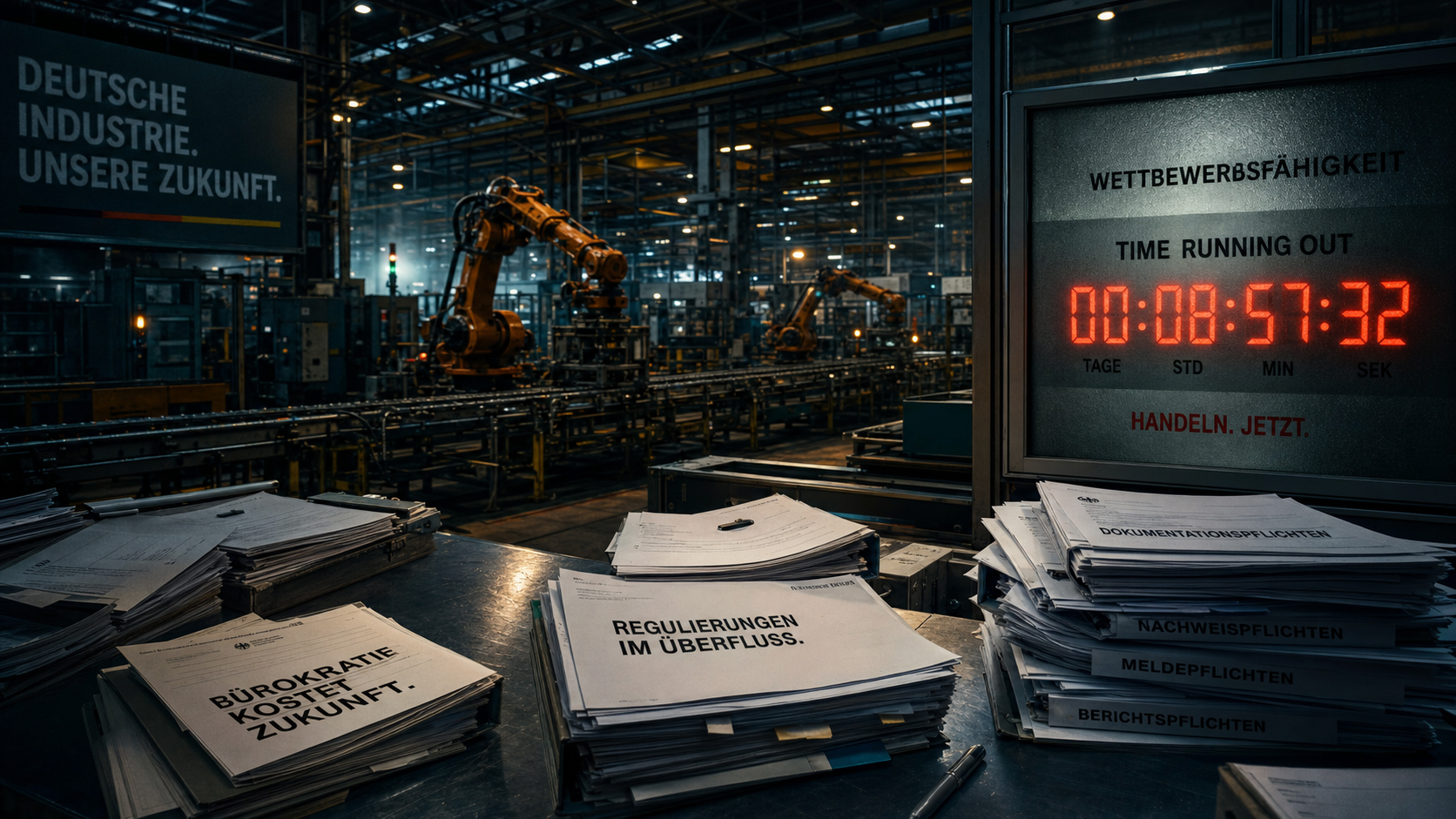
Energy Efficiency Act | A bureaucratic project on a collision course – or: How Berlin is destroying its own industry with budget cuts – Image: Xpert.Digital
Growth ban for Germany: How a new law threatens thousands of jobs
Deindustrialization as a national goal? The bitter consequences of the new energy cap
"Completely pointless": Top economists dismantle Germany's most controversial energy law
The Energy Efficiency Act (EnEfG) was intended to be a historic milestone in climate protection – but for Germany, it is increasingly proving to be a toxic growth cap. With its rigid upper limits on national energy consumption, the law threatens to stifle future economic growth in its infancy. Instead of achieving genuine efficiency gains through technological innovation, Germany is currently artificially reducing its energy consumption through factory closures and production cutbacks. While leading economists warn of state-mandated deindustrialization and tens of thousands of industrial jobs have already been lost, politicians in Berlin are still struggling to soften the regulations. This fatal stalemate not only blocks investment but also jeopardizes the prosperity of an entire nation.
A law with explosive potential: What the EnEfG prescribes – The Energy Efficiency Act and its economic consequences
In autumn 2023, the then-governing coalition passed the Energy Efficiency Act (EnEfG), which, for the first time in the history of the Federal Republic of Germany, legally enshrines binding upper limits on energy consumption. The law obligates Germany to reduce its final energy consumption by at least 26.5 percent by 2030 compared to the base year 2008 – to a maximum of 1,867 terawatt hours (TWh). For primary energy consumption, an even greater reduction of 39.3 percent to a maximum of 2,252 TWh is planned. Furthermore, a reduction in final energy consumption of 45 percent compared to 2008 is targeted for the period up to 2045. Since January 1, 2024, the federal government has been obligated to achieve annual final energy savings of at least 45 TWh through strategic measures.
The crucial political problem lies in defining these targets as rigid, quantitative upper limits for the entire economy. While the legislation formally stipulates that the general savings targets should not impose any restrictions on individual consumption and that the targets should be adjusted in the event of exceptional economic developments, in practice a nationally binding cap means that any additional economic growth associated with energy consumption jeopardizes the target. This is precisely where the economic implications of the law lie.
The gap between aspiration and reality: Efficiency improvements far below demand
A sobering assessment of energy efficiency developments in Germany to date reveals how unrealistic the legally enshrined targets are under real-world economic conditions. According to the Association of German Chambers of Industry and Commerce (DIHK), German companies achieve an average annual energy saving of approximately 1.7 percent through efficiency improvements over the long term. However, to actually meet the energy cap targets by 2030, an annual efficiency improvement rate of at least 3.3 percent would be required – almost double the rate achieved so far.
It is noteworthy that current energy consumption in Germany is indeed showing a downward trend – though less as a result of targeted efficiency measures and more as a direct consequence of the economic downturn. The Working Group on Energy Balances estimates primary energy consumption in 2025 at around 2,931 TWh, which corresponds to a value 26.6 percent below the baseline value of 2008. This initially sounds promising. However, appearances are deceptive: A significant portion of this reduction in consumption is not attributable to technological progress or efficiency investments, but rather to the massive decline in production and deindustrialization that Germany has been experiencing for several years. Energy consumption falls when factories are not producing – this is not an efficiency gain, but a loss of prosperity.
When the cap becomes a growth cap: The macroeconomic consequences
The German Chamber of Industry and Commerce (DIHK) has calculated in an internal paper the economic cost of strictly adhering to the energy cap: Germany's economic output would have to shrink by almost nine percent to reach the consumption target of 1,867 TWh by 2030. A decline in gross domestic product of this magnitude would amount to a severe economic crisis, significantly more serious than the downturn during the global financial crisis of 2008/2009 or the COVID-19 pandemic. The immediate consequences would be massive job losses and substantial wage reductions across all sectors.
DIHK President Peter Adrian has clearly and unequivocally articulated this connection: A rigid target jeopardizes the competitiveness of Germany as a business location and the overall prosperity of the population. This warning is particularly serious given that Germany has been experiencing economic stagnation for several years. The DIHK had projected a slight decline in GDP of 0.3 percent for 2025 and fears that Germany will experience a third consecutive year of declining economic output for the first time in its post-war history. DIHK Managing Director Helena Melnikov stated in the spring of 2025 that the hoped-for economic upswing was nowhere in sight. For an economy already in a period of sustained weakness, a legally mandated energy-saving target with a built-in growth cap would come at the worst possible time.
Degrowth by law: What leading economists say
Prominent economists have sharply criticized the energy efficiency law in its current form, and their arguments are remarkably incisive. Professor Veronika Grimm, a member of the German Council of Economic Experts, considers the energy cap completely pointless, arguing that under realistic growth conditions, it can only be achieved through a deliberate contraction of the economy. Grimm points out that Germany is already losing production and jobs due to structurally high energy costs – therefore, legally accelerated deindustrialization through further regulatory restrictions would be counterproductive. This criticism is noteworthy because Grimm, as a member of the Council of Economic Experts, is not considered a proponent of economically liberal deregulation, but rather advocates for a pragmatic, evidence-based economic policy.
Professor Lars Feld of the University of Freiburg goes even further in his criticism: He calls for a fundamental departure from centrally planned targets in energy policy as a whole. Feld sees the energy cap as an expression of the regulatory spirit that has driven Germany into a structural competitive disadvantage in recent years. In various interviews, he has pointed out that industrial production in Germany has been declining since 2018 and that the pace of job losses has accelerated since then. For Feld, the energy cap is not an isolated problem, but part of a broader pattern of economic policy that prioritizes short-term climate goals over the long-term competitiveness of Germany as an industrial location.
Our EU and German expertise in business development, sales and marketing

Our EU and German expertise in business development, sales and marketing - Image: Xpert.Digital
Industry focus areas: B2B, digitalization (from AI to XR), mechanical engineering, logistics, renewable energies and industry
More information here:
A thematic hub offering insights and expertise:
- Knowledge platform covering global and regional economies, innovation and industry-specific trends
- A collection of analyses, insights, and background information from our key areas of focus
- A place for expertise and information on current developments in business and technology
- A hub for companies seeking information on markets, digitalization, and industry innovations
Job loss alert: How the Energy Efficiency Act (EnEfG) could drive industry into a location crisis
The shadow of deindustrialization: Job losses on the scale of a structural crisis
The economic situation against which the debate surrounding the Energy Efficiency Act is taking place is alarming. Since 2019, the pre-pandemic year, a total of 341,500 jobs have been lost in German industry – a decline of more than six percent of industrial employment. At the end of the first quarter of 2026, only around 5.335 million people were employed in German industry, 127,000 fewer than a year earlier. In 2025 alone, around 124,000 industrial jobs were lost – almost twice as many as in the previous year.
The crisis is hitting the automotive industry particularly hard, where around 125,800 jobs have been lost since 2019 – one in seven jobs in this sector has now disappeared. In mechanical engineering, the second pillar of Germany's export economy, more than 86,000 jobs have been lost since 2019. Employment in the metal industry fell by 15 percent during the same period, and in the textile industry by around 22 percent. EY expert Jan Brorhilker soberly observes: After three years of continuous declines, the industrial hemorrhage is now affecting the very foundations of the industry. These figures illustrate that the fear of legally mandated job losses is not a theoretical future projection – deindustrialization is already well underway, and the Energy Efficiency Act (EnEfG) threatens to accelerate this process.
Political tug-of-war: Reform with half-measures
The political reaction to the criticism of the Energy Efficiency Act is characterized by a characteristic hesitancy, symptomatic of the reform gridlock in Berlin. The coalition agreement of the current federal government, comprised of the CDU/CSU and SPD, explicitly includes a commitment to amend the Energy Efficiency Act and bring it back into line with EU law. Since December 2025, a draft from the Federal Ministry for Economic Affairs and Energy has been circulating, proposing a significant simplification and return to the European minimum requirements. However, a cabinet decision was not reached by mid-March 2026, as the Ministry for Economic Affairs and Energy and the Federal Ministry for the Environment apparently pursue different philosophies regarding the balance between climate protection and economic relief.
Economics Minister Katherina Reiche (CDU) is working on softening the regulations, while Environment Minister Carsten Schneider (SPD) is unwilling to commit to a specific position. This picture of a coalition that recognizes the need for reform but cannot find the necessary political consensus is problematic from an economic perspective because companies need planning certainty for their investment decisions. Those deciding today whether to build a new production hall in Germany or Poland base their decisions on expectations regarding future regulations and cost burdens. Delays in reforming the Energy Efficiency Act (EnEfG) will therefore not only have an impact in 2030, but will affect investment decisions and thus future employment immediately.
Furthermore, the EU has already initiated infringement proceedings against Germany for the delayed implementation of the European Energy Efficiency Directive. This creates additional pressure to reform the law – not necessarily in a more business-friendly direction, but potentially in a stricter one. The German government's room for maneuver is thus limited from both sides.
The structural dilemma: Energy policy between climate goals and location competition
The debate surrounding the Energy Efficiency Act ultimately reflects a deeper structural dilemma in German economic and energy policy: How can the legitimate and necessary demand for climate protection be reconciled with the equally legitimate demand for economic competitiveness when these two are in tension with each other? Germany has the highest, or at least among the highest, industrial electricity prices in international comparison – according to calculations by the Association of German Chambers of Industry and Commerce (DIHK), energy costs for companies in Germany are three to four times higher than in the United States. At the same time, German industrial companies are losing market share to Asian, American, and Eastern European competitors who produce under significantly more favorable energy conditions.
A rigid energy consumption cap that applies to the entire economy doesn't solve this dilemma—it exacerbates it. While a CO2 price or an emissions trading system, in principle, creates market-based incentives and allows companies the freedom to choose how they reduce emissions, a cap on total energy consumption imposes a limit on economic activity. Critics like Lars Feld have therefore been advocating for years for a consistently market-based approach: higher CO2 prices within the framework of the European emissions trading system instead of bureaucratic consumption caps. This approach would price emissions at the source, leave the steering task to the market, and simultaneously incentivize technological innovation—without creating a fundamental problem for growing economies.
Between climate protection obligations and economic sense: An objective assessment
A balanced economic assessment of the Energy Efficiency Act (EnEfG) must take both sides seriously. The need to substantially reduce energy consumption and the associated greenhouse gas emissions is scientifically well-founded and politically binding through international agreements. Moreover, Germany has a structurally energy-intensive industry that is undergoing an unavoidable transformation process. Taking energy efficiency seriously as a location factor is, in the long term, also in the best interests of German industry – greater efficiency reduces costs and strengthens competitiveness.
The problem, however, lies not in the goal of energy conservation, but in the methodology of its implementation. An absolute cap on energy consumption that makes no distinction based on sectoral efficiency, technological progress, or the economic situation is a crude instrument in a complex reality. It penalizes economic growth across the board, without differentiating between energy-efficient and energy-wasting growth. Given that Germany is attempting to recover from a multi-year period of recession and stagnation in 2026, a legally mandated energy cap acts as a regulatory brake at the worst possible time.
The amendment of the law is therefore not only necessary from an economic policy perspective, but also wise from a climate policy perspective: A system based on market-based incentives, ambitious but flexible sector-specific efficiency targets and a reliable CO2 price path should both better protect Germany's economic substance and have realistic chances of actually achieving the climate targets – instead of, as before, showing statistical progress primarily because the economy is shrinking.
🎯🎯🎯 Data-driven B2B industry hub as a quasi-in-house solution

The quasi-in-house solution: How Xpert.Digital closes operational gaps in B2B marketing and sales – Smart Content-Driven Business - Image: Xpert.Digital
Xpert.Digital is a data-driven B2B industry hub led by Konrad Wolfenstein . The company acts as an external, quasi-in-house solution for industrial partners, closing operational gaps in marketing, content, and sales – without requiring additional resources on the client side.
More information here:
Your global marketing and business development partner
☑️ Our business language is English or German
☑️ NEW: Correspondence in your native language!

Konrad Wolfenstein
I and my team are happy to be available to you as your personal advisor.
You can contact me by filling out the contact form here simply call me at +49 7348 4088 965. My email address is [email protected]:or
I'm looking forward to our joint project.










