
Structural problems and stagnation: Loss of prosperity in Germany – A country in economic stagnation
Xpert Pre-Release

Available in 27 languages 📢
Prefer Xpert.Digital on GoogleⓘPublished on: September 28, 2026 / Updated on: September 28, 2026 – Author: Konrad Wolfenstein
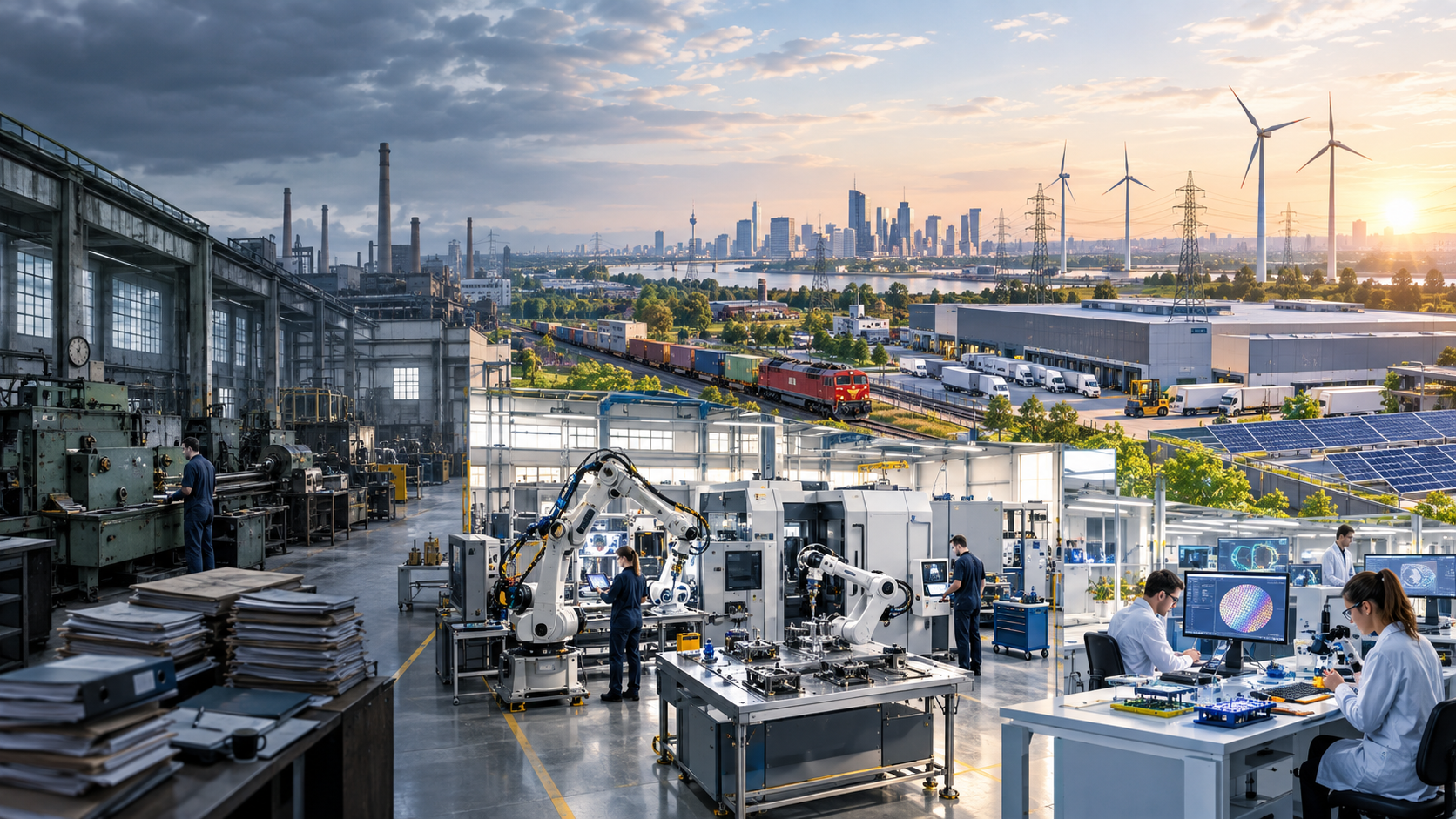
Structural problems and stagnation: Loss of prosperity in Germany – A country in economic stagnation – Creative image on the topic, with AI: Xpert.Digital
The challenges facing the German economy: From crisis to transformation
Bureaucracy and Innovation: How Germany is Losing Its Competitiveness
The future of German industry: How structural change threatens prosperity
Germany, once considered the economic powerhouse of Europe, currently faces a number of challenges that threaten the country's prosperity. Although its nominal gross domestic product still ranks among the world's largest economies, a deeper analysis reveals significant economic erosion. Structural problems such as an aging population, stagnant productivity, slow digitalization, and high energy costs contribute to this stagnation. These developments are not only the result of external shocks, such as the pandemic or geopolitical tensions, but also of homegrown problems that have accumulated over years.
The crucial question is not whether Germany needs reform – there is broad agreement on that – but whether a consistent growth strategy can emerge from this diagnosis. Individual measures and subsidies can, at best, buy time, but they are no substitute for a well-thought-out economic policy. To secure prosperity and prevent future generations from being left in economic stagnation, a comprehensive strategy is needed that links deregulation, education, immigration, and the promotion of innovation. Only through such an integrated approach can Germany regain its competitiveness and set the course for sustainable growth.
Germany's prosperity is idling: A rich country can manage itself into poverty – and Germany is well on its way there
Germany is not facing a sudden economic collapse. That would be a dramatic, but analytically inaccurate, description. The country continues to possess a broad industrial base, high-performing companies, a well-educated workforce, an internationally competitive research landscape, substantial private wealth, and a fundamentally capable state. Measured by nominal gross domestic product, Germany remains one of the world's largest economies. It is precisely this substance, however, that explains why the economic weakness has long appeared less threatening than it actually is. Those who draw on a large capital stock, strong export positions, and past reforms can stagnate for years without immediately experiencing visibly impoverished economic decline. The loss of prosperity does not begin with closed factories and mass unemployment. It begins where investments are neglected, productivity barely grows, innovations are scaled up elsewhere, and political systems manage problems instead of solving them.
Since 2019, the German economy has been hit by a series of exceptional challenges: the pandemic, supply chain disruptions, the Russian attack on Ukraine, the loss of cheap Russian energy supplies, high inflation, rapidly rising interest rates, growing geopolitical tensions, and a weaker global economy. However, these crises only explain part of the picture. Other European and non-European economies were also affected and yet grew more strongly. Germany's particular vulnerability arose from the combination of external shocks with homegrown structural problems: an aging population, sluggish digitalization, high energy and labor costs, slow permitting processes, weak public infrastructure, insufficient entrepreneurial activity, and an economic model that relied for too long on cheap energy, open markets, and technological advantages.
The crucial question, therefore, is not whether Germany needs reform. There is now widespread agreement on that. The crucial question is whether a consistent growth strategy emerges from this diagnosis. Individual measures, subsidies, and new special programs can buy time, but they do not replace sound economic policy. A sustainable reform must consider bureaucracy and state organization, education and immigration, capital markets and innovation, energy and infrastructure, as well as taxes, social security contributions, and work incentives together. The economy creates jobs, and jobs create prosperity, but this relationship does not happen automatically. It presupposes that productive activity, investment, and entrepreneurial risk are more attractive than stagnation, maintaining the status quo, and shifting responsibility to the state.
The stagnation is long since structural
In 2025, price-adjusted gross domestic product was only slightly above the previous year's level. This followed two consecutive years of economic contraction. This phase thus differs significantly from a typical economic downturn. A classic recession ends when inventories are cleared, interest rates fall, and demand returns. Germany's problem runs deeper: even with an economic recovery, growth potential remains low because labor is becoming scarcer, investment is lacking, and productivity is increasing too slowly.
The weakness is particularly evident in the manufacturing sector. Its price-adjusted gross value added fell for the third consecutive year in 2025. Those sectors most affected were precisely those that have underpinned the German export model for decades: the automotive industry, mechanical engineering, chemicals, metal processing, and electrical equipment. The loss of approximately 341,500 industrial jobs since 2019 represents a decline of just over six percent. In the automotive industry, roughly one in seven jobs was lost during this period. These figures do not automatically indicate widespread deindustrialization, as production-related activities can be outsourced to specialized service companies. However, they do demonstrate a shift in value creation, employment, and investment within key industrial clusters.
The insolvency trend also requires a sober assessment. In 2025, local courts registered 24,064 corporate insolvency applications, 10.3 percent more than in 2024. This was almost the same level as in 2014, but still significantly lower than during previous crisis years. Therefore, the statement that Germany is experiencing a historically unprecedented wave of bankruptcies would be an exaggeration. Nevertheless, the trend is serious because the number rose again after strong increases in 2023 and 2024, and because these cases involve substantial claims, job losses, and regional repercussions. The insolvency rate was particularly high in the transportation and warehousing sector, an area central to the industrial division of labor.
The combination of weak growth, declining industrial production, rising bankruptcies, and falling employment in core industrial sectors signals an adjustment process whose outcome is uncertain. Structural change is not inherently negative. Productive economies must shift labor and capital from shrinking to growing sectors. It becomes problematic when new activities are less productive, investments flow abroad, or employees do not acquire new skills quickly enough. Then, structural change turns into a gradual erosion of the economy's substance.
The old export model is no longer sufficient on its own
Germany's economic rise was based on a powerful combination of industrial specialization, medium-sized supplier networks, a skilled workforce, moderate unit labor costs, and globally open markets. The Agenda 2000 reforms improved employability and helped transform Germany from a European problem child into an export champion. At the same time, industry benefited from relatively cheap energy from Russia, growing demand from China, and a rules-based global trade system whose security costs were largely borne by the United States.
This constellation no longer exists. China is not only a sales market, but also a technological competitor in an increasing number of industries. Chinese companies are entering the market with significant economies of scale in electric vehicles, batteries, solar technology, machinery, automation, and digital platforms. The United States is linking industrial policy, energy security, and national security interests much more aggressively than before. Trade conflicts, tariffs, export controls, and local production regulations are changing investment decisions. As a result, companies are no longer optimizing supply chains solely based on cost, but also on resilience, political risk, and market access.
German exports of goods and services declined for the third consecutive year in 2025, adjusted for inflation. Goods exports suffered particularly, while service exports saw a slight increase. This underscores that Germany should not abandon its strength in foreign trade, but must diversify its efforts. Increased domestic demand alone would not be a convincing solution. An aging society with high social spending and low productivity growth cannot sustainably secure prosperity through government-stimulated consumption. What is needed is a new equilibrium: competitive exports, stronger private and public investment, productive services, and greater domestic scaling of future technologies.
The term "transformation" should not be used as a euphemism for the loss of existing industry. A successful transformation replaces old value creation with new, at least equally productive value creation. If a combustion engine plant closes, but battery cells, power electronics, software, and industrial AI are produced elsewhere, the overall economic effect is not automatically positive. Crucial factors include location, ownership, research depth, supply chain integration, and the quality of the new jobs. Germany therefore needs neither a nostalgic defense of every old business model, nor a policy that treats industrial substance as an obsolete relic.
From the jungle of regulations to the investment republic
Bureaucracy is often discussed as a bothersome, peripheral issue. Economically, however, it is a form of transaction cost. Companies must allocate personnel, time, and capital to fulfill reporting, verification, documentation, and approval requirements. These resources are then unavailable for customers, innovation, training, and investment. This particularly affects small and medium-sized enterprises (SMEs) because they have to spread fixed regulatory costs across a smaller workforce and lower revenue.
According to estimates by the ifo Institute, high levels of bureaucracy could cost Germany up to €146 billion in economic output annually. This figure is not a precisely measurable accounting calculation, but rather a model-based estimate of direct and indirect effects. It should therefore not be treated as a certainty. However, its magnitude illustrates that regulation not only generates forms but also influences growth. The National Regulatory Control Council arrives at significantly lower figures when using a narrower definition of direct bureaucracy costs. This difference demonstrates the importance of a clear definition: Direct compliance costs encompass measurable labor and material costs; indirect costs arise additionally when investments are delayed, omitted, or outsourced.
Effective deregulation does not mean abolishing environmental, safety, consumer, or labor standards across the board. A modern economy needs reliable rules. The quality of regulation is crucial. Objectives should be clear, procedures digital, deadlines binding, and responsibilities unambiguous. A company should generally only have to submit data to the government once. Authorities must be able to exchange information themselves within legal limits. Permits should be processed through a unified digital portal that provides transparent status updates. For projects that can be standardized, deemed approval is useful: If the authority does not respond within a reasonable timeframe, the application is considered approved under defined conditions.
Another problem is the political tendency to organize bureaucracy reduction through new bureaucracy programs. Additional commissioners, reports, and working groups create activity, but not necessarily relief. A binding regulatory balance sheet would be better. For new burdens, existing obligations would have to be eliminated to at least the same extent. Laws should be more strongly accompanied by expiration dates, practical tests, and measurable impact targets. European regulations should be implemented without additional national requirements unless there is a clearly justified added value. Faster procedures are particularly urgent for networks, power plants, data centers, housing construction, transport infrastructure, and industrial facilities. In Germany, growth is increasingly failing not due to a lack of plans, but rather due to the time lag between planning and implementation.
The state needs fewer interfaces and more responsibility
German public administration suffers not only from excessive regulations but also from fragmented responsibilities. The federal government, states, municipalities, and the European Union interact with differing competencies. This federal system has advantages: it distributes power, enables regional solutions, and can foster competition between institutions. In practice, however, it often leads to parallel IT systems, differing interpretations, multiple audits, and unclear lines of responsibility.
The fundamental problem can be observed in large investment projects. Political decision-makers announce multi-billion-euro programs, but planning capacities, skilled personnel, land, digital registers, and permitting authorities do not grow at the same pace. Money is available, but it cannot be deployed productively in a timely manner. Therefore, the investment rate alone does not measure the quality of government economic policy. What is crucial is whether projects are prioritized according to their economic benefit, planned efficiently, monitored transparently, and maintained sustainably.
A high-performing state organization requires clear accountability for results. Ministries should not only produce laws but also be given publicly measurable targets for processing times, digitization, and investment implementation. Municipalities need standardized procedures and shared technical platforms so that every administration is not trying to solve identical problems on its own. Digital identities, interoperable registers, and uniform data standards are not mere technical details but essential economic infrastructure. Estonia, Denmark, and other digitally advanced countries demonstrate that citizens and businesses can benefit from simpler interactions with public authorities without compromising the rule of law.
At the same time, the state must prioritize. If every societal concern becomes a legal obligation, funding program, or reporting requirement, politics overburdens its own institutions. A functioning state is not the one with the most programs, but rather the one that reliably fulfills its core tasks: internal and external security, education, infrastructure, legal certainty, social security, and fair competition. Political credibility arises when announced measures visibly work. Without this implementation capability, even well-intentioned reforms lose their effectiveness because companies postpone decisions under uncertainty.
Our EU and German expertise in business development, sales and marketing

Our EU and German expertise in business development, sales and marketing - Image: Xpert.Digital
Industry focus areas: B2B, digitalization (from AI to XR), mechanical engineering, logistics, renewable energies and industry
More information here:
A thematic hub offering insights and expertise:
- Knowledge platform covering global and regional economies, innovation and industry-specific trends
- A collection of analyses, insights, and background information from our key areas of focus
- A place for expertise and information on current developments in business and technology
- A hub for companies seeking information on markets, digitalization, and industry innovations
Reform scenarios for Germany's economic future
From nation of inventors to nation of scaling
Germany does not have a fundamental problem with ideas. Universities, research institutions, industrial development departments, and specialized medium-sized companies continuously produce new processes and products. The weakness more often lies between invention and large-scale market penetration. Research results are translated into applications too slowly, spin-offs encounter regulatory and financial hurdles, and rapidly growing companies later seek capital or sales opportunities outside Europe.
Venture capital is not a panacea, but it is an important component. Only a limited number of startups are suitable for venture capital financing because investors expect exceptionally high growth potential and scalable business models. However, it is precisely these companies that can shape new markets. Studies show that venture capital-funded startups grow significantly faster on average than other young companies. At the same time, many successful acquisitions and IPOs of German startups take place abroad. This poses a risk of losing some of the future value creation, control, and technological expertise.
A better innovation policy must integrate research, technology transfer, public procurement, data access, and the capital market. Universities need professional structures for patents and spin-offs. Scientists should be able to hold shares in young companies with legal certainty. Public research funding should be more strongly evaluated based on whether it leads to sustainable collaborations, products, and new companies, without reducing basic research to short-term commercialization. The government can act as a demanding primary customer, for example, in cybersecurity, defense, healthcare, energy, and administrative software. This creates prestige but does not replace competition.
The European capital market is also crucial. Germany has substantial savings, but a large portion flows through low-risk investments and international financial markets, bypassing European growth companies. A stronger, funded pension system, improved conditions for institutional investors, and a more robust European capital market could mobilize private capital. At the same time, government funds must not become instruments for ad hoc political decisions. Successful innovation policy establishes framework conditions, shares early risks where societal benefits are generated, and accepts that not every supported technology will be successful.
Germany must also realistically define technological sovereignty. It is neither possible nor sensible to produce every key technology entirely domestically. Strategically important are capabilities without which entire value creation systems become dependent: power electronics, industrial software, robotics, semiconductor design and selected manufacturing, quantum technology, biotechnology, energy technology, cybersecurity, and artificial intelligence. The goal should not be autarky, but rather the ability to operate on an equal footing in international partnerships.
Education is the toughest economic policy
Economic policy debates tend to focus on taxes, energy prices, and regulation because changes in these areas can be implemented relatively quickly. Education has a slower effect but is more fundamental in the long run. The PISA results have shown that the performance of German fifteen-year-olds in mathematics, reading, and science has declined significantly. In mathematics and reading, Germany now ranks only at the OECD average. The high proportion of young people who lack a solid grasp of basic skills is particularly problematic. Those who cannot reliably understand texts or apply simple mathematical concepts have fewer opportunities in a digitized job market.
The causes range from social inequality and inadequate language support to canceled classes and sluggish digitalization. More money alone won't solve these problems, even though dilapidated buildings and staff shortages represent real bottlenecks. Crucial are early intervention, binding competency standards, regular assessments, and a culture that takes results seriously. Schools need more autonomy, but in return, they must also take responsibility for student progress. Resources should be directed more strongly to areas where social disadvantages and support needs are particularly high.
The dual vocational training system remains a significant competitive advantage, but even here, the pressure to adapt is increasing. In the 2024/25 training year, tens of thousands of apprenticeship positions remained unfilled, while at the same time many applicants did not find a training position or continued their search. This is a mismatch: region, qualifications, career aspirations, and company requirements do not sufficiently align. Career guidance must therefore begin earlier, include practical experience, and credibly convey the equivalence of vocational and academic pathways. Companies, in turn, must make training more attractive, offer modern learning content, and also give opportunities to applicants with support needs.
Continuing education is becoming the second pillar. Artificial intelligence, automation, and decarbonization are changing jobs faster than formal education systems can react. A profession learned once no longer guarantees an unchanged career path. Continuing education should therefore be modular, certifiable, and closely linked to actual skills needs. Government funding is useful if it improves employability, but it must not result in courses without labor market value. Companies usually know their technological goals better than government agencies and should therefore assume greater responsibility for training. The government sets quality standards, facilitates transitions, and supports, above all, small businesses and employees who cannot finance the changes on their own.
Skilled immigration must become practice, not just a law
Germany cannot fully compensate for demographic change through immigration, but without skilled immigration, the labor shortage will worsen considerably. The baby boomers are retiring, while younger generations are entering the workforce. The Council of Economic Experts therefore expects that the volume of work will increasingly weigh on growth potential. Even with higher productivity, a sufficient number of skilled workers will remain necessary to keep businesses, healthcare, skilled trades, public administration, and infrastructure functioning.
Germany has reformed its immigration law several times. Nevertheless, the practical experience of many applicants and companies remains characterized by lengthy visa procedures, complicated recognition processes, a lack of available appointments, and fragmented responsibilities. A modern law is useless if the administration is too slow. Digital applications, binding processing deadlines, increased capacity at German embassies and consulates, and central contact points for companies and skilled workers are needed. Recognition procedures should more thoroughly examine the actual competencies possessed, rather than solely requiring formal equivalence of qualifications.
Immigration policy doesn't end with entry into the country. Language, housing, childcare, social openness, and career prospects determine whether skilled workers stay. Germany competes with English-speaking countries, dynamic metropolitan areas, and states with lower taxes. High gross salaries are less attractive when a large portion is tied up in taxes and social security contributions, and housing remains scarce. For international talent, therefore, the overall package and everyday experience are what count.
A sober debate must also distinguish between humanitarian admission and labor market-related immigration, without pitting the two against each other. Asylum seekers can become valuable workers, but the asylum system is not the appropriate primary instrument for specifically addressing skills needs. Conversely, labor migration must not be overburdened by political expectations. It alleviates shortages, but it does not replace better education or higher labor force participation within the country. Germany, in particular, must better integrate women, older workers, and people without vocational qualifications into productive employment.
Shift labor policy to where jobs are created
The organizational merger of economic and labor policy within a single ministry initially sounds plausible. Companies create the vast majority of employment, define new job profiles, and organize training and professional development. Shared political responsibility could make conflicting objectives more visible, accelerate processes, and focus labor market policy more strongly on productivity, skills, and transitions.
But institutional reorganization is not an end in itself. A large ministry can create new silos just as easily as two separate agencies. Moreover, labor policy has an independent protective function. Labor law, collective bargaining, co-determination, occupational safety, and social security must not be evaluated solely from the perspective of short-term corporate interests. Good working conditions increase employee retention, health, and productivity. The crucial question, therefore, is less about the name of a ministry, but rather whether economic, educational, social, and migration policies pursue common goals.
A binding, cross-departmental strategy for work and productivity would be beneficial. It would need to integrate industry developments, skills needs, continuing education, immigration, and social security. Unemployment insurance and basic income support should facilitate transitions into employment while simultaneously guaranteeing a reliable minimum standard of living. The welfare state remains indispensable, but it must not permanently compensate for the consequences of failed education, integration, or structural policies. If people rotate through programs for years without acquiring usable qualifications, neither they nor the economy benefits.
Performance must be financially rewarded. In 2025, Germany burdened a single average earner with particularly high taxes and social security contributions compared to other countries. High levies finance valuable services but weaken work incentives and increase the cost of employment. Reform should provide relief for low and middle incomes, smooth out benefit withdrawal rates, and make additional working hours more attractive. This also includes sustainable financing of social security. If rising healthcare, long-term care, and pension costs are passed solely on to earned income, the gap between employer costs and net earnings will widen further.
Energy policy is location policy
The energy crisis has exposed a weakness previously masked by cheap gas imports. Germany is simultaneously pursuing the phase-out of fossil fuels, the expansion of renewable energies, the electrification of transport and heating, and the decarbonization of energy-intensive industries. This transformation is technically feasible, but capital-intensive and organizationally demanding. It requires grids, storage facilities, flexible power plants, digital control systems, and faster permitting processes.
For many medium-sized commercial consumers, German electricity prices in 2025 were significantly higher than the European Union average. Energy-intensive companies receive partial relief, which is why average values do not reflect the actual costs of every business. Nevertheless, high and volatile prices influence location decisions. In the chemical, metal, glass, paper, and basic materials industries, energy can represent a substantial share of total costs. If new, climate-friendly plants consistently produce at a higher cost than their international competitors, climate targets alone will not be sufficient to attract investment.
The answer should not lie in unlimited, permanent subsidies. A government-subsidized industrial electricity price can slow down the shift to renewable energy in the short term, but it entails high fiscal costs and creates perverse incentives if it preserves inefficient structures. More sustainable approaches include rapid grid expansion, increased renewable energy generation, guaranteed capacity, improved storage conditions, and lower government-mandated price components. Long-term power purchase agreements can provide investment security. Regarding hydrogen, realistic prioritization is necessary: Scarce, climate-neutral gas should initially be used where direct electrification is technically difficult.
Security of supply, affordability, and climate protection are not independent goals. If one is persistently neglected, the transformation will lose social and economic acceptance. Energy policy must therefore adopt a more systemic approach. The decisive factor is not the installed capacity of individual technologies, but the ability of the entire system to reliably and competitively provide electricity every hour. Germany needs fewer symbolic debates about individual energy sources and more pragmatic planning for grids, reserves, storage facilities, and cross-border trading.
Infrastructure determines private investment
Companies don't invest in isolation. They need roads, railways, ports, power grids, digital networks, commercial space, and efficient local authorities. When bridges are closed, rail connections are unreliable, network connections are delayed, or mobile phone coverage is patchy, costs rise along entire value chains. The condition of public infrastructure thus acts as an additional location factor that no single company can compensate for.
Expanding government investment opportunities offers a chance, but it doesn't guarantee a growth spurt. The composition of these investments is crucial. Consumption-based spending can be socially beneficial, but it doesn't automatically increase production potential. Investments in networks, education, digitalization, research, and transportation, on the other hand, create capacity if implemented efficiently. A golden rule for investment is only credible if the definition of investment remains clear and isn't used to reclassify current spending.
Maintenance also deserves more attention. Politicians prefer visible new construction, while maintenance receives less public attention. Economically, it is usually more cost-effective to maintain existing infrastructure in a timely manner than to completely replace it after years of wear and tear. Multi-year funding commitments and professional project companies can provide planning certainty. At the same time, standards must be standardized and planning processes parallelized. It makes little sense to allocate additional billions if the same scarce engineers and government employees are expected to handle an ever-increasing number of projects.
Private investment also responds to reliability. Companies plan investments over decades. Frequent changes in subsidies, technical specifications, and taxes increase the risk premium. Sound industrial policy therefore sets long-term goals but remains technologically open and makes transparent adjustments to its instruments. Planning certainty does not mean continuing every bad decision unchanged. It means making transitions predictable and not unexpectedly passing on the burden of already completed investments due to shifts in political direction.
Productivity instead of mere job romanticism
Germany has achieved record employment levels for a long time. This has been a great social and fiscal success. However, a high number of employed people alone does not guarantee high growth. If working hours are spent on unproductive tasks and value added per hour barely increases, it becomes difficult to simultaneously finance higher wages, social benefits, defense, and investment. While overall labor productivity per hour did increase again in 2025 after a period of weakness, the longer-term trend remains unsatisfactory.
Productivity doesn't mean forcing people to work at an ever-increasing pace. It arises primarily from better technology, organization, skills, and capital resources. An employee with modern software, automated processes, and clearly defined responsibilities can create more value in the same amount of time. Small businesses, in particular, need support with digitalization and process innovation, but not permanent subsidies for individual providers. Standards, consulting, training, and competitive programs are more effective than piecemeal funding programs.
Artificial intelligence offers significant potential, particularly in administration, engineering, maintenance, logistics, customer service, and research. However, its economic benefits depend on data quality, processes, and expertise. AI won't automatically improve a poorly organized company; it can only amplify errors more rapidly. Therefore, companies shouldn't stop at isolated demonstration projects but rather redesign workflows. The government must guarantee legal certainty and data protection without burdening low-risk applications with the same requirements as high-risk systems.
Higher productivity also makes it easier to cope with demographic shortages. If fewer people in the workforce create more value, incomes and public services can remain stable. Nevertheless, Germany should expand its labor supply. Better childcare, more flexible retirement transitions, skilled immigration, and lower taxes on additional work all work together. A debate that focuses solely on longer working hours is too narrow. Equally inadequate is the notion that productivity gains alone will solve every labor shortage.
An agenda for change needs a sequence and a scale
Germany has no shortage of reform proposals. Business associations, trade unions, research institutes, government agencies, and expert commissions have repeatedly described the weaknesses. The implementation deficit arises because goals compete with one another, political costs are incurred immediately, and benefits often only become apparent later. Furthermore, reforms get bogged down in isolated measures whose effects are not evaluated.
A credible agenda should therefore set a few measurable priorities. Within the first phase, approval times would need to be halved, business start-ups fully digitized, registers linked, and additional work incentives created. Simultaneously, planning capacities for energy, transport, and digital infrastructure would need to be expanded. In the second phase, education, training, social security, and the capital market would need to be reformed to ensure a sustained increase in productivity and labor supply. Industrial and innovation policy should focus on overarching capabilities, not on saving every single business model.
Reforms also require a fair distribution of opportunities and burdens. Those who demand economic change must provide employees with credible transitions. Further training, job placement, and temporary income protection are better than trying to permanently preserve every job. At the same time, adjustment costs must not be unilaterally passed on to taxpayers and consumers while private profits remain untouched. Government support for companies should be tied to clear objectives, required contributions from their own employees, and transparent exit criteria.
Germany still possesses sufficient capital, knowledge, and institutional stability to reverse this trend. However, time is an economic factor. Every postponed investment exacerbates the infrastructure backlog. Every generation with insufficient basic skills burdens the labor market for decades. Every successful growth company that permanently relocates abroad weakens future tax bases and innovation networks. The real danger, therefore, lies not in a spectacular collapse, but in a gradual acceptance of mediocrity.
A forward-looking agenda must make performance more rewarding, investments simpler, and government action more reliable. It must not treat the market and the welfare state as opposites. A dynamic economy finances social security; social security, in turn, increases the willingness to accept change. Germany does not need to reinvent every element of its model. It must adapt its strengths—industrial depth, dual vocational training, co-determination, research, and small and medium-sized enterprises—to a world in which energy, capital, talent, and technological speed are being redistributed. Prosperity is not a historical dividend. It is earned anew in every generation.
🎯🎯🎯 Data-driven B2B industry hub as a quasi-in-house solution

The quasi-in-house solution: How Xpert.Digital closes operational gaps in B2B marketing and sales – Smart Content-Driven Business - Image: Xpert.Digital
Xpert.Digital is a data-driven B2B industry hub led by Konrad Wolfenstein . The company acts as an external, quasi-in-house solution for industrial partners, closing operational gaps in marketing, content, and sales – without requiring additional resources on the client side.
More information here:
Your global marketing and business development partner
☑️ Our business language is English or German
☑️ NEW: Correspondence in your native language!

Konrad Wolfenstein
I and my team are happy to be available to you as your personal advisor.
You can contact me by filling out the contact form here [email protected]:or simply call me at +49 7348 4088 965. My email address is
I'm looking forward to our joint project.










