
Germany is a country of SMEs, hidden champions - the heart and innovation from the middle, the middle class

Available in 27 languages 📢
Prefer Xpert.Digital on GoogleⓘPublished on: March 19, 2024 / Update from: March 24, 2024 - Author: Konrad Wolfenstein

Germany's invisible giants: The power of medium-sized companies - Image: Xpert.Digital
🏭👨👩👧👦 Family businesses as a foundation - the silent backbone of Germany: How medium-sized businesses shape the economy
🏭📘 Germany: The unshakable foundation of SMEs
Germany, often referred to as the land of engineers and poets, owes its economic success and innovation to a sector that may be underestimated in other countries: small and medium-sized enterprises (SMEs), also known as Mittelstand. These companies are the unshakable foundation on which the German economy is built and from which it is supported to a degree that is hardly comparable in many other countries.
In Germany, the term “medium -sized companies” comprises far more than just the size of a company with regard to employees or annual sales. It represents a deeply rooted cultural identity that is expressed by special values such as sustainability, long -term and strong ethical responsibility towards society and its own employees. It is not only economic units, but often family -run companies that pass on their expertise, passion and values over generations. These units form the strong heart of the German economy and are often the world market leader in their special niches - the so -called “hidden champions”.
🌱 The secret of success: “Hidden Champions”
Germany has more than 1,300 of these “hidden champions” worldwide, a number that appears more remarkable when you look at them in a global context. There are medium -sized companies that take top positions in their fields without their brand names being known to the general public. They dominate their markets through highly specialized knowledge, strong focus on research and development, and deep rooting in the tradition of craftsmanship. These elements form the cornerstones of their global success.
🏢 Role in the German economy
The enormous economic importance of SMEs for Germany can be expressed in numbers: they represent more than 99% of all German companies, employ around 60% of all employees in the private sector and are responsible for around 35% of total German sales revenue. These impressive figures illustrate why medium-sized businesses are often referred to as the backbone of the German economy.
🤝 The symbiosis of theory and practice: the dual training system
A key factor that underpins the success of SMEs and medium-sized businesses as a whole is the unique German dual training system. This system combines theoretical training at vocational schools with practical training within companies. It ensures that trainees not only have extensive theoretical knowledge, but also practical experience and a high level of competence in their specialist area. The dual training system has proven to be a key advantage for SMEs, enabling them to recruit highly qualified specialists specifically tailored to their needs.
💡 Innovation as a driver of medium-sized businesses
Despite their often traditional values, German SMEs and medium-sized companies are extremely innovative. A significant proportion of patent applications in Germany come from them. Their agility makes it possible to react quickly to market changes and develop new technologies and products. SMEs play a leading role, especially in promising areas such as digitalization, renewable energies and sustainable business.
🚀 Challenges and future prospects
Nevertheless, German SMEs and medium-sized businesses also face challenges. Demographic change, the shortage of skilled workers, increasing digitalization and globalization as well as the need to develop more sustainable business models are just some of the tasks that need to be overcome. In addition, the pressure to innovate, especially with regard to digitalization, is forcing many companies to adapt. Despite these challenges, most medium-sized companies are optimistic about the future. Their adaptability, their innovative potential and their strong roots in ethical values enable them to master future challenges.
The promotion of SMEs and medium-sized businesses remains a central task for German politics and business. Programs to support research and development, the digitalization of smaller companies and the training of specialists are essential pillars in not only securing the position of SMEs, but also further expanding them. In addition, the European and global networking of medium-sized businesses is becoming increasingly important in order to open up new markets and increase international competitiveness.
🌟 Economic performance and its innovative spirit
Germany's economic output and its innovation are derived from the strength and essence of its SMEs and medium -sized companies. The country's “hidden champions”, with their impressive mixture of tradition and innovation, specialist knowledge and quality awareness, play a key role in global economic landscape. They prove that size is not always the most important factor for success. Rather, it is the ability to adapt to maintain the proximity to the customer and constantly innovate that makes the German middle class a model for the world. Despite all the challenges, the future of German middle class looks promising because it builds on a solid foundation of values, innovation and a strong community.
📣 Similar topics
- 🏭 The silent power plant: How SMEs drive Germany's economy
- 🌱 Between tradition and innovation: The sustainable path of German medium-sized businesses
- 🚀 Hidden Champions: The invisible giants behind Germany's global success
- 💡 Innovation from the core: The role of medium-sized companies in the German patent landscape
- 📚 Theory meets practice: The success story of the dual training system in Germany
- 🌍 From local strength to global dominance: The international influence of German SMEs
- 📈 Challenges and future prospects: The path of medium-sized businesses into a digital era
- 🛠 The foundation is being rebuilt: the adaptability and innovative power of German family businesses
- 🌐 Leading the world: How Germany's medium-sized businesses shape the international markets
- 🤖 Digitization and sustainability: The new pillars of German business success ”**
#️⃣ Hashtags: #Mittelstand #HiddenChampions #DualeAusbildung #Innovation #DeutscheWirtschaft
🎯🎯🎯 Benefit from Xpert.Digital's extensive, fivefold expertise in a comprehensive service package | R&D, XR, PR & SEM

AI & XR 3D Rendering Machine: Fivefold expertise from Xpert.Digital in a comprehensive service package, R&D XR, PR & SEM - Image: Xpert.Digital
Xpert.Digital has in-depth knowledge of various industries. This allows us to develop tailor-made strategies that are tailored precisely to the requirements and challenges of your specific market segment. By continually analyzing market trends and following industry developments, we can act with foresight and offer innovative solutions. Through the combination of experience and knowledge, we generate added value and give our customers a decisive competitive advantage.
More about it here:
🚀🏭 SMEs: The invisible giants of the German economy
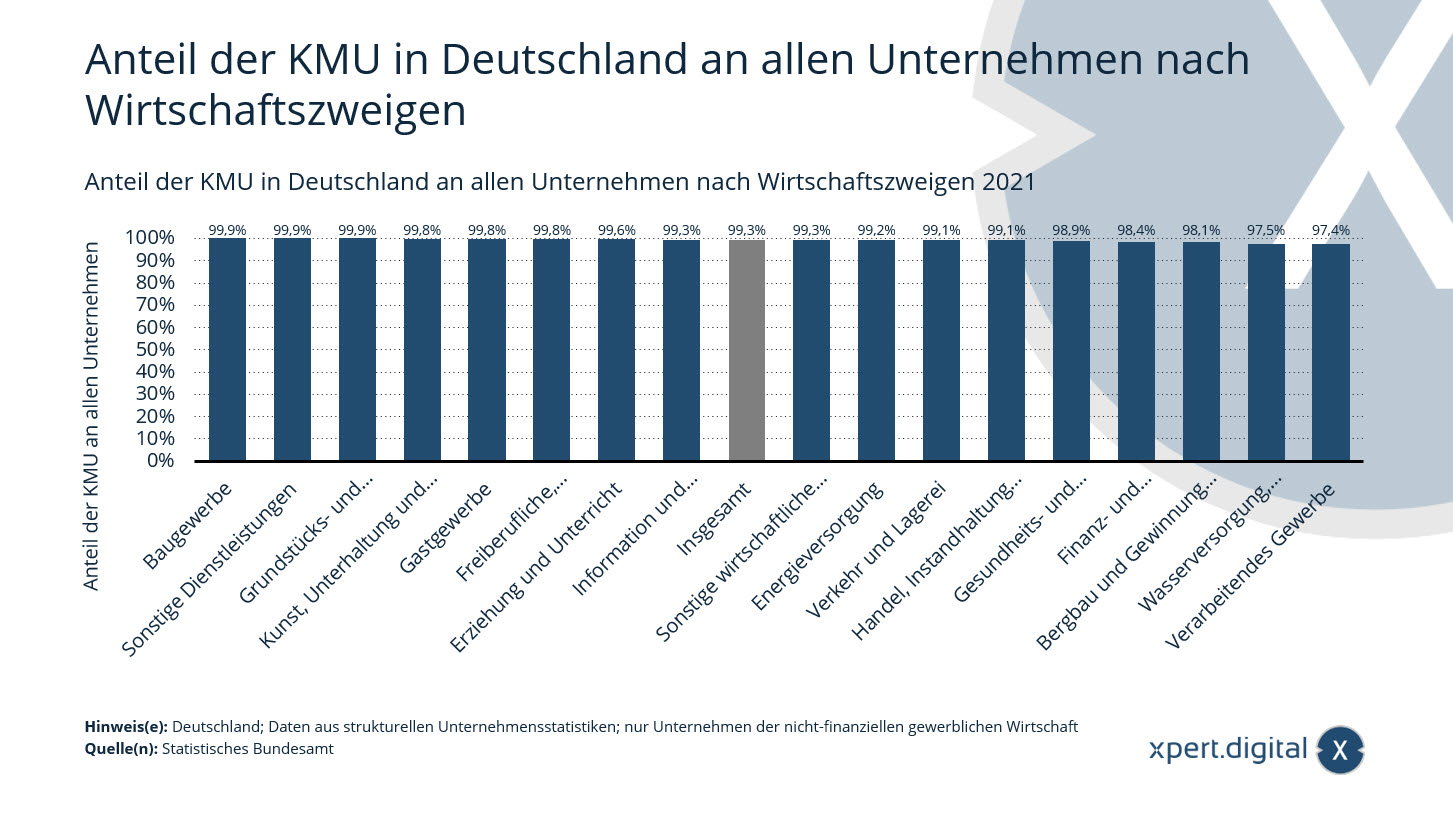
Share of SMEs in Germany among all companies by economic sector - Image: Xpert.Digital
Small and medium-sized companies (SMEs) are the backbone of the German economy 🏭. They include micro, small and medium-sized enterprises and play a crucial role in innovation, employment and economic growth. The importance of these companies is undisputed, as they represent the majority of companies in Germany and offer an enormous variety of products and services. This article highlights their role, challenges and prospects in today's economy.
📚 Definition and classification
According to the definition of the European Union (EU), the term “enterprise” refers to the smallest combination of legal entities that serves as an organizational unit for the production of goods and services. This definition emphasizes the company's freedom of choice regarding the use of its resources and its activities at one or more locations. Companies can either be simple legal entities or composed of multiple legal entities, which can create complexity in the corporate structure.
🛠📈The classification of companies according to their size is as follows
This classification helps to better understand the enormous contribution of SMEs to the national economy and to recognize their specific needs.
Micro-enterprises
Up to 9 employees and an annual turnover of up to 2 million euros.
Small businesses
10 to 49 employees and an annual turnover of up to 10 million euros.
Medium-sized companies
50 to 249 employees and an annual turnover of up to 50 million euros.
Large companies
More than 249 employees or over 50 million euros in annual sales.
💼 Contribution of SMEs to the German economy
In 2021, the share of SMEs in all manufacturing companies in Germany was an impressive 97.4 percent. These statistics not only underline the dominance of SMEs in certain sectors of the economy, but also their crucial role as employers and drivers of innovation.
SMEs are essential for job creation. They offer training positions, promote the local economy and contribute to the diversification of the economic structure. Their flexibility and proximity to customers enable SMEs to react quickly to market trends and offer innovative solutions.
🚀 Challenges for SMEs
The SMEs face various challenges ranging from financial difficulties to technological challenges. Digitalization is changing the way companies operate and opening up new opportunities, but also presenting major challenges for small and medium-sized businesses. Investing in new technologies, adapting to digital business models and protecting against cyber risks require resources and know-how that can be difficult to manage, especially for smaller companies.
Another critical issue is financing. SMEs often struggle to access credit, which can limit their ability to expand and innovate. Securing financing and improving financial health are therefore crucial to the growth and sustainability of these companies.
🌱 Outlook and opportunities
Despite the challenges, there are numerous opportunities for SMEs. The trend towards a sustainable economy and the growing demand for environmentally friendly products and services are opening up new markets. SMEs can use their agility to develop innovative solutions and position themselves as pioneers in sustainable business practices.
Internationalization represents another opportunity for SMEs, as access to new markets offers the potential to expand the customer base and increase sales. Support from government programs and initiatives to promote the internationalization of small and medium-sized enterprises can facilitate this process.
In addition, digitalization plays a key role in the future of SMEs. Implementing digital technologies can optimize operations, increase efficiency and enable new business models. Investing in digital skills and technologies is therefore essential for long-term competitiveness.
💪 The driving force of the German economy
Small and medium-sized companies are a driving force in the German economy. They stand for innovation, employment and diversity. Successfully overcoming the challenges, especially with regard to digitalization, financing and sustainability, is crucial for their future. With the right strategies and support, SMEs can play to their strengths, seize new opportunities and continue to play a central role in the economy. Their adaptability, customer proximity and innovative strength make them irreplaceable players in the economic structure of Germany and beyond.
📊💼 Share of SMEs in Germany among all companies by economic sector in 2021
- Construction – 99.90%
- Other services – 99.90%
- Real estate and housing – 99.90%
- Arts, Entertainment and Recreation – 99.80%
- Hospitality – 99.80%
- Professional, scientific and technical services – 99.80%
- Education and teaching – 99.60%
- Information and communication – 99.30%
- Overall – 99.30%
- Other economic services – 99.30%
- Energy supply – 99.20%
- Transport and storage – 99.10%
- Trade, maintenance and repair of motor vehicles – 99.10%
- Health and Social Care – 98.90%
- Financial and insurance services – 98.40%
- Mining and quarrying – 98.10%
- Water supply, disposal, removal of environmental pollution – 97.50%
- Manufacturing – 97.40%

We are there for you - advice - planning - implementation - project management
☑️ Industry expert, here with his own Xpert.Digital industry hub with over 2,500 specialist articles

Konrad Wolfenstein
I would be happy to serve as your personal advisor.
You can contact me by filling out the contact form below or simply call me on +49 7348 4088 965 (Munich) .
I'm looking forward to our joint project.
Write to me

Xpert.Digital - Konrad Wolfenstein
Xpert.Digital is a hub for industry with a focus on digitalization, mechanical engineering, logistics/intralogistics and photovoltaics.
With our 360° business development solution, we support well-known companies from new business to after sales.
Market intelligence, smarketing, marketing automation, content development, PR, mail campaigns, personalized social media and lead nurturing are part of our digital tools.
You can find out more at: www.xpert.digital - www.xpert.solar - www.xpert.plus
Keep in touch











