

Defence as an economic engine: Why the initiative by Deutz and Honold is waking up the entire logistics industry
Xpert Pre-Release

Available in 27 languages 📢
Prefer Xpert.Digital on GoogleⓘPublished on: July 10, 2026 / Updated on: July 10, 2026 – Author: Konrad Wolfenstein
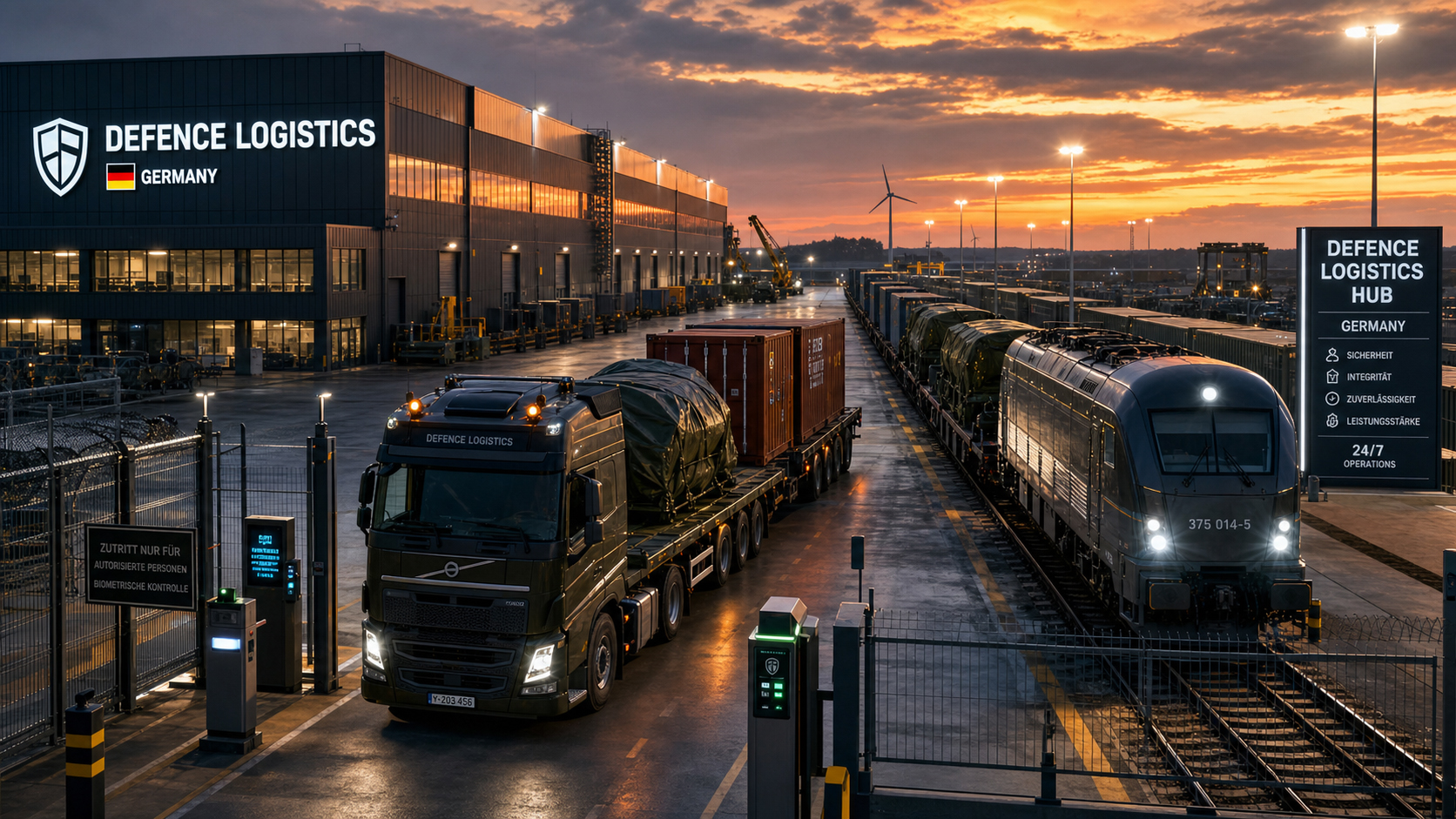
Defence as an economic engine: Why the initiative by Deutz and Honold is waking up the entire logistics industry – Image: Xpert.Digital
Deutz earthquake in the MDAX: How a gigantic defense cluster is currently emerging in southern Germany
From political slogan to industrial structural change: Why the defense economy is the new growth engine of the economy
When the changing of the guard becomes an economic transformation: Defence economics encompasses industry and logistics
Since the Russian attack on Ukraine in 2022, the European economic landscape has been rapidly reshaping itself. What politicians once declared a "turning point" is now unfolding as a profound industrial structural transformation. Fueled by unprecedented budgets—such as Germany's defense budget, which has ballooned to over €150 billion, and the new NATO target of five percent of GDP—immense capital is flowing into sectors that had languished in obscurity for decades.
This analysis shows that the current boom in arms and defense logistics is not a short-term economic phenomenon, but rather a decades-long restructuring of global value chains. While traditional sectors like road freight transport are being crushed by waves of bankruptcies, margin pressure, and enormous fixed costs, established companies are reinventing themselves. The most impressive example is currently Deutz AG: With a multi-billion-euro acquisition and its entry into AI-controlled combat robotics, the Cologne-based engine manufacturer is transforming itself into a defense tech giant. This development is flanked by highly specialized players like the Honold Logistics Group, which is overcoming the massive barriers to entry in this high-security market with concepts like the "Defence Cube." One thing is clear: Those who establish themselves as system partners now will secure lucrative contracts for decades to come – those who miss the transformation will soon find themselves facing closed doors.
More information here:
- Honold further expands its market position and invests with foresight in strategic future fields – record investments planned in Defence & Aerospace
- DEUTZ accelerates transformation through a billion-dollar transaction in the defense sector
Defense logistics as a structural program – why the boom is not a short-term cycle
For the past decade, Germany was characterized by a fundamental economic policy consensus that, in its self-evidence, seemed almost dogmatic: defense is a state duty that should be fulfilled as cost-effectively as possible, while private sector energy should flow into civilian innovation, digitalization, and export markets. This consensus has been history since February 24, 2022. The Russian war of aggression against Ukraine has not only shaken security policy certainties but has also initiated a structural reorganization of industrial and logistical value chains in Europe, the full economic implications of which are only now becoming apparent.
What has been described politically as a turning point is unfolding in industrial economics as a profound structural transformation – one that is redirecting capital, expertise, and capacity to sectors that have been on the margins of economic interest for years. Anyone who misunderstands this transformation as a temporary cyclical phenomenon fails to grasp the underlying dynamics: it is long-term, government-backed demand, secured for decades by international alliance obligations and geopolitical realities.
Billions as the foundation – the fiscal basis of the defense boom
The figures alone tell a story of historic dimensions. Germany's defense spending has risen within just a few years from a chronically underfunded level to a level that surprises even hardened financial policymakers: In 2025, total spending amounted to 86.37 billion euros, and in 2026 it will rise to 108.2 billion euros – an increase of over 21 billion euros in a single year and the highest military budget in the history of the Federal Republic.
This leap is made possible by a dual financial architecture: the special fund for the German Armed Forces, established in 2022 and endowed with €100 billion, and a constitutional amendment from spring 2025 that exempts defense spending from the restrictions of the debt brake. The 2026 budget thus provides €82.69 billion from the regular defense budget and a further €25.51 billion from the special fund. €47.88 billion is earmarked for military procurement alone – that is, awarding contracts to industry – of which €12.67 billion is specifically for ammunition.
But this is not the end of the development, but at best the middle. According to the German government's financial plan, the defense budget is to climb to €93.35 billion by 2027 and to €152.83 billion by 2029 – thus tripling compared to 2023. This is due to the new spending target agreed upon at the NATO summit in The Hague in June 2025: All 32 member states agreed to invest five percent of their gross domestic product annually in defense and security-related infrastructure by 2035 at the latest, divided into at least 3.5 percent for traditional defense spending and up to 1.5 percent for resilience, cyber defense, and militarily usable infrastructure. Germany plans to reach the 3.5 percent target as early as 2029 – six years earlier than stipulated by the alliance.
The macroeconomic effects are already measurable: According to the Federal Statistical Office, government investment rose by 12.3 percent in 2025, the strongest increase since the turn of the millennium. This was driven by a sharp increase of 47.7 percent in government equipment investment, which also includes military weapons systems and other procurements for the German Armed Forces.
Real-time business transformation – the Deutz example
In no other event in recent German corporate history is the economic realignment as vividly evident as in the decision of Deutz AG, Europe's oldest engine manufacturer with a history spanning over 160 years: On July 9, 2026, the Cologne-based MDAX company announced its intention to acquire 100 percent of the shares in FFG Flensburger Fahrzeugbau Gesellschaft mbH for 1.6 billion euros – the largest transaction in the corporate history of Deutz AG.
FFG is anything but an unknown quantity in the German defense sector. The Flensburg-based company, with more than 1,100 employees, produces, maintains, and modernizes military wheeled and tracked vehicles, including recovery vehicles, armored personnel carriers, troop transports, and special-purpose vehicles for the German Armed Forces, NATO partners, and Ukraine. FFG's growth dynamics illustrate the pull of the defense market: in 2022, the company generated approximately €173 million in revenue; by 2025, this figure had risen to around €760 million according to German GAAP (HGB) – more than four times the previous year's revenue – within just a few years. The order backlog amounts to €1.9 billion, many times the current annual revenue, signaling that this growth is structurally embedded and not based on one-off large orders.
The transaction will not be settled in cash, but rather combines a cash payment with the issuance of new DEUTZ shares: The current owner families of FFG will become new long-term anchor shareholders in DEUTZ with a stake of up to 29.9 percent and are slated to receive two seats on the Supervisory Board after the transaction is completed. This structure ensures strategic continuity and secures the entrepreneurial experience of the FFG owners for the long term within the Group. It is therefore not a simple acquisition, but a structural merger of two industrial traditions with complementary strengths.
For DEUTZ, the acquisition represents a leap into a new dimension: The existing Defence business unit, which generated only €22.1 million in revenue in 2025, will become a key pillar of the group with FFG at its core, alongside the established Engines, Energy, NewTech, and Service divisions. The strategic revenue target of €4 billion and an EBIT margin of 10 percent by 2030 – previously ambitious – is expected to be achieved earlier than planned thanks to the transaction.
Robotics in collaboration – the first southern German defense cluster is being created in Ulm
In parallel with the major transaction with FFG, DEUTZ is taking a second, equally strategic step in Ulm: Since July 2026, the DEUTZ plant in Ulm, in cooperation with the Munich-based start-up ARX Robotics, has been undertaking industrial series production of the GEREON unmanned ground system. ARX Robotics is considered one of the leading European defense technology companies of the new generation and develops software-defined, AI-controlled land defense systems. The partnership was agreed upon in October 2025, and the operational ramp-up followed at record speed. The first systems are scheduled for delivery to Ukraine in late summer.
The GEREON platform combines DEUTZ's drive expertise – from battery-electric drives and hybrid solutions to smaller combustion engines – with ARX Robotics' Mithra OS AI software platform. DEUTZ not only provides the drives themselves, but also the battlefield energy infrastructure: power generators, storage solutions, and swappable batteries from its Energy and NewTech business units. Furthermore, access to DEUTZ's global production and service network gives ARX Robotics an industrial scalability that would be unavailable to a pure start-up.
What is being created in Ulm is more than just a production facility for a weapons system: it is the first seed of a southern German defense cluster that connects engine manufacturing, robotics, and digital weapons platforms both spatially and technologically. This cluster formation follows a classic industrial-economic logic – proximity reduces coordination costs, accelerates development cycles, and attracts further suppliers and service providers.
Logistics is also being equipped – the Honold model and the Defence Cube
Industrial transformation always entails logistical transformation. Weapon systems and military vehicles must be transported, stored, maintained, and integrated into the supply chain. This is no trivial problem: Military equipment places the highest demands on logistics service providers in terms of security, permits, specialized infrastructure, and legal compliance. Low-loaders for battle tanks, secure facilities with access control, critical infrastructure-compliant IT systems, and qualified personnel who have passed official security clearances are the entry ticket to this market—and at the same time, a formidable barrier to entry for those who fail to position themselves early.
Against this backdrop, the course taken by the Honold Logistics and Real Estate Group from Ulm is strategically remarkable: In fiscal year 2025, the family-owned company exceeded the €300 million mark in net revenue for the first time – specifically, €304 million, compared to €284 million in the previous year, representing growth of 7.0 percent. This places Honold among the few medium-sized logistics service providers achieving substantial growth in a structurally challenging market environment. The flagship of this strategic realignment is the Honold Defence Cube concept: a highly specialized combination of security-oriented logistics real estate and systems services for the defense industry. Two such facilities are slated for completion in southern Germany by the end of 2026.
The geographical proximity to DEUTZ's defense activities in Ulm is no coincidence. Honold, DEUTZ, and ARX Robotics are located in close proximity, thus creating the infrastructural and logistical prerequisites for a functioning cluster. The fact that Honold simultaneously manages over one million square meters of developed logistics space in Bavaria and Baden-Württemberg and acquired a further 150,000 square meters of land in 2025 underscores the systemic nature of this positioning.
Honold's decision is noteworthy insofar as the company simultaneously and soberly acknowledges the limitations of the traditional transport business: The transport division at the Neu-Ulm location is suffering from rising diesel prices and the inability to pass on higher costs to the market – a structural weakness affecting 140 of the 1,400 employees. This parallel to the industry trend is symptomatic.
Structural crisis as a backdrop – why conventional logistics faces historic challenges
To properly assess the strategic significance of the Honold model, one must understand the industry context. The German transport and logistics sector is facing one of its most severe crises in decades. In 2025, large-scale insolvencies among companies with more than ten million euros in revenue rose by 5.6 percent to 19 cases; the previous year, the number had doubled. According to the restructuring consultancy Falkensteg, the rescue rate for insolvent logistics companies is only 16.7 percent – compared to 33.7 percent across all sectors. In the entire road freight transport sector, the number of insolvencies rose by 10.8 percent to 689 cases in 2025. The risk ratio for transport companies is 392 potentially insolvent firms per 10,000 companies – meaning that almost one in 25 businesses is considered to be at acute risk.
The causes are multifaceted and structural, not cyclical: Energy prices and toll adjustments have massively increased fixed costs. Driver shortages are driving up personnel costs. A chronic price-cutting culture among clients, which has been exploiting the relative dominance of the pandemic years since 2022, is keeping transport margins in the single digits. Added to this is a gradual relocation of logistics centers to Eastern Europe, where labor and infrastructure costs are significantly lower.
No fundamental trend reversal is expected for 2026; rather, a continuation of structural burdens at a high level is anticipated. Creditreform warns that the insolvency situation could worsen further before potentially reaching a plateau in 2027. Against this backdrop, the question of the defense market as a strategic solution for struggling logistics service providers takes on new urgency.
Hub for Security and Defense - Advice and Information

Hub for Security and Defense - Image: Xpert.Digital
The Security and Defence Hub offers expert advice and up-to-date information to effectively support companies and organizations in strengthening their role in European security and defence policy. Working closely with the SME Connect Defence Working Group, it particularly promotes small and medium-sized enterprises (SMEs) that wish to further develop their innovative capacity and competitiveness in the defence sector. As a central point of contact, the Hub thus creates a crucial bridge between SMEs and European defence strategy.
Related to this:
Invest early, profit long-term: Success recipes for defense providers – barriers to entry and opportunities
The European defense logistics market – growth through selection principles
The market data is clear. The European market for defense logistics is estimated at around €28.7 billion for 2025; by 2030 it is expected to grow to almost €37 billion, and globally to over €190 billion. German defense logistics spending alone already amounts to between €3 and €5 billion annually – and this despite logistics services accounting for only 10 to 15 percent of total defense spending.
For logistics real estate, the defense sector has already become the most important growth driver: the segment has been on a growth trajectory since 2021; in 2025, a 150 percent increase in demand for existing space was recorded. Rheinmetall, Thyssenkrupp, Hensoldt, and Diehl increased their revenue by around 36 percent and expanded their defense and aerospace sites by 4.3 million square meters. At 43 percent, the demand for space for defense equipment is the highest of all sectors within the logistics real estate segment.
And yet: This market is not an opportunistic Eldorado for anyone looking for a quick career change. Defense logistics is a market with systematically high barriers to entry, due to structural and regulatory reasons. Since January 2026, the amended Security Clearance Act (SÜG) has been in effect, requiring companies to report security-sensitive positions and only deploy employees after official approval – with processing times of three to six months. Since March 2026, the Critical Infrastructure Protection Act (KRITIS) has been in effect, covering approximately 1,700 facilities across ten sectors and mandating risk analyses and resilience plans.
In addition, the following are required: ISO 27001-certified IT and information security, organizational structures capable of maintaining confidentiality, comprehensive export control checks for supply chains involving third countries, and the ability to maintain services even under crisis conditions. The decisive factor for awarding contracts is not primarily price, but operational availability, supply chain transparency, and company resilience. For a medium-sized freight forwarder without the necessary groundwork, entering this market is unrealistic; for a strategically prepared player like Honold, however, it is a logical next step.
McKinsey and the industrial truth behind the boom
A sober analytical perspective is needed to strip the euphemistic slant of the term "boom." McKinsey & Company calculates that the annual defense spending of European NATO states could rise to around €800 billion by 2030 – roughly €300 billion more than in 2025. At the same time, however, the McKinsey study also shows that more than 50 percent of major European armaments programs are behind schedule or exceeding their budgets. Order backlogs and delivery times are growing without a corresponding increase in operational military capabilities.
Another structural obstacle is the shortage of skilled workers: According to a Kearney study from March 2025, Europe will need an additional 163,000 skilled workers if defense spending is increased to two percent of GDP; at 3.5 percent, the need rises to 760,000. In Germany alone, between 55,000 and 75,000 additional skilled workers will be needed in the direct arms industry by 2030 – a bottleneck that is slowing down the capacity expansion of all companies along the value chain.
The European defense industry also operates significantly more diverse platforms and systems than the US – a fragmentation that leads to higher development costs, poorer interoperability, and longer modernization cycles. McKinsey estimates that targeted consolidation in supply chains could unlock around €9 billion in efficiency and cost benefits annually – totaling up to €45 billion by 2030. For logistics service providers and industrial suppliers who participate early in these consolidation processes, this translates into a long-term position as indispensable system partners.
The capital market has spoken – investors are ahead of industry
The capital market has priced in the implications of this paradigm shift more quickly than the real economy. European defense stocks have risen by over 400 percent since 2022, significantly outperforming US defense stocks and broad stock indices. The STOXX Europe Total Market Aerospace & Defense Index alone recorded a gain of over 65 percent in 2025. Venture capital investments in European defense tech startups rose to around €2.6 billion by 2025 – more than tenfold compared to 2021.
The DEUTZ transaction itself reflects this capital market logic: Through the combination of a cash component and a share issuance, FFG becomes an anchor shareholder that actively supports the new strategic direction. The FFG's owning families are transforming from private company owners into capital market-integrated strategic investors in a listed corporation – a pattern that is likely to be paradigmatic for the ongoing consolidation process in the European defense industry.
The order books of the eight largest European defense companies grew by 15 percent in 2024, and their combined free cash flow exceeded a record high of more than €8 billion. The European Investment Bank tripled its financing program for defense industry suppliers from €1 billion to €3 billion. These are not signs of a boom that is about to evaporate – they are the hallmarks of a structural reassessment of an entire industry category.
The 10-15 year thesis: Structural change as a long process
The assessment that the current structural change towards a defense economy could last another 10 to 15 years is not optimism for its own sake, but is based on several structural factors that reinforce each other.
First, defense programs differ fundamentally from civilian contracts in their procurement and duration logic. The DEUTZ press release explicitly points out that defense programs have durations of 10 to 30 years – and thus secure high-quality jobs for the long term. A defense company involved in a procurement project today has generally also secured maintenance and modernization contracts for the entire lifespan of the platform.
Secondly, NATO's target structure is fixed by government law until 2035 and beyond. Even if the geopolitical climate were to improve, no NATO member can politically reverse its defense financing commitments in the short term. The amendment to the German Basic Law, which exempts defense spending from the debt brake, is an institutional entrenchment of this course.
Thirdly, the industrial catch-up race has only just begun. Many European countries have equipment inventories that, due to years of underinvestment and support for Ukraine, are significantly below 2021 levels. Even if procurement budgets are tripled today, industrial capacity cannot be scaled overnight. Capacity building, recruitment of skilled workers, certifications, and production ramp-up take years, not months.
Fourth: The technological transformation of the armed forces – from analog platforms to digitally networked, AI-driven systems – generates ongoing modernization needs. The GEREON system from ARX Robotics and DEUTZ is an early example of a new class of defense technologies that is evolving rapidly, constantly generating procurement and logistics requirements.
Lifeline or niche market? – An honest assessment
The question of whether defense logistics can be the salvation for struggling logistics service providers deserves a nuanced answer – beyond marketing euphoria and structural pessimism.
For the vast majority of German freight transport companies—around 96 percent—that employ fewer than 250 people, entering the defense logistics sector is not a realistic short-term option. Regulatory hurdles, the investment requirements for certified security infrastructure, and the de facto market access protection afforded by established providers largely preclude spontaneous market entry. Anyone attempting to enter the defense logistics sector today without preparation will fail—not due to a lack of demand, but due to their own shortcomings.
For medium-sized and larger logistics providers willing to invest in infrastructure, compliance, and personnel development over several years, defense logistics is indeed a growth market with exceptional visibility, long contract durations, and a pricing logic that differs fundamentally from the grueling margin battle in conventional transport. It's not price that decides, but reliability, security expertise, and system integration capabilities.
Honold in Ulm demonstrates this approach. The company recognized the moment of industrial reorientation, advanced the development of a concept (Defence Cube), and announced concrete investments in southern Germany before the market had fully formed. This is precisely where the strategic advantage lies: those who arrive early set the standards, build their references, and secure access to long-term framework agreements before the competition has even submitted a security clearance application.
The economic conclusion is not that defense logistics will save the industry. Rather, it is that those who position themselves strategically and early will be the winners of a structural shift that will last at least a decade. For everyone else, the market will remain largely closed – despite rising demand.
Structural change as an industrial opportunity: Those who don't act now will be left behind tomorrow
Deutz AG is transforming itself into a defense tech company at record speed: €1.6 billion for FFG Flensburg, series production of unmanned ground systems in Ulm, strategic alliances with AI startups. The Honold Logistics Group is exceeding €300 million in revenue for the first time and is building security properties for the defense industry with its Defence Cube – in the same regional ecosystem as Deutz and ARX Robotics. And in the background: a federal budget that will increase defense spending to €152 billion by 2029, a NATO alliance that has committed to five percent of GDP, and a European arms market that, according to McKinsey, could break the €800 billion mark in annual spending by 2030.
These are not speculative future scenarios, but rather approved budget items, ratified alliance decisions, and production orders already underway. The paradigm shift has arrived in the balance sheet. Anyone who ignores this is ignoring the biggest structural shift in European security and industrial economics since the end of the Cold War.
Is the German economy and logistics sector ready for the defense economy? Given the billions in investments, the answer is a resounding yes
Consulting - Planning - Implementation

Markus Becker
I would be happy to serve as your personal advisor.
Head of Business Development
Chairman SME Connect Defense Working Group
Consulting - Planning - Implementation
Konrad Wolfenstein
I would be happy to serve as your personal advisor.
You can contact me at wolfenstein∂xpert.digital or
Just call me on +49 7348 4088 965 .





