
Survival struggle in mechanical engineering: 6 trends that will determine the future of the industry – An industry under multiple pressures
Xpert Pre-Release

Available in 27 languages 📢
Prefer Xpert.Digital on GoogleⓘPublished on: May 10, 2026 / Updated on: May 10, 2026 – Author: Konrad Wolfenstein
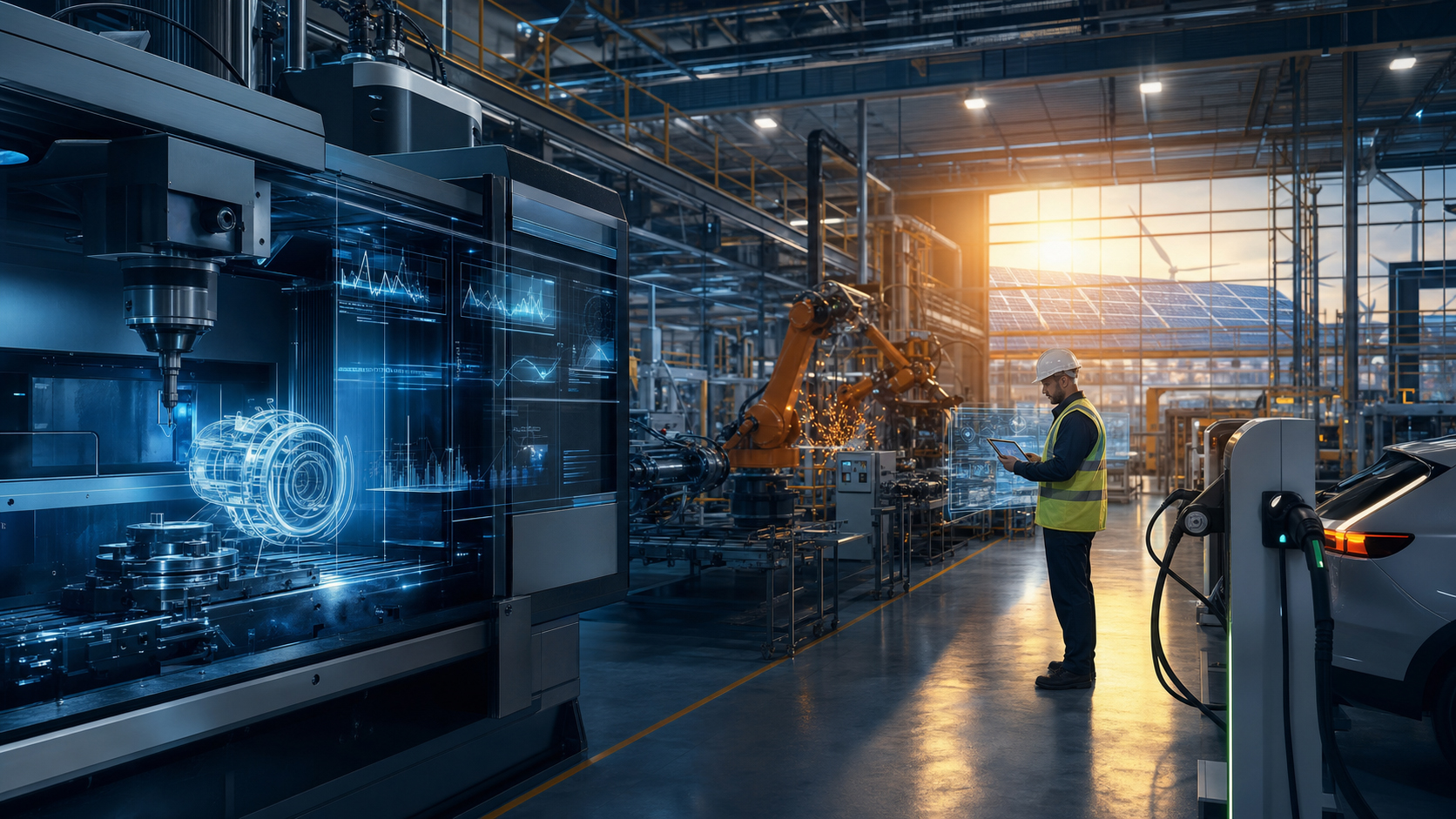
Survival struggle in mechanical engineering: 6 trends that will determine the future of the industry – An industry under multiple pressures – Image: Xpert.Digital
The end of the downward spiral? How 6 new rules of the game can save German mechanical engineering
More than just an economic downturn: Why data and energy are now more important than steel in mechanical engineering
The German mechanical and plant engineering sector is undergoing an unprecedented transformation. After twelve consecutive quarters of losses and massive job losses, one thing is clear: the current period of weakness is not simply a temporary economic downturn that can be weathered. Rather, profound structural shifts – from exploding energy costs and new cybersecurity laws to a dramatic shortage of skilled workers – are forcing one of Europe's most important key industries to radically rethink its approach. But where old certainties crumble, enormous opportunities simultaneously arise for those companies that actively shape this change. The following analysis reveals the six fundamental forces now reshaping the market and why traditional cost-cutting programs are no longer sufficient. Those who understand these mechanisms and combine them across departmental boundaries will prepare their companies for the industry of the future – and secure crucial competitive advantages in a market whose rules are currently being completely rewritten.
Mechanical engineering at a turning point: Six forces that are reinventing an entire industry
Those who don't act today will be overtaken tomorrow – why German mechanical engineering has no time to hesitate
The German mechanical and plant engineering sector is in the midst of a structural crisis of unprecedented scale. Since the beginning of 2023, the industry's production has been shrinking continuously – the fourth quarter of 2025 marked the twelfth consecutive quarter of decline, a level last seen in the early 1990s. Capacity utilization, at 78.3 percent, is significantly below the long-term average of just over 85 percent, and around 22,000 jobs were lost across the sector in 2025. At the same time, global mechanical engineering production is growing by 3.6 percent, while Germany, as Europe's largest economy – and accounting for over 45 percent of total Eurozone mechanical engineering production – stands out as a negative outlier in the statistics.
This diagnosis sounds like decline, were it not for a crucial difference from the crisis of the 1990s: Today's challenges are not cyclical fluctuations that will correct themselves. They are structural shifts that demand new solutions – technological, organizational, and strategic. Those who understand the mechanisms behind these shifts and respond accordingly will position themselves as indispensable partners in a market that is currently undergoing a transformation. For 2026, the VDMA (German Engineering Federation) anticipates real production growth of 1 percent – a bottoming out that allows for cautious optimism.
The six key development trends shaping this transformation cannot be viewed in isolation. They are interconnected, mutually reinforcing, and thereby offering extraordinary opportunities, particularly to those companies willing to think beyond short-term cost reductions.
Energy costs as a strategic competitive factor
For industrial companies, energy is no longer a fixed cost item that is not negotiable. It is a key competitive factor. The average industrial electricity price in Germany, including electricity tax, is around 18.75 cents per kilowatt-hour – a figure that will be around 15.9 cents for medium-sized industrial companies with an annual consumption of 20 to 70 million kilowatt-hours in 2025, and around 14.4 cents for large consumers with 70 to 150 million kilowatt-hours. These prices significantly exceed competitive conditions in the USA or China and directly impact the production cost calculations of mechanical engineering companies' customers.
The consequence is predictable: Machine manufacturers who sell equipment whose energy consumption cannot be precisely measured, controlled, and optimized will lose out in the selection process to competitors who can convincingly present the Total Cost of Ownership (TCO) approach. In energy-intensive industries, purchasing decisions are no longer based solely on the purchase price, but rather on a machine's energy profile throughout its entire life cycle. Experience shows that traditional cost accounting methods, which focus exclusively on the purchase price, overlook 20 to 40 percent of the actual operating costs. Machine manufacturers who equip their products with integrated energy measurement systems, intelligent motor control, and predictive maintenance thus provide their customers with a direct economic argument – and sustainably differentiate themselves from the competition.
Energy transition as a growth market, not as a regulatory burden
The energy transition, which many companies initially viewed as a bureaucratic obligation, is proving to be a significant growth driver for the mechanical engineering sector. Growth in renewable energies, electromobility, and energy storage is creating new markets that have nothing in common with the stagnating traditional core business.
The expansion of charging infrastructure in Germany alone illustrates the potential: Public charging capacity increased to more than 200,000 charging points in 2025, and installed charging capacity now exceeds nine gigawatts. The National Charging Infrastructure Control Center projects a need for between 380,000 and 680,000 charging points by 2030 – meaning that currently, at best, only a fraction of the necessary infrastructure has been built. This market is still developing and requires precision machinery for manufacturing charging stations, power electronics for power conversion systems, cable management and cooling systems for high-performance chargers, as well as integrated control solutions for grid management. Machine manufacturers who position themselves early as competent suppliers in this ecosystem will tap into revenue streams that are completely decoupled from the current economic downturn in their traditional core business. A similar situation exists in the market for stationary battery storage systems and heating, ventilation, and air conditioning (HVAC) technology, which is growing rapidly under pressure from the German Building Energy Act (GEG) and the increasing demand for heat pumps.
Digital development architectures as a productivity lever
The pressure to achieve shorter development cycles is vital for machine manufacturers. The market won't wait for costly new developments when requirements change annually. Future-proof design architectures based on pre-configured digital building blocks, digital twin models, and reusable component libraries offer a structural advantage over companies that still develop each machine from scratch.
The global market for digital twins is growing at an enormous pace: from around US$12 billion in 2025, it is projected to reach almost US$88 billion by 2035, representing an average annual growth rate of nearly 22 percent. This technology has long since moved beyond the status of an experimental innovation in mechanical engineering – it has become the standard for efficient product development. By utilizing digital building blocks that already contain relevant specifications, embedded control software, energy optimization algorithms, and predictive maintenance functions, companies can significantly reduce development time, minimize potential errors, and simultaneously create the foundation for a modular, customer-configurable product system. Total IT costs in the German mechanical engineering sector have risen an average of five percent per year faster than revenue since 2017, reaching an IT cost ratio of 2.6 percent in 2024. This is not a loss – it is an investment in speed and flexibility, provided the resources are used strategically.
🎯🎯🎯 Data-driven B2B industry hub as a quasi-in-house solution

The quasi-in-house solution: How Xpert.Digital closes operational gaps in B2B marketing and sales – Smart Content-Driven Business - Image: Xpert.Digital
Xpert.Digital is a data-driven B2B industry hub led by Konrad Wolfenstein . The company acts as an external, quasi-in-house solution for industrial partners, closing operational gaps in marketing, content, and sales – without requiring additional resources on the client side.
More information here:
From one-off sales to recurring revenue: Business models for networked machines
Data-driven operating models as a differentiation strategy
Digital design architectures are just one aspect of the broader transformation towards data-driven operating models. The real strategic opportunity for machine manufacturers lies in the fact that networked machines are no longer mere capital to be sold and then forgotten – they are becoming a continuous source of data from which new business models emerge.
Machines equipped with sensors and intelligent devices that transmit their operating parameters in real time enable their operators to implement predictive maintenance strategies, preventing unplanned downtime and thus costly production losses. For machine manufacturers, this creates the opportunity to develop service- and data-based revenue models that can be structured as recurring revenue – a decisive advantage over one-off, transactional business. The challenge lies not in the sensors themselves, but in their integration: Intelligent plug-and-play cabling solutions that can be seamlessly integrated into standard fieldbus systems reduce installation effort and costs, making networked machines economically attractive even for medium-sized operators. Currently, 70 percent of IT budgets in mechanical engineering are allocated to day-to-day operations; only 30 percent are available for innovation projects – a ratio that, in the long run, limits strategic flexibility and must be reversed.
Cybersecurity as a market entry requirement and liability risk
As the capabilities of networked machines grow, so do the associated risks. The total damage suffered by companies in Germany in 2025 due to theft, sabotage, and industrial espionage amounted to approximately €289.2 billion – an increase compared to €266.6 billion in 2024 and €205.9 billion in 2023. Of this, 70 percent was directly attributable to cyberattacks. The trend is clear: the more intelligent and networked production facilities become, the more attractive they are as targets.
The regulatory framework is exacerbating the situation for machine manufacturers on several levels simultaneously. NIS-2 has been in effect since December 2025 and affects approximately 29,500 entities in Germany, including explicitly manufacturers of networked machines and systems. The Cyber Resilience Act (CRA) will implement its reporting obligations from September 2026, while the new EU Machinery Regulation with its cybersecurity requirements will come into force in January 2027. Fines for NIS-2 violations can amount to up to seven million euros or two percent of turnover – with personal liability for management. Anyone who views this regulatory landscape as merely a compliance burden misses the strategic message: demonstrable cybersecurity based on the principle of "security by design" – meaning integrated into the design from the outset and not added retroactively – is becoming a prerequisite for market entry in networked machine manufacturing. Machine manufacturers who can actively support their customers with NIS-2 compliance will secure long-term supplier relationships – all others risk losing these customers.
Demographic change as a design imperative
The sixth structural trend is perhaps the most underestimated in its impact because it unfolds more slowly than a cyberattack and is less spectacular than a new technological paradigm. Nevertheless, the shortage of skilled workers is one of the most severe structural constraints that the mechanical engineering sector and its customers will face in the coming years.
Over the next ten years, an estimated 296,000 employees in the German mechanical engineering sector will retire – roughly a quarter of the total workforce – while only about 118,000 replacements will be available. This translates to a potential skills gap of 178,000 positions by 2034. The Institute for Employment Research (IAB) also forecasts that the number of employed persons in Germany will decline slightly for the first time in 2026, while the potential labor force will begin to shrink from 2026 onward. For the mechanical engineering sector, this development has a direct design consequence: systems must be designed so that they can be operated safely and efficiently by less experienced personnel. Intuitive user interfaces, simplified human-machine interaction, and shorter training periods are not mere convenience features – they are operational necessities. Those who build machines that require 45 years of professional experience are building for a working world that no longer exists in this form.
Transformation as an entrepreneurial attitude
These six development trends share one important characteristic: they are not additive, but multiplicative. Energy efficiency without data communication remains untapped. Data networking without cybersecurity becomes a risk. Cybersecurity without user-friendly interfaces fails due to a lack of employee acceptance. The companies that will emerge strongest from this phase of change are those that consider these interrelationships systemically and do not manage them in silos.
The VDMA's optimism for 2026 – real production growth of one percent, and for the first time since spring 2024, more positive than negative outlooks among member companies – should not be misinterpreted as a sign that the situation is over. It signals that the period of uncertainty is over. Those who invest in the right direction now have a tailwind; those who wait until the industry returns to its previous production levels will find that the rules of the game have fundamentally changed. Energy efficiency is no longer an environmental issue, but a competitive advantage. Digital transformation is not an IT issue, but a business model issue. Cybersecurity is not a compliance issue, but a prerequisite for market access. And user-friendly design is not an aesthetic question, but a response to an aging workforce.
The mechanical engineers who internalize these redefinitions and draw operational conclusions from them will not only survive the current lean period – they will play a key role in shaping the industrial structure of the coming decade.
Your global marketing and business development partner
☑️ Our business language is English or German
☑️ NEW: Correspondence in your native language!

Konrad Wolfenstein
I and my team are happy to be available to you as your personal advisor.
You can contact me by filling out the contact form here simply call me at +49 7348 4088 965. My email address is [email protected]:or
I'm looking forward to our joint project.










