
Awesome or risky? The end of the AI secretary? Ki startup Mistral Ai relies on radical openness
Xpert pre-release

Available in 27 languages 📢
Prefer Xpert.Digital on GoogleⓘPublished on: June 6, 2025 / update from: June 6, 2025 - Author: Konrad Wolfenstein
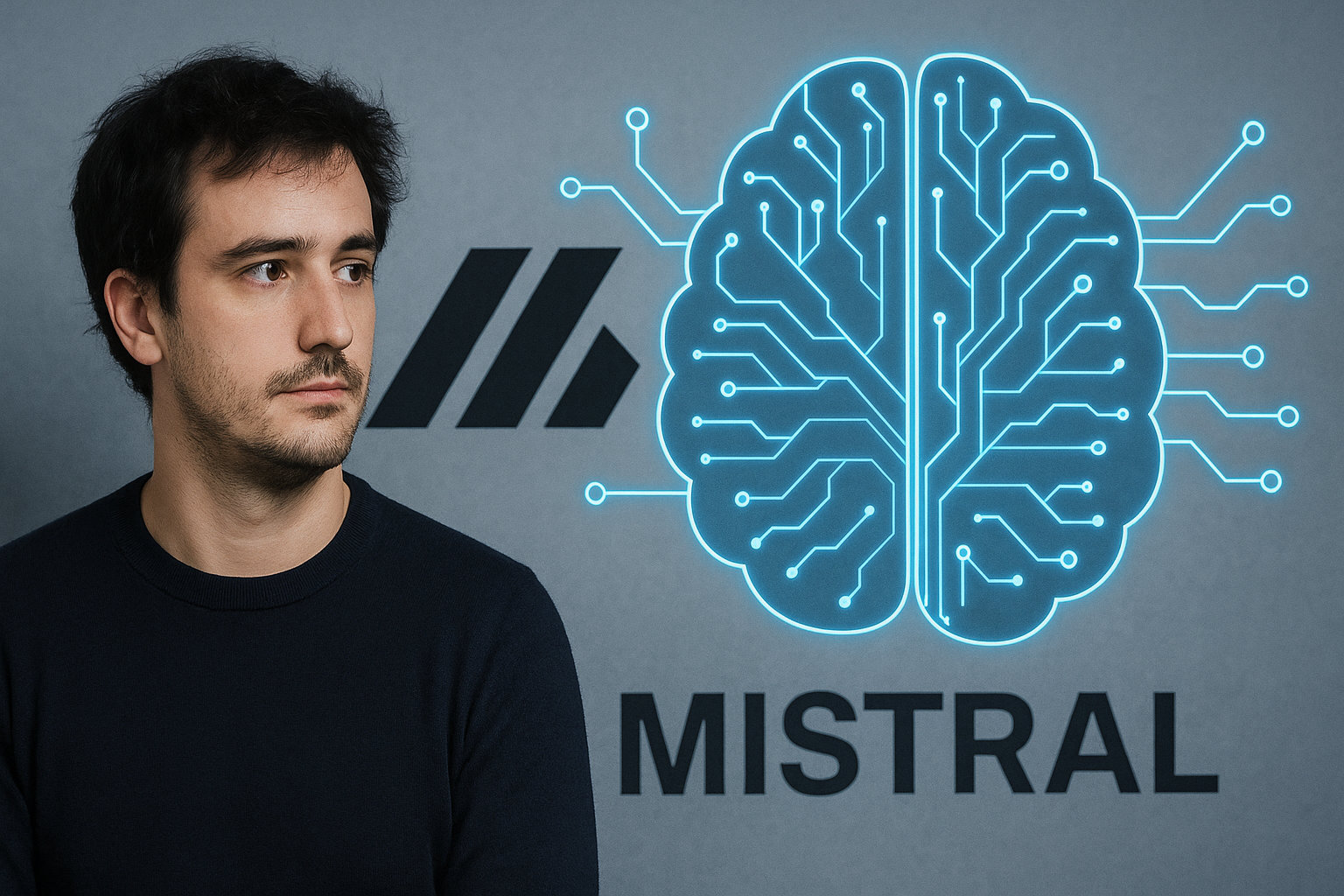
Awesome or risky? The end of the AI secretary? Ki startup Mistral Ai relies on radical openness-picture: Xpert.digital
Mistral Ai against the mainstream: European AI innovation on the advance
Transparency and innovation: Mistral Ai in focus
The French Ki Startup Mistral Ai has positioned itself as a serious challenger for established US technology companies since it was founded in April 2023 by relying on complete transparency and open source approaches. While Openaai and Anthropic operate their language models as opaque “black boxes” and only provide limited insights into their way, Mistral follows a radically different way of democratization of artificial intelligence. The company, founded by the former Google Deepmind and Meta-researchers Arthur Mensch, Guillaume Lample and Timothée Lacroix, has proven with its Mistral Small 3.1, which was published under Apache 2.0 license, such as Mistral 7b, Mistral 8x7b and the recently presented, that open source models would definitely compete with proprietary solutions can. This development marks a turning point in the AI landscape, in which European innovation and openness compete against American market dominance and non-transparency.
Suitable for:

Foundation and mission: A new approach to artificial intelligence
Mistral Ai emerged from the vision of three researchers who wanted to create an alternative to the dominant AI companies. Arthur Mensch, Guillaume Lample and Timothée Lacroix, all with academic roots at the École Polytechnique and Professional experience on Google Deepmind and Meta, founded the company with the explicit goal of challenging the opaque nature of the “big AI” and making the most modern technology accessible to everyone. This philosophy is reflected in the corporate mission, which aims to make Frontier-Ai available for everyone and create a future in which AI is abundant and accessible.
The founders recognized early on that the increasing concentration of the AI power in the hands is a threat to innovation and fair competition. Your approach is fundamentally different from that of the established player by commitment to open source development, in which the model weights are completely published. This strategy enables developers and researchers worldwide to understand, modify, modify the models and adapt them for their specific applications, which forms a significant contrast to the closed systems of Openaai or anthropic.
The company has recorded impressive growth since its foundation. Just four weeks after the foundation, Mistral collected 105 million euros in one of the largest seed financing rounds in Europe. This early financing was borne by the conviction that open source AI can represent a credible alternative to the resulting “AI-oligopol”. The team has now grown to over 200 employees from 15 different nationalities, although it is noteworthy that 50% of the management positions are occupied by women.
The open source revolution: transparency against unity
The fundamental difference between Mistral Ai and the American market leaders lies in the philosophy of openness. While companies such as Openaai and Anthropic treat their models as proprietary technologies and only provide limited insights into their way, Mistral publishes its models under the permissive Apache 2.0 license. This license allows everyone to use the models free of charge, modify and even use it commercially, without restrictions through license fees or restrictions on use.
The importance of this open source strategy becomes particularly clear when you look at the current efforts to transparency AI. While Openaai has recently started publishing details about his “Model Spec” - a document that describes the desired behaviors of your models - remains the actual architecture and functionality of your systems. Anthropic pursues transparency initiatives, but is not planning a complete disclosure of the model mechanisms until 2027. Mistral, on the other hand, not only provides the trained model weights, but also enables local execution and complete adjustment of the systems.
This transparency has a practical effect on the applicability of the technology. While users of Chatgpt or Claude are dependent on the cloud services of the providers and their pricing and availability are subject, Mistral models can be carried out locally. This is particularly relevant for companies and organizations that do not want to transfer sensitive information to external services due to data protection, security or compliance reasons. The possibility of fully operating AI models in your own infrastructure is a significant competitive advantage, especially in regulated industries or processing confidential data.
Technical performance: competitive open source models
The technical achievements of Mistral Ai impressively demonstrate that open source models not only keep up with proprietary solutions, but can also surpass them in different areas. The mixed 8x7b model, which uses an innovative mixture-of-experts architecture, reaches a score of 8.30 on the MT-Bench and is therefore considered the best open source model with a performance comparable to GPT-3.5. This architecture uses several smaller “experts” models that are only activated if necessary, which leads to a significant improvement in performance while reducing the computing costs.
The recently published Mistral Small 3.1 sets new standards for small voice models and exceeds comparable models such as GEMMA 3 and GPT-4O mini with impressive inference speeds of 150 tokens per second. With its extended context window of 128,000 tokens and multimodal skills, the model demonstrates that open source development not only keeps pace with the innovations of the large technology groups, but can even overtake them in certain areas. This performance is underlined by the fact that the model can be operated on a single RTX 4090 graphics card or a Mac with 32GB RAM, which makes it accessible to a broad user.
The benchmarking results show a remarkable performance of the Mistral models in direct comparison with proprietary alternatives. While GPT-4 reaches 86.4% on the MMLU benchmark, Mistral Large comes to a respectable 81.2%. The price-performance ratio is particularly impressive: Mistral Large costs only $ 8 per million tokens for both input and output, while GPT-4 $ 30 for input and $ 60 for output. These considerable cost differences make open source models for many applications more economically attractive, especially for companies with a high throughput or limited budgets.
🎯📊 Integration of an independent and cross-data source-wide AI platform 🤖🌐 for all company matters

Integration of an independent and cross-data source-wide AI platform for all company matters-Image: Xpert.digital
Ki-Gamechanger: The most flexible AI platform-tailor-made solutions that reduce costs, improve their decisions and increase efficiency
Independent AI platform: Integrates all relevant company data sources
- This AI platform interacts with all specific data sources
- From SAP, Microsoft, Jira, Confluence, Salesforce, Zoom, Dropbox and many other data management systems
- Fast AI integration: tailor-made AI solutions for companies in hours or days instead of months
- Flexible infrastructure: cloud-based or hosting in your own data center (Germany, Europe, free choice of location)
- Highest data security: Use in law firms is the safe evidence
- Use across a wide variety of company data sources
- Choice of your own or various AI models (DE, EU, USA, CN)
Challenges that our AI platform solves
- A lack of accuracy of conventional AI solutions
- Data protection and secure management of sensitive data
- High costs and complexity of individual AI development
- Lack of qualified AI
- Integration of AI into existing IT systems
More about it here:
Transformative approaches: Mistral Ai and the AI landscape of tomorrow
Market positioning and business strategy
Mistral Ai is pursuing a hybrid business strategy that includes both completely open models and commercial offers. The company offers both open source models such as Small 3 under the Apache 2.0 license as well as proprietary models such as Mistral Medium and Mistral Large via API interfaces via the “La Plateforme” platform. This duality enables the company to operate various market segments: developers and researchers can use the open models free of charge, while companies can use special requirements on commercial services.
The market reaction to Mistral approach is remarkably positive. The chatbot “Le Chat”, Mistral Answer to Chatgpt, reached a million downloads within two weeks of his launch on mobile platforms and even conquered the top position of free downloads in the French iOS App Store. This response was reinforced by political support when French President Emmanuel Macron publicly asked Le Chat instead of chatt. Such endorsements underline the strategic importance of the development of European governments of developing their own AI capacities in order to reduce the dependency on US technology companies.
Mistral's financing profile reflects the trust of investors in this strategy. After the record-breaking seed round, Series A financing of over 385 million euros followed in December 2023, which the company rated over $ 2 billion. By June 2024, the assessment rose to over $ 6 billion after a total of about $ 1.04 billion was collected. These reviews position Mistral as one of the most valuable AI startup in Europe and demonstrate the potential for significant returns through open source innovation.
Suitable for:

Mistral Ai: Europe's answer to tech giants
Despite the impressive progress, Mistral Ai faces significant challenges in competition with established US giants. Despite the $ 6 billion rating, the company's market share remains relatively low in comparison to Openaai or Google. The resource differences are considerable: While Openaai and Anthropic can access massive computing capacities and databases, Mistral must develop more efficiently and develop innovative approaches in order to achieve comparable services with smaller models.
However, the geopolitical tensions between the USA and China could benefit Mistral as a European alternative. Companies and governments that want to reduce their dependence on US or Chinese technology providers see an attractive option for technological sovereignty in Mistral. The European Union has already started initiatives to promote its own AI capacities, and Mistral is well positioned to benefit from these political developments.
Mistral's technological roadmap focuses on the continuous improvement of the efficiency and performance of your models. The focus on smaller, optimized models, which can nevertheless compete with larger systems, addresses an important market requirement after sustainable and cost -efficient AI. This strategy could be particularly relevant because the industry is increasingly paying attention to the environmental impacts and operating costs of large language models. Mistral's emphasis on environmental friendliness as a “greenest and leading independent AI developer” appeals to growing sustainability concerns in the technology industry.
Effects on the AI landscape
Mistral Ai's success has extensive implications for the entire AI industry and the way artificial intelligence is developed and used. The demonstration that open source models can achieve competitive services in question that large corporations are only able to develop state-of-the-art AI systems. This development democratizes access to advanced AI technology and enables a wider community of developers, researchers and companies to create innovative applications.
The availability of high-quality open source models also promotes innovation in downstream applications. Developers can use the Mistral models as the basis for specialized applications, integrate Fine tunes or integrate them into existing systems without having to worry about license fees or API restrictions. This flexibility is particularly valuable for startups and smaller companies that may not have resources to use expensive commercial AI services.
Mistral's successes have also encouraged other companies and institutions to pursue similar open source approaches. Meta with its LLAMA models, various universities and other AI startups have started to make their models more open. This development towards more transparency and openness in AI development could lead to more robust, safer and ethical AI systems in the long term, since a wider community is involved in reviewing and improving the technology.
The future of open AI
Mistral Ai's position as the challenger of the US AI dominance is more than just a technological competition-it represents a fundamental paradigm shift in the way KI is developed and provided. The continuation of this open source strategy could significantly change the balance of power in the AI industry and lead to a more decentralized, more democratic development of artificial intelligence. While the established companies may continue to have advantages in relation to resources and market presence, Mistral shows that innovation and openness can create competitive alternatives.
The long-term effects of this development are expected to manifest in various areas: from research, where more scientists will have access to state-of-the-art models, to commercial applications where companies will be less dependent on individual providers. The European Dimension of Mistral Success could also serve as a catalyst for other regional AI initiatives and contribute to a more multipolar global AI landscape.
Suitable for:

AI democratization by Mistral: A way to the future
Mistral Ai has shown remarkably short time that open source approaches can represent a viable alternative to the closed systems of the established AI giants. With the combination of technical excellence, strategic openness and efficient use of resources, the French startup has set a new standard for the democratization of AI technology. The ability to achieve comparable or better performance than the competition with significantly smaller models, while at the same time complete transparency and accessibility is guaranteed, is significant progress in AI development.
Mistral's success also shows that the future of artificial intelligence does not necessarily have to be determined by a few dominant companies. The open source philosophy enables a global community of developers and researchers to contribute to the further development of technology and create innovative applications that arise from the specific needs of different user groups. This decentralization of AI development could lead to more robust, more diverse and ethical AI systems that are better tailored to the needs of society as a whole.
While the challenges for Mistral in competition with the resource-strong US competitors are still considerable, the company has already had a lasting influence on the AI landscape. The demonstration that open source AI can not only be technically feasible, but also commercially successful, inspires other actors and contributes to a more open, more accessible future of artificial intelligence. At a time when the social effects of AI are discussed intensively, Mistral offers a valuable contribution to the design of a responsible AI development.
We are there for you - advice - planning - implementation - project management
☑️ SME support in strategy, consulting, planning and implementation
☑️ Creation or realignment of the AI strategy
☑️ Pioneer Business Development

Konrad Wolfenstein
I would be happy to serve as your personal advisor.
You can contact me by filling out the contact form below or simply call me on +49 7348 4088 965 (Munich) .
I'm looking forward to our joint project.
Write to me

Xpert.Digital - Konrad Wolfenstein
Xpert.Digital is a hub for industry with a focus on digitalization, mechanical engineering, logistics/intralogistics and photovoltaics.
With our 360° business development solution, we support well-known companies from new business to after sales.
Market intelligence, smarketing, marketing automation, content development, PR, mail campaigns, personalized social media and lead nurturing are part of our digital tools.
You can find out more at: www.xpert.digital - www.xpert.solar - www.xpert.plus
Keep in touch










