

No more cheap goods from the Far East? The end of the linear economy – EU law puts an end to the throwaway economy
Xpert Pre-Release

Available in 27 languages 📢
Prefer Xpert.Digital on GoogleⓘPublished on: August 17, 2026 / Updated on: August 17, 2026 – Author: Konrad Wolfenstein
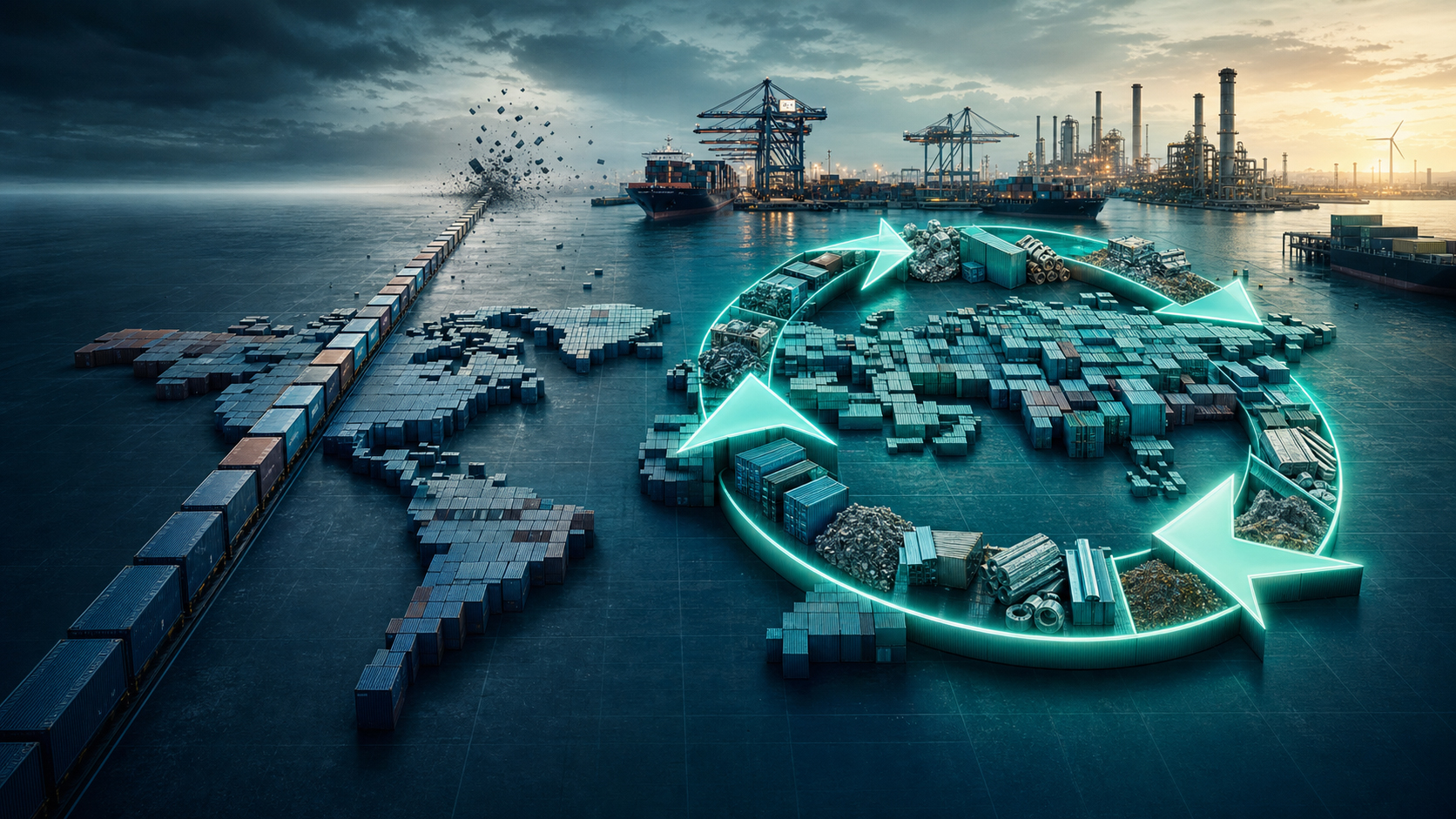
No more cheap goods from the Far East? The end of the linear economy – EU law ends the throwaway economy – Image: Xpert.Digital
How new CO2 tariffs are turning global procurement upside down: Those who ignore this logistics trend risk their business
China's Resource Trap: How the Circular Economy is Becoming a Geopolitical Fight for Survival for Companies
From waste to a multi-billion dollar market: How Europe's regulatory zeal is revolutionizing supply chains
For decades, global trade was based on a simple but consequential logic: extract raw materials, produce, ship, and ultimately dispose of them. But this linear "take-make-dispose" model is facing its final demise. Driven by an unprecedented wave of regulations from Brussels, the finite nature of critical raw materials, and geopolitical dependence on China, the circular economy is currently transforming from a niche green issue into a hard-nosed industrial policy imperative. By 2026 at the latest, new regulations—from digital product passports and CO2 tariffs (CBAM) to the Critical Raw Materials Act—will drastically change the rules of the game for international supply chains. At the same time, the often-neglected reverse logistics sector is emerging as a multi-billion-dollar growth market that will redraw the global procurement map. Those who see this upheaval as merely a bothersome bureaucratic exercise risk their competitiveness. Those who, on the other hand, recognize it as an opportunity will secure decisive advantages in the new era of global logistics.
The end of the linear economy in global logistics and supply chain
How Europe's regulatory zeal turns waste into capital and who gets left behind
For over seven decades, the global economy followed a deceptively simple logic: raw materials are extracted somewhere in the world, processed into products in factories, shipped across continents, sold, used, and disposed of at the end of their life cycle. This take-make-dispose principle was the blueprint of industrial modernity and was continually optimized toward a single goal: maximum cost efficiency through the global division of labor. Ports, shipping companies, freight forwarders, and cargo airports became servants of a system that traded distance for price and was increasingly blind to the ecological and geopolitical costs of this linearity.
This model is now reaching its structural limits. The finite nature of critical raw materials, the explosion in energy and freight costs, geopolitical upheavals, and above all, an unprecedented wave of regulations from Brussels are forcing companies to fundamentally rethink their supply chains. What was long considered a secondary green issue is becoming a mandatory industrial policy measure. The circular economy is transforming from a voluntary sustainability initiative into a cutthroat competitive criterion that determines market access, financing conditions, and ultimately, the survival of companies.
When littering becomes a crime
The decisive break with the old logic is currently taking place at the European level. From 2026, companies will no longer be allowed to simply destroy unsold goods; they must introduce a digital product passport that makes information such as material composition, repair instructions, sustainability certificates, and the CO2 footprint transparent along the entire supply chain. The EU Ecodesign Regulation (ESPR) thus obliges companies to integrate the principles of the circular economy into their business models not as an optional extra, but as a requirement. In the future, products must be designed in such a way that they prevent waste from the outset, can be kept in circulation, and contribute to the regeneration of natural systems at the end of their life cycle.
This regulation is flanked by the Circular Economy Act, announced for the third quarter of 2026, which, according to the European Commission's plans, is intended to be a central pillar of the Clean Industrial Deal and the competitiveness compass for the current mandate. The draft legislation aims to double the usage rate of circular materials in the EU to 24 percent by 2030 and to create a single internal market for secondary raw materials, significantly reducing strategic dependence on third countries. Unlike previous sustainability initiatives, the legislator is no longer relying on incentives, but rather on binding targets that are intended to strategically link existing regulations such as the Waste Framework Directive, the Waste Electrical and Electronic Equipment Directive, and the Critical Raw Materials Act.
In parallel, the digital product passport is establishing a completely new data infrastructure. The central EU register for product passport identifiers is scheduled to be operational by July 2026, while the first mandatory passport for vehicle, light commercial vehicle, and industrial batteries with a capacity of over two kilowatt-hours will enter into force in February 2027. Textiles, iron, and steel are expected to follow with their own delegated acts in 2027 and 2028, respectively, while furniture, mattresses, and electronics will only be covered towards the end of the decade. This phased, product-group-specific introduction means that companies cannot wait for a single deadline but have different preparation windows depending on the sector, all of which nevertheless ultimately rely on the same technical and organizational infrastructure.
How CO2 tariffs are redrawing the world shopping map
Since January 1, 2026, the Carbon Border Adjustment Mechanism, better known as CBAM, has been in its final implementation phase. What was merely a reporting obligation during the transition period between 2023 and 2025 has now become a compliance requirement subject to payment. Every importer bringing more than fifty tonnes of CBAM-liable goods into the EU per year must apply for authorized CBAM declarant status, accurately document the embedded emissions of their imports, and purchase and surrender the corresponding allowances. Initially, six particularly energy-intensive sectors at risk of carbon leakage are affected: cement, iron and steel, aluminum, fertilizers, electricity, and hydrogen.
The economic impact of this mechanism extends far beyond the directly affected basic materials industries. Mechanical engineering, construction, automotive trade, and electrical engineering regularly import intermediate products from these sectors, such as screws and pipes made of aluminum or steel, rims and roof racks for vehicles, or nitrogen fertilizer for agriculture. These higher import costs are passed on along the value chains, thereby altering the basis for calculations for entire industries. In the future, the choice of supplier will no longer be determined solely by the purchase price, but increasingly by the emissions intensity of the respective production process, because production facilities in countries without equivalent CO2 pricing automatically generate higher CBAM costs.
For companies, this means a fundamental realignment of their procurement strategy. Those importing energy-intensive intermediate goods must firmly integrate the effective CO2 cost surcharge into their overall calculations and require reliable primary data from their own supply chain, because companies without systematic CO2 tracking risk both regulatory sanctions and cost disadvantages due to inaccurate standard values. The purchase of certificates for imports in 2026 will only become due from February 2027 onwards, which, while providing companies with some financial relief, does not change the fundamental economic trigger for the obligation. Overall, CBAM is thus shifting the geographical logic of global sourcing in favor of regions with clean energy production and strategically bringing production sites within the European single market back into focus.
The fight for raw materials controlled by only one entity
A second, deeper-lying driver of the linear crisis is the extreme concentration of critical raw materials in the hands of a few geopolitical powers. According to the European Parliament, China controls around 75 percent of global production and 85 percent of processing capacity for rare earth elements; for individual elements such as terbium, yttrium, and dysprosium, this share is even higher, exceeding 95 percent. The EU covers 98 percent of its demand for permanent magnets and 92 percent of its demand for neodymium-iron-boron magnets through imports from China. This dependence affects not only niche applications but also the very cornerstones of the energy transition itself, such as wind turbines, electric motors, and batteries.
China has repeatedly used this market power in recent years to exert political pressure. Export restrictions have been in place for gallium and germanium since August 2023, for graphite since December 2023, for antimony since September 2024, and for tungsten and bismuth since February 2025, while scandium was also affected in April 2025. The consequences were immediately apparent in prices: gallium nearly doubled, germanium rose by over fifty percent within a few months, and antimony reached an all-time high. In response, the EU adopted the Critical Raw Materials Act in March 2024, which sets ambitious targets: by 2030, at least ten percent of annual raw material consumption should be covered by domestic mining, forty percent by domestic processing, and twenty-five percent by recycling within the EU, while dependence on a single third country should be limited to a maximum of sixty-five percent.
At the end of 2025, the European Commission followed up with the RESourceEU action plan, which aims to derisively reduce China's supply of critical raw materials in the short term, including through improved stockpiling, accelerated funding of strategic projects, and a significant increase in recycling rates. However, the reality remains ambivalent. For sixteen of the twenty-eight raw materials classified as strategic, the EU is exceeding the targeted sixty-six percent limit for a single supplier country, in some cases dramatically, with China alone supplying ten of these materials almost exclusively. Critical voices from the scientific community also point out that the law's self-sufficiency targets are hardly achievable in full for technical and environmental reasons, and that strengthened partnerships with like-minded states remain necessary. It is precisely at this point that the circular economy becomes a geopolitical instrument, because every ton of recycled raw materials directly reduces import dependence on a single, potentially vulnerable supplier.
LTW Intralogistics Solutions

LTW Intralogistics – Engineers of Flow - Image: LTW Intralogistics GmbH
LTW offers its customers not individual components, but integrated complete solutions. Consulting, planning, mechanical and electrotechnical components, control and automation technology, as well as software and service – everything is networked and precisely coordinated.
In-house production of key components is particularly advantageous. This allows for optimal control of quality, supply chains, and interfaces.
LTW stands for reliability, transparency, and collaborative partnership. Loyalty and honesty are firmly anchored in the company's philosophy – a handshake still means something here.
Related to this:
From cost factor to billion-dollar market: Why reverse logistics will become the new driving force of industry
Returns become a billion-dollar business
While regulation and raw material shortages create external pressure, a tangible economic incentive is simultaneously emerging, accelerating internal transformation. Reverse logistics—the organization of returns, repairs, refurbishment, and recycling—has evolved from a purely cost-related factor into an independent growth market. Market analyses from various institutions may differ in absolute figures, but they paint a consistent picture: The global market for reverse logistics is estimated to be between roughly nine hundred billion and just under one trillion US dollars by 2026 and is projected to grow to between 1.4 and 1.75 trillion US dollars by the mid-2030s, depending on the forecast, corresponding to annual growth rates of roughly five to over seven percent.
The main drivers of this growth are the steadily increasing return rates in e-commerce, regulatory requirements for sustainability, and the growing market maturity of refurbished products. For logistics companies, this means a fundamental reassessment of their own business model. What previously consisted primarily of delivery, occasional recycling, and isolated returns is being replaced in the circular economy by diverse and complex return flows that create so-called micro-cycles between the individual value chain stages. Logistics service providers are thus moving from being mere executors to the strategic center of future business models and are being called upon to meet this new responsibility with their own value-added services, such as localized, condition-specific transport solutions for used or refurbished goods.
Digital technologies such as blockchain, the Internet of Things, and advanced data analytics are considered key enablers of this transformation because they make traceability, material tracking, and data-driven decision-making possible on the scale required for a functioning circular economy. Artificial intelligence is increasingly taking on the role of integrating demand planning, performance adjustment, and intelligent take-back logistics in such a way that, ideally, waste is avoided before it is even generated.
When proximity becomes more important than the cheapest price
The combination of regulatory pressure, raw material scarcity, and new economic opportunities is fundamentally shifting the geographical architecture of global supply chains. Instead of centrally manufactured products that are then shipped around the globe via air, sea, and road transport through a network of distribution centers and warehouses, a more regional manufacturing and distribution model is increasingly taking hold. Products manufactured near their point of consumption can be returned to the same facility for remanufacturing after use, requiring local manufacturers to maintain both the equipment and the specific expertise for repair and remanufacturing. With the increase in remanufactured products and local manufacturing, the need for extremely long supply chains, which formed the backbone of globalization for decades, is simultaneously decreasing.
This development is closely linked to the strategic concept of nearshoring, i.e., the deliberate relocation of production capacities closer to the European sales market. Combined with intelligent container pooling systems that reduce empty runs and optimize capacity utilization, this creates supply chains that are less vulnerable to geopolitical disruptions and trade conflicts. Cooperation with external logistics providers and the joint development of pooling infrastructures are increasingly becoming a strategic necessity rather than mere cost optimization. Those who invest in these structures early on not only secure better financing terms from investors and banks, which are increasingly focused on verifiable sustainability indicators, but also secure lasting market share in an increasingly stringent regulatory environment.
At the same time, the first disclosures under the Corporate Sustainability Reporting Directive in 2025 have already demonstrated that sustainability data is just as verifiable as traditional financial data. This new form of transparency will continue globally in the coming years and increasingly reach supply chain partners outside the European Union, allowing the circular economy to gradually export its impact beyond the European single market to other regions of the world.
Whoever pays the bill in the end
Despite all the economic opportunities, the transformation should not be seen as a smooth or even conflict-free process. For many companies, the transition from linear to circular structures initially means considerable additional costs and a significantly increased burden of documentation and processes. Critics rightly warn that CBAM hits companies doubly hard, especially during a period of economic uncertainty – economically through additional costs and administratively through massively increased documentation and auditing requirements. According to business associations, without targeted adjustments, there is a risk of distortions of competition, a relocation of supply chains to less regulated regions, and a structural competitive disadvantage for export-oriented medium-sized companies, which rarely possess the administrative resources of large corporations.
The self-sufficiency goals of the Critical Raw Materials Act are also reaching their limits. Developing new mining and processing capacities within the EU takes years, even decades, is subject to strict environmental regulations, and encounters local resistance to new mining projects in many regions. Even optimistic forecasts assume that the EU will not be able to substantially reduce its extremely high dependence on China for raw materials after 2030, but only delay it, unless it simultaneously strengthens international partnerships with like-minded producing countries. The circular economy can mitigate this gap, but given the limited return volumes of existing products, it cannot close it completely in the short term, especially for technologies like permanent magnets, whose widespread market entry only occurred in the last decade and a half and whose recycling streams are therefore still comparatively small.
Another, often overlooked, point of conflict concerns the international competitiveness of European companies outside the single market. While European manufacturers are increasingly required to make their products circular, repairable, and traceable, competitors from regions with less stringent regulations are not subject to these additional costs to the same extent. Without effective border adjustment mechanisms for finished products that extend beyond the existing CBAM sectors, there is a risk of production capacities being shifted to third countries, which could counteract the actual objective of the regulation: greater industrial resilience within Europe. It is therefore logical that the European Commission is already working on a gradual expansion of the CBAM scope to downstream products in order to minimize precisely this risk of circumvention.
A new economic operating system
Despite all the justified criticism regarding the speed of implementation, bureaucratic burden, and sometimes contradictory objectives, a clear structural trend is emerging that is virtually irreversible. The linear economic logic, based on cheap fossil fuels, seemingly unlimited raw material reserves, and global division of labor without significant CO2 costs, was a historical model of a specific era and not an economic constant. Rising commodity prices, geopolitical vulnerability regarding critical materials, stricter climate targets, and a new generation of investors who take sustainability indicators as seriously as traditional balance sheet metrics are permanently shifting economic incentives toward circular economy models.
For companies of all sizes, this means that reverse logistics, nearshoring, digital product passports, and CO2 transparency can no longer be isolated compliance projects, but must become an integral part of corporate strategy. Those who dismiss this transformation as a bothersome regulatory exercise risk losing market access in the European single market and facing less favorable financing conditions in the medium term. Conversely, those who see it as an opportunity to realign their business model can secure early competitive advantages in a market that is expected to generate several trillion US dollars in additional economic value creation in the area of reverse logistics alone over the next ten years.
Ultimately, the global logistics and supply chain industry is not facing a cosmetic adjustment, but a genuine paradigm shift that, for the first time, treats the principles of efficiency, resilience, and regeneration as equally important. For seventy years, the linear economy was the unspoken assumption behind every calculation, every sourcing decision, and every investment plan. This assumption no longer holds true, and the companies that internalize this first will decisively shape the coming decade of global value chains.
Consulting - Planning - Implementation

Konrad Wolfenstein
I would be happy to serve as your personal advisor.
You can contact me at wolfenstein∂xpert.digital or
Just call me on +49 7348 4088 965 .
Your intralogistics experts

Consulting, planning and implementation of complete solutions for high-bay warehouses and automated storage systems - Image: Xpert.Digital
More information here:










