
Why Daifuku's new robot series is a strategic stroke of genius – Daifuku brings SOTR series to LogiMAT
Xpert Pre-Release

Available in 27 languages 📢
Prefer Xpert.Digital on GoogleⓘPublished on: March 20, 2026 / Updated on: March 20, 2026 – Author: Konrad Wolfenstein
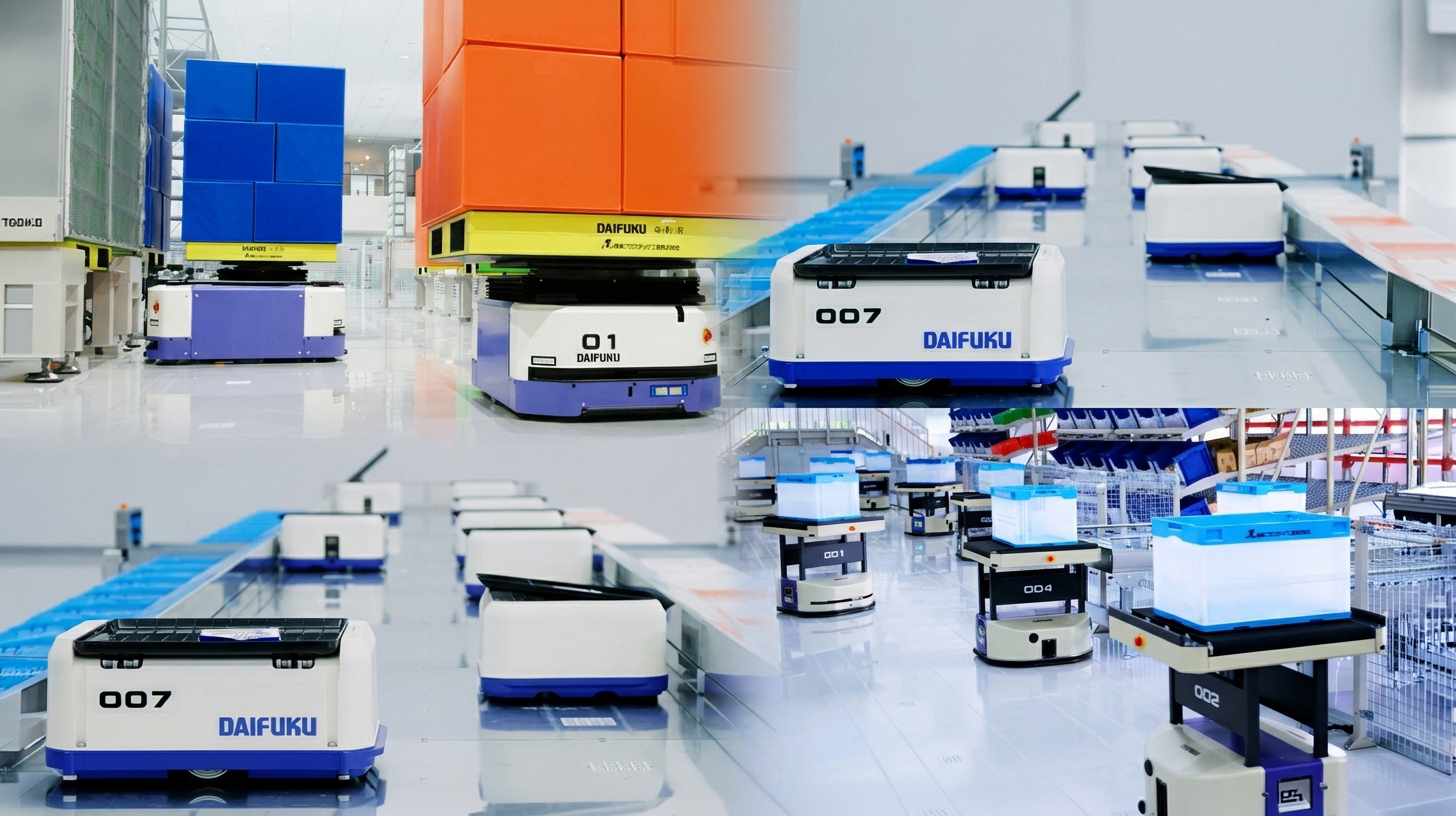
Why Daifuku's new robot series is a strategic stroke of genius – Daifuku launches SOTR series at LogiMAT – Image templates: Daifuku / Creative image: Xpert.Digital
The end of rigid conveyor belts? How Daifuku is shaking up European logistics with new robots
10,000 items per hour: This Japanese sorting robot is revolutionizing the warehouse
Europe's intralogistics is on the verge of a transformation: What's behind Daifuku's spectacular LogiMAT debut?
The European logistics industry is facing a massive structural transformation: a historic shortage of skilled workers, exploding e-commerce volumes, and enormous cost pressures are forcing warehouse operators to radically rethink their strategies. It is precisely at this crucial juncture that Daifuku, the Japanese global market leader in intralogistics, is making a clear statement at LogiMAT 2026 in Stuttgart. With the European premiere of its innovative SOTR (Sorting Transfer Robot) family, the company is not simply presenting new hardware, but launching a direct attack on rigid, inflexible conveyor technology. The three autonomous robot systems – SOTR-S, SOTR-M, and SOTR-L – promise top speeds of up to 10,000 sorting operations per hour and unprecedented, stepless scalability for individual items, boxes, and pallets weighing several tons. Learn in our comprehensive analysis why Daifuku's market entry is far more than an ordinary trade fair premiere, how the enormous investments in autonomous fleets pay off, and why intelligent robots could soon make the traditional conveyor belt obsolete.
Daifuku SOTR series: Japanese sorting robots on a European course
When conveyor systems fall silent and robots rewrite the flow of goods – why Daifuku's Stuttgart debut is more than just a trade fair premiere
LogiMAT 2026, taking place in Stuttgart from March 24 to 26, marks a strategic turning point: Daifuku, the Japanese global market leader in automated material handling systems, will be presenting its new SOTR family for the first time in Europe – three autonomous sorting robot systems covering different segments of warehousing. What at first glance appears to be just another trade fair appearance is, upon closer inspection, a well-calculated strategic move into a market undergoing fundamental change. The economic forces behind this development – skills shortages, exploding e-commerce, rising personnel costs, and the structural pressure on logistics operators – lend remarkable logic to the timing of this market launch.
Daifuku and the weight of a world market leader
To understand the significance of the SOTR premiere, one must first understand who is present. Daifuku is not a startup seeking attention with a disruptive idea – the company is one of the most experienced and well-capitalized players in the global intralogistics market. In fiscal year 2025, the company generated net sales of approximately US$4.40 billion and operating income of US$672.6 million. R&D expenditures amounted to US$87.4 million – a clear indication that innovation is not just lip service, but is structurally embedded within the company. Daifuku has a presence in over 26 countries and employs thousands of people worldwide, giving it a global installation and service base that few competitors can match.
In international rankings of the intralogistics industry, Daifuku is listed as a leading provider from Asia – with a broad portfolio of automated material flow systems and strong R&D investments. However, traditional analysis identifies a structural weakness: Daifuku has historically had a smaller presence in Europe and North America than in Asia, where the company dominates. The SOTR launch at LogiMAT is therefore not just a product presentation, but a targeted attempt to address this geographical gap. According to current data, revenue and operating profit have consolidated at a solid level, following a slight decline compared to the peak revenue of approximately €4.06 billion in 2022.
Daifuku's business model is based on the idea of reducing costs while simultaneously increasing productivity and quality through intelligent automation, innovative technology, and comprehensive process knowledge. In addition to robotic systems, the portfolio includes modern warehouse management and information systems as well as automated high-bay warehouses. This system depth is a significant competitive advantage, as customers can rely on a platform strategy instead of having to integrate isolated solutions from various providers.
One product family, three levels of the warehouse hierarchy
The centerpiece of the Stuttgart presentation is the SOTR series, consisting of three independent systems that together cover the entire spectrum of modern warehouse material handling. SOTR stands for Sorting Transfer Robot. The three variants differ primarily in the size of the objects they can handle, thus addressing different stages of the logistics value chain.
SOTR-S: The speed king in the general cargo range
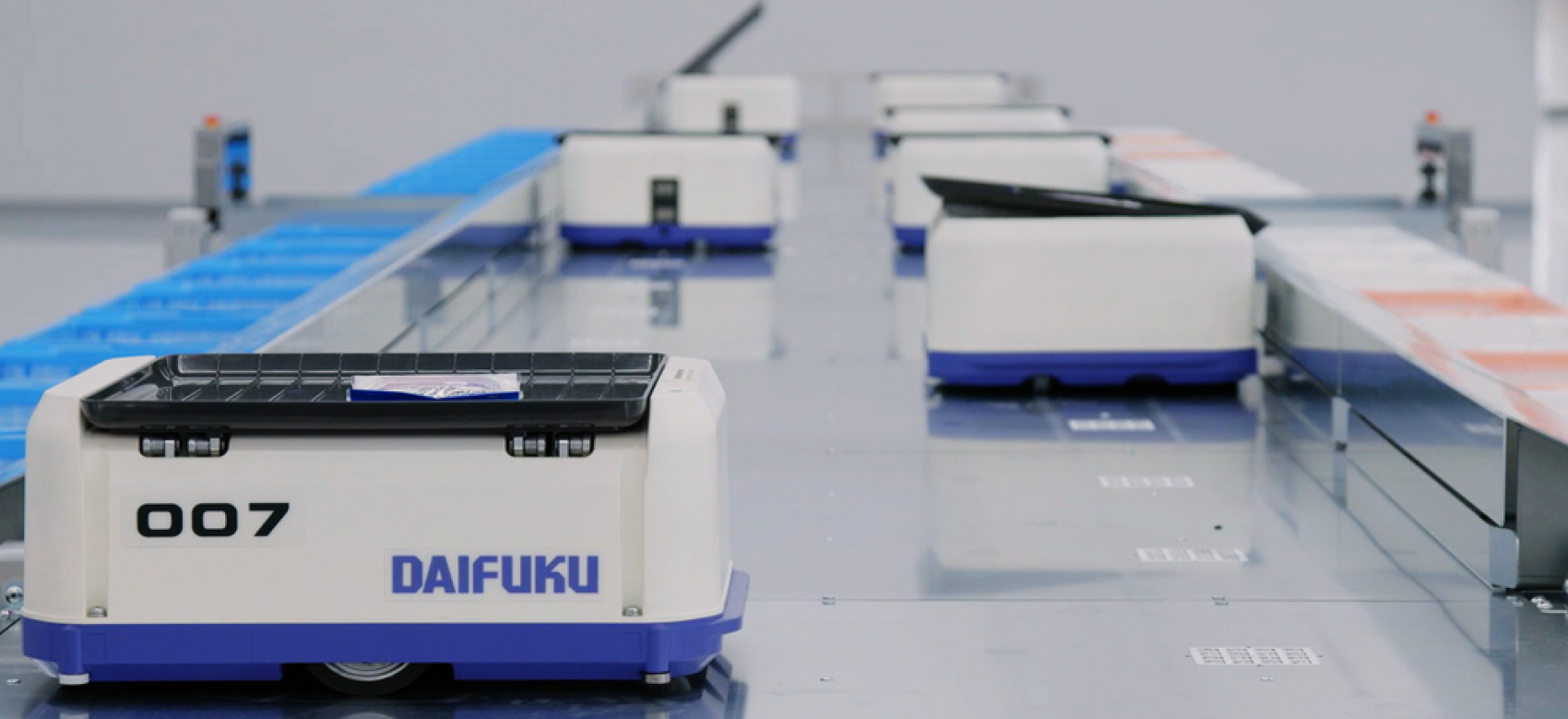
SOTR-S: The speed king in the general cargo range – Image: Daifuku
The SOTR-S is the most spectacular member of the family – a high-speed sorting robot for individual items, packages, and garments. The system travels at speeds of up to 180 meters per minute and is capable of sorting up to 10,000 items per hour – figures that are considered exceptional even by international standards. The technological basis for this performance is a two-level system design that ensures a smooth flow of traffic and prevents congestion. While one level serves as the main lane, the second level allows for the continuous circulation of vehicles without any conflicts.
A key design feature is the tilting trays, which allow for a narrow aisle layout. This means the SOTR-S requires less than half the floor space of conventional sorting systems. For warehouse operators under constant pressure to utilize space, this advantage is invaluable: warehouse rents in metropolitan areas have risen considerably in recent years, and every square meter saved directly improves profitability. The SOTR-S vehicles deliver goods directly to employees, resulting in ergonomic improvements and simultaneously reducing the number of operators required. The integrated barcode scanner at the induction loop ensures that each item is correctly identified and assigned to the appropriate chute.
Depending on requirements, various discharge components are available for sorting: plate chutes for robust goods such as clothing, and belt chutes where goods are transported in bags and transferred by employees into collection containers. This versatility makes the SOTR-S particularly attractive for multichannel retailers who have to manage a heterogeneous product range on a daily basis.
SOTR-M: The flexible conveyor belt replacement
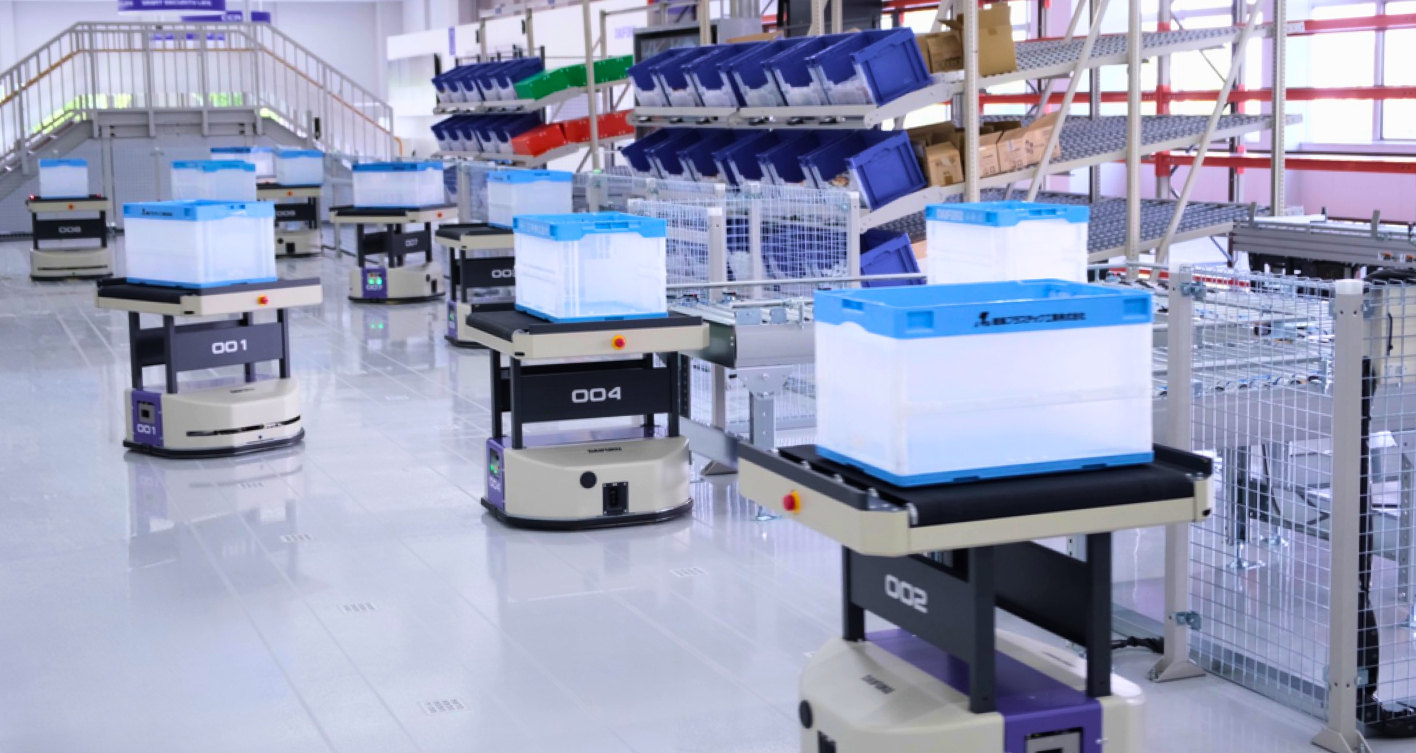
SOTR-M: The flexible conveyor belt replacement – Image: Daifuku
The SOTR-M addresses a different, but no less strategically important problem: it aims to replace the ubiquitous conveyor belts in warehouses. For decades, conveyor belts were the standard for moving boxes and containers through distribution centers – reliable, but inflexible. Anyone needing a different layout had to accept considerable conversion costs. Anyone wanting to increase capacity had to lay new routes. The SOTR-M fundamentally breaks with this logic.
The system replaces fixed conveyor lines with autonomous mobile robots that can handle transport and crate loads of up to 30 kilograms and perform transport tasks along optimized routes between picking and packing stations. Capacity scaling is achieved not through infrastructure investments, but simply by adding more robots. A warehouse layout can be adapted without structural modifications if product volumes or processes change. The application of just-in-time line supply is particularly interesting: Integrated with automated storage systems, the SOTR-M robots can deliver parts directly to production lines on demand – a function that goes far beyond traditional warehousing and extends into manufacturing logistics.
Reliability is also a key advantage: If a single robot fails, the remaining units take over its tasks without interrupting the system. With conventional conveyor systems, a single defect can paralyze the entire line – a risk that has enormous economic consequences in high-throughput operations. The SOTR-M was presented in a full live demonstration at LogiMAT 2026, underscoring the system's maturity.
SOTR-L: Pallet automation without the need for conveyor lines
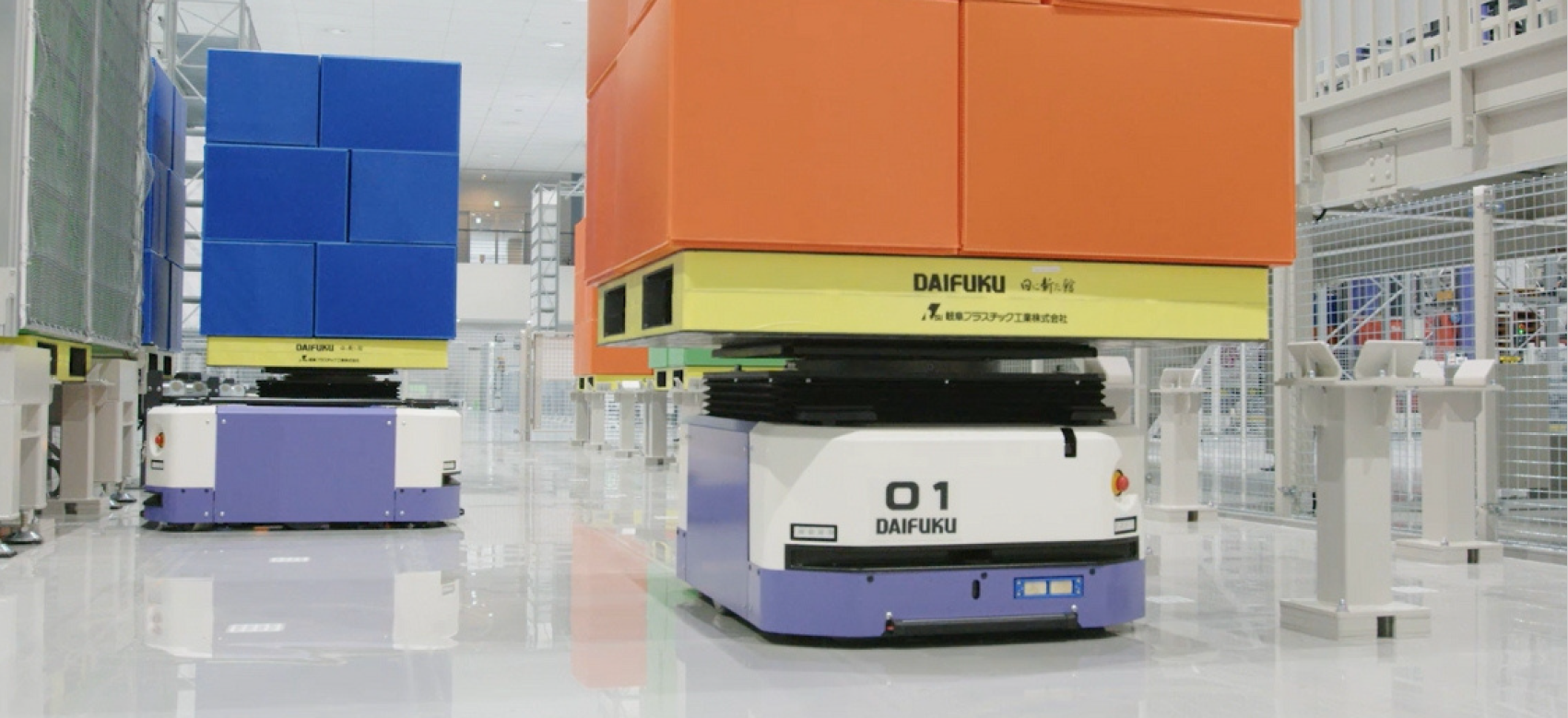
SOTR-L: Pallet automation without the need for conveyor lines – Image: Daifuku
While the SOTR-S and SOTR-M primarily operate in general cargo and container logistics, the SOTR-L intervenes one level deeper in the material flow: It is designed for the transport and sorting of entire pallets, thus bridging the gap between pallet storage and shipping or production processes. With a maximum payload of 1,000 kilograms and a pallet capacity of 1,350 x 1,350 millimeters, the SOTR-L handles the standard pallet format of the Asia-Pacific markets. In pedestrian areas, the system travels at speeds of up to 72 meters per minute; in pedestrian zones, it accelerates to 120 meters per minute under load and up to 160 meters per minute without a load.
The key advantage of this system lies in its independence from permanently installed conveyor lines. Conventional pallet conveyor systems require significant structural modifications and can hardly be reconfigured without production downtime. In contrast, the SOTR-L can be easily reprogrammed for new routes when requirements change. The system integrates seamlessly with Daifuku's Unit Load AS/RS high-bay racking systems, which efficiently store and retrieve palletized goods. Furthermore, SOTR-L units can transport pallets to picking robots, which in turn automate palletizing, sorting, and shipping – an end-to-end automation chain that minimizes human intervention.
The market that Daifuku encounters
The decision to launch the SOTR series in Europe now must be understood against the backdrop of a market situation that is almost textbook-perfect for automation investments. Several structural forces are converging to form an economic imperative.
The AMR market: Uninterrupted growth momentum
The global market for autonomous mobile robots (AMRs) surpassed the $3.1 billion mark in 2025 and is projected to reach $3.4 billion in 2026. It is expected to hit the $7 billion mark by 2031 and grow to $17 billion by 2035 – an average annual growth rate of 19.5 percent. These forecasts vary considerably depending on the market research firm and definition methodology, but they all point in the same direction: robust, double-digit growth over a period of at least a decade.
The European submarket amounted to US$816.2 million in 2025 and is growing, driven by demand from the automated logistics sector and the expansion of e-commerce and retail. Germany occupies a special position: The German market for autonomous mobile robots dominates the European market and shows strong growth potential. This makes Stuttgart particularly attractive not only as a trade fair location but also as a strategic market hub.
In parallel, the German intralogistics market as a whole is growing – it was valued at US$4.09 billion in 2023 and is projected to reach US$11.05 billion by 2033, with an average annual growth rate of 10.45 percent. The growth drivers are well-known: e-commerce expansion, increasing demands in the automotive and chemical sectors, and the widespread use of industrial robots.
E-commerce as a permanent growth engine
The German e-commerce market continues to grow steadily, even under challenging conditions. In 2025, the German E-Commerce and Distance Selling Association (bevh) reported growth of 3.2 percent, with gross revenue rising to €83.1 billion. For the first time since 2021, revenue increased in every single quarter. Online marketplaces, the strongest growth driver, alone increased their revenue by 4.9 percent to €46.2 billion. The association forecasts further growth for 2026.
This continuous growth trajectory has direct consequences for warehouse operators. More orders mean more sorting and fulfillment operations. Product variety increases with the product range, which in turn increases the complexity of sorting tasks. Return rates in online retail – ranging from 15 to 40 percent depending on the industry – add another dimension to the material flow that must be managed. Traditional manual processes are increasingly reaching their limits: they can deliver neither the speed nor the accuracy that modern fulfillment demands. Systems like the SOTR-S, with its capacity of 10,000 items per hour, fill precisely this gap.
Skills shortage and personnel costs: The structural drive for automation
The most compelling argument for warehouse automation is structural in nature and is not significantly weakened by economic fluctuations. According to the ifo Institute, in February 2026, 22.7 percent of German companies reported a shortage of skilled workers – a decrease compared to 25.8 percent in October 2025, but still a historically high figure. Particularly noteworthy: In the transport and logistics sector, while the proportion of companies with staff shortages fell from 42.7 to 30.6 percent, it remains well above the industry average.
The DIHK Skilled Workers Report 2025/2026 shows that more than one in three companies are unable to fill at least some of their open positions due to a lack of suitable personnel. The most frequently anticipated consequences of this labor shortage are rising labor costs for 63 percent of affected companies, increased workload for employees for 55 percent, and limitations in the range of services offered for 36 percent. At the same time, wages for warehouse workers are rising by 5 to 6 percent annually – an increase that directly improves the cost-benefit analysis for automation investments.
A 2024 study by TMG Consultants illustrates the extent of the need to catch up in automation: 63 percent of the more than 2,500 industrial companies surveyed have not automated their intralogistics at all or only to a limited extent. Only 4 percent have reached the highest level of autonomous intralogistics. At the same time, 94 percent of the companies that have already invested in automation solutions report positive results. This discrepancy between the perceived benefits and the actual level of automation reveals a huge, largely untapped market potential – precisely the target market that Daifuku is targeting with its SOTR series.

Expert partner in warehouse planning and construction
Your warehouse grows with you: Why scalability is the new currency of logistics
Cost pressure as a strategic accelerator
The BVL Trends and Strategies Study 2025 identifies cost pressure as one of the most significantly increased issues in logistics and supply chain management – climbing considerably from a clearly secondary topic to third place on the priority list, flanked by automation (fourth place, up five places). While digitalization and cybersecurity top the ranking, the operational cost structure is increasingly perceived as an existential challenge.
FedEx analysis confirms that inflation, rising wage demands, and a shortage of skilled workers will continue to impact logistics and warehousing costs, forcing companies to adopt more flexible models that combine cost control with business continuity. For warehouse operators working with tight margins, this pressure is not an abstract threat, but a daily operational reality.
The economic calculation: What automation really costs and brings
The decision for or against a system like the SOTR-S is essentially a return on investment calculation. The basic formula is simple: investment costs must be offset by value saved or generated over an acceptable period.
Modern automation solutions typically pay for themselves within 1.5 to 4 years, with ROI values exceeding 40 percent being possible. A general guideline for sound automation projects is a payback period of 2 to 5 years. These figures are plausible for systems like the SOTR family because the potential savings are clearly identifiable: reduced personnel requirements with the same or higher throughput, lower sorting error rates, optimized space utilization, reduced risk of injury, and consequently, lower insurance costs.
The Total Cost of Ownership (TCO) perspective deserves particular attention. Intralogistics analysts emphasize that in an international survey, 86 percent of companies cited system reliability and the TCO, including maintenance costs, as very important for automation decisions. Acquisition costs are therefore only one starting point in the calculation. Maintenance costs, energy consumption, software updates, and lifecycle measures can amount to considerable sums over the years and significantly impact the TCO. Modular systems like the SOTR family have an inherent advantage here: Individual vehicles can be replaced without taking the entire system out of service. Scalability through the simple addition of further units—instead of costly infrastructure expansions—significantly improves investment planning.
Another economically significant aspect is the rapid installation speed. Conventional sorting systems with permanently installed conveyor belts not only require considerable construction time but also cause lost revenue during the conversion phase. SOTR systems promise significantly faster commissioning, which improves the break-even point.
A growing trend in the industry, directly linked to this calculation, is the offering of automation technology as a rental or leasing model. At LogiMAT 2026, the transition to cloud-based software models and the provision of hardware as a service will be a prominent trend, making it easier for small and medium-sized enterprises (SMEs) in particular to get started with automation.
Competitive landscape: Daifuku in a heterogeneous field
Daifuku is entering an already crowded European market. Competition ranges from global corporations and specialized AMR providers to regional system integrators.
Geek+, a Chinese provider of mobile robots, has been ranked the global market leader for order fulfillment robots by Interact Analysis, with a market share more than double that of the second and third-placed companies. Geek+ also won the IFOY Award 2025 in the Integrated Customer Solution category – a mark of quality that carries significant weight in the European market. AutoStore from Norway dominates the high-density storage sector with its cube storage concept. Dematic, part of the KION Group, offers end-to-end logistics automation with a deep European network. Körber Supply Chain is also a highly relevant player in the German market.
Daifuku's positioning differs from these competitors in one key aspect: The company offers a complete portfolio, from automated storage and warehousing to sorting and shipping preparation, all under one roof. While Geek+ and similar providers primarily focus on flexible AMR fleets, Daifuku provides the system depth of an integrated material flow planner. The SOTR-L, for example, is explicitly designed for seamless integration with Daifuku's own Unit Load AS/RS high-bay warehouse – a cross-selling dynamic that increases customer value and reduces switching costs.
Daifuku's historical weakness in Europe – its smaller market presence compared to local providers – remains a real challenge. Trust and service networks in the intralogistics sector have been built up over decades, and new providers must invest heavily in this area. The gradual market launch via the UK and now in continental Europe suggests a deliberate, reference-project-based go-to-market strategy that reflects Daifuku's corporate culture.
LogiMAT 2026 as a seismograph of the industry
LogiMAT has consolidated its position as the most important European intralogistics event. With over 1,600 exhibitors from more than 40 countries and over 120,000 square meters of exhibition space, it is fully booked for 2026, marking a new peak in industry attention, both in terms of quantity and scale.
The thematic focus of LogiMAT 2026 precisely reflects the forces that economically justify the introduction of SOTR (System on the Run). Automation, digitalization, and sustainability are the defining megatrends, accompanied by the ever-present issue of skilled labor shortages. AI integration, robotics, modular scalability, and rental/leasing models for hardware are key topics. Michael Ruchty, director of Euroexpo, describes the trade fair as an indispensable event for companies that want to evaluate innovations early on.
Artificial intelligence is transforming not only robot control but the entire operation of modern warehouses. Intelligent warehouse management systems analyze order entries, inventory levels, and material flows in real time to dynamically optimize performance. Autonomous transport vehicles navigate dynamic warehouse environments using mapping and obstacle detection. Shuttle systems and robotic grippers are increasingly being integrated into coordinated fleets. Daifuku's SOTR systems address these trends: They integrate with higher-level warehouse management systems and can be controlled as a smart fleet.
Scalability as a key investment argument
A key feature that distinguishes the SOTR family both technically and economically is its virtually unlimited scalability. With conventional systems, growth means redesign planning, building permits, production stoppages, and long lead times. With the SOTR series, increasing capacity is simply a matter of fleet management: additional vehicles are ordered, calibrated, and integrated into the existing infrastructure.
Daifuku's automation philosophy for 2026 reflects a broader paradigm shift: away from large-scale, capital-intensive, one-off installations, towards modular growth, hybrid systems, and the integration of AI into ROI-driven automation strategies. This allows companies to start with a manageable pilot project, validate its economic viability, and only then scale up. This entry-level model significantly lowers the investment barrier and aligns with the decision-making logic of medium-sized businesses that don't have the budgets of large corporations but still need to remain competitive.
Redundancy is another argument that is often underestimated in practice. In a system consisting of ten vehicles, the capacity drops by only ten percent if a single robot fails – not to zero. With a conventional conveyor belt, however, a single component defect can paralyze the entire sorting system. For operators who require 24/7 availability of their systems, this difference is of considerable economic importance.
Industry relevance: Who benefits and why
Daifuku positions the SOTR family primarily for three market segments, all of which are under massive pressure from the structural forces described.
E-commerce fulfillment is the most obvious use case. Online retailers have to pick, sort, and prepare thousands to hundreds of thousands of orders for shipment every day – under the pressure of tight delivery windows, high accuracy requirements, and strong seasonal fluctuations. The growth of German e-commerce to €83.1 billion in 2025 and the continued positive forecast for 2026 make this segment particularly attractive.
Brick-and-mortar retailers with large distribution centers face similar challenges: increasing product range depth, omnichannel demands, and the expectation of timely replenishment deliveries to their stores. The SOTR-S capacity of 10,000 items per hour addresses precisely these volume requirements.
Courier, express, and parcel (CEP) service providers form the third core segment. In an industry characterized by strict next-day delivery promises and growing parcel volumes, sorting throughput is a direct competitive factor. System failures mean delays, customer complaints, and contractual penalties. The redundancy and high speed of the SOTR platform address a key pain point here.
Strategic classification: Japanese quality intelligence meets European pragmatism
The introduction of the SOTR series at LogiMAT 2026 is no coincidence, but the result of a well-thought-out market analysis. Japan has a unique tradition in intralogistics automation: a high-precision manufacturing culture, decades of experience with labor shortages – Japan was familiar with the demographic pressure for automation long before it reached Europe – and a systematic approach to product development that treats reliability and maintainability as design goals on an equal footing with pure performance.
These qualities resonate with a European market undergoing structural change. Companies are not seeking technology for its own sake, but rather proven, scalable, and service-oriented solutions that deliver demonstrable returns on investment. Daifuku's strengths – comprehensive systems expertise, years of testing the SOTR platform in its Japanese home market, and the necessary financial resources for long-term market penetration – are precisely the qualities that European logistics decision-makers are looking for.
Success will ultimately be measured by whether trade fair contacts translate into real pilot projects and whether these pilots deliver the promised efficiency indicators in practice. The industry data is clear: the market is ready, the economic environment is favorable, and the technological maturity of the SOTR platform gives no cause for hesitation. Daifuku has chosen the right stage with LogiMAT – whether this approach will convince the European market in the long term remains to be seen.

Xpert.Plus Warehouse Optimization - High-bay warehouses and pallet warehouses: Consulting and planning
Your global marketing and business development partner
☑️ Our business language is English or German
☑️ NEW: Correspondence in your native language!

Konrad Wolfenstein
I and my team are happy to be available to you as your personal advisor.
You can contact me by filling out the contact form here or simply call me at +49 7348 4088 965. My email address is: [email protected]
I'm looking forward to our joint project.
☑️ SME support in strategy, consulting, planning and implementation
☑️ Creation or realignment of the digital strategy and digitization
☑️ Expansion and optimization of international sales processes
☑️ Global & Digital B2B trading platforms
☑️ Pioneer Business Development / Marketing / PR / Trade Fairs
Our global industry and economic expertise in business development, sales and marketing

Our global industry and economic expertise in business development, sales and marketing - Image: Xpert.Digital
Industry focus areas: B2B, digitalization (from AI to XR), mechanical engineering, logistics, renewable energies and industry
More information here:
A thematic hub offering insights and expertise:
- Knowledge platform covering global and regional economies, innovation and industry-specific trends
- A collection of analyses, insights, and background information from our key areas of focus
- A place for expertise and information on current developments in business and technology
- A hub for companies seeking information on markets, digitalization, and industry innovations










