
Automated boat storage | 600% more space on the water: How an ingenious system is transforming our marinas
Xpert Pre-Release

Available in 27 languages 📢
Prefer Xpert.Digital on GoogleⓘPublished on: March 20, 2026 / Updated on: March 20, 2026 – Author: Konrad Wolfenstein
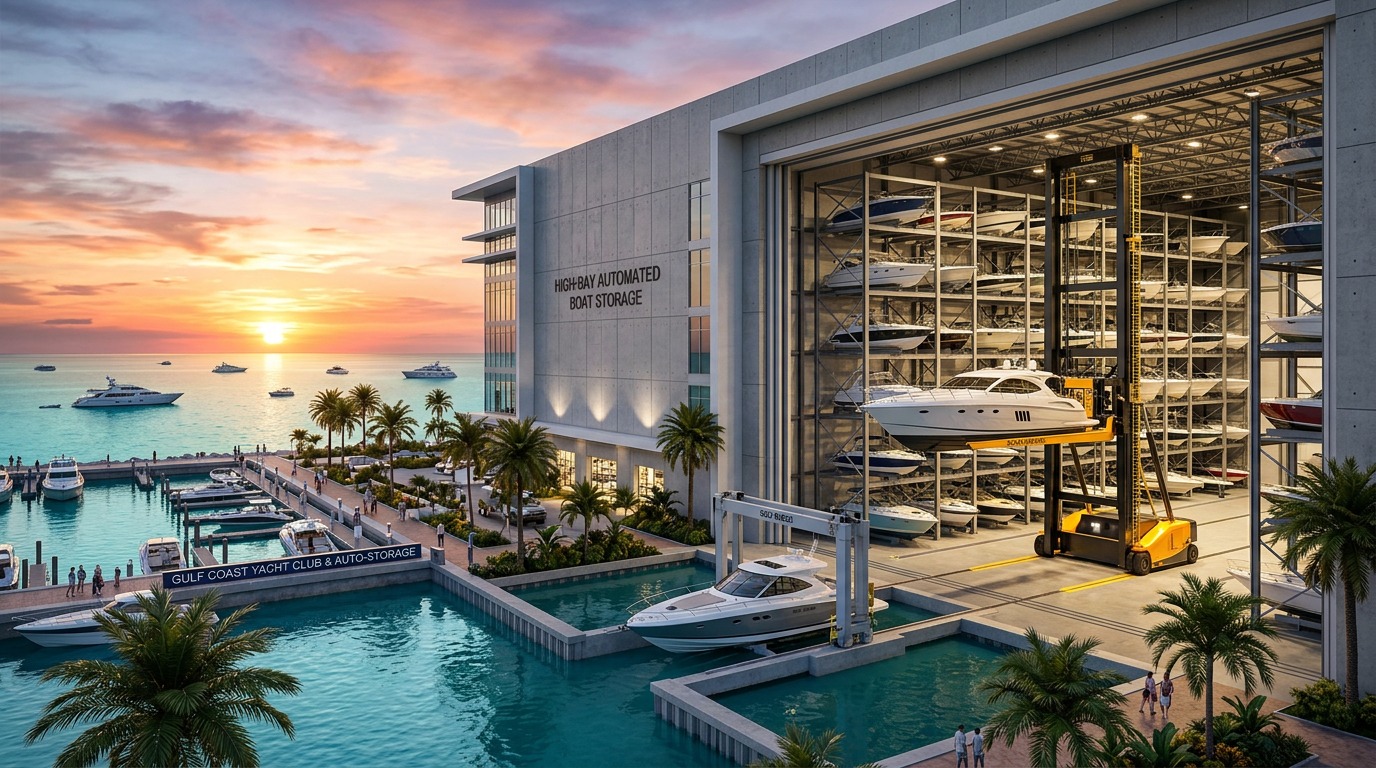
Automated boat storage | 600% more space on the water: How an ingenious system is transforming our marinas – Creative image: Xpert.Digital
The hurricane test: Why this fully automated boat storage facility withstood a Category 5 storm
Launching your boat via app? The fully automated boat storage of the future is already a reality
Space shortage on the coast: Why the classic boat storage facility is finally obsolete
Anyone looking for a berth for their boat in the sought-after coastal resorts of Europe, America, or Australia today needs one thing above all: a great deal of patience. The global market for recreational boats is booming, but space along the shorelines is strictly limited and fiercely contested. When marinas are bursting at the seams, waiting lists can stretch to a decade, and traditional dry storage facilities reach their capacity limits, fundamentally new concepts are needed. This is precisely where a technological revolution comes in, one that originated far from the water, in industrial intralogistics: the fully automated high-bay warehouse for boats. What at first glance appears to be a gigantic logistics center turns out to be an ingenious answer to a pressing global space problem. With capacity increases of an incredible 600 percent on the same footprint, app-controlled outsourcing processes in record time, and a massive concrete construction that can withstand even catastrophic hurricanes, companies like the Austrian firm LTW Intralogistics are completely redefining the marina market. The following article explores why this paradigm shift is far more than just a technological gimmick – and how it is sustainably changing land use, customer service, and the resilience of entire coastal regions.
A global spatial problem with a local face
Anyone looking for a boat slip in a popular coastal town during the summer often knows the answer even before inquiring: waiting list, no vacancies, come back in two to three years. This situation is not limited to the coastal regions of Florida or Australia, but is increasingly common in European port cities as well. What appears on the surface to be a local space problem is, at its core, a structural economic challenge arising at the intersection of urban land pressure, growing prosperity, and technological change.
The basic assumption of traditional boat storage – boats are stored horizontally on trestles, in simple warehouse racks, or directly at the dock – is reaching its natural limits in an environment of growing demand and a stagnant or even shrinking supply of shoreline and storage space. The answer to this bottleneck is an approach originating from industrial intralogistics that is now transforming the boating sector: the fully automated high-bay warehouse for boats.
The Austrian company LTW Intralogistics from Wolfurt, with its Gulf Star Marina project in Fort Myers Beach, Florida, became the first provider worldwide to implement such a fully automated high-bay warehouse for boat storage, setting a benchmark that extends far beyond this individual case. The implications of this paradigm shift are as significant economically as they are technically: They touch upon issues of space efficiency, capital commitment, insurance logic, customer service, and the market positioning of marinas in a dynamically growing global recreational boating market.
The underlying market: Everyone buys boats, but there's nowhere to park them
Global growth in the recreational boating market without corresponding infrastructure
The global recreational boating market is experiencing significant growth. Market size was estimated at US$46.6 billion in 2024 and is projected to expand further through 2034 at an average annual growth rate of 7.3 percent. Other analyses estimate the global boating market at US$36.31 billion in 2025 and forecast a value of US$72.71 billion by 2034, with an annual growth rate of 8.2 percent. North America dominates this market with a share of nearly 51 percent in 2025.
This growth is driven by several factors: rising disposable incomes among the global middle and upper classes, a surge in demand for outdoor leisure activities following the COVID-19 pandemic, and a booming coastal and marine tourism sector. The increase is particularly significant in the segment of larger motorboats and yachts, which not only command greater prestige but also require considerably more space and infrastructure.
The problem: The number of moorings is not growing at the same rate as demand. Prime waterfront areas in metropolitan regions are scarce, expensive, and increasingly contested by competing interests such as housing, tourism, and nature conservation. In regions like Sydney Harbour, waiting lists for a boat mooring can stretch to a decade – and moorings there are already being traded at prices between 500,000 and 1.5 million Australian dollars. Similar patterns are emerging in Europe, although not yet with this extreme price dynamic.
The specific bottleneck in Florida
Lee County, the county surrounding Fort Myers Beach in southwest Florida, had approximately 38,000 registered boat owners at the time the project began. At the same time, the region's marinas had long since reached their capacity limits—especially for boats exceeding a certain size and height, which cannot be adequately accommodated in conventional dry storage facilities or at docks. Gulf Star Marina, the pioneering project at the Matanzas Pass Bridge in Fort Myers Beach, faced precisely this challenge: The existing facility, with single-deep storage, had space for just 44 boats.
The market for dry storage solutions – so-called dry stack systems – is itself an independent and rapidly growing economic sector. Globally, the market segment was estimated at US$1.25 billion in 2024, with a projected annual growth rate of 12.2 percent until 2030. A parallel market research firm estimates the market volume for 2024 at nearly US$2 billion and expects growth to US$3.5 billion by 2035. In Germany alone, which is the leading market in Europe, the segment grew from US$60.4 million (2024) to a projected US$121.6 million by 2030 – an annual growth rate of 12.5 percent.
The concept of an automated high-bay warehouse for boats
From industrial logistics to the marina: Technology transfer with a major impact
High-bay warehouses in silo construction have been a proven technology in industrial intralogistics for decades. LTW Intralogistics, a specialist for fully automated high-bay warehouses based in Wolfurt, Austria (Vorarlberg), has adapted this concept to the specific requirements of boat storage – overcoming significant technical and structural challenges in the process.
The principle is borrowed from the warehousing concept of fully automated warehouses: A storage and retrieval machine (SRM) travels in a racking aisle, storing and retrieving goods – in this case, boats – from multiple staggered storage locations. What seems straightforward with pallets becomes a precision engineering challenge when dealing with watercraft weighing up to 7,000 kilograms and possessing considerable space. For the Gulf Star project in Fort Myers Beach, LTW deployed an aisle-bound SRM of type LTW 7019-QSHU-2/A, which operates at a travel speed of 80 meters per minute and a lifting speed of 20 meters per minute.
The high-bay warehouse itself is built in a silo style, measures 54 x 46 x 19 meters, and offers space for approximately 300 boat storage spaces with multi-deep storage. For comparison, the previous, conventionally operated facility offered only 44 boat spaces on the same site. The system is complemented by two transfer cars (type LTW VW-70 QSHU-2/A) that handle transport within the facility. The throughput is six storage or retrieval cycles per hour per stacker crane – sufficient to easily manage the operational flow of a fully utilized marina in shift work.
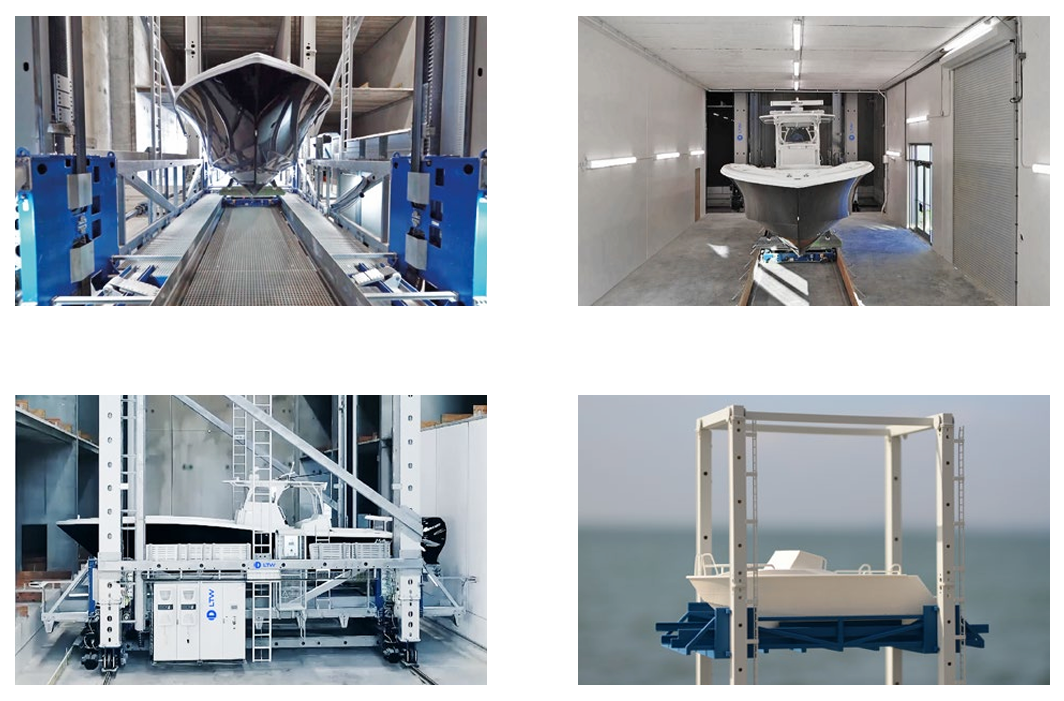
The concept of an automated high-bay warehouse for boats – Image: LTW Intralogistics GmbH
More information here:
Space efficiency as the economic core
The key economic advantage of automated high-bay warehouses lies in their superior space utilization. Compared to manual systems, automated storage systems can save up to 80 to 85 percent of floor space. In the context of boat storage, this means that on the same plot of land that conventionally housed 44 boats, the fully automated high-bay warehouse now offers space for approximately 300 boats. This corresponds to a capacity increase of almost 600 percent on the same footprint.
This space efficiency has far-reaching economic consequences. Waterfront properties are among the most valuable and expensive real estate, especially in popular coastal locations. Every square meter must be used to its maximum potential. Automated high-bay warehouses make precisely this possible: they utilize the third dimension – height – as an economic production factor. In the USA, for example, these automated systems will also allow for 40 to 50 percent more boats and larger vehicles than conventional racking systems.
Speed and customer experience as a differentiating factor
Besides space efficiency, service speed is a key quality criterion. The LTW system delivers a relocated, ready-to-launch boat in less than ten minutes. This far surpasses conventional forklift-based dry storage facilities, which often require 20 to 30 minutes even under optimal conditions – provided no relocation work is necessary. In the previous Gulf Star facility, boats had to be laboriously repositioned, depending on the desired vessel.
The digital customer interface completes the service offering: With the BoatCloud app, boat owners can reserve their vessel in advance and specify their desired relocation time. The system then automatically optimizes the storage position of the boats, ensuring that the vessels needed the next day are already optimally positioned for easy access – even if this relocation takes place at night, which is easily possible thanks to the quiet electric drive. Upon arrival at the harbor, the customer finds their boat already prepared and ready for use. This experience elevates the service far beyond what traditional marinas can offer.
Resilience as a business model: The hurricane test
Designed for extreme conditions
The automated high-bay warehouse in Fort Myers Beach is constructed of solid concrete and built to meet stringent storm-resistant building standards. The structure is designed to withstand wind speeds exceeding 300 kilometers per hour – a figure that significantly surpasses the requirements of the highest hurricane category. Additionally, the design incorporates a foam fire suppression system for maximum fire safety.
This interpretation is not a luxury, but an economic necessity in the Florida context. The Gulf Coast of the "Sunshine State" is one of the most hurricane-prone regions in North America. For marina owners and boat owners, losses due to storm damage are a constant and calculable threat to their capital.
Hurricane Ian: Proof in practice
In September 2022, Hurricane Ian, a Category 5 storm with wind speeds of up to 260 kilometers per hour, struck the coast of Fort Myers Beach. The devastation caused by Ian was of historic proportions: the storm flooded entire neighborhoods, ripped houses from their foundations, and caused damage that then-Governor Ron DeSantis described as the worst in Florida's history.
Conventional boat storage facilities in the region suffered total losses of more than 120 boats. The LTW high-bay warehouse, however, remained undamaged. Not a single boat stored there was damaged. Gulf Star Marina was able to resume operations within a few weeks after minor repairs – while other facilities remained out of service for months or were completely destroyed.
The economic impact of this resilience is multifaceted. First, there are no direct claims for damages and no capital loss for boat owners. Second, there is a rapid resumption of revenue-generating operations. Third—and this is particularly noteworthy—insurance premiums for boats stored in the LTW high-bay warehouse have been subsequently reduced. Insurers are thus rewarding the proven protective function of the facility with cash. This provides both the marina owner and their customers with a concrete, recurring annual financial benefit.
Quantitative damage analysis
The financial difference between a loss in a traditional boat storage facility and an incident involving a high-bay warehouse can be quantified with an example. With an average market price of €50,000 per recreational boat, 120 lost boats – as happened in a neighboring traditional storage facility after Hurricane Ian – represent total damages of approximately six million euros. This figure does not include business interruption, reputational damage, legal costs, or reconstruction expenses. A fully automated high-bay warehouse, which experiences zero losses in a comparable extreme event, recoups its higher purchase price compared to a conventional facility many times over with a single storm.
LTW Intralogistics Solutions

LTW Intralogistics – Engineers of Flow - Image: LTW Intralogistics GmbH
LTW offers its customers not individual components, but integrated complete solutions. Consulting, planning, mechanical and electrotechnical components, control and automation technology, as well as software and service – everything is networked and precisely coordinated.
In-house production of key components is particularly advantageous. This allows for optimal control of quality, supply chains, and interfaces.
LTW stands for reliability, transparency, and collaborative partnership. Loyalty and honesty are firmly anchored in the company's philosophy – a handshake still means something here.
Related to this:
The invisible revolution that secures the value of your yacht for years to come
Operations and Sustainability: The Economics of Daily Operations
Moving away from diesel-powered forklifts
Traditional dry storage in marinas relies almost exclusively on diesel-powered forklifts to transport boats between storage berths and the water. This model is not only noisy and polluting, but also maintenance-intensive. Every boat moved out of storage typically exhibits corrosion damage from saltwater and rust after prolonged use, which must first be removed. The forklift itself is susceptible to corrosion from salty sea air, shortening maintenance and repair intervals and increasing life-cycle costs.
In contrast, LTW's fully automated system relies on electric motors and is specially equipped for use in saltwater environments. LTW explicitly identified special measures for corrosion protection of the mechanical and electrical components as one of the key challenges, addressing this through appropriate additional equipment. The system operates almost silently – a crucial factor in coastal areas with high tourist and residential activity, where noise pollution can quickly lead to conflicts with neighbors.
Personnel structures and operating costs
Conventional boat storage requires experienced forklift operators, complex shift schedules, personnel costs for weekend and holiday operations, and coordinators for manual storage management. Automated systems dramatically reduce personnel requirements: a monitoring operation and maintenance team is sufficient to maintain 24/7 operation. Compared to manual systems, which are by definition labor- and space-intensive, automated high-bay warehouses offer faster processes, lower error rates, and permanently reduced operating costs.
Furthermore, the system offers the possibility of full night operation: LTW is so quiet that it can relocate and pre-sort boats at night without disturbing the surroundings. This means that the efficiency of the next day's operations begins the night before – a structural advantage over manually operated systems that are strictly bound to working hours.
Maintenance economics of the stored boats
Not only do the marina's operating costs benefit from the automated storage system, but the owners of the stored boats also gain economic advantages. Within a closed concrete structure, boats are protected from UV radiation, saltwater exposure, hail, wind, and weathering. Boats that are permanently submerged or stored on open shelves accumulate algae, barnacles, osmosis, and corrosion significantly faster than those stored in dry conditions. A high-bay warehouse constructed of concrete combines the advantages of dry storage with those of a protective building: the boat ages more slowly, maintenance costs are reduced, and its resale value is maintained for a longer period.
The typical rule of thumb for boat maintenance states that a boat owner spends around ten percent of the purchase price annually on operation and upkeep. Lower maintenance costs due to improved storage conditions can significantly reduce this figure – a strong argument that, from a buyer's perspective, directly favors automated high-bay warehouses.
The marina investor's calculations: Return on investment and market positioning
Capacity as a direct source of revenue
From a marina investor's perspective, the most important economic benefit of an automated high-bay warehouse is this: The number of units stored can be increased by up to 600 percent on the same footprint. Every additional storage space directly generates revenue. With average annual rental prices for commercial boat storage in well-developed US regions ranging from several thousand to over ten thousand US dollars, depending on boat size, the revenue curve differs dramatically between conventional and automated facilities.
A simplified example: 44 conventional courts at $6,000 annual rent each generate annual revenue of $264,000. In contrast, 300 courts at the same rate generate $1.8 million in annual revenue – on the exact same plot of land. Even though automated systems require higher initial investments, maintenance contracts, and technology costs, this significant difference often fully justifies the investment within just a few years.
Premium positioning and pricing power
Automated boat storage significantly enhances a marina's market position. Gulf Star Marina bills itself as the world's first smart marina and explicitly emphasizes the state-of-the-art nature of its indoor storage. The system offers premium features—lightning-fast retrieval, 24-hour app service, and a storm-protected concrete silo—that justify a price difference compared to conventional facilities. Customers who place great value on vessel protection, convenience, and speed are willing to pay considerably more for this level of service.
In the waterfront real estate market, which industry observers say is in a high-growth cycle and establishing marina projects as a distinct asset class, fully automated boat storage facilities are increasingly becoming a differentiating factor, significantly increasing the value of entire development projects. The Whitecap NPI project in Corpus Christi—an $800 million master-planned luxury development on North Padre Island, Texas—explicitly integrates an LTW high-bay warehouse for over 300 boats as a premium component of its marina district concept, which also includes a yacht club, restaurants, pools, and a natural oasis. Here, the boat storage facility functions not merely as infrastructure, but as a true lifestyle statement.
Technological context: The automated boat storage system as part of a larger megatrend
AS/RS technology is on the global rise
The fully automated high-bay warehouse for boats is not a technological standalone innovation, but rather an expression of a global megatrend: the automation of warehousing and logistics processes. The global market for automated storage and retrieval systems (AS/RS) was estimated at US$9.58 billion in 2025 and is projected to grow to US$17.4 billion by 2034 – an annual growth rate of seven percent. North America dominates this market with a share of 39.2 percent.
In parallel, the broader market for warehouse automation is growing: The global market volume for warehouse automation was estimated at US$26.5 billion in 2024, with a projected growth rate of almost 20 percent annually until 2034. Drivers include the increasing shortage of skilled workers, rising labor costs, limited space, and the technological maturity of robotics, AI, and sensor technology. By 2035, the logistics automation market as a whole is expected to grow to almost US$400 billion.
For the boat storage sector, this means that the technology enabling the operation of automated marina facilities will not become more expensive, but rather progressively cheaper and more efficient. Innovations such as the Internet of Things (IoT) for condition monitoring, improved control software, and resource-saving drive concepts continuously optimize the cost-benefit ratio.
Software integration as a competitive factor
The BoatCloud app is a perfect example of how software-based services extend physical facility operations with a customer-centric service layer. Customers can submit storage and retrieval requests around the clock via the application; the marina uses the backend for resource planning and inventory management. This seamless digitalization of the entire customer journey, from booking and preparation to boat launch, is a core feature of modern, technology-driven service concepts. It creates valuable data points that can be used to further optimize operations and strengthens customer loyalty through tangible convenience.
DockMaster, a leading provider of marina management software, entered into a strategic partnership with Safe Harbor Marinas in March 2025 to integrate dry-stack scheduling functionalities as a standard feature in their portfolio. In February 2025, Marina Systems launched an OpenDry-Stack automation platform, addressing the industry with an open standard for automating dry-stack operations. These activities clearly signal that the software infrastructure for automated boat storage is maturing rapidly and significantly lowering the barrier to entry for marina operators.
Follow-up projects and scaling perspectives: The model is growing
Corpus Christi: High-bay warehouse as the centerpiece of a luxury resort project
LTW Intralogistics' most ambitious follow-up project to date in the boat storage sector is the high-bay warehouse for over 300 boats as part of the Whitecap NPI project on North Padre Island in Corpus Christi, Texas. The overall project, an $800 million luxury coastal development, includes over 600 residential units, a resort hotel, retail outlets, restaurants, parks, a yacht club, and a large nature preserve. The automated boat storage facility is an integral part of the marina district, which is designed as the vibrant heart of the entire project.
The scale of this second project – twice the size of the facility in Fort Myers Beach – impressively demonstrates that the concept should not be seen merely as a niche application for particularly challenging locations. Rather, it is a universally applicable solution to a growing problem: the lack of storage capacity coupled with increasing boat demand in desirable coastal locations.
Isles of Capri: The third project in Florida
A third project, another facility currently under construction on the Isles of Capri in Florida, will offer space for just over 220 boats. This project will also include a storage and retrieval system and a boat lift, and will utilize LTW's proprietary warehouse management software. The fact that a satisfied operator like Todd Carroll of Gulf Star Marina is already planning the next facilities immediately after the completion of the first project is far more than a simple customer testimonial – it is tangible proof of the concept's economic viability in the demanding realities of everyday operations.
International scalability
The technology behind the LTW boat storage system is, in principle, completely location-independent and scalable. Wherever the following criteria apply – high boat density, limited waterfront, premium tourist environment, and significant natural hazard potential – the fully automated high-bay warehouse provides a far superior solution compared to conventional alternatives. This applies not only to Florida or the Texas Gulf Coast, but also to large parts of the Mediterranean coast, the coasts of Southeast Asia and Australia, as well as selected locations in Northern and Western Europe with heavily frequented recreational boating areas.
Overall economic analysis: Why high-bay warehouses are the future of boat storage
Multidimensional value creation
What transforms automated boat storage from a technological gimmick into an economic imperative is its multidimensional value creation: it solves not just one problem, but several simultaneously. First, it addresses the space constraint through vertical storage with up to 600 percent capacity increase. Second, it protects boat owners' invested capital with storm and weather protection at a level that conventional facilities simply cannot achieve. Third, it significantly improves the customer experience through consistent digitalization and short waiting times. Fourth, it reduces ongoing operating costs through automation and the elimination of expensive, corrosion-prone diesel forklifts. Fifth, it positions the marina operator as a premium provider in an increasingly competitive market.
Megatrend convergence as a catalyst
Automated boat storage benefits greatly from the simultaneous convergence of several global megatrends: the growth of the recreational boating market, the structural shortage of waterfront space in attractive regions, the increasing availability and decreasing costs of automation technology, the growth of waterfront properties as an exclusive luxury asset class, and the general pressure for digitalization in the service sector. When four or five independent megatrends point in exactly the same direction, a concept experiences massive structural tailwinds – and this is precisely the case with automated boat storage.
A paradigm shift with economic substance
The fully automated boat high-bay warehouse exemplifies a much broader movement: the intelligent transfer of industrial logic solutions to leisure infrastructure and the associated professionalization of a sector that was long dominated almost exclusively by artisanal business models. What LTW Intralogistics first implemented in Fort Myers Beach in 2017 is no longer a pilot project, but a proven, replicated concept with demonstrated resilience even under the most extreme conditions.
The market confirms the innovative concept. With a global dry-stack market projected to grow at double-digit rates until 2030, a continuously increasing global demand for recreational boats, and an AS/RS technology market that is delivering increasingly powerful and cost-efficient components, the structural conditions for automated boat storage are simply ideal.
For investors, marina developers, and coastal regions increasingly grappling with the challenge of managing the immense pressure on scarce waterfronts, high-bay storage for boats offers not an abstract theory, but a concrete, proven, and economically compelling solution. The devastating Hurricane Ian vividly demonstrated this: in a world where extreme weather events are becoming more frequent and intense, automated concrete bunker storage is not merely a luxurious convenience enhancement—it is an essential survival advantage for boat owners, marina operators, and the entire regional coastal economy.
Consulting - Planning - Implementation

Konrad Wolfenstein
I would be happy to serve as your personal advisor.
contact me at wolfenstein ∂ xpert.digital
Just call me on +49 7348 4088 965 (Munich) .
Your intralogistics experts
Consulting, planning and implementation of complete solutions for high-bay warehouses and automated storage systems - Image: Xpert.Digital
More information here:










