Cybercabs from 2029: Tesla invests three billion euros in Grünheide – but the robotaxi bet is risky
Xpert Pre-Release

Available in 27 languages 📢
Prefer Xpert.Digital on GoogleⓘPublished on: November 16, 2026 / Updated on: November 16, 2026 – Author: Konrad Wolfenstein
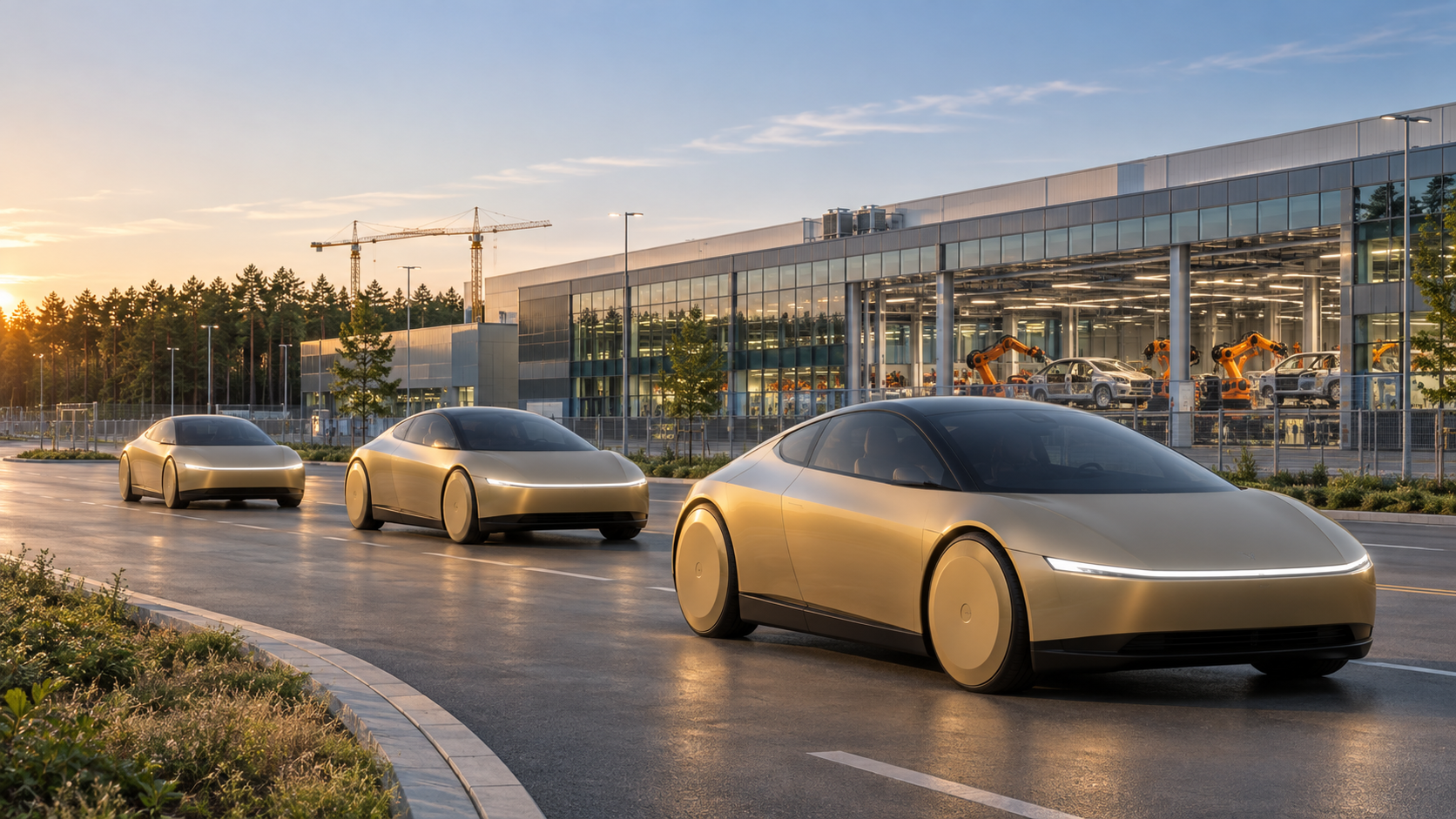
Cybercabs from 2029: Tesla invests three billion euros in Grünheide – but the robotaxi bet is risky – creative image on the topic, with AI: Xpert.Digital
One million robotaxis from Brandenburg? Tesla's ambitious plan fact-checked
Robotaxis instead of just electric cars: How Tesla wants to change Grünheide
Tesla's billion-dollar plan: Why the success of robotaxis doesn't depend solely on the factory
Tesla plans to invest three billion euros in expanding its factory in Grünheide. Starting in 2029, driverless Cybercab robotaxis are to be produced there; in the long term, a capacity of up to one million vehicles is envisioned. At the same time, the company intends to increase existing car production to 7,500 vehicles per week and expand battery cell production. However, a large factory alone is not proof of a viable business model: The crucial factor will be whether Tesla can sell enough vehicles and deploy them reliably, legally, and profitably as robotaxis. Between production capacity and actual profit, therefore, lie key questions regarding demand, costs, utilization, and operations. Grünheide could become an important industrial location for automated mobility – or an expensive gamble on a market that develops more slowly than hoped.
Three billion euros for the factory of the future – but without profitable operations, even the most modern plant remains an expensive gamble
Tesla plans to invest three billion euros in expanding its factory in Grünheide, Germany, and begin producing driverless Cybercab robotaxis there in 2029. The new production facility is intended to have a long-term capacity of up to one million of these vehicles. The permit application is expected in 2026, with construction slated to begin in the first half of 2027. This will also involve hiring several hundred employees, initially primarily for construction and production planning, as well as the announced expansion of existing vehicle and battery cell production. Current car production is expected to increase to 7,500 vehicles per week. With this move, Tesla is combining short-term industrial expansion with a much broader bet on a new mobility market.
The economic significance of this project extends far beyond the investment sum. Grünheide could evolve from a European production site for electric cars into an industrial hub for automated mobility services. However, several distinct challenges lie between building a factory, mass-producing a robotaxis, and establishing a profitable driverless transport service. Conflating these aspects easily leads to an overestimation of short-term profit prospects. Conversely, keeping them fundamentally separate allows one to recognize both the industrial opportunity and the considerable risks.
Therefore, the crucial question is not solely how many vehicles Tesla can produce in the future. Equally important is how many are actually needed, under what conditions they are permitted to operate, what the operating costs are, and who ultimately controls the most economically attractive parts of the value chain. From this perspective, Grünheide is neither a guaranteed triumph nor merely an overblown promise for the future. It is an investment project whose success depends on the combination of manufacturing capacity, software quality, capital discipline, and marketable services.
Behind the investment sum lie three different growth stories
The announced projects should first be considered separately from an economic perspective. The first growth story concerns the existing automotive business. Increased weekly production can improve the utilization of existing facilities, meet additional demand, and allow fixed costs to be spread across more vehicles. This aspect of the development can generally be assessed using classic industrial key performance indicators: production volume, scrap, labor hours per vehicle, material costs, and achieved sales price.
The second growth story lies in battery cell manufacturing. Here, the question is to what extent Tesla can manufacture a key component of the electric car itself and technically integrate it with the vehicle. Greater integration can offer advantages, but it also ties up additional capital and requires stable process quality. Therefore, an announced expansion of cell production should not automatically be equated with competitive mass production.
The third growth story is the cybercab. This involves a vehicle whose economic viability depends significantly on a driverless business model. An ordinary electric car can fulfill its purpose when driven by a human. A robotaxi designed specifically for autonomous transport, however, must function reliably without a driver within its intended operating environment to deliver on its core promise.
The use of the three billion euros also warrants close scrutiny. The announced sum includes the new production building, ancillary buildings, and, for example, an additional wastewater treatment plant. It therefore cannot be attributed entirely to the actual vehicle assembly, nor can it simply be interpreted as the final total budget for all future automotive, battery, and robotaxi activities. A detailed breakdown of the investment and the timeline of cash outflow would be necessary for a reliable return on investment assessment.
Why 7,500 vehicles per week do not yet equal a million robotaxis
The different capacity figures describe various scales and development stages. The target of 7,500 vehicles per week refers to the existing vehicle production. Assuming 50 production weeks, this equates to 375,000 vehicles annually. Considering a continuous production period of 52 weeks, this would be 390,000. Both figures are projections and not a guarantee of actual annual production.
The long-term target capacity of up to one million Cybercabs in the new building is on a different level. It describes expansion potential and not guaranteed sales. Similarly, the planned production start in 2029 does not mean that final capacity will be reached this year. Significant differences in production speed, quality costs, and delivery reliability can exist between the first near-series production vehicles and a financially stable ramp-up.
Therefore, three terms must be clearly distinguished when assessing the project: installed capacity, actual production, and vehicles sold or used economically. A factory can technically produce a high number of units without actually manufacturing them. It can manufacture vehicles without selling them promptly. And a sold robotaxi can cause losses for its operator if too few paid rides are actually taken.
This separation is crucial, especially for a newly emerging business model. The economic bottleneck doesn't necessarily lie in assembly. It can equally arise from operational permits, demand for transportation services, fleet financing, or the establishment of suitable charging and service centers. High production capacities only create value when downstream systems also grow sufficiently quickly.
Europe's electric car market offers growth, but no protection against overcapacity
Tesla's expansion plans are entering a market characterized by long-term growth and significant competitive pressure. Worldwide, more than 20 million electric vehicles were sold in 2025, roughly one-fifth more than the previous year. In Europe, sales rose by more than 30 percent to approximately 4.2 million vehicles. It's important to note that the electric vehicle category used here includes both battery-electric cars and plug-in hybrids. Consequently, it is not the same as Tesla's directly addressable market.
This distinction is important because high growth rates alone say little about the profit potential of an individual manufacturer. A growing overall market can simultaneously lead to falling sales prices, increasing discounts, and a greater number of competing models. If numerous suppliers expand at the same time, production capacity may grow faster than the available demand.
The scale of this risk is illustrated by European capacity expansion. According to current project plans, production capacity for electric cars in the European Union could reach around 15 million units by 2030. This includes both dedicated electric car plants and facilities capable of producing vehicles with different drive systems. In a political development scenario, this contrasts with EU demand for electric cars of approximately seven million vehicles. While this is not a prediction of specific capacity utilization, it clearly demonstrates the risk of a significant gap between projected production capacity and regional demand.
For Grünheide, this has a clear consequence: additional capacity alone is not a competitive advantage. It must be combined with low unit costs, attractive products, sufficient demand, and, if applicable, export opportunities. Against this backdrop, the robotaxi strategy can also be understood as an attempt to develop an additional sales channel that goes beyond traditional private car purchases.
The real change in strategy leads from vehicle sales to mobility revenue
In the traditional automotive business, a significant portion of a manufacturer's revenue is generated from the sale of the vehicle. A robotaxi model can change this logic. The vehicle is then not only viewed as a product, but as the basis for recurring revenue from distances traveled, rides provided, software functions, or fleet services.
However, it remains unclear how these revenues will be distributed between the manufacturer, software provider, platform, and fleet operator. If Tesla sells the Cybercab to independent companies, the buyer bears a large portion of the utilization and financing risks. If Tesla operates the vehicles itself, more of the potential rental revenue remains within the company. However, Tesla must also finance the vehicles, organize their operation, and bear the risks of weak demand.
Hybrid models are conceivable. An external investor could finance the vehicles, a local service provider could handle cleaning and maintenance, and a digital platform could facilitate rides. Such structures distribute tasks but create additional interfaces and potential conflicts of interest. Each party involved requires adequate compensation.
The economically interesting question, therefore, is not only whether robotaxis will one day be able to offer affordable fares. It is also which player will achieve an attractive return after deducting all necessary costs and compensation. A low fare for the customer can be compatible with high vehicle utilization, yet still result in only modest profits for the manufacturer. Conversely, a manufacturer can profit from vehicles and software, while individual fleet operators suffer from poor profitability.
The key metric is the paid kilometer
The key metric for a robotaxis is not just the mileage on the odometer, but the mileage that actually generates revenue. A vehicle has to pick up passengers, potentially move to a location with higher demand, and travel for charging or maintenance. These journeys incur costs without necessarily generating immediate revenue.
A simplified model calculation illustrates the relationship. Let's assume a robotaxi incurs total costs of €36,000 over a year and travels a total of 100,000 kilometers. Then the cost is 36 cents per kilometer driven. These values are explicitly arbitrary calculations and not specific to a Tesla vehicle.
If 70 percent of the route is paid for, the same annual costs are spread over 70,000 revenue kilometers. The calculated costs then rise to approximately 51 cents per paid kilometer. If this percentage drops to 50 percent, the cost becomes 72 cents. At 80 percent, it would be 45 cents. This difference occurs without any change to the assumed vehicle costs.
This example demonstrates how significantly good fleet management can impact profitability. A fleet needs sufficient demand, short travel distances, and a sensible distribution of vehicles. At the same time, it must not be so small that long waiting times drive customers away. The challenge lies in optimizing both availability and utilization.
Furthermore, the timing of demand plays a role. High demand on Friday evening doesn't automatically solve the capacity problem on Tuesday morning. Similarly, a vehicle that is theoretically available around the clock doesn't generate revenue around the clock. Economically, what matters is the actual service provided, not the technically possible operating time.
Driverless does not mean staffless
Eliminating a driver can significantly alter a cost item. However, this doesn't mean that a robotaxi service can operate without labor-intensive tasks. Vehicles still need to be cleaned, checked, maintained, and serviced when problems arise. Lost items, damaged interiors, jammed doors, or broken-down vehicles won't simply disappear with improved driving software.
Passenger support also needs to be organized. A customer might not be able to find the vehicle, might provide the wrong pick-up point, or might need assistance during the journey. People with reduced mobility have additional requirements regarding access and usability. The level of support required, both economically and logistically, depends heavily on the specific service offered.
Some of these tasks can be standardized or performed remotely. Others remain tied to physical locations and available personnel. Therefore, the calculation depends on how many vehicles a service unit can reliably service and how frequently exceptions occur.
The relevant benchmark, therefore, is not a conventional taxi with a driver versus a completely human-free system. What needs to be compared are two different operational structures. Robotaxis can reduce personnel costs per trip, but at the same time incur higher expenses for technology, fleet management, technical support, and infrastructure. Whether the overall calculation works out remains to be seen in real-world operation.
Capacity utilization, depreciation, and residual value determine the return on capital
For fleet vehicles used intensively, the significance of the purchase price changes. A higher purchase price can be economically justifiable if the vehicle operates reliably for a long time, consumes little energy, and experiences minimal downtime. Conversely, a seemingly inexpensive vehicle can become costly if repairs are frequent or important components cannot be replaced quickly.
Depreciation is more than just an accounting figure. It describes the economic consumption of the capital employed. In the case of a robotaxi, high mileage can accelerate wear and tear. At the same time, new software or hardware generations can make older vehicles less technically attractive, even if their mechanical components are still functional.
Assessing the residual value is particularly difficult. For a specialized vehicle, the eventual selling price depends on whether suitable applications still exist. The more the use is tailored to a specific autonomous operating system, the more important long-term software support, spare parts availability, and portability to other operators become.
This gives the technical architecture direct financial significance. Interchangeable components, repair-friendly designs, and clearly predictable maintenance intervals can facilitate financing. For banks and investors, reliable operational experience is often more valuable than optimistic assumptions about future fares. Only when risks become more measurable can capital be provided under more reliable conditions.
A factory permit does not automatically create an autonomous sales market
The plant's timeline and the mobility business's timeline must be considered separately. An approved production building does not automatically permit the driverless operation of the vehicles built there. For economic analysis, vehicle manufacturing, technical readiness, and the permissible operating conditions are different prerequisites.
A robotaxi can operate economically within a narrowly defined area, but it is not suitable for every road, every weather condition, and every traffic situation. Therefore, it would be just as imprecise to consider every limited operation as proof of a universally applicable technology as it would be to declare it fundamentally meaningless simply because of its limitations.
This creates a coordination problem for Tesla. Production must be prepared in a timely manner to ensure sufficient vehicles are available when demand grows. At the same time, expanding capacity too quickly can tie up capital if potential applications grow more slowly than expected.
A phased ramp-up would therefore be economically justifiable. Initially, limited production volumes could provide real-world operating experience. Subsequently, production and fleet size could be adjusted to proven demand and reliable operating conditions. Such an approach would be less dramatic than immediate full capacity utilization, but could significantly limit the risk of costly mistakes.
Our EU and German expertise in business development, sales and marketing

Our EU and German expertise in business development, sales and marketing - Image: Xpert.Digital
Industry focus areas: B2B, digitalization (from AI to XR), mechanical engineering, logistics, renewable energies and industry
More information here:
A thematic hub offering insights and expertise:
- Knowledge platform covering global and regional economies, innovation and industry-specific trends
- A collection of analyses, insights, and background information from our key areas of focus
- A place for expertise and information on current developments in business and technology
- A hub for companies seeking information on markets, digitalization, and industry innovations
A factory permit does not automatically create an autonomous sales market
Germany's locational advantage must translate into productivity
A billion-euro investment in Brandenburg sends a significant industrial signal. It demonstrates, first and foremost, that Tesla believes the location can play a role in its future production structure. However, this does not mean that all of Germany's location-related problems have been solved, nor that every further investment will automatically be economically attractive.
For a highly automated factory, wages are not the only decisive factor. The availability of qualified employees, the reliability of the energy supply, the quality of logistics, proximity to sales markets, and the ability to quickly stabilize new processes are also crucial. Higher costs in one area can be offset by improved performance in another.
The actual location comparison therefore takes place at the level of total costs per saleable vehicle. Nominally inexpensive production is of little use if long transport routes, quality problems, or delays cause additional expenses. Conversely, a high-performing environment does not justify every price premium.
For Germany, the opportunity lies in combining industrial expertise with automation, software, and efficient infrastructure. Grünheide could demonstrate whether this combination is also viable for a highly digital mobility product. Success would then not solely depend on low costs, but also on rapid learning processes and consistently high production quality.
More employment is possible, but not proportional to the number of vehicles
In October 2026, the plant employed approximately 12,600 people, according to company figures. The number had temporarily fallen below 11,000. In the preceding months, around 2,000 additional employees had already been hired, according to published data. The several hundred employees now being sought for construction and production planning are in addition to this growth, but should not be automatically interpreted as representing the fully defined, permanent staffing needs of the future robotaxi operation.
The employment impact of such a project is multifaceted. Different tasks arise during the construction phase than during series production. Additionally, external companies are needed for planning, assembly, maintenance, transport, and technical services. Some of this work may be done regionally, while other parts may be outsourced to specialized supra-regional or international providers.
A significant increase in production capacity does not necessarily lead to a corresponding increase in employment. A key objective of modern manufacturing is precisely to enable greater output with comparatively little additional resource input. Therefore, what matters is not only the number of new jobs, but also their qualification level, job security, and career development prospects.
The region also faces the question of whether sufficient skilled workers are available. Additional demand for personnel can improve incomes and training opportunities. However, it can also intensify competition for employees. Therefore, proactive skills development is more economically valuable than simply hoping that the necessary skills will be available on the labor market in time.
Regional value creation does not automatically occur behind the factory gate
A large investment does not automatically translate into a similarly large increase in regional income. Machinery can be imported, key development services can be provided at other locations, and profits can be reinvested outside the region. Conversely, a factory can generate significant local impacts if it consistently relies on services, maintenance, logistics, and technical support from its surrounding area.
For Brandenburg, it is therefore relevant what proportion of ongoing expenditures remain regionally. A one-off construction project differs from recurring contracts awarded to local companies. Sustainable value creation arises particularly when businesses develop their own expertise, which they can later offer to other customers as well.
The establishment of additional specialists can amplify this process. When plant manufacturers, automation companies, software service providers, and training programs complement each other, the industrial performance of the entire environment improves. However, this effect is not automatic. It requires that local companies meet the technical requirements and gain access to the emerging business opportunities.
At the same time, the region should limit its dependence on a single large company. A strong industrial base can accelerate development. However, an overly one-sided economic structure makes communities and service providers vulnerable to internal corporate decisions. Successful location policy therefore uses a major investor as a starting point for diversification, not as a replacement for it.
Battery integration promises control, but demands operational discipline
The planned expansion of battery cell production can strengthen Grünheide's industrial position. For a heavily used robotaxi, battery costs, usable lifespan, charging behavior, and reliability are closely linked. A technically well-designed battery can help increase the overall economic benefit of the vehicle.
Maximum range is not necessarily the sole development goal. A larger battery increases the available driving range but ties up more capital and adds weight. A smaller battery can be cheaper but may require more frequent charging stops. The economic optimum depends on the usage profile and the available infrastructure.
In-house production must also compete with the market. Average battery prices worldwide fell by eight percent in 2025. Key drivers include improvements in manufacturing, changes in cell chemistries, and intense competition. Therefore, in-house production processes are under constant pressure to further develop their costs and quality.
Vertical integration is therefore not an end in itself. It can improve development, supply, and system coordination, but it can also create high fixed costs and technological dependencies. For Tesla, the crucial question is whether the additional control provides a measurable advantage over externally sourced cells. For this, stable yields, low defect rates, and reliable costs are more important than simply having its own production facilities.
Energy, water and wastewater are components of competitiveness
The planned additional wastewater treatment plant illustrates that a modern vehicle factory needs more than just halls and assembly lines. Industrial expansion demands a correspondingly efficient water supply and wastewater disposal system. Its costs and reliability are integral to the investment calculation and not secondary considerations.
For the location, it is particularly important whether resource requirements and infrastructure are compatible in the long term. An economically sound analysis should not focus solely on individual fuel consumption figures per vehicle. The absolute load also matters. If a factory produces significantly more, the overall demand can increase, even if each individual production step becomes more efficient.
The same applies to energy supply. Low consumption figures are of limited help if the required power is not reliably available. Conversely, proactive control of energy-intensive processes can limit costs and peak loads. Which measures are worthwhile depends on specific production processes and contractual conditions.
Transparency is crucial for regional acceptance. A project must combine economic opportunities with comprehensible solutions to environmental and infrastructure issues. Conflicts cannot be resolved simply by pointing to jobs. Likewise, blanket rejection does not replace the examination of technical improvements. An expansion becomes viable only when its advantages and disadvantages are realistically assessed and addressed practically.
Intralogistics is becoming the silent lever of billion-dollar investment
As production volumes increase, the importance of material flow grows. Every component must be available on time, in the correct quality, and at the right place. When assembly speeds up, the demands on goods receiving, warehousing, sequencing, and internal transport increase. A bottleneck in a seemingly insignificant sub-process can limit the performance of an expensive overall system.
For economic efficiency, speed is not the only important factor. High inventory levels tie up capital and require space. Conversely, insufficient inventory increases vulnerability to supply disruptions. An efficient factory must balance these risks and continuously adapt its material flow to actual production.
Robotaxi manufacturing could bring additional requirements, such as different vehicle architectures, specialized electronics, or new testing processes. The exact extent of the demand depends on the final design and manufacturing depth. Therefore, the announced expansion does not allow for a specific volume to be derived for individual automation or logistics technologies.
However, opportunities generally arise for companies that offer measurable improvements: shorter lead times, lower error rates, better plant availability, or less tied-up working capital. In a capital-intensive plant, such effects are often more economically significant than additional technology without a clear operational benefit.
The competition will be decided both in the factory and on the street
Tesla must master two distinct competitive arenas in its robotaxi business. On the one hand, there is the industrial production of a cost-effective, robust vehicle. On the other hand, there is the reliable and economical operation of a mobility system. A lead in one area does not guarantee a lead in the other.
A company can develop an excellent autonomous system and still struggle to mass-produce vehicles affordably. Another provider can produce efficiently without offering a sufficiently capable driverless system. Tesla's strategic ambition is to combine both of these challenges.
Competition shouldn't be reduced to individual vehicle brands. Platforms, software companies, local mobility providers, and fleet financiers can also occupy key positions. Whoever controls the customer interface influences demand. Whoever controls operating costs determines profitability. Whoever finances the vehicles shapes the pace of expansion.
For Tesla, a potential strength lies in the close integration of these areas. However, this same integration also increases responsibility. When many functions converge within a company, technical, operational, and financial problems must be solved simultaneously. Integration can reduce friction, but it is no substitute for proven performance.
Cheaper fares can also increase traffic
From a macroeconomic perspective, a robotaxi is not advantageous simply because it is electric and driverless. Crucially, it also depends on which existing journeys it replaces and which additional trips it generates. If a well-utilized vehicle replaces several private cars and improves access to public transportation, significant benefits can arise.
Conversely, if journeys shift from buses, trains, bicycles, or walking to individually used vehicles, traffic congestion can increase. Additional empty journeys would exacerbate this effect. A lower fare can create new demand and thus negate some of the technical efficiency gains.
For cities, therefore, the price of a single trip is not the only relevant factor. Road space utilization, stopping facilities, accessibility, and connections to existing transport options are also important. A commercially successful service is not necessarily the best mobility solution from a municipal perspective.
This results in a significant limitation to simple growth calculations. The theoretical number of replaceable car journeys cannot be directly translated into marketable robotaxis. Prices, waiting times, regulations, land availability, and traffic objectives all influence the actual achievable market. Realistic sales planning must take these interrelationships into account.
Three development paths show what will be important by 2029
In a favorable development scenario, construction, technical testing, and market launch proceed largely in coordination. Production starts in 2029, the vehicles prove their worth in suitable operating environments, and additional fleets can be financed under viable conditions. Expansion then proceeds in line with actual demand. Grünheide would benefit from increasing production volumes without tying up too much capital in unused capacity too early.
In a medium development path, the basic model functions, but growth is slower than hoped. Some markets and application profiles are attractive, while others remain too expensive or organizationally challenging. Initially, the factory produces significantly below its long-term potential. Economic success then depends heavily on the flexibility with which equipment, personnel, and investment steps can be adapted.
In an unfavorable development trajectory, reliable driverless operation is delayed, or its costs remain too high. In that case, industrial capacity could develop faster than the corresponding market. Additional financing costs, low utilization, and necessary technical modifications would negatively impact returns.
These pathways are not predictions, but rather illustrate the crucial dependencies. Particularly meaningful in the coming years would be concrete construction progress, verifiable production milestones, reliable operational experience, and a demonstrable willingness to pay from professional fleet customers. The isolated repetition of a maximum possible production volume would be significantly less informative.
The quality of the investment is reflected in its adaptability
In a project of this scale, it's not just important whether the original plan is fully implemented. Equally relevant is how well the company can react to new information. An investment can remain economically viable even if its ramp-up is slower than initially anticipated, provided that further expenditures can be managed flexibly.
Conversely, a project that is formally on schedule can destroy value if it encounters demand that is not yet viable. The crucial discipline is not to confuse technical confidence with guaranteed market success. Especially with new business models, the willingness to adapt is a sign of economic strength.
A similar logic applies to the public sector. It should support reliable framework conditions, efficient infrastructure, and skills development without making every business assumption its own forecast. Private returns and public benefits must be assessed separately. Additional jobs are relevant, but they do not replace an evaluation of infrastructure costs, resource requirements, and long-term location dependencies.
The project's communication should also reflect this uncertainty. Not all risks justify deterring industrial investment, nor does a grand promise for the future negate the need for sober evaluation. A credible perspective combines ambitious goals with verifiable milestones.
Grünheide's opportunity lies not in the largest number, but in a sustainable system
Tesla's expansion plans could be of considerable importance for Brandenburg and Germany as an industrial location. They combine additional vehicle production, the further development of battery expertise, and the prospect of a new mobility product. This opens up the possibility of linking more industrial value creation with software-supported services.
The economically decisive achievement, however, would not be the construction of a building with the highest possible theoretical capacity. It would consist of producing a vehicle that can be reliably, safely, and cost-effectively integrated into a real-world transportation operation. Only then will manufacturing capabilities translate into solid sales opportunities and an investment announcement into sustainable returns.
The clearly reasoned perspective is therefore: Grünheide offers a significant industrial option, but not yet proof of a profitable robotaxi market. Existing car production and potential advances in battery manufacturing can generate independent economic benefits. The additional cybercab capacity, on the other hand, must be measured against a more demanding metric: the performance of the entire operating model.
Ultimately, success won't depend on the highest possible number of vehicles produced. The crucial factor is whether Tesla can align production costs, capital requirements, technical reliability, and paid mileage in such a way that customers, operators, and the manufacturer all achieve sustainable benefits. If this balance is achieved, Grünheide could become a key component of a transformed mobility economy. If it fails, even a state-of-the-art factory would remain primarily one thing: a very expensive head start in a market that is not yet sufficiently developed.
🎯🎯🎯 Data-driven B2B industry hub as a quasi-in-house solution

The quasi-in-house solution: How Xpert.Digital closes operational gaps in B2B marketing and sales – Smart Content-Driven Business - Image: Xpert.Digital
Xpert.Digital is a data-driven B2B industry hub led by Konrad Wolfenstein . The company acts as an external, quasi-in-house solution for industrial partners, closing operational gaps in marketing, content, and sales – without requiring additional resources on the client side.
More information here:
Your global marketing and business development partner
☑️ Our business language is English or German
☑️ NEW: Correspondence in your native language!

Konrad Wolfenstein
I and my team are happy to be available to you as your personal advisor.
You can contact me by filling out the contact form here [email protected]:or simply call me at +49 7348 4088 965. My email address is
I'm looking forward to our joint project.