Container terminal on Hutchinson Island: Savannah invests $2.3 billion – will the port become a US trade hub?
Xpert Pre-Release

Available in 27 languages 📢
Prefer Xpert.Digital on GoogleⓘPublished on: October 19, 2026 / Updated on: October 19, 2026 – Author: Konrad Wolfenstein
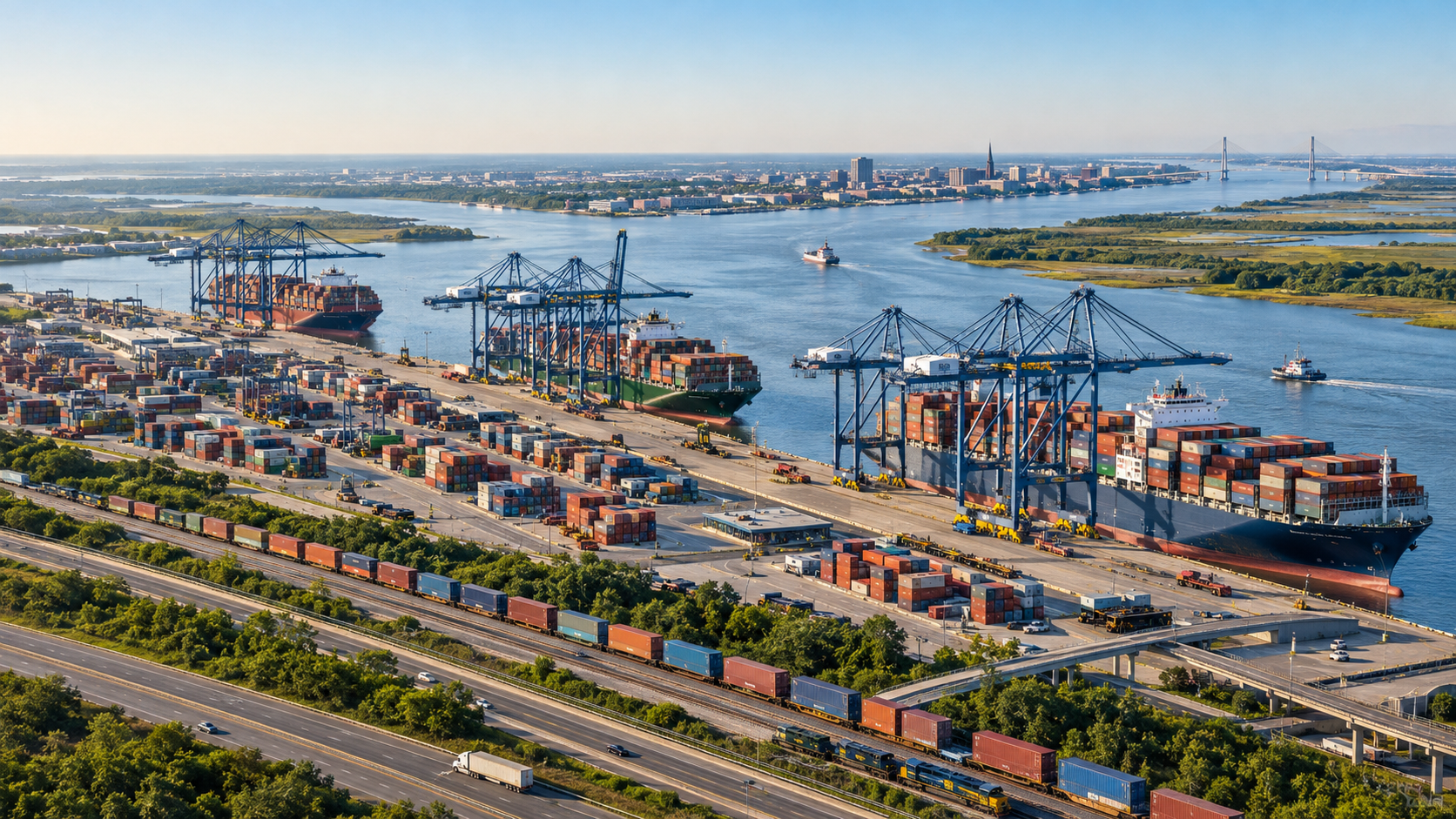
Container terminal on Hutchinson Island: Savannah invests $2.3 billion – will the port become a US trade hub? – Creative image on the topic, created with AI: Xpert.Digital
America's port race: Why Savannah wants to almost double its capacity
3.5 million more containers: Savannah relies on a historic port expansion
Savannah versus New York and Charleston: The billion-dollar plan for the East Coast
The Port of Savannah is taking a historic step: a new container terminal is to be built on Hutchinson Island for approximately $2.3 billion, capable of handling up to 3.5 million additional standard containers annually. Together with other expansion projects, this could increase the port's capacity from its current 7.75 million to about 12 million TEU. This ambition goes beyond simply wanting larger berths and additional storage space. Georgia aims to attract the growing trade in the American Southeast, promote industrial development, and establish Savannah as a central hub between global markets and the American heartland.
The calculation assumes that population, industry, and freight traffic in the Southeast will continue to grow—and that the port will develop its rail, road, and shipping connections in a timely manner. Additional capacity alone does not guarantee success: Without efficient rail networks, reliable access routes, and a safe shipping channel, bottlenecks would simply shift from the docks to the roads and railways. Environmental impacts, climate risks, and long-term demand also raise questions. Savannah's multi-billion-dollar project is therefore also a gamble on the future of global trade: If the coordinated development of the port, hinterland, and industry succeeds, Georgia could become one of the most important logistics hubs on the American East Coast. If it fails, there is a risk of expensive infrastructure whose capacity is not fully utilized.
Savannah's $2.3 billion bet on the future of global trade
America's port crown is not for sale – Savannah intends to seize it
The Port of Savannah is poised for the largest development in its history. The planned Savannah Container Terminal on Hutchinson Island, a new facility costing approximately $2.3 billion, will be able to handle an additional 3.5 million standard containers annually. This project is far more than just regional infrastructure. It represents an attempt to influence trade flows, industrial development, and logistics decisions for decades to come, benefiting Georgia and the American Southeast. Savannah is investing not only in additional storage space and berths, but also in its own role within a newly structured global economy.
The scale is extraordinary. On an area of approximately 350 acres, or roughly 142 hectares, three berths for large container ships, extensive container areas, and efficient intermodal connections are planned. Construction is scheduled to begin in January 2028, with full completion expected in the mid-2030s. Together with other ongoing projects, this will increase the port's annual capacity from its current 7.75 million to approximately 12 million TEU. TEU stands for Twenty-foot equivalent unit, the internationally recognized unit of measurement for container throughput.
The economic logic behind the expansion is understandable, but not without risk. Savannah is banking on population, production, consumption, and logistics in the southeastern United States growing faster than in other parts of the country for many years to come. At the same time, the port aims to attract additional cargo from established West Coast ports as well as from competing locations on the East Coast. This can succeed if the port, rail, road, warehousing, and industry grow together. If, however, only port capacity is created without the downstream networks keeping pace, bottlenecks risk simply shifting from the docks to roads, railways, and industrial areas.
From regional port to national power center
Even before the recent expansion, Savannah had already transformed from a significant regional port into one of North America's most important container hubs. In fiscal year 2026, approximately 5.67 million TEU were handled, only slightly below the previous year's volume of around 5.7 million TEU. What is remarkable is not so much the small change between these two years, but rather the long-term trend: since fiscal year 2020, throughput has increased by roughly 28 percent. The port has thus permanently established itself at a scale that, just a few decades ago, was almost exclusively reserved for major coastal metropolises.
This development is not based on a single advantage. Savannah combines a relatively central location in the rapidly growing Southeast with large, contiguous terminal areas, two major railroad companies, short connections to Interstates 16 and 95, and an extensive network of distribution centers. In addition, there is an institutional advantage: The Georgia Ports Authority can manage the development of port facilities, rail infrastructure, and inland terminals in a relatively unified manner. In ports with many independent terminal operators, investments and operations are often more fragmented.
The success achieved so far is further supported by the structure of cargo flows. In calendar year 2025, approximately 5.69 million TEU were handled. Import and export volumes were almost equal, each at roughly 2.84 million TEU. While this theoretical balance doesn't automatically mean that an equal number of loaded containers travel in both directions, it is an economic advantage. Ports with strongly one-sided import flows have to reposition large quantities of empty containers. Savannah, on the other hand, can draw on agricultural products, timber and paper, foodstuffs, industrial goods, and other exports from Georgia and the neighboring states.
The port is therefore not only a gateway for consumer goods from Asia and Europe. It is also a starting point for American exports and a supply platform for a growing industrial region. This dual function is precisely what increases its attractiveness to shipping companies. Regular cargo in both directions improves ship utilization, stabilizes services, and reduces the risk of Savannah being used merely as a temporary alternative.
Capacity as a strategic weapon
The new terminal is expected to increase Savannah's annual capacity by 3.5 million TEU. Compared to the current capacity of 7.75 million TEU, this represents an increase of approximately 45 percent through this project alone. Together with the redevelopment of the Ocean Terminal and other optimizations, the total capacity is projected to rise to around 12 million TEU. This would be more than double the actual throughput for fiscal year 2026.
At first glance, this difference seems like a massive oversizing. A port handling 5.67 million TEU doesn't immediately need 12 million TEU capacity. However, infrastructure of this kind isn't built for immediate demand. Planning, permitting, financing, construction, and commissioning often take a decade or more. If Savannah were to react only when existing facilities are permanently operating at their limit, the port could lose cargo, shipping services, and investors during a multi-year construction phase.
Crucially, there's a difference between theoretical and practically usable capacity. A terminal can theoretically handle a certain number of containers long before that amount is achievable in everyday operations without congestion and productivity losses. As soon as utilization becomes very high, operational stability decreases. Containers need to be restacked more frequently, trucks wait longer, trains can be delayed, and ships lose time at berth. Reserve capacity is therefore not an unproductive luxury, but rather a kind of insurance against peak demand, disruptions, and seasonal fluctuations.
Savannah also uses capacity as a competitive tool. Shipping companies and large shippers don't decide solely based on today's price, but also on whether a port can accommodate growth in five or ten years. Companies that credibly offer additional berths, cranes, rail capacity, and land make long-term location decisions easier. The new terminal is thus sending a message even before its completion: companies can expand in the Southeast without fearing that the maritime gateway will become a bottleneck.
The actual expansion will cost more than $2.3 billion
The aforementioned investment sum represents only a portion of the overall economic project. Simultaneously, the Ocean Terminal is being modernized for approximately US$1.6 billion and largely converted to container operations. Its capacity is expected to increase from around 200,000 to 1.75 million TEU. Completion is scheduled for the end of 2028. These two major terminal projects alone thus represent a combined investment of approximately US$3.9 billion.
Furthermore, Georgia Ports is pursuing an infrastructure program of nearly five billion US dollars for the coming decade. This includes additional berths for large container ships in Savannah, improvements at the Port of Brunswick, rail projects, road connections, and other measures at the port facilities. In the previous ten years, more than four billion US dollars have already been invested in port and hinterland infrastructure. The new terminal construction is therefore not an isolated prestige project, but rather another building block in a long-term capital strategy.
Investments that formally take place outside the port are also economically significant. New road intersections, bridge connections, railway lines, warehouses, cold storage facilities, energy supply, data connections, and land development are partly financed by other public bodies or private companies. The actual capital requirement of the emerging logistics system is therefore significantly higher than the price of the terminal.
This also changes how economic viability is assessed. A new terminal cannot be judged solely on whether its direct fee revenues generate a return of US$2.3 billion. Public port infrastructure creates additional benefits for industry, trade, employment, property values, and tax revenue. At the same time, such indirect benefits should not be used as a blanket justification for every expenditure. A sound assessment must distinguish between activities that are genuinely new and those that are merely relocated from other ports or regions.
The track determines the success
The maritime aspect of the port attracts the most attention, but the quality of hinterland transport determines its economic reach. In fiscal year 2026, 541,405 containers were moved by rail at the Mason Mega Rail Terminal. For the third consecutive year, the figure exceeded half a million. Of the total container traffic, approximately 17 percent was transported by rail, while the vast majority was carried out by truck.
Savannah is currently connected to domestic markets by approximately 42 trains per week. Two major North American railroads, CSX and Norfolk Southern, serve destinations in the Southeast and Midwest. This allows the economic port region to extend far beyond Georgia. Cargo destined for Atlanta, Nashville, Memphis, Charlotte, or more distant industrial centers doesn't necessarily need to pass through closer ports if Savannah can offer a reliable and competitively priced rail connection.
The inland terminal system amplifies this effect. The Appalachian Regional Port in northwestern Georgia and the Blue Ridge Connector near Gainesville shift container traffic from road to rail, bringing the port closer to inland production and distribution sites. The Blue Ridge Connector is designed for a capacity of approximately 200,000 containers per year. The rail connection eliminates the need for a long truck journey for each shipment, thus reducing not only emissions but also the need for drivers, fuel, and road capacity.
A dedicated intermodal rail facility is planned for the new Savannah Container Terminal. This integration is essential. A terminal with an additional capacity of 3.5 million TEU could generate a significant number of additional truck journeys if the current transport mix remains unchanged. Conversely, if the rail share increases considerably, Savannah can expand its catchment area without burdening the road network to the same extent. The economic leverage, therefore, lies not only in more ship calls but also in a higher proportion of block trains departing directly from the port.
Georgia's industrial policy is getting a deep-water connection
The port is closely linked to Georgia's industrial transformation. This is particularly evident at the Hyundai Motor Group Metaplant in Bryan County, west of Savannah. The site is located near Interstate 16 and only a few dozen kilometers from the port. The plant and its associated battery production have attracted numerous suppliers. This results in imports of components, machinery, materials, and semi-finished products for Savannah, as well as additional logistics services.
This development demonstrates how ports and industrial policy reinforce each other. An efficient port reduces the anticipated transport costs of a new factory and increases security of supply. Once large manufacturers establish operations, the port's cargo volume, in turn, increases. Suppliers follow the main investor, logistics companies expand their capacities, and specialized service providers set up shop. In this way, a single project can give rise to an entire industrial network.
The impact extends beyond the automotive industry. Georgia benefits from investments in batteries, solar technology, food processing, wood products, mechanical engineering, e-commerce, and retail distribution. For many of these industries, proximity to a container port is a significant location factor. Importers shorten the distance from the dock to the warehouse or factory, while exporters gain access to regular liner services.
However, not every development is automatically economically efficient. States and municipalities often compete for large projects with tax breaks, land, and infrastructure grants. A port can make such funding decisions more attractive, but it doesn't eliminate the risk of excessive subsidies. In the long run, what matters is whether it creates sustainably productive jobs, local supply chains, and technical expertise. Therefore, expansion should be linked to skills development, spatial planning, and a sober assessment of government funding costs.
LTW Intralogistics Solutions

LTW Intralogistics – Engineers of Flow - Image: LTW Intralogistics GmbH
LTW offers its customers not individual components, but integrated complete solutions. Consulting, planning, mechanical and electrotechnical components, control and automation technology, as well as software and service – everything is networked and precisely coordinated.
In-house production of key components is particularly advantageous. This allows for optimal control of quality, supply chains, and interfaces.
LTW stands for reliability, transparency, and collaborative partnership. Loyalty and honesty are firmly anchored in the company's philosophy – a handshake still means something here.
Related to this:
Savannah's major port redevelopment: The new container terminal and its significance
The Southeast is becoming the new American focal point
Savannah's expansion is part of a larger economic-geographic shift. Population and businesses are growing faster in many states of the American South and Southeast than in the Northeast. Metropolitan areas like Atlanta, Charlotte, Nashville, and Orlando are gaining residents, purchasing power, and industrial capacity. At the same time, companies are building manufacturing and distribution networks closer to these markets.
This development is particularly important for the port industry. Containers are not moved for their own sake, but because consumers buy goods, factories need intermediate products, and exporters serve international customers. When demand and production shift geographically, the optimal choice of port also changes. Savannah is conveniently located near Atlanta and can serve a large part of the Southeast and parts of the Midwest by road and rail.
Added to this is the shifting of supply chains. Companies are trying to spread risks more broadly and reduce dependence on individual countries, routes, or coastlines. Production shifts to Southeast Asia, India, Mexico, or other regions are changing shipping networks. Savannah can benefit from cargo arriving on the East Coast via the Panama Canal, the Suez Canal, or direct transatlantic services.
The shift away from the American West Coast is not an irreversible process, however. Los Angeles and Long Beach still benefit from enormous economies of scale and network advantages, as well as a particularly short sea route to Northeast Asia. If labor relations there are stable and the intermodal rail network operates reliably, these ports will remain highly competitive. Savannah, therefore, needs to offer more than just available space. It needs consistently fast turnaround times, predictable costs, good rail connections, and a high density of liner services.
An attack on New York, Norfolk and Charleston
With a capacity of twelve million TEU, Savannah would enter a scale that would reshape competition on the East Coast. New York and New Jersey remain the region's largest container port. Their proximity to the densely populated Northeast is a virtually uncopyable advantage. At the same time, land is scarce, construction projects are expensive, and many transportation routes are heavily congested. Growth there must be achieved primarily through densification and productivity improvements.
Savannah is pursuing a different model. The port relies on large areas, additional berths, and an extensive logistics and industrial network. The goal is not to economically route cargo for Manhattan through Georgia. Rather, Savannah wants to prevent goods destined for the Southeast from being imported through northern ports and then transported long distances back. Furthermore, the port can compete for cargo destined for parts of the Midwest.
Charleston is the most geographically obvious competitor. Both ports serve similar hinterland markets and compete for the same shipping companies, distribution centers, and industrial projects. Norfolk scores points with its deep, well-protected harbor, strong rail connections, and proximity to major population centers. Further competition comes from Houston and from ports on the Gulf of Mexico, which benefit from growth in Texas and new supply chains.
Competition isn't solely determined by maximum capacity. Shipping companies consider a vessel's total turnaround time, crane reliability, available time slots, draft, bridge clearances, and container throughput speed. Shippers also evaluate freight rates, rail prices, storage costs, and the likelihood of disruptions. Therefore, despite significant investments, Savannah could lose market share if its operational quality or hinterland infrastructure falls short.
Size alone does not solve the nautical problem
The new terminal is designed to accommodate the largest container ships operating on the East Coast. Modern cranes and long quays alone are insufficient for this. Ships must reach the port safely, economically, and with minimal waiting time. The Savannah River presents a challenging approach, and large vessels can be subject to draft, tides, and passing restrictions.
The harbor has already been deepened from 42 to 47 feet. A further study is now being prepared to examine the feasibility of deepening it again and creating additional passing or passing areas. The aim is to accommodate larger ships with heavier cargoes and less dependence on tides. Passing areas could allow arriving and departing ships to use certain sections simultaneously, instead of passing one after the other.
This is economically crucial. A high-capacity vessel only offers economies of scale if it can enter port fully loaded and leave again without undue delay. If a shipping company has to leave cargo behind or wait a long time for a suitable tidal window, the benefit of an additional berth diminishes. Terminal capacity, fairway, pilotage, and traffic management must therefore be planned as a single system.
Further deepening, however, would be expensive and ecologically problematic. Construction costs are just the beginning; regular maintenance dredging also incurs ongoing expenses. Furthermore, changes to the river's geometry can affect salinity, oxygen levels, and habitats. Therefore, the economic benefits must justify not only the initial investment but also long-term operating, environmental, and compensation costs.
The bottleneck threatens in front of the port gate
A port can be efficient on the water but still overloaded on land. In Savannah, many thousands of truck movements are already handled daily. With a significant expansion of cargo handling, the pressure on access roads, bridges, intersections, and residential areas will increase. The location of the new terminal near major highways offers opportunities, but it doesn't automatically solve the problem.
The plan is to connect port traffic to main roads as directly as possible and to limit additional truck journeys through the city center and residential areas. Where feasible, truck and passenger traffic will be separated. Such measures make economic sense because traffic jams not only burden residents. Every delay increases driver costs, fuel consumption, vehicle requirements, and supply chain uncertainty.
The terminal on Hutchinson Island presents unique challenges. Connections to US Route 17, Interstate 95, and Interstate 16 must be sufficiently efficient. Interactions with the Talmadge Memorial Bridge and regional commuter traffic must also be considered. A nominally fast route to the highway could become a new bottleneck during periods of high traffic.
The best safeguard is a higher proportion of rail transport, combined with time-controlled truck windows and digital coordination. Terminal appointments, container releases, customs information, chassis availability, and storage capacities should be linked. The more precisely the port manages arrivals and pickups, the less buffer time freight forwarders need to plan. Digitalization cannot replace missing physical capacity, but it can significantly improve the utilization of existing infrastructure.
Growth comes at an ecological and social cost
The economic benefits of the expansion are considerable, but they are not automatically distributed fairly. Additional shipping, rail, and truck traffic causes air pollution, noise, and land consumption. Construction work and dredging encroach on sensitive river and wetland areas. Communities in the immediate vicinity of terminals, railway lines, and truck corridors are often particularly affected, while a large portion of the economic profits accrues in other regions.
Hutchinson Island currently comprises partially undeveloped land, forests, and wetlands. Extensive earthworks, shoreline construction, and dredging are required for the terminal's construction. Environmental organizations have pointed to potential impacts on freshwater wetlands, salt marshes, water quality, fish species, and other wildlife. Long-term maintenance dredging is also crucial, as it will be necessary not only during the construction phase but throughout the terminal's entire operational lifespan.
Added to this is the issue of local air quality. Large ocean-going vessels also consume energy while in port unless they are powered by shore power or otherwise operated with low emissions. Shunting locomotives, cargo handling equipment, and older trucks also contribute to the pollution. If Savannah wants to nearly double its capacity, emissions reduction must be part of its capacity strategy. Otherwise, it risks facing healthcare costs, political conflicts, and more expensive retrofitting later on.
Economically sound measures would include shore power for suitable ships, electric or low-emission handling equipment, cleaner locomotives, charging infrastructure for trucks, and reliable emissions monitoring. Equally important are noise abatement, transparent traffic data, and the involvement of affected communities. Environmental measures are not merely additional costs. They can secure the political and social viability of infrastructure intended to operate for many decades.
Climate risks should be included in every return calculation
The port is located in a low-lying coastal region and is therefore at long-term risk from rising sea levels, storm surges, heavy rainfall, and hurricanes. A higher average water level does not necessarily flood the terminals immediately, but it does alter the situation during extreme events. Quays, drainage, power supply, roads, railways, and storage areas may be affected more frequently or to a greater extent.
For a project intended to be fully operational in the 2030s and used for many decades, simply looking at historical weather data is insufficient. Design and financing must take plausible climate scenarios into account. This includes elevated facilities, redundant power supplies, efficient drainage, flood-resistant technology, and rapid restart plans.
Resilience increases the initial investment, but can prevent significant damage over the lifetime of the port. A single prolonged port outage would not only affect the operator, but also shipping companies, manufacturers, retailers, and logistics firms throughout the hinterland. Precisely because Savannah is becoming increasingly vital to Georgia and the Southeast, the economic value of every avoided business interruption is growing.
This leads to an apparent contradiction: Expansion concentrates more economic activity in one location, thereby increasing its importance, but also the potential for damage in the event of a failure. The answer cannot be to forgo growth. What is needed instead is technical resilience, alternative transport routes, robust data systems, and coordinated emergency plans with railway companies, road authorities, and customers.
The calculation depends on long-term trade growth
Whether the investment pays off economically depends largely on actual demand in the 2030s and 2040s. If Savannah were to grow from 5.67 million TEU in fiscal year 2026 to 12 million TEU, this would represent more than a doubling. Over ten years, this would require roughly an average annual growth rate of just under eight percent. With a longer ramp-up phase extending into the 2040s, the necessary rate decreases, but remains ambitious.
Such growth can stem from several sources: general growth in American trade, a rising population in the Southeast, additional industrial production, market share gains over other ports, and the shift of West Coast cargo. These factors can reinforce each other. However, they can also be weaker than expected. Tariffs, geopolitical conflicts, nearshoring, automation, and changing consumer patterns can dampen container growth or alter its geographic distribution.
The latest figures show how uneven development can be. In fiscal year 2025, throughput increased by 8.6 percent, while in fiscal year 2026 it remained almost stable at 5.67 million TEU. Part of this growth may be due to imports brought forward in anticipation of tariff increases and is therefore not necessarily sustainable. Port planning should not simply extrapolate short-term peaks into the future.
At the same time, it would be equally wrong to conclude from a weak year that there is a lack of long-term demand. Large port projects go through several economic cycles. Their strength lies precisely in their ability to provide capacity when demand returns unexpectedly quickly. A modular approach is therefore crucial. Areas, berths, cranes, and rail facilities should be able to be commissioned gradually so that capital expenditures and actual demand are aligned as closely as possible.
Jobs between growth and automation
Georgia's ports are of enormous economic importance. According to current estimates, port activities in the state support more than 600,000 full- and part-time jobs. The associated annual business revenue is estimated at around 181 billion US dollars. Approximately twelve percent of Georgia's employment is therefore directly or indirectly related to the ports.
Such figures should be interpreted carefully. They do not mean that all the jobs mentioned are located on the port premises or would disappear entirely without the port. The figures also include employees in industry, trade, transportation, and services whose companies utilize port connections. Nevertheless, the figures clearly demonstrate that Savannah is no longer an isolated transportation hub, but rather a central component of Georgia's economic structure.
The new terminal construction will create additional jobs in engineering, construction, plant engineering, and project management during the construction phase. Once operational, jobs will be created in handling, maintenance, IT, security, rail and road transport, and at logistics service providers. At the same time, modern terminals are becoming increasingly automated. Remotely operated cranes, digital gates, automated stacking systems, and data-driven planning increase productivity while limiting the number of traditional manual jobs per container handled.
The political debate should therefore not focus solely on the number of new jobs. Qualifications, wages, job security, and career advancement opportunities are crucial. A highly productive port can create more and better-paid jobs with fewer employees per TEU if maintenance, software, energy, data analysis, and industrial services are located within the region. Without targeted training and development, however, there is a risk that well-paid specialist positions will be filled from outside the region, while local communities bear the brunt of traffic and environmental burdens.
A big bet with convincing logic
Savannah's $2.3 billion project is economically sound because it builds on real structural strengths: the growth of the Southeast, its proximity to Atlanta, an expanding industrial sector, ample available land, balanced trade flows, and efficient rail connections. The port isn't starting from scratch. It already boasts a capacity of well over five million TEU, dense shipping line connections, and an established logistics cluster.
The investment is by no means a sure thing. Twelve million TEU capacity is only valuable if shipping companies and shippers actually use it. This requires the simultaneous development of shipping lanes, bridges, roads, railways, inland terminals, and commercial areas. Environmental impacts, climate risks, and the interests of local residents must also be factored into the economic analysis.
The greatest strategic advantage may not lie in the eventual full development, but rather in the credibility the project already generates. Industrial companies, traders, and logistics providers see that Georgia is prepared to invest in international connectivity for the long term. This expectation can trigger new business development, which in turn will drive port growth. In this case, infrastructure not only creates capacity for existing demand but also influences where future demand will arise.
The provocative truth, therefore, is this: Savannah isn't building because twelve million TEU are already guaranteed. The port is building to make that capacity possible and to permanently attract a portion of American trade to Georgia. Therein lies both the economic opportunity and the risk. If the coordinated development of the port, its hinterland, and industry succeeds, Savannah could become the dominant logistics hub of the American Southeast by the 2030s. If it fails, an expensive reserve of concrete, steel, and reclaimed land will remain. As things stand today, the arguments in favor of expansion outweigh the arguments against, but its success won't be decided on opening day. It will be measured by how reliably, cleanly, and productively the entire system operates over decades.
Consulting - Planning - Implementation

Konrad Wolfenstein
I would be happy to serve as your personal advisor.
You can contact me at wolfenstein∂xpert.digital or
Just call me on +49 7348 4088 965 .
Your intralogistics experts

Consulting, planning and implementation of complete solutions for high-bay warehouses and automated storage systems - Image: Xpert.Digital
More information here: