
The invisible pacemaker of the tire factory: Those who underestimate the curing buffer are burning capital at the most expensive point in production
Xpert Pre-Release

Available in 27 languages 📢
Prefer Xpert.Digital on GoogleⓘPublished on: October 1, 2026 / Updated on: October 1, 2026 – Author: Konrad Wolfenstein
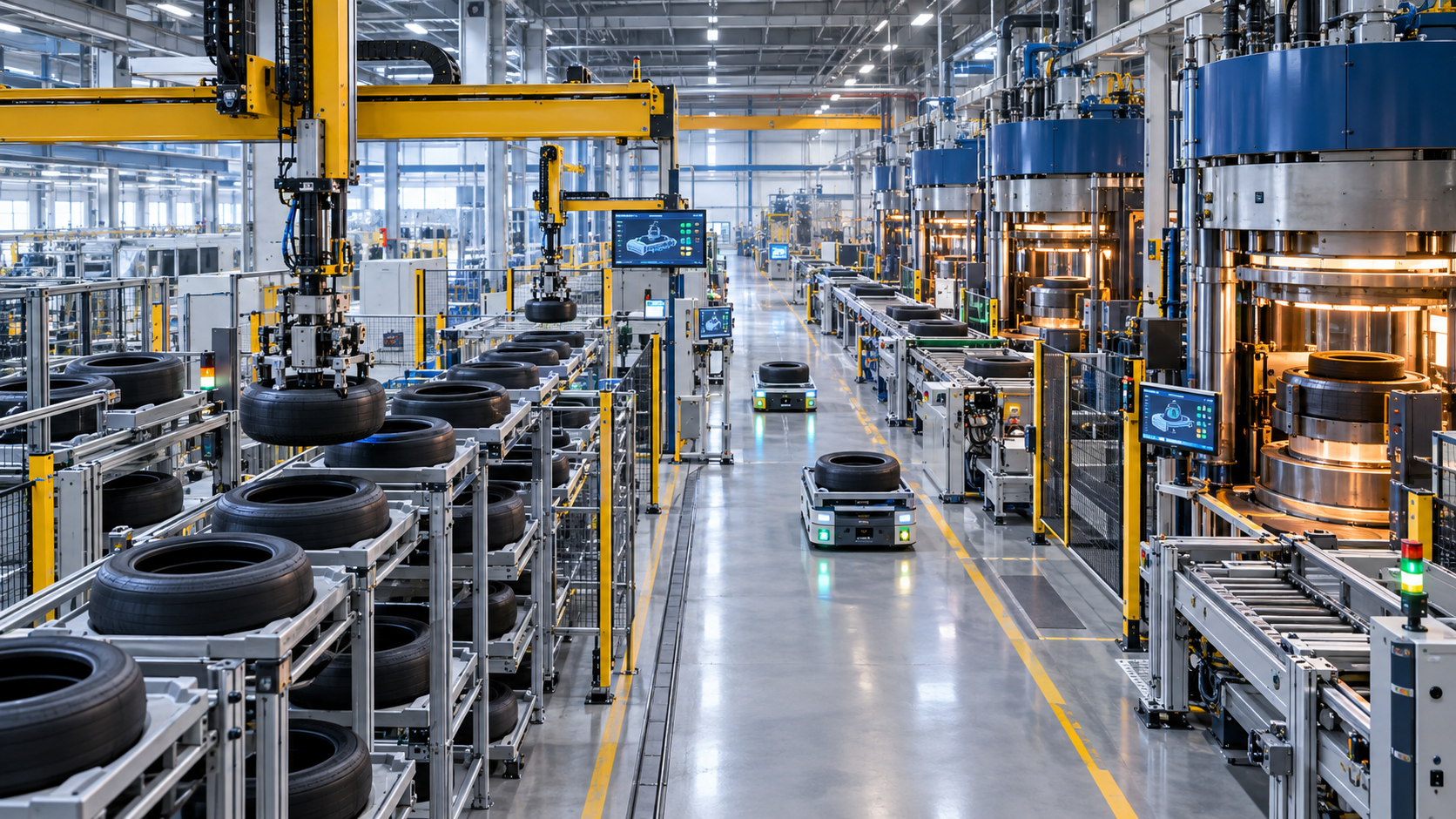
The invisible pacemaker of the tire factory: Underestimating the curing buffer means burning capital at the most expensive point in production – creative image on the topic, created with AI: Xpert.Digital
Optimal tire management: The role of the green tire storage
Efficiency in the tire factory: Why the curing buffer is crucial
In the complex world of tire production, the crucial role of the so-called curing buffer – also known as the green tire storage area – is often overlooked. This invisible pacemaker of the tire factory not only acts as a storage area for unvulcanized tires but is also a decisive element for the economic efficiency of the entire production process. The green tire storage area compensates for the differences between the tire assembly and vulcanization production stages, ensuring a stable material flow even in the event of unforeseen disruptions. An optimally sized curing buffer can therefore not only guarantee the supply of materials to the curing presses but also reduce capital tied up in production and increase overall productivity. In this article, we will analyze the various aspects of the curing buffer and demonstrate the importance of not underestimating this crucial component of tire production.
More than just a warehouse between two machine worlds
The green tire storage area, often called a curing buffer in German and in international production technology, is one of the inconspicuous but economically crucial areas of a tire factory. It holds the fully assembled but not yet vulcanized tires between the tire builder and the curing presses. In this state, the tire already possesses its essential material structure, but not yet its final strength, geometry, and tread pattern. It is sensitive to deformation, pressure, incorrect support, mix-ups, and excessively long or unsuitable storage. Therefore, the storage area does more than simply manage inventory. It stabilizes a technically sensitive material flow between two production stages whose cycle times, susceptibility to disruptions, and batch sizes differ structurally.
Tire building machines typically produce green tires in specific sequences and batches. Vulcanizing presses, on the other hand, operate with product-specific molds, formulas, heating curves, and production schedules. A direct one-to-one coupling of both areas would only be conceivable in an idealized factory without disruptions, product changes, quality control, or maintenance. In reality, cycle times fluctuate, individual machines experience temporary outages, molds are changed, orders are prioritized, and tires must be sorted by type, age, release status, and target press. The curing buffer decouples these fluctuations and translates them into a manageable inventory.
From an economic perspective, it's insurance against downtime, but not without cost. Too small a buffer jeopardizes the supply to the presses. Too large a buffer ties up space, equipment, working capital, and potentially energy, increases dwell time, and can mask process problems. Therefore, the optimal inventory level is neither zero nor the maximum technically possible volume. It results from the relationship between press capacity, plant availability, product mix, failure profile, replenishment time within the factory, and the desired service level compared to vulcanization. The central management task is to achieve supply security with the lowest possible inventory.
The vulcanization press determines the economic leverage
The economic importance of the green tire warehouse stems primarily from the role of vulcanization in the overall process. Heat presses are capital-intensive, space-consuming, and energy-intensive. They give the tire its final shape under pressure and heat and cross-link the rubber compounds. Available press time is therefore a scarce production resource. If it is lost due to a lack of supplies, the lost output cannot be easily recovered. Additional shifts, overtime, or higher speeds on upstream equipment cannot compensate for lost press cycles if the bottleneck is already in the vulcanization stage.
The logic is simple: The value of a buffer is not measured by the price of storage space, but by the avoided costs of an unproductive minute at the bottleneck. This includes more than just lost production volume. Idle time can cause further energy losses, unstable temperatures, increased organizational effort, and less efficient utilization of personnel and equipment. In a plant with many presses, even a small improvement in material availability can have a cumulative effect over thousands of operating hours. Therefore, seconds saved in material availability and a few percentage points increase in plant availability can have a significant impact over the course of a year.
At the same time, it would be wrong to automatically consider every additional storage unit as increasing productivity. If presses are down due to die changes, maintenance, media problems, or quality issues, a larger stock of green tires won't solve the underlying problem. A buffer can absorb fluctuations, but it cannot compensate for a persistently flawed capacity design. It should not serve as a substitute for reliable equipment, nor as a dumping ground for poorly coordinated production planning. The best solution makes disruptions visible, prioritizes their causes, and maintains only the stock level that is economically viable for statistically predictable fluctuations.
Decoupling creates efficiency but also waste
A curing buffer fulfills three functions simultaneously: It decouples production cycles, sorts product variants, and protects a sensitive intermediate product. This combination distinguishes it from a traditional finished goods warehouse. The tire is not stored because it will be sold and shipped later, but because the next process requires a specific product at a specific time. Therefore, every storage operation is part of a time-critical production decision.
Decoupling allows tire building machines to operate in economical batch sizes and reduces changeovers. A single machine can produce several identical or related variants consecutively, even if the presses don't call up these tires at exactly the same intervals. This increases productive time in tire building. Conversely, presses don't need to wait for the completion of a preceding order if the required type is already in the buffer. The inventory thus temporarily assumes the role of a capacity reserve.
However, this reserve has its limits. Excessively long residence times increase the risk of aging, deformation, surface problems, or exceeding internal process windows. A green tire is not a chemically and mechanically neutral storage medium. Its permissible buffer time depends on the material formulation, pretreatment, environment, and quality specifications. Therefore, economically sound control considers not only quantity and type, but also production time, batch, status, and latest possible processing date. The commonly used principle of "first in, first out" is an important foundation, but it is insufficient on its own when dealing with priority orders, restricted batches, varying shelf lives, or targeted press allocation.
The green tire requires its own logic
Before vulcanization, the tire is soft, sticky, and geometrically fragile. Incorrect handling can stress the carcass, bead, or sidewall. If tires are stacked on top of each other or supported improperly, they can flatten or warp. Such damage is particularly undesirable from an economic standpoint because the product already incorporates material, energy, and machine time from several upstream process stages. Therefore, rejects shortly before vulcanization destroy significantly more value than an earlier error in raw material supply.
A modern storage system must therefore handle green tires in a way that preserves their shape. Often, each tire rests on a customized or universal tray or pallet. This prevents the tires from touching and provides geometric support during transport, storage, and handling. Alternatively, specialized systems can handle tires without a separate load carrier. This solution saves on carriers, return technology, and potentially process steps, but places high demands on grippers, storage geometry, and tire type flexibility.
The choice between a tray-based and a trayless system is a business-oriented system decision. Trays incur procurement, cleaning, maintenance, and circulation costs. Furthermore, a sufficient supply of empty trays must always be available in the right place. However, they standardize the interface between different transport and storage technologies and protect the product. A trayless system reduces tied-up capital and handling, but can be more dependent on specific tire dimensions and mechanical designs. The decisive factor is not the isolated price of a tray or gripper, but rather the overall cost impact over lifespan, product mix, availability, and adaptability.
Automation does not just replace manual labor
The automation of a green tire warehouse is often justified by the need for personnel savings. While this effect is relevant, it doesn't tell the whole story. The greater benefits usually arise from reproducible processes, higher throughput reliability, unambiguous identification, and better utilization of the presses. Manual systems can be economical for small quantities and a manageable product mix. However, with increasing production volume, greater product variety, and stricter quality requirements, search efforts, the risk of errors, and organizational complexity increase disproportionately.
Depending on the factory layout, automated solutions utilize stacker cranes, shuttle systems, gantry cranes, area storage robots, monorails, conveyor technology, or automated guided vehicles (AGVs). A stacker crane consolidates inventory vertically and is suitable for clearly structured high-bay warehouses. Multi-stage shuttle systems offer high throughput and redundancy but are technically complex. Gantry cranes can dynamically service large floor areas and flexibly handle various tires or pallets. Monorails relieve traffic congestion and connect warehouses and presses overhead, but require a load-bearing building structure and careful planning of switches and maintenance.
No single architectural design is inherently superior. A compact buffer above or directly adjacent to the tire building machines may suffice in a well-synchronized plant. A large high-bay warehouse makes sense when dealing with numerous product variants, high inventory levels, or significant spatial distances. In a brownfield project, however, column grids, ceiling heights, fire safety regulations, existing utilities, and ongoing production can preclude even the most technically elegant solution. Therefore, cost-effectiveness arises from adapting to the specific material flow, not from purchasing the most efficient individual machine.
Variety of variants makes software a bottleneck
The tire industry no longer produces just a few standard sizes in large batches. Vehicle classes, rim diameters, speed ratings, winter and summer versions, electric vehicle requirements, regional specifications, and brand-specific variants expand the product range. The greater this product diversity becomes, the less easily buffer stock can be managed with simple quantity rules. Physical warehousing technology remains important, but the real performance is shifting to software.
A warehouse control system coordinates conveyors, robots, stacker cranes, and transfer stations. A manufacturing execution system (MES) then plans orders, inventory, releases, and production sequences. The connection to the higher-level enterprise system ensures that requirements, material data, and feedback remain consistent. In a functioning architecture, the system knows at least the identity, type, batch, production time, quality status, storage location, target process, and processing history of every single green tire.
This level of data depth enables predictive control. The system can not only retrieve a tire when a press requests it, but also anticipate demand based on the press schedule. It can move suitable tires to a storage buffer in advance, consolidate transport routes, and avoid conflicts between storage and retrieval. In the event of a disruption, the sequence can be automatically recalculated. This transforms the buffer from passive inventory into an active production tool.
The downside is a high dependence on data quality and interfaces. An incorrectly entered item, a delayed response, or a conflicting approval can block the physical flow of materials. Software errors then have an immediate impact on production. Therefore, master data management, versioning, test environments, restart concepts, and clear responsibilities are not secondary tasks for IT, but rather integral components of operational reliability.
Traceability becomes a value-creating function
Complete traceability is often treated as a quality or compliance issue. Economically, it's far more than that. When every tire is clearly tracked from its construction to vulcanization, deviations can be traced back to specific batches, machines, time windows, or process parameters. Without this precision, companies may have to block or investigate larger quantities. Good data thus reduces the amount of scrap, rework, and potential recalls.
Identification can be achieved via barcodes, Data Matrix codes, RFID, or a combination thereof. Barcodes are inexpensive but usually require line of sight and a suitable surface. RFID can be read contactlessly without direct line of sight and supports automated single-item tracking. However, this increases the demands on tag selection, read position, data model, and electromagnetic robustness. In the metal-rich and dynamic environment of a tire factory, the read rate must be practically proven, not just theoretically assumed.
In the long term, this infrastructure will gain even more importance because product identities extend beyond the factory. Digital product passports, the circular economy, retreading, and more precise material documentation are increasing the need for standardized tire data. A green tire warehouse with a clean, individual tire history establishes a robust data chain right from the start of the product lifecycle. Therefore, investing in traceability should not be viewed solely as a warehouse cost center. It forms the basis for quality management, regulatory compliance, complaint analysis, and new digital services.
LTW Intralogistics Solutions

LTW Intralogistics – Engineers of Flow - Image: LTW Intralogistics GmbH
LTW offers its customers not individual components, but integrated complete solutions. Consulting, planning, mechanical and electrotechnical components, control and automation technology, as well as software and service – everything is networked and precisely coordinated.
In-house production of key components is particularly advantageous. This allows for optimal control of quality, supply chains, and interfaces.
LTW stands for reliability, transparency, and collaborative partnership. Loyalty and honesty are firmly anchored in the company's philosophy – a handshake still means something here.
Related to this:
Automation and its role in modern tire management
The right size is a risk calculation
The sizing of a curing buffer should not be derived solely from average daily production or a fixed number of production hours. Average values mask precisely those fluctuations against which the buffer is intended to protect. Relevant factors include the distribution of downtime, cycle time, changeover time, demand per variant, and restart behavior. Planned maintenance, shift patterns, and the timing of tire construction and vulcanization also influence the required capacity.
A robust model distinguishes between safety stock, cyclic stock, and strategic reserve. Safety stock covers short-term uncertainties. Cyclical stock arises from batch production and varying cycle times. A strategic reserve can be allocated for known maintenance windows, shift changes, or critical product families. These inventory components have different causes and should be measured separately. Otherwise, the total inventory grows without it being clear what portion actually ensures supply security.
Simulation is particularly valuable for system design. Discrete event simulation can model real-world order sequences, system malfunctions, transport times, and priority rules. This allows you to examine how frequently presses wait for material at different buffer sizes, where transport routes intersect, and what level of redundancy is required. Crucially, you shouldn't just simulate normal operation. A system that functions well on average but collapses when a main robot or transfer station fails is economically fragile.
The target metric should therefore be formulated as a service level: What is the probability that the correct, approved tire will be available at the correct press on time? This service level is then compared to the costs of additional capacity. Beyond a certain point, each additional storage space offers only minimal additional protection. This is often precisely where the economically viable limit lies.
Throughput is more important than nominal capacity
Suppliers and planners often cite the maximum number of tires that can be stored or the theoretical number of movements per hour. However, for the operator, the sustainable throughput under realistic conditions is crucial. Storage and retrieval occur simultaneously, tires differ in size and destination, transports must be prioritized, and disruptions must be managed. The nominal peak capacity can therefore be significantly higher than the continuously usable capacity.
The number of bottleneck transfer points deserves particular attention. A warehouse with high internal throughput remains ineffective if only one conveyor, identification station, or press supply route handles the entire flow. Similarly, a single robot may be technically fast but lose productivity due to long travel distances, unfavorable storage location, or frequent gripper changes. Therefore, the analysis must be based on the tire flow, not on machine specifications.
The operating strategy also influences throughput. Storing frequently used items near the exit reduces travel distances. Conversely, purely space-optimized storage can decrease performance. Dynamic storage location allocation, dual-cycle operations with combined storage and retrieval, and intelligent sequencing often increase usable capacity without additional mechanical components. Software optimization can thus deliver a similar value as a larger system, but usually requires less space and material.
Quality begins with movement
The economic calculations for a green tire warehouse must include quality costs. A damaged tire is not just material waste. It creates inspection costs, interrupts the flow, alters inventory levels, and can leave a press without a suitable replacement. If damage goes undetected, the risks increase after vulcanization and, in the worst-case scenario, for the customer. Gentle handling is therefore not a convenience feature, but risk prevention.
Grippers must reliably handle varying inner diameters, widths, and weights without stressing critical areas. Motion profiles should limit acceleration, vibration, and placement forces. Trays and fixtures must be clean, dimensionally accurate, and clearly identifiable. Sensors can verify correct tire seating, empty storage locations, and that the expected geometry matches the identified product.
Quality also depends on time. The system should monitor maximum dwell times and make aging inventory visible. A tire nearing its expiration date can be prioritized, inspected, or removed in a controlled manner. This transforms the warehouse management system into a tool for waste prevention. The linking of inventory data with subsequent inspection results is particularly valuable: If specific dwell times, transport routes, or handling events correlate with defect patterns, the root causes can be addressed based on data.
Reassessing work productivity and ergonomics
Manual handling of green tires is physically demanding and repetitive. Depending on the tire type, weight, size, and ergonomic challenges increase considerably. Automation reduces lifting, turning, and transport operations, thereby lowering the risk of strain-related failures. It shifts work from direct manipulation to monitoring, maintenance, data analysis, and troubleshooting.
However, personnel cost calculations should not assume a complete elimination of human labor. Automated systems require qualified operators, mechatronics engineers, software support, and spare parts management. In high-wage countries or regions with a shortage of skilled workers, this shift can nevertheless be clearly advantageous. It increases productivity per employee and makes the company less dependent on hard-to-fill positions. At the same time, the importance of training and knowledge retention increases.
A common mistake is trying to operate new technology with the old organizational structure. If responsibilities between production, logistics, maintenance, and IT remain unclear, disruptions are prolonged. Successful plants therefore define response chains, escalation procedures, and responsibilities before ramping up production. The productivity of an automated plant does not arise solely from robotics, but from the interplay of technology, processes, and expertise.
Energy efficiency follows the material flow
The green tire storage facility itself is rarely the largest energy consumer in a tire factory. Its economic impact on the climate lies primarily in ensuring consistent utilization of the energy-intensive vulcanization process and avoiding unnecessary waiting or restart cycles. A stable supply supports predictable press utilization and facilitates the coordination of heating media, molds, and production batches. This doesn't automatically save energy per tire, but it can improve the overall energy productivity of the plant.
At the same time, high-bay warehouses, conveyor technology, robotics, compressed air, air conditioning, and IT systems all consume their own energy. Selecting efficient drives, energy recuperation in hoists, demand-based operating modes, and short travel distances reduce this energy consumption. An oversized system continuously moves more mass and houses more technology than necessary. Sustainability and cost-effectiveness therefore both argue in favor of precise system design.
Land use also has an indirect environmental and cost impact. Vertical storage can save building space, but requires taller structures and potentially complex fire protection. Horizontal storage uses simpler mechanics, but occupies valuable production space. The optimal balance depends on land prices, building height, expansion options, and the value of alternative land uses. In an existing factory, freeing up just a few square meters can be more valuable than the energy saved by the storage system.
Capital commitment is not just inventory
Economic comparisons often pit the acquisition costs of automation against personnel savings. A complete calculation includes more. The invested capital encompasses steel construction, conveyor technology, trays, robots, control systems, software, safety technology, building modifications, fire protection, interfaces, engineering, commissioning, training, and start-up losses. For conversions, production interruptions and temporary material flows are additional factors.
On the benefits side, there are avoided press downtimes, less waste, less handling, reduced space costs, lower accident risks, better traceability, and faster response to order changes. Added to this is the option value: A flexible system can accommodate new dimensions, additional variants, or higher volumes without needing to be replaced immediately. This value is more difficult to measure but significant in a volatile market.
Capital tied up in inventory also arises from green tires and load carriers. Every additional buffer space encourages the accumulation of stock. If the capacity is used as a convenient reserve, working capital increases and lead times lengthen. A modern warehouse should therefore not only offer space but also enforce inventory discipline. Transparent age structures, upper limits per item, and key performance indicators for slow-moving inventory prevent automation from merely making waste better organized.
The business case needs real loss data
A sound business case begins with a loss analysis of the existing or planned process. How many press minutes are actually lost due to missing, incorrect, or delayed green tires? What are the costs of manual transport, searches, damage, and misallocations? What area is used, and what economic value would an alternative use have? Without this data, the calculation is dominated by assumptions.
The most important metric is the contribution margin per additional bottleneck unit, not the average selling price of a tire. A avoided minute of downtime only creates real added value if the additional production can be sold or replaces another expensive measure. In an oversupplied market, higher technical capacity may be less economically valuable than reduced scrap or lower personnel costs. In a fully utilized plant with supply bottlenecks, however, the same time saving is highly profitable.
In addition to a baseline scenario, a conservative and a more ambitious scenario should be calculated. Factors to be varied include production volume, wage development, energy prices, availability gains, scrap reduction, maintenance costs, and residual value. The ramp-up curve is equally important. New systems rarely reach their target performance on the first day. If several months of reduced productivity, additional personnel, and software adjustments are not taken into account, the amortization period appears artificially short.
The net present value (NPV) method is superior to a simple payback period calculation because it incorporates payments over the entire useful life, capital costs, and future replacement investments. Nevertheless, the payback period remains important for assessing risk. The more a project depends on uncertain sales growth, the more critical a long payback period becomes. Projects that already benefit from robust effects such as reduced scrap, improved ergonomics, and less press downtime are more resilient.
Greenfield and brownfield require different answers
In a new plant, the curing buffer can be planned as part of the overall flow from the outset. Buildings, press layout, tire configuration, traffic routes, and IT architecture can all be coordinated. This enables short distances, clear material flows, and appropriate scaling. It is often more economical to plan for future expansion areas, additional rails, or software capacity without immediately installing the complete final stage of development.
In contrast, in existing plants, constraints dictate the design. Production must continue, foundations are already in place, ceiling heights are limited, and safety zones are already occupied. Here, a modular solution with a gantry crane, compact flat storage, or decentralized buffers can be more economical than a theoretically optimal high-bay warehouse. In brownfield projects, the integration costs often exceed the price of the nuclear technology itself.
Switchover phases are particularly critical. Old and new material flows must function in parallel for a period of time, inventory data must be migrated, and tires must be unambiguously transferred. A phased ramp-up reduces risk but may require additional transfer technology. Therefore, the best investment decision considers not only the future target state but also the path to achieving it.
Resilience arises from controlled disruptions
A fully automated warehouse can be highly productive yet vulnerable. If a central robot, server, or conveyor section fails, the entire inventory may be physically present but operationally inaccessible. Resilience, therefore, doesn't mean duplicating every component. It means understanding critical failure patterns and limiting their consequences to an economically acceptable level.
Possible measures include redundant controls, multiple independent storage aisles, bypasses, manual emergency removal, local press buffers, and a spare parts strategy for long delivery times. The restart time after a malfunction is crucial. A system may be technically available, but after data loss, it could take hours to reconcile positions and orders. Regular restart tests and documented emergency procedures are therefore just as valuable as preventative maintenance.
Cyber risks are gaining importance because warehouse management, MES, and enterprise systems are interconnected. Network segmentation, role-based access, secure remote maintenance, patch management, and offline recovery protect not only data but also production capacity. An attack or faulty update can have the same economic impact as a mechanical defect. Therefore, the security architecture must be an integral part of the plant design and not an afterthought IT task.
Key performance indicators must separate cause and effect
A good system of key performance indicators (KPIs) shows not only whether the warehouse is operating, but also whether it economically supports vulcanization. The technical availability of the warehouse equipment is important, but says little about timely press supply. Similarly, a high fill level can appear positive, even though it actually indicates excessive inventory.
Relevant metrics include the on-time delivery rate to the presses, press downtime caused by missing green tires, average and maximum dwell time, inventory per item, number of misidentifications, damage rate, movements per energy unit, and restart time after malfunctions. Additionally, planned and unplanned interventions, as well as the causes of manual overrides, should be recorded. Frequent overrides indicate a gap in rules, data, or system capability.
Key performance indicators (KPIs) only become effective when translated into economic terms. An hour of plant downtime, a damaged green tire, and an additional storage space all have different costs. When these effects are monetized, management can prioritize improvements. Otherwise, the most visible technical malfunction often wins out, even though an inconspicuous inventory problem causes the greater annual loss.
Artificial intelligence needs a solid foundation
Artificial intelligence can forecast demand, optimize inventory positions, detect malfunctions, and derive maintenance requirements. In the curing buffer, its greatest potential lies in the dynamic integration of production plans, actual cycle times, inventory levels, and equipment conditions. A learning system could, for example, identify which order sequences regularly lead to bottlenecks and make tires available earlier.
However, the benefits depend on reliable data and clear decision boundaries. If identities are missing, timestamps are inaccurate, or the reasons for malfunctions are not recorded consistently, the model learns organizational errors instead of physical relationships. Therefore, sensors, master data, and process discipline must be correct from the outset. Many improvements marketed as artificial intelligence can already be achieved with sound event logic, optimization algorithms, and statistical analysis.
A phased approach makes economic sense. First, transparency and stable rule control are established. This is followed by forecasting and decision support. Fully automated adjustments should only be implemented where data quality, safety limits, and fallback logic are well controlled. This ensures that the curing buffer remains controllable even with faulty models or changing product conditions.
The strategic decision lies within the overall system
A green tire warehouse is neither a simple storage project nor an isolated automation measure. It integrates production planning, quality, intralogistics, maintenance, energy, and data. Those who merely procure storage space underestimate its value. Those who install maximum technology without understanding fluctuations and bottlenecks risk overinvestment.
The most convincing solution reliably supplies the vulcanizing presses, protects every green tire, limits inventory and lead time, and remains adaptable to product variations. It makes deviations visible instead of hiding them in large buffers. It has a robust contingency plan and delivers data that improves quality and planning. Its economic success is reflected not in full warehouses, but in smoother material flows, higher capacity utilization at bottlenecks, and less tied-up capital.
Therein lies the provocative truth: The curing buffer itself doesn't produce a single saleable tire, but it can determine how many tires the factory actually sells. It's not merely a necessary intermediate storage facility, but a control mechanism for the factory. Properly sized and integrated, it protects the most expensive process stage from avoidable downtime. Incorrectly designed, it becomes either a costly bottleneck or a convenient hiding place for planning errors. Therefore, the most economically viable option isn't the largest or most modern, but the one that reliably manages uncertainty with the lowest total capital requirement.
Consulting - Planning - Implementation

Konrad Wolfenstein
I would be happy to serve as your personal advisor.
You can contact me at wolfenstein∂xpert.digital or
Just call me on +49 7348 4088 965 .
Your intralogistics experts

Consulting, planning and implementation of complete solutions for high-bay warehouses and automated storage systems - Image: Xpert.Digital
More information here:










