
Fully automated honeycomb storage in XXL format: When the warehouse threatens production – The underestimated risk of manual intralogistics
Xpert Pre-Release

Available in 27 languages 📢
Prefer Xpert.Digital on GoogleⓘPublished on: May 27, 2026 / Updated on: May 27, 2026 – Author: Konrad Wolfenstein
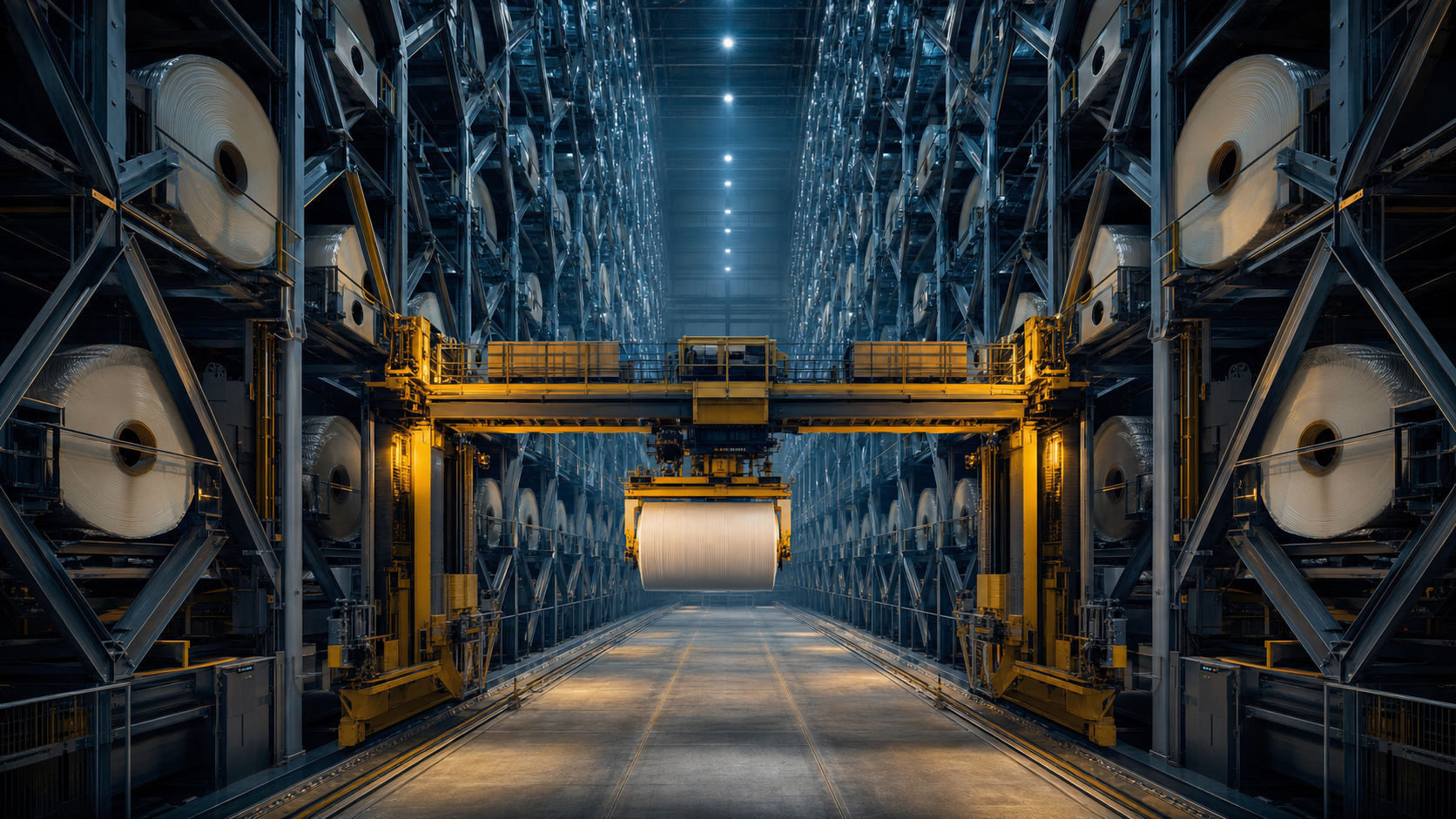
Fully automated honeycomb storage in XXL format: When the warehouse threatens production – The underestimated risk of manual intralogistics – Creative image: Xpert.Digital
The billion-dollar gamble of heavy haul logistics: Why standard solutions fail miserably here
Engineering at its limit: This 80-ton system breaks all intralogistics rules
What happens when 31-meter-long, 13.5-ton, highly sensitive high-tech materials have to be stored with millimeter precision and temperature control within 15 minutes? For the Austrian vibration protection specialist Getzner Werkstoffe, this question became an existential challenge. With a storage utilization rate of just 30 percent, manual processes were reaching their absolute limits – and, in the worst-case scenario, threatened the company's global delivery capability. Salvation came in the form of an engineering masterpiece: LTW Intralogistics developed a globally unique, fully automated, XXL-format honeycomb storage system. It transfers the inherent process risk to a high-precision 80-ton system and impressively demonstrates why intralogistics in modern mechanical engineering is no longer merely a cost factor, but rather the crucial strategic competitive advantage. Read how an Austrian megaproject is redefining the boundaries of what is technically feasible
When the warehouse becomes a lifeline: LTW Intralogistics and the Getzner project
Why a high-bay warehouse determines the survival of a production facility – and how an Austrian mechanical engineering company has redefined the limits of what is technically feasible
There are production processes that brook no delay. The manufacture of polyurethane mats is one of them. Hardly has the material been poured from the mold when it begins its chemical maturation process – and this cannot be accelerated or interrupted without irreversibly compromising the quality. Anyone relying on manual storage processes in this environment is playing with fire.
This was precisely the starting point for Getzner Werkstoffe GmbH in Bürs, Vorarlberg, Austria. Founded in 1969, the company is now one of the world's leading specialists in vibration isolation for the railway, construction, and industrial sectors. For decades, it has been producing its iconic materials Sylomer®, Sylodyn®, and Sylodamp® – highly elastic polyurethane elastomers that make trains quieter, protect buildings from vibrations, and dampen industrial noise sources. These products are distributed through a global sales network with branches in China, France, India, Japan, Jordan, and the USA, with an export rate of approximately 93 percent.
The company's economic success depends directly on the quality of its materials. And this quality is not solely determined during the production process itself, but to a significant extent during storage. The PU mats are cast in Bürs, rolled up to a length of 31 meters, and must be transported by forklift while still warm – within a time window of just 15 to 30 minutes. Afterward, they mature for one to four weeks under strictly controlled temperature and humidity conditions. Even the smallest impressions on the surface or minor temperature fluctuations can permanently impair the material properties.
These physical requirements defined the strategic problem situation with which Getzner entered the planning phase of a new storage system.
A utilization rate of 30 percent: The economic diagnosis of a dysfunctional system
Before implementing the LTW solution, Getzner operated under conditions that were simply unsustainable for a growing company with increasing production volumes. The 31-meter-long polyurethane mats were wound and unwound manually. Available storage space was limited, stacks of material blocked each other, and ergonomic working conditions were virtually impossible. The most serious symptom of this structural undercapacity: the utilization rate of the storage areas was only around 30 percent.
From an economic perspective, this figure is alarming. A utilization rate of 30 percent means that, on average, seven out of ten available parking spaces remained unused – not because there was no demand, but because the system was structurally unable to utilize the existing capacity. Every blocked parking space represents tied-up capital, inefficient material flows, and ultimately, lost growth potential.
The truly critical risk, however, was not of a business-related nature, but rather an operational one: the warehouse is the company's lifeline. If the flow of materials comes to a standstill, production can be jeopardized within minutes – because polyurethane mats stored at warm temperatures, if not placed on the cassettes in time, become unusable. A warehouse failure would not merely result in a drop in efficiency, but would be a direct attack on production continuity. Every hour of downtime translates to lost production, raw material, and potentially delayed deliveries to global customers.
It is this production-critical nature of the warehouse that distinguishes the Getzner project from a typical automation project. This wasn't about peripheral optimization – it was about safeguarding the core business.
Market context: Why automation in intralogistics is not a trend, but a necessity
The Getzner project is not an isolated case, but rather an expression of a profound structural change in industrial logistics. The European market for automated storage and retrieval systems (AS/RS) is estimated at around US$6.62 billion for 2025 and is projected to grow to over US$11.44 billion by 2031 – representing an annual growth rate of 9.28 percent. This growth pressure stems from several structural forces simultaneously.
First, land and real estate costs in industrial centers are rising continuously, forcing companies to utilize existing warehouse space much more intensively. High-bay warehouses with automated storage and retrieval systems allow for three to five times greater space utilization compared to conventional flat storage facilities. Second, the shortage of skilled workers is worsening across Europe, particularly in Germany and the Nordic countries, making manual warehousing processes increasingly expensive and more susceptible to staff shortages. Third, EU ESG regulations – from the Ecodesign Regulation to the Net Zero Industrial Act – are driving companies toward more energy-efficient production and storage infrastructures.
Robotics and automation in warehousing can increase productivity by 25 to 70 percent, reduce operating costs by up to 40 percent by 2025, and cut picking times by up to 30 percent through AI-supported optimization. The global market for warehouse automation is expected to exceed US$63 billion by 2030, while 26 percent of all warehouses worldwide are projected to be automated by 2027.
For specialized niche products such as long and bulky goods, this general market dynamic applies in an even more pronounced form: Their physical dimensions and weights make manual handling not only inefficient, but also problematic from a safety perspective and ergonomically demanding. Automating these segments places particularly high demands on system integrators – and simultaneously offers the greatest potential for differentiation.
The requirements profile: When standard solutions reach their limits
The requirements Getzner placed on a new storage system went far beyond the scope of any standard solution. The key parameters were: safe and precise handling of 31-meter-long and 1.7-meter-wide polyurethane mats weighing up to 13,500 kilograms, 600 load carriers for simultaneous operation, temperature-stable curing conditions between +5 and +35 degrees Celsius, and a significant increase in capacity and efficiency compared to the status quo.
This combination of extreme length (31 meters), extraordinary weight (13.5 tons), and simultaneously the material's extremely sensitive surface is virtually unique in intralogistics. While conventional high-bay warehouses are dominated by standard dimensions of four to twelve meters in length and payloads of one to five tons are the norm, the Getzner project required a system that far exceeds all known dimensional parameters.
Added to this was the time-critical component: Storage must take place within 15 to 30 minutes of production. The system cannot allow any buffer time for human decision-making or incorrect positioning – any delay risks material loss. And finally, the availability requirement, in line with the criticality of the system, was non-negotiable: The warehouse must be ready for use at all times, because any failure immediately jeopardizes ongoing production.
After extensive concept studies, the decision was made to use a custom-designed honeycomb storage system – a concept that had not previously existed in this form and for these dimensions.
The LTW solution: Engineering excellence at the limits of what is possible
LTW Intralogistics, founded in 1981 in Wolfurt (Vorarlberg), Austria, and now operating with locations in Austria, Germany, and the USA, positions itself as a full-system provider for customized intralogistics solutions. The company employs between 200 and 500 people and specializes in the development, manufacturing, and turnkey construction of automated high-bay warehouses.
The honeycomb storage system developed for Getzner sets new standards in several respects. The racking system was built using an in-house construction method – meaning the racking itself forms the building's load-bearing structure, resulting in significant construction savings. The system's overall dimensions are 33 x 95 x 21.5 meters. The single aisle contains 600 single-deep honeycomb compartments, each 31 meters deep. The payload per storage location is 13,500 kilograms. Twelve transfer stations with integrated access control and interfaces to on-site robots complete the system.
The centerpiece of the system, however, is the LTW 2HE-13521 AZV/S/A storage and retrieval machine – a globally unique system developed specifically for this task. It consists of two permanently connected heavy-duty stacker frames that operate synchronously and together move a three-section lifting carriage with a total width of 31 meters. The total weight of the system, including the load, is approximately 80 tons. The travel speed is 80 meters per minute, the lifting speed 30 meters per minute, with a travel acceleration of 0.30 m/s² and a lifting acceleration of 0.25 m/s². The cycle rate is eleven double cycles per hour per storage and retrieval machine.
These performance figures are remarkable in the context of the system's dimensions. An 80-ton system operating on a 33-meter-long UIC60 track, accelerating and decelerating at approximately 1.4 meters per second, places extreme demands on mechanics, control technology, and safety systems. Precise synchronization of the two RBG frames requires highly accurate measurement and control technology, as even minimal phase shifts between the two drive systems would lead to unacceptable mechanical stresses in the lifting carriage.
Innovation in detail: Load carriers as an underestimated system component
An often underestimated aspect of complex intralogistics solutions is the development of load carriers. In Getzner's case, the carriers represented an independent engineering challenge that had to balance mechanical load-bearing capacity with surface quality, weight, cost-effectiveness, and durability.
The 600 specially developed load carriers each measure 31 by 1.7 meters and are made of optimized wood-based panels. The choice of this material is economically justified: wood-based materials offer a favorable ratio of weight, load-bearing capacity, and cost at this length and width. However, the surface design is crucial for functionality: the platforms must be perfectly flat, because even the slightest irregularities would leave indentations in the not-yet-fully-cured polyurethane mats – rendering them unusable.
Roller tracks are mounted on the underside, enabling smooth extension and retraction across the entire 31-meter honeycomb depth. A specially developed extension mechanism ensures precise and reliable guidance, even under a weight of 13.5 tons. This design must function reliably for tens of thousands of cycles, which is why LTW first constructed a complete test setup, tested all processes under near-production conditions, and used the results for service life calculations and fine-tuning the design.
This validation approach is a prime example of industrial quality assurance: Instead of relying on pure simulation, real-world wear behavior was tested under operating conditions. For Getzner, this practical relevance was a decisive factor in their award decision.
Air conditioning as a quality feature: The economic dimension of process stability
A frequently underestimated competitive advantage of automated high-bay warehouses over manual solutions lies in the reproducibility of storage conditions. In Getzner's case, this aspect is not an optional extra feature, but a mandatory quality requirement.
Polyurethane elastomers react to temperature and humidity fluctuations during maturation with altered mechanical properties. Too low a temperature slows down the cross-linking reaction, while too high a temperature can accelerate it uncontrollably. Humidity fluctuations affect the foam's cell structure. For a product that must ultimately exhibit precisely defined spring characteristics to function accurately in railway superstructures, building construction, or industrial machinery, this process stability is not a matter of perfection, but of product liability.
The LTW system ensures precisely controlled temperature and humidity throughout the entire storage area, perfectly flat support surfaces without pressure points, and precise positioning of the load carriers within the honeycomb structure. This creates ideal conditions for reliable material curing – reproducible, transparent, and without quality risks. This point is not only relevant from a production engineering perspective but also commercially: Getzner products like Sylomer® hold global standard certifications and must guarantee consistent material properties across all batches. Any deviation in the curing process would jeopardize warranty claims.
LTW Intralogistics Solutions

LTW Intralogistics – Engineers of Flow - Image: LTW Intralogistics GmbH
LTW offers its customers not individual components, but integrated complete solutions. Consulting, planning, mechanical and electrotechnical components, control and automation technology, as well as software and service – everything is networked and precisely coordinated.
In-house production of key components is particularly advantageous. This allows for optimal control of quality, supply chains, and interfaces.
LTW stands for reliability, transparency, and collaborative partnership. Loyalty and honesty are firmly anchored in the company's philosophy – a handshake still means something here.
Related to this:
Millimeter-precise and weatherproof: The challenges behind Getzner's in-house automation – precisely controlled heavy loads
Availability of over 99 percent: What this number means economically
The plant availability of over 99 percent is one of the key performance promises of the LTW system for Getzner. This figure sounds technically abstract, but has considerable economic substance.
With 99 percent availability, the maximum acceptable downtime is approximately 87 hours per year – equivalent to about 3.6 days in single-shift operation or significantly less in multi-shift operation. For a system that represents the lifeblood of production, this value is not just a technical quality indicator, but an insurance-like guarantee against production interruptions.
For comparison, average industrial automation systems achieve availability levels of 95 to 97 percent. Every percentage point of availability above this level requires increased design effort in redundancy planning, maintenance planning, and remote diagnostics capabilities. LTW's decision to integrate this goal into the system architecture reflects the understanding that the system's value is defined not solely by its technical performance, but by its reliability in continuous operation.
For Getzner, this means specifically: Automating the warehouse has shifted the inherent production risk, arising from the narrow time window between manufacturing and storing the PU mats, from a human-operational to a technical-systemic risk level. And technical-systemic risks can be controlled much more effectively through design, redundancy, and preventive maintenance than human process risks.
Installation challenges: Precision work under real-world conditions
The technical complexity of a project often only becomes apparent during the installation phase. In the Getzner project, the installation of the system was particularly challenging from a logistical standpoint: minimal space was available between the existing buildings, and changing weather conditions further complicated the process.
The in-house construction method – that is, the integration of the racking system as a load-bearing building element – requires extremely high precision during assembly, because dimensional deviations in the millimeter range can affect the function of the storage and retrieval machine. At the same time, the connection to the existing material flow systems had to be ensured, including the interfaces to the on-site robots at the twelve transfer stations.
According to both parties, this integration proceeded smoothly from day one. The technical interface between the LTW system and the existing conveyor and production systems was evidently so carefully prepared that commissioning took place without any significant start-up difficulties. In practice, this is by no means a given: the integration of heterogeneous control systems from different manufacturers is one of the most frequent sources of project delays in intralogistics.
Alexander Batlogg, Logistics Process Engineer at Getzner Werkstoffe, describes the collaboration with LTW as characterized by immediate responsiveness: solutions were developed within just a few hours. This availability of on-site experts made a significant contribution to the project's success. This collaborative quality of cooperation between system integrator and client is a key success factor in complex special-purpose machine projects.
Capacity leap and efficiency gains: The transformation in numbers
The comparison between the situation before and after the LTW implementation illustrates the economic impact of automation particularly clearly. The starting point was a utilization rate of around 30 percent for manual, error-prone processes. With 600 fully usable storage locations and a significantly reduced personnel requirement for warehouse operations, the new system represents a qualitative realignment of the entire intralogistics operation.
The transformation can be quantified on several levels:
Space efficiency: The in-house construction and the vertical use of the airspace across the full hall height of 21.5 meters allow for a storage capacity that would not have been achievable with conventional methods on a comparable floor area. At the same time, the existing building is used more efficiently.
Process reliability: Automation eliminates manually caused errors during storage and retrieval. Incorrect storage, incomplete placement of mats, or damage from manual handling are structurally prevented. This has a direct impact on the scrap rate and thus on material efficiency.
Throughput: With a playing capacity of eleven double games per hour and the possibility of seamless integration into the production cycle, the system can reliably meet the time-critical storage requirement of 15 to 30 minutes after production – regardless of shift times, staff availability or weather conditions.
Predictability: Automated systems deliver precise, real-time data on occupancy, throughput, and system status. This transparency enables reliable production planning and creates the data basis for continuous process improvements.
Strategic market positioning: LTW as a specialist for the impossible
For LTW Intralogistics, the Getzner project is more than just a technical flagship project – it's a strategic positioning tool in a market segment where regular competitors cannot compete. Anyone who can develop a system that handles 13.5-ton, 31-meter-long goods with over 99 percent system availability signals to the market a competence that goes far beyond the standard portfolio.
This positioning is highly relevant from an economic perspective: In special-purpose machine manufacturing and customized intralogistics solutions, price competition and comparability are structurally limited. Those who can solve a problem that no one else can achieve prices significantly higher than those of standardized products. At the same time, strong customer loyalty effects are created: An operator who has geared their entire production system towards a specific storage system is unlikely to switch to a competitor for the next expansion or maintenance.
LTW was founded in 1981 and has since established itself as a specialist in intralogistics, with a team of 200 to 500 employees. Its geographic expansion into Germany and the USA demonstrates its ambition to use reference projects like the Getzner honeycomb warehouse as a gateway to international markets. In the European AS/RS market, which is projected to grow to over $11 billion by 2031, this strategy is clearly justified: unique technological selling points are the most effective protection against margin erosion in an increasingly competitive automation market.
Getzner Materials in a global context: Growth drivers of a niche industry
The Getzner project gains additional significance against the backdrop of the growth dynamics in which the company operates. The global market for building vibration isolation is projected to grow from US$2.66 billion in 2023 to US$4.31 billion by 2032, representing an annual growth rate of 5.5 percent. The European polyurethane market is expected to expand from US$20.1 billion in 2023 to US$31.1 billion by 2033.
This growth is driven by several megatrends: the global expansion of high-speed rail networks (especially in Asia and the Middle East), increasing urbanization and the associated need for noise reduction solutions in densely populated areas, and the growing awareness of vibration protection in industrial plants. As the world market leader with an export quota of 93 percent, Getzner benefits disproportionately from this global demand trend.
With around 500 employees worldwide and its entire production site in Bürs, growth for Getzner means increased production volume at the same location. This places constant pressure on intralogistics in terms of efficiency and capacity. Against this backdrop, the decision to invest in a highly automated honeycomb warehouse is not a costly luxury solution, but a strategic necessity – the foundation for further growth without having to expand the production area.
Benchmark in special-purpose machine manufacturing: Technological implications for the industry
The LTW 2HE-13521 stacker crane contributes to the advancement of special-purpose machine construction as a discipline in several respects. The design solution of connecting two synchronized stacker crane frames to form a three-part lifting carriage is an elegant answer to a fundamental geometric problem: individual masts with a 31-meter span would be mechanically unmanageable under the bending stress of a 13.5-ton load. In contrast, connecting two independent frames to form a cooperating system enables even load distribution and highly precise synchronous control.
The control technology required for this operates in the realm of high-precision synchronization of two mechanically decoupled but electrically coordinated drive trains. Positional deviations between the two frames during operation must remain within the sub-millimeter range to ensure the positioning accuracy of the load carrier and to prevent mechanical deformation in the lifting carriage. This control task, taking into account inertia, elastic deformations, and dynamic load changes, presents a challenging control engineering problem.
The Getzner project demonstrates that the limits of automated long-goods and heavy-load storage extend further than previously assumed. What appears to be a special case could find imitators in other industries in the medium term: shipbuilding, wind energy (rotor blade manufacturers), aerospace, and steel processing all face similar logistical challenges with extremely long and heavy semi-finished products.
Partnership as a success factor: What the project teaches beyond the boundaries of the transactional
One of the most remarkable results of the Getzner project is not technical, but rather collaborative. Getzner describes the collaboration with LTW as partnership-based, goal-oriented, and characterized by genuine commitment. In an environment where complex special-purpose plant projects regularly fail due to communication breakdowns, unclear interfaces, or a lack of responsiveness to problems, this quality of collaboration is a key success factor in its own right.
The immediate availability of LTW experts, the smooth technical integration from the first day of operation, and the constructive solution of challenges without escalation into formal contract levels – these are quality features that are rarely explicitly addressed in classic mechanical engineering, but which significantly determine the success or failure of complex projects.
For LTW, this reputational gain means more than just a positive reference: In a market where purchasing decisions for multi-million-euro investments depend heavily on recommendations and reference visits, the quality of the customer relationship is a measurable economic asset. For Getzner, it forms the basis for a long-term service and maintenance partnership that safeguards the value of the assets throughout their entire lifespan.
When intralogistics becomes a strategic competitive advantage
The LTW honeycomb storage system for Getzner Werkstoffe is more than just a technical masterpiece – it's a vivid lesson in the strategic importance of intralogistics in modern industry. In an era where production sites are under increasing pressure for efficiency and cost reduction, the quality of internal material flows is a key factor in determining the competitiveness of entire companies.
The project's economic message is clear: Investing in highly automated intralogistics precisely tailored to the production process is not an expense, but a fundamental requirement. It protects production continuity, increases capacity utilization from 30 to nearly 100 percent, eliminates quality-critical manual process steps, and creates the data transparency necessary for sustainable process improvements. For Getzner, which, with an export quota of 93 percent, must prove its competitiveness in global markets daily, such a system is not optional – it is the logistical foundation for further growth.
For LTW Intralogistics, the project demonstrates the capabilities of a highly specialized niche provider that develops solutions where others give up. In a European AS/RS market with a projected volume of over 11 billion dollars by 2031 and a structural demand for customized heavy-duty and long-goods solutions, this positioning is a lasting strategic advantage – and the Getzner honeycomb storage system is its most compelling proof.
Consulting - Planning - Implementation

Konrad Wolfenstein
I would be happy to serve as your personal advisor.
me at wolfenstein∂xpert.digital contact
Just call me on +49 7348 4088 965 .
Your intralogistics experts
Consulting, planning and implementation of complete solutions for high-bay warehouses and automated storage systems - Image: Xpert.Digital
More information here:










