
Why only direct networks can survive in global commodity trading now: Commodity markets in a state of emergency
Xpert Pre-Release

Available in 27 languages 📢
Prefer Xpert.Digital on GoogleⓘPublished on: April 22, 2026 / Updated on: April 22, 2026 – Author: Konrad Wolfenstein
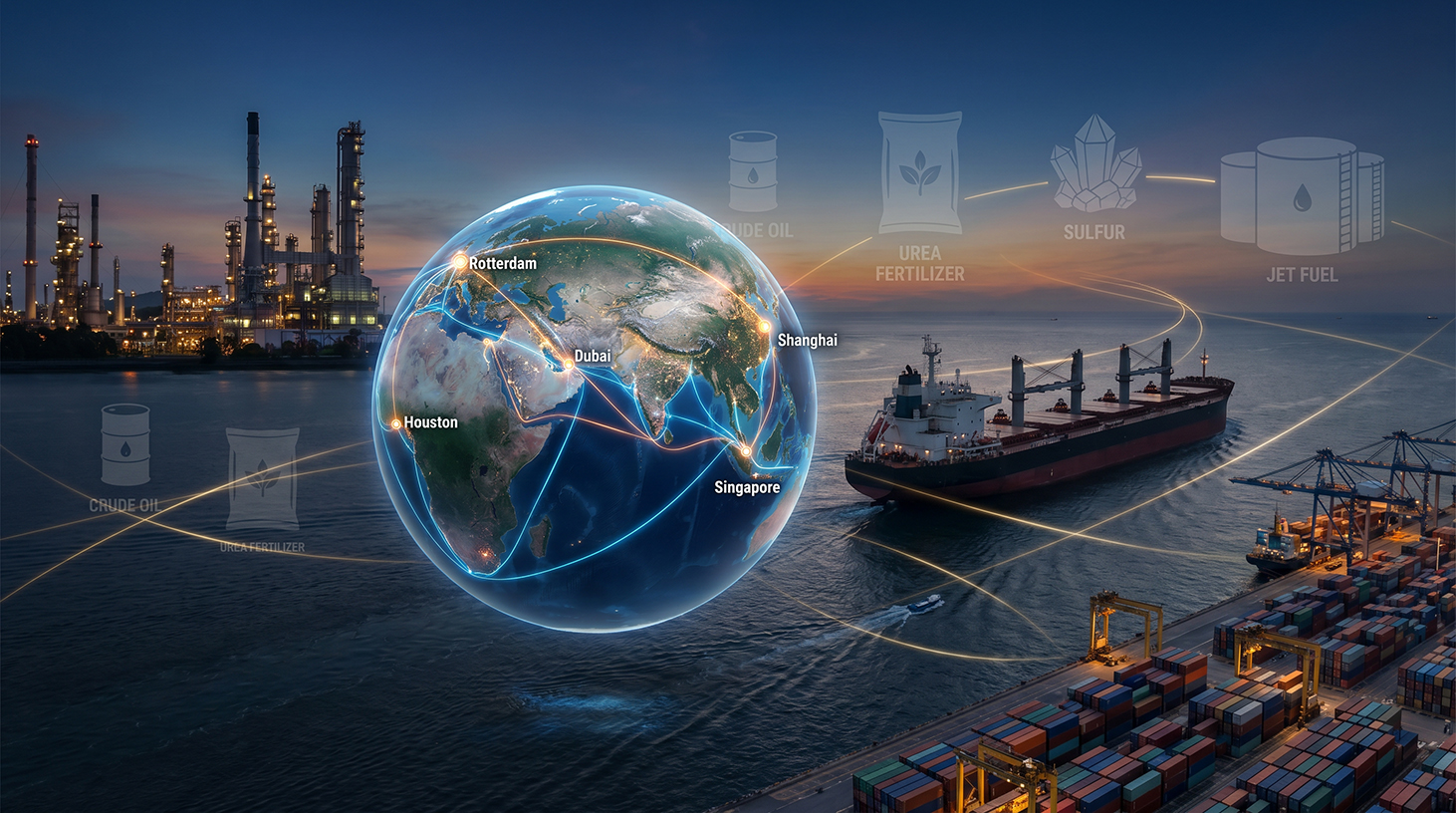
Why only direct networks can survive in global commodity trading now: Commodity markets in a state of emergency – Image: Xpert.Digital
The 2026 commodity shock: How the Hormuz crisis will forever change our supply chains
The sulfur paradox: Why a waste product is suddenly determining the future of batteries
The invisible bottleneck: How a fertilizer shortage threatens the global food supply
Global commodity markets are in an unprecedented state of emergency. What was once governed by reliable cycles and gradual market shifts is now dictated by geopolitical shocks – with far-reaching consequences for prices and global supply security. When strategic chokepoints like the Strait of Hormuz are blocked, it triggers a devastating chain reaction: kerosene for European aviation becomes dramatically scarce, diesel fuel prices skyrocket under the pressure of new regulations, and an acute shortage of urea fertilizer threatens global agriculture. At the same time, inconspicuous byproducts like sulfur are suddenly transformed into critical bottleneck resources by the boom in the battery and semiconductor industries. In this unpredictable new reality, traditional trading models that rely on long chains of intermediaries are definitively obsolete. This analysis examines the five most important commodity markets from 2022 to 2026 and reveals, without mincing words, that in times of embargoes and blocked sea lanes, only companies operating as true "Integrated Sourcing & Trading Houses" will survive. Direct market access to producers and proprietary logistics networks are no longer a mere luxury – they are the only guarantee of security of supply, trustworthy customer relationships, and stable margins.
Those who still trade without market access will pay the price – with delivery delays, margin erosion, and loss of trust
The foundation of global commodity trade: Direct connection beats intermediaries
In an era where commodity markets are driven not by gradual shifts but by shock events, the business model of the integrated sourcing and trading firm has transformed from an option to a strategic necessity. The essence of this model—connecting producers and consumers globally directly, with deep market access in regions inaccessible to conventional suppliers—is no longer a unique selling proposition but a survival strategy for companies that take security of supply seriously. This is because the geopolitical upheavals of 2022 to 2026 have fundamentally and permanently altered global commodity and supply chain markets.
What once appeared as an abstract risk premium in trade agreements is now daily operational reality: straits are blocked, export restrictions are imposed without warning, tanker markets react within hours to political decisions, and prices for critical commodities can double or halve in a matter of weeks. In this environment, a trading house that relies on direct producer relationships, its own logistics networks, and deep market access has a structural advantage over any aggregation model with multiple intermediaries.
This analysis examines the five core markets that are of central strategic importance to such an Integrated Sourcing & Trading House: crude oil, EN590 diesel, kerosene/jet fuel, urea (urea fertilizer), and sulfur/sulfuric acid. It highlights how closely these markets are interconnected and why a geopolitical shock such as the blockade of the Strait of Hormuz in the spring of 2026 would simultaneously shake all of them – and why this presents the greatest opportunity for trading companies with genuine market access.
Crude oil: The geopolitical nerve center of all commodity markets
Between OPEC discipline, shale oil expansion and the Hormuz shock
The global crude oil market in 2026 is characterized by a structural tension that fundamentally distinguishes it from all previous phases: A large oversupply in terms of production capacity coincides with a geopolitical risk environment that can neutralize any fundamental price dampening effect within hours. The International Energy Agency (IEA) had forecast a global supply increase of around 2.4 million barrels per day for 2026, with demand rising by only 860,000 barrels per day – a scenario that, on paper, suggests falling prices. At the same time, benchmark crude oil prices reached temporary peaks in early March 2026 as a result of the Hormuz blockage, when Brent crude rose by 13 percent to $82.37 per barrel in a single trading day.
This paradox – structural oversupply coupled with extreme price volatility – is the defining characteristic of the current crude oil market. On the supply side, non-OPEC+ producers initially dominated: they contributed approximately 1.3 million barrels per day of additional supply in 2025, and a further 820,000 barrels were expected in 2026. OPEC+, for its part, operates within a strategic dilemma: production cuts defend price levels but permanently cost them market share in US shale oil, Canada, and Brazil. Voluntary cuts by individual members, as well as an unusually high degree of cartel discipline, prevented significant price declines in 2025, even during periods of weaker demand.
The geopolitical dimension, however, completely overshadows this fundamental analysis as soon as key shipping routes are threatened. The Strait of Hormuz—through which roughly one-fifth of all global oil and liquefied natural gas shipments flow—transformed into a geopolitical weapon in March 2026. Following the launch of the US-Israeli offensive "Epic Fury" against Iranian nuclear infrastructure and Iranian attacks on tankers, the strait is effectively a restricted zone. Iranian attacks reportedly destroyed between 30 and 40 percent of the Gulf's refining capacity, eliminating an estimated 11 million barrels per day from the global supply. For Germany, an oil price of $100 per barrel, according to calculations by energy expert Thomas Bahlers, translates into an import bill of over €60 billion—a cost shock that could jeopardize its economic recovery.
Russia, tariffs, and the new geometry of oil flows
Parallel to the Hormuz crisis, the geopolitical realignment of crude oil flows caused by the war in Ukraine has permanently altered global trade geography. Russian crude oil prices averaged $55.64 per barrel in April 2026, structurally positioning Moscow below Brent prices—an indirect competitive advantage for buyers willing to bear the political risk. For an integrated trading house, this translates into a complex balancing act between price advantages, compliance requirements, and reputational risks. The challenge lies not in identifying the cheapest source, but rather the compliant, reliable, and legally sound one—criteria that, in a fragmented supplier environment, can only be met through in-house due diligence capabilities.
China's role in the global crude oil market remains a key uncertainty factor. The country absorbs the lion's share of cheaper Russian and Iranian oil, reducing supply diversion to the West and forcing Western European importers to rely on more expensive alternatives. At the same time, the IEA, which has significantly revised its demand forecast for 2026 downwards—now expecting a decline of 80,000 barrels per day instead of an increase—signals that past growth momentum is no longer sustainable. Electric vehicles, efficiency gains, and structural shifts in industry are putting downward pressure on OECD demand, while non-OECD markets are driving growth.
For crude oil sourcing, this complex situation means that supply stability today requires not only pricing expertise, but also access to diverse sources that can be substituted even if a critical route fails. In a Hormuz scenario, the ability to mobilize volumes from Oman, West Africa, or unsanctioned Gulf sources will determine whether delivery reliability is guaranteed or penalties are imposed.
Diesel EN590: The silent price driver in the shadow of the energy transition
Regulatory upward pressure, supply shortages and the costs of compliance
Diesel EN590, the European standard for fuel diesel with a maximum sulfur content of 10 ppm, is the backbone of the European freight transport industry – and simultaneously a market facing exceptional multiple pressures in 2026. On the price and regulatory front, according to the German price index, the diesel price for large consumers rose to €133.08 (per 100 liters) at the beginning of 2026 – following an annual average of €124.65 in 2025, which itself was already considerably lower than the 2024 average of €128.08. However, this index value masks the true cost dynamics: dealers offered B7 diesel for January 2026 with a premium of €10 to €17 per 100 liters, driven by the increase in the CO₂ tax and the greenhouse gas quota – the highest price increase at the turn of the year the market has ever recorded.
In European wholesale markets, EN590 diesel with 10 ppm was quoted at around US$722 per metric ton (corresponding to approximately US$0.639 per liter) in mid-2025, showing signs of stabilization following a previous market correction. The CO₂ price in Germany took effect in 2026 as a key regulatory factor: at a price level of €55, the consumer burden theoretically remains constant; at €60, there are additional costs of 1.6 cents per liter for diesel and heating oil; and at €65, even 3.2 cents. These regulatory costs directly and structurally affect heavy transport, agriculture, and industry.
Sourcing perspective: Why quality certification and origin diversification are crucial
For a trading house that sources and markets EN590, diversification of origin is a key strategic parameter. The EN590 specification (EN590:2013, Euro 5/6 compliant) requires a sulfur content below 10 ppm, defined cetane numbers, density, and stability values – parameters that can only be demonstrably met by SGS- or Intertek-certified products. Regions of origin with large procurement volumes include Russia, the United Arab Emirates, the Netherlands, India, Qatar, Saudi Arabia, Singapore, and the USA. Each of these sources has different levels of political risk, different transit times, and different margin structures.
The Hormuz crisis is also indirectly impacting the diesel market: Gulf refineries, which were previously among the most competitive sources of EN590, have largely ceased operations. India, a key exporter to European markets, is increasingly diverting its capacity towards Asian markets with higher margins. The result is a narrowing of the available supply coupled with growing demand. Those who lack direct refinery relationships or long-term offtake agreements in this environment are paying spot price premiums that wipe out any calculated margin. The logic is simple: In bottleneck situations, direct producer-consumer connections are not a matter of efficiency, but rather a matter of security of supply.
The regulatory dimension remains a permanent feature – the gradual tightening of greenhouse gas quotas, rising CO₂ pricing, and the medium-term political debate surrounding the internal combustion engine are narrowing the profitable market for conventional EN590 diesel. At the same time, heavy transport in Europe will remain diesel-dependent for the foreseeable future: fleet renewal cycles of 12 to 15 years, insufficient charging infrastructure for alternative drive systems, and the lack of an electric equivalent for 40-ton trucks mean that EN590 will be in critical demand until at least 2035. This structural demand continuity is the foundation of any stable diesel trading business.
The kerosene crisis: Europe's aviation industry at the limit of supply security
From the Strait of Hormuz to the European airport – a chain reaction
No other commodity crisis of 2026 impacted the daily lives of the European population as directly as the looming kerosene shortage. What began as a geopolitical conflict in the Persian Gulf culminated in warnings of canceled summer flights, fuel rationing at Italian airports, and a price surge for jet fuel from around $742 to over $1,700 per ton—a doubling within just a few weeks. At the end of March 2026 alone, over 7,000 flights worldwide were canceled in a single day, representing almost seven percent of all scheduled connections.
IEA chief Fatih Birol put it in unusually clear terms: Europe might only have sufficient kerosene reserves for about six more weeks, and the agency should soon hear of flights that could be canceled due to fuel shortages. The European Commission described kerosene as its "main concern" and acknowledged that shortages could occur in the near future – even though there was no immediate shortage at the time of the statement. EU member states were urged to closely monitor supplies for the next six months.
The structural weakness: Europe's chronic import dependency
The kerosene shortage is not an acute event, but rather the result of a structural import dependency that has been growing for years. Italy, for example, consumed around 1.3 million barrels of jet fuel daily in 2025 – almost twice its domestic production of 674,000 barrels – and was forced to import half of its daily needs. Poland sourced nearly 97 percent of its kerosene from abroad, Greece 82 percent, and Spain and Portugal 70 percent each. The trading volume of jet fuel imports to Europe fell to 420,000 barrels per day with the outbreak of the Hormuz crisis – a 40 percent decrease compared to the previous week and the lowest level since March 2022, the beginning of the Ukraine energy crisis.
The alternatives failed collectively: India, previously a major kerosene supplier to Europe, increasingly diverted its tankers eastward, where higher margins beckoned. South Korea and China introduced export restrictions to protect their domestic markets. Singapore experienced massive price fluctuations, and ships already loaded changed routes to find more lucrative buyers elsewhere. Aviation analyst Alex Macheras warned that a serious jet fuel shortage was less than a week away from major European hubs. Ryanair considered cancellations during the peak travel season, and Lufthansa examined the possibility of grounding up to 40 aircraft.
🎯🎯🎯 Global Sourcing & Commodity Trading with integrated logistics

Raw materials, global procurement & trade - Image: Xpert.Digital
State-of-the-art cargo planes, optimized transport routes, and multimodal logistics chains are interchangeable—they can be bought, leased, or outsourced. What money can't buy are direct contacts with producers in Peruvian mines, reliable supply relationships in the CIS countries, and years of built-up trust in markets that are unfamiliar to outsiders. The decisive competitive advantage in global commodity trading lies not in transporting the good from A to B, but in knowing where the good comes from, who produces it, and how to gain access before others even know the market exists. Whoever owns the network sets the price. Everyone else pays it.
More information here:
Sourcing beyond the standards: Strategies for resilient commodity trading
The trading perspective: Market access beyond the beaten path
It is precisely in this situation that the strategic value of an integrated trading house with access to unconventional sourcing regions becomes apparent. When standard tanker routes are blocked, when the usual exporting nations are holding back their capacity, and when the major international oil companies prioritize their established customers, then access to alternative sources—West Africa, unsanctioned smaller Gulf states, Eastern European refineries, and US suppliers via western routes—determines the ability to meet supply requirements. The price paid on the spot market for such volumes is high, but it is predictable if the necessary relationships have been established beforehand.
While Europe sources kerosene from the US and West Africa, these sources are structurally insufficient to compensate for a complete disruption of Gulf deliveries. For a trading house, this means that the competitive advantage of the future lies not in the cheapest standard source, but in the ability to deliver under stress – from markets where few or no competitors are active. This is the very core of the value proposition: "Regions where others can't go."
Inventories at the Amsterdam-Rotterdam-Antwerp (ARA) hub, Europe's most important warehousing center, were already below average before the crisis. This systemic weakness was therefore known – the geopolitical upheaval merely brought it to light. Companies investing now in storage capacity and alternative supply routes are positioning themselves for the next crisis, which is almost certain to come.
Urea: The invisible bottleneck behind global food security
Urea as a geopolitical tool – when fertilizer becomes scarce
Urea is the chemical compound without which a large part of global food production would be impossible. As the nitrogen-richest solid fertilizer, with a nitrogen content of 46 percent, it is the foundation of modern agriculture on every continent. The global urea market had a volume of approximately US$56.6 billion in 2025 and is projected to grow to US$67.15 billion by 2033 – at an annual growth rate of 1.9 percent. However, this moderate growth curve masks the dramatic volatility that has characterized the market in recent years.
The geopolitical mapping of the urea market makes the risk immediately apparent: Approximately 42 percent of all global urea exports originate from the Gulf region – including Qatar, Saudi Arabia, the United Arab Emirates, Iran, and Egypt. Between 20 and 22 million tons of urea are shipped annually through the Strait of Hormuz alone, representing 35 to 40 percent of the globally traded volume. With the outbreak of the Iran-Iraq War and the de facto closure of the strait, Iran's urea production facilities – all seven units of major producers such as Pardis, Lordegan, MIS, KPIC, and Shiraz – were shut down. Iran had an annual capacity of around 9 million tons, with export volumes of approximately 4.5 million tons.
The price consequences were immediate and brutal: Urea has become 35 percent more expensive since February 2026, and mineral fertilizers overall have risen by 30 to 40 percent compared to the beginning of the year. Philipp Spinne, Managing Director of the German Raiffeisen Association, compared the situation to February 2022, the start of the Russian attack on Ukraine: World market prices for nitrogen fertilizers are once again approaching the peak levels of that time. European farmers are currently paying around 550 euros net per ton of urea.
The Russia Dilemma: Between Sanctions, Dependence and Export Restrictions
The alternative to Gulf exports – Russia – is itself not a stable source of urea. In 2024, Russia was the world's largest exporter of urea, with 8.9 million tons. However, limited capacity, domestic export restrictions, and Ukrainian attacks on key facilities severely restrict its ability to expand production. Russia itself imposed export restrictions to protect its own farmers – a signal demonstrating how even exporting nations prioritize their domestic markets in times of crisis. At the same time, the EU has decided on phased tariff increases for Russian and Belarusian fertilizers: since July 2025, surcharges of €45 per ton have been in effect, rising to €70 from July 2026.
Paradoxically, Russia's share of EU fertilizer imports rose from 17 percent in 2022 to around 30 percent in 2025 – even though fertilizers were exempt from EU sanctions until June 2025, Russian manufacturers benefited from the losses of other exporters. The EU aims to eliminate fertilizer imports from Russia by 2028. In February 2026, the European Commission proposed temporarily suspending tariffs on fertilizers from other countries to facilitate imports from North Africa and the USA.
China, the world's largest urea producer, has completely halted its exports to prioritize the domestic market – a move that further exacerbates the global supply situation. New export-oriented plants are not expected to come online before 2027, ruling out any short-term capacity expansions.
Strategic action required: Diversify access now
For a trading house that sources urea, this results in a clear strategic directive: Dependence on individual regions of origin must be actively managed through long-term supply contracts with producers in non-crisis regions – North Africa (Egypt, Morocco), the USA (CF Industries, Nutrien), South Asia, and the Baltic states. Logistics integration is crucial here: Urea is a bulk commodity that places special demands on moisture protection, loading infrastructure, and storage. A trading house that masters this logistics chain can exploit price arbitrage and prioritize customers during periods of scarcity – thus securing both customer loyalty and premium margins.
The global market size for urea fertilizers is estimated at approximately US$32.73 billion in 2026 and is projected to grow to US$43.63 billion by 2034, with an annual growth rate of 3.66 percent. This long-term growth trajectory – driven by population growth, the intensification of agriculture in emerging economies, and increasing demand from bioenergy production – makes urea one of the most attractive structural trading segments overall.
Sulfur and sulfuric acid: The underestimated dual market at the interface of energy and chemistry
Sulfur: When a byproduct becomes a critical raw material
Sulfur is a paradox among raw materials: it is an unavoidable byproduct of crude oil refining and natural gas processing – yet it is at the heart of a strategic scarcity dynamic that will not end with the energy transition, but rather be exacerbated by it. The global sulfur market had a volume of approximately US$13.75 billion in 2025 and is projected to grow to US$22.4 billion by 2033, representing a CAGR of 6.12 percent. The Asia-Pacific region dominates with a 42.7 percent share of the global market, with China alone accounting for 24.3 percent. Agriculture – particularly sulfuric acid production for phosphate fertilizers – is the most important end-user sector, representing 55.8 percent.
The price development in 2025 was spectacular: In the Chinese market, the sulfur price followed a clear trajectory of "lowest price at the beginning of the year – gradual increase – high consolidation at the end of the year." In March 2025, prices in Shandong rose by 46.5 percent within a few weeks to 2,434 RMB per ton, before consolidating at a high level for six months. Looking ahead to 2026, the fundamental imbalance between limited supply growth and structurally increasing demand remains unresolved. The Chinese sulfur price reached a record high of 6,800 CNY per ton in April 2026, before declining slightly. Compared to the previous year, this represents an increase of 164 percent.
The new demand driver: Sulfur in the energy transition
What will fundamentally change the sulfur market from 2025 onwards is the explosive demand from the new energy sector – specifically, lithium iron phosphate (LFP) batteries in China and Indonesian nickel hydrometallurgy (MHP). Both processes require significant quantities of sulfuric acid. Lithium-sulfur batteries, considered the next generation of energy storage and capable of achieving a theoretical energy density of 2,600 watt-hours per kilogram – roughly ten times more than conventional lithium-ion systems – are driving research needs and, in the medium term, further increasing sulfur consumption. The Fraunhofer Institute IWS is developing cell architectures that are expected to enable a practical energy density of over 600 watt-hours per kilogram.
This new dimension of demand coincides with a supply that is structurally shrinking due to the energy transition: the less oil and gas is refined—whether through declining consumption, political decarbonization targets, or energy transition policies—the less sulfur is produced as a byproduct. The consequence is a long-term supply-demand gap that elevates sulfur from a cheap industrial chemical to a strategic raw material. Added to this are regionalized supply bottlenecks caused by plant shutdowns, copper concentrate shortages (which affect smelter production), and declining copper concentrate processing fees.
Sulfuric acid: A multi-stage growth market with dual dynamics
Sulfuric acid (H₂SO₄) is the world's most produced industrial chemical by volume – and one of the fastest growing. The global sulfuric acid market was worth approximately US$35.13 billion in 2025 and is projected to reach US$52.86 billion by 2034, at a CAGR of 4.7 percent. The Asia-Pacific region dominates with a market share of 50.58 percent. A smaller but more dynamic sub-market – high-purity sulfuric acid for the semiconductor industry – is expected to grow at a CAGR of 6.1 percent, reaching US$0.75 billion by 2032.
In China, the sulfuric acid market experienced significant upward momentum in the first two months of 2026. The reference price for sulfuric acid reached 1,057 RMB per ton at the end of February 2026, representing an increase of 12.8 percent compared to the beginning of the year and 125 percent compared to the previous year. Market analysts estimate the sulfuric acid market at approximately US$19.31 billion for the full year 2026. The market is projected to grow to over US$49 billion by 2035, exhibiting a remarkable CAGR of 10.8 percent, driven by phosphate fertilizers, chemical production, mining, and the expanding semiconductor industry.
Sourcing strategies for volatile sulfur and sulfuric acid markets
For a trading house that integrates sulfur and sulfuric acid into its portfolio, a two-tiered strategy emerges: On the raw sulfur side, the most attractive sources of supply lie with large refineries and natural gas processors – in the Middle East, Central Asia, and Canada – which must sell sulfur as an unavoidable byproduct. Here, leverage arises from volume commitments and logistical integration: Whoever reliably transports and markets sulfur quantities receives preferential terms compared to spot market buyers.
With sulfuric acid, the product's chemical hazards (highly corrosive, stringent safety requirements) act as both a barrier to entry and a safeguard against competition: Only suppliers with appropriate logistics certification, ADR/IMDG-compliant tanks, and safety expertise are considered by industrial customers. This structural quality advantage translates into premium margins, particularly when supplying mining companies, phosphate fertilizer manufacturers, and semiconductor manufacturers, all of whom rely on consistent quality.
Market Synergy: Why Integrated Trading Is Superior
When all raw materials are under pressure at the same time – and what that means
The most fascinating and simultaneously most dangerous aspect of the current commodity situation is the coincidence: A single geopolitical shock – the blockade of the Strait of Hormuz – simultaneously shakes crude oil, diesel, kerosene, urea, and sulfur. This is due to the chemical and logistical interconnectedness of these markets: Crude oil is the basis for diesel and kerosene. Natural gas, exported via Hormuz, is the production input for urea. Refinery processes hampered by oil shortages reduce the by-product supply of sulfur. The price signals of all these markets rise simultaneously, reinforcing each other and creating an inflationary spiral that can drive companies without secure supply chains into existential crises.
Russia is profiting from this situation with shocking precision: The de facto closure of the Strait of Hormuz has, according to current calculations, brought the country additional revenue of over ten billion euros per month – solely through increased prices for oil, gas, and fertilizer. Countries that have signed Western sanctions are losing their price advantage; countries that continue to buy Russian goods are benefiting from lower purchase prices. For a trading house, this presents a complex challenge of navigating compliance – and a market environment in which transparency and legal certainty are becoming the defining characteristics of the product.
Integrated logistics as a strategic differentiator
In this market environment, logistics integration is not an operational add-on, but a core strategic element. A tanker that is in the right place at the right time – whether carrying diesel for a North German refinery or urea for a Brazilian agricultural importer – generates margins during shortages that would be unthinkable in a normal market. Conversely, a trading house that relies on third-party logistics is the supplier of last choice in times of crisis – and consequently receives poor terms or cannot find any capacity at all.
Direct shipping contracts, flexible Incoterm structures (CIF, FOB, DDP, EX-TANK), owned or long-term leased storage terminals in strategic hubs such as Rotterdam, Antwerp, Hamburg, Dubai, and Singapore – this is the infrastructural foundation without which deep sourcing in peripheral markets is not scalable. The commodity markets of 2026 will reward companies that have established this foundation – and penalize those that have not, with delivery delays, reputational damage, and margin losses.
Compliance, sanctions and due diligence – the invisible competitive advantage
The tightening of international sanctions has opened up a new dimension of competition: compliance has become a differentiator. Those who demonstrably work exclusively with non-sanctioned sources, can provide SGS/Intertek certificates for every shipment, maintain complete documentation of origin, and process payments through vetted banking partners (LC/DLC with bank guarantee) gain the trust of institutional buyers and government clients. This advantage in terms of trust can be translated into long-term supply contracts with stable margins – the ultimate goal of every reputable commodity trader.
Commodity markets will continue to face structural challenges in the coming years: 79 percent of all global supply chains anticipate that costs will lead to a major disruption in 2026. The solution lies not in hoping for a return to normalcy, but in actively shaping resilient procurement networks – diversified, direct, documented, and secured by in-house logistics capabilities. This is precisely the value of an Integrated Sourcing & Trading House that not only brokers but also delivers.
Commodity markets 2026/2027 – Structural change as a permanent condition
Global commodity markets are in a state that can no longer be described as a temporary disruption, but rather as a permanent structural transformation. Geopolitical risks—from the Hormuz blockade to the war in Ukraine and US tariff policy—are no longer anomalies, but systemic market drivers. The IEA's downward revision of its oil demand forecast by 730,000 barrels per day in a single month illustrates how rapidly fundamental parameters are shifting. The OPEC+ strategy of controlled scarcity and US shale oil expansion form a fragile equilibrium that can be disrupted by any regional conflict.
For sulfur and sulfuric acid, the rising demand from the battery industry and agriculture will have a long-term structurally driving price increase, as long as the supply of these byproducts shrinks due to the energy transition. For urea, the challenge of dual dependence on fossil production inputs (natural gas) and politically exposed export regions remains. For diesel and kerosene, regulatory cost increases and geopolitically induced supply bottlenecks mean permanently heightened price volatility.
In this environment, the ability to react quickly to market changes, activate alternative sources, and meet delivery obligations even under extreme conditions is the only sustainable competitive advantage in commodity trading. It is not the lowest price that wins in the long run, but the most reliable delivery performance – in markets where others cannot reach, and at times when others cannot deliver.
Your contact for raw materials ⛏️ Global sourcing 🚢🌐 & trading 📦

Konrad Wolfenstein
I would be happy to serve as your personal advisor.
• Contact: [email protected]
• Tel: +49 7348 4088 961
Our global industry and economic expertise in business development, sales and marketing

Our global industry and economic expertise in business development, sales and marketing - Image: Xpert.Digital
Industry focus areas: B2B, digitalization (from AI to XR), mechanical engineering, logistics, renewable energies and industry
More information here:
A thematic hub offering insights and expertise:
- Knowledge platform covering global and regional economies, innovation and industry-specific trends
- A collection of analyses, insights, and background information from our key areas of focus
- A place for expertise and information on current developments in business and technology
- A hub for companies seeking information on markets, digitalization, and industry innovations





