
Belt and Road Initiative (BRI) | The geostrategic significance of the “New Silk Road”: China’s largest geopolitical experiment
Xpert Pre-Release

Available in 27 languages 📢
Prefer Xpert.Digital on GoogleⓘPublished on: May 13, 2026 / Updated on: May 13, 2026 – Author: Konrad Wolfenstein
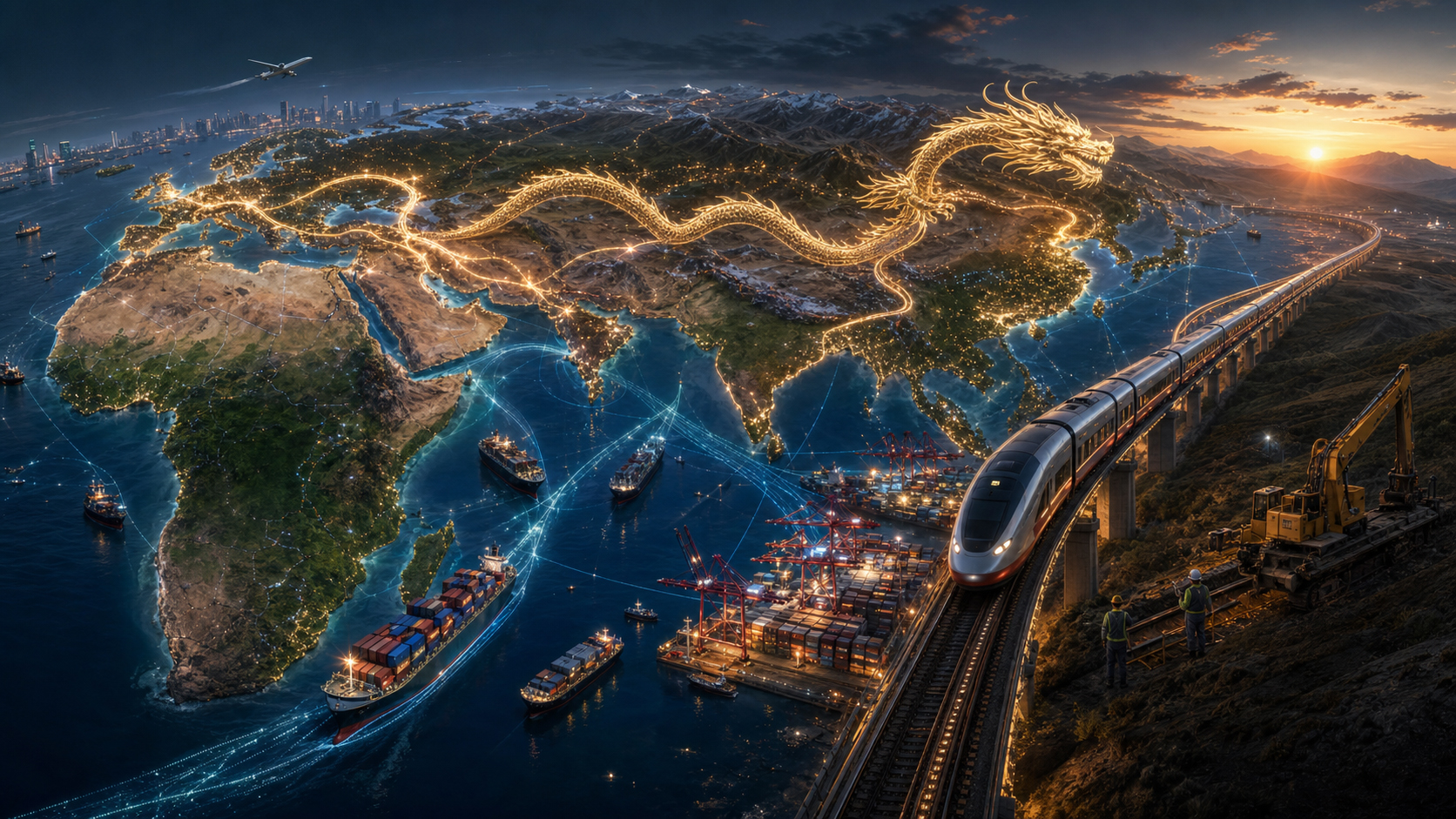
Belt and Road Initiative (BRI) | The geostrategic significance of the “New Silk Road”: China’s largest geopolitical experiment – Image: Xpert.Digital
The invisible danger: Why China's "Digital Silk Road" should alarm the West
China's biggest experiment: How China is reshaping the globe with the New Silk Road
The Belt and Road Initiative is far more than just a gigantic infrastructure project – it is China's most powerful tool for reshaping global power relations. In 2025, the controversial trillion-dollar program will reach an unprecedented peak: never before have so many investments flowed into ports, power plants, and digital networks around the globe. But behind the gleaming facades of these mega-structures, deep cracks are revealed. While more and more partner countries groan under crushing debt burdens, Beijing is increasingly transforming from a generous lender into a relentless debt collector. At the same time, with the Digital Silk Road, China is weaving an invisible but highly effective web of technological dependencies. This article illuminates the true dimensions of Xi Jinping's geopolitical masterpiece, exposes the system's glaring weaknesses, and analyzes why the West's hastily formulated counter-offers have so far often fallen flat.
Between record investments and the reality of debt — how Beijing's global infrastructure offensive is redefining the world order
Since its inception in 2013, the Belt and Road Initiative (BRI) has grown into one of the most consequential and controversial geopolitical megaprojects of our time. What began as an ambitious infrastructure program by Chinese President Xi Jinping has evolved into a complex global network of capital flows, strategic dependencies, economic opportunities, and mounting debt burdens. In 2025, the initiative will reach its current peak—while at the same time, signs of a structural realignment are mounting, both confirming and fundamentally challenging Beijing's original ambitions.
Origin and concept: A vision for the 21st century
When Xi Jinping announced the initiative in two key speeches in the fall of 2013—first in Kazakhstan for the land corridor, then in Indonesia for the maritime route—he deliberately appealed to historical memories. The ancient Silk Road, that legendary network of trade routes between China and the West which had connected cultures and created prosperity for centuries, served as a symbolic blueprint for a modern project of a far greater scale.
The Belt and Road Initiative (BRI) is organized along two main axes: The Silk Road Economic Belt connects China to Europe via Central Asia, Iran, and Turkey; the Maritime Silk Road of the 21st Century leads from Chinese coastal ports across the South China Sea, the Indian Ocean, the Horn of Africa, and the Red Sea to the Mediterranean Sea. These traditional corridors are complemented by a Digital Silk Road, which has been systematically developed since 2017 and encompasses fiber optic cables, 5G network infrastructure, data centers, smart cities, and cloud computing capacities in the BRI partner countries.
The conceptual core of the initiative is the idea of connectivity—in Chinese, hui tong, which means something like "establishing connections and opening channels." Underlying this is the strategic belief that improved physical and digital infrastructure accelerates the movement of goods, reduces transaction costs, opens up new markets, and ultimately promotes economic growth for all involved. This logic is not wrong—however, it ignores the asymmetrical power relations that arise when a single state actor plans, finances, and builds infrastructure on such a scale.
The financial volume: dimensions beyond all historical comparison
No infrastructure program in human history even comes close to the scale of the BRI. Since its launch in 2013, China has signed investment and construction contracts with over 150 countries totaling more than US$1.4 trillion. This equates to a network encompassing more than 70 percent of the world's population, 55 percent of global GDP, and 75 percent of global energy reserves.
The year 2025 marks a historic turning point. With a total commitment of US$213.5 billion in new contracts—of which US$128.4 billion were for construction projects and US$85.2 billion for direct investment—China surpassed its previous record by a remarkable 75 percent compared to the previous year. In the first half of 2025 alone, contracts worth US$124 billion were signed, already exceeding the total for 2024. The latest mid-year report, jointly published by Griffith University and the Green Finance & Development Center in Shanghai, recorded a total of 350 transactions in the first half of 2025, a 19 percent increase compared to the same period last year.
In 2024, China had signed construction contracts worth $70.7 billion and made foreign direct investments exceeding $51 billion. The most attractive region at that time was the Middle East with $39 billion, followed by Africa with $29.2 billion. The pace of acceleration in 2025 is therefore remarkable and cannot be explained solely by economic factors—it reflects a strategic reprioritization by Beijing, which will be discussed further below.
Sectors and Geography: Where China places its capital
The energy sector dominated BRI engagement in 2025, accounting for approximately 43 percent of the total volume—an increase of more than ten percentage points compared to the previous year. Of the $44 billion invested in energy projects in the first half of 2025 alone, half went to oil and gas infrastructure. The largest single project was a $20 billion gas processing park in Nigeria. At the same time, renewable energy saw a significant increase in importance: investments in wind, solar, and waste-to-energy projects reached $9.7 billion, and nearly 12 gigawatts of new capacity were installed globally in BRI countries.
The Griffith Asia Institute therefore described 2025 as the greenest and dirtiest year in the history of the BRI energy agreements—a fitting paradox. On the one hand, China is increasingly translating its leadership role in renewable energies into its foreign investments; on the other hand, the strategic securing of fossil fuels and raw materials remains the core of its commitment.
The concentration of mining projects is particularly striking: around 60 percent of all mining agreements in 2025 were for Kazakhstan. The country produces 19 of the 34 raw materials classified as critical by the European Union and possesses significant deposits of rare earth elements, lithium, cobalt, and uranium. China's systematic pursuit of these reserves is no accident, but rather follows a long-term supply chain strategy: whoever controls the extraction and transportation infrastructure for transition metals controls essential parts of the global energy and technology transformation.
Africa remains the most important BRI region in terms of the number of projects, accounting for more than a third of all new contracts, followed by the ASEAN states with around a quarter. The Middle East is rapidly gaining importance due to its energy policy significance and its strategic location between Europe, Asia, and Africa. For Central Asia, where Kazakhstan plays a key role, BRI investments have expanded from resource development and transport infrastructure to more technology-intensive projects.
The debt question: Between myth and measurable reality
Few aspects of the BRI have been discussed as intensely and controversially as the concept of so-called debt-trap diplomacy. The term was coined in 2017 by Indian security expert Brahma Chellaney, who accused China of deliberately driving poorer countries into unsustainable debt burdens in order to then acquire strategic infrastructure in return. The Hambantota port in Sri Lanka, which China leased for 99 years in 2017 in exchange for debt relief following a default by the Rajapaksa government, has consistently served as a prime example.
However, the scholarly analysis of this case by the renowned Chatham House in London revealed a more nuanced picture. The port project was by no means initiated by China to maneuver Sri Lanka into dependency—it was the Sri Lankan government of Rajapaksa itself that, for domestic election campaign reasons, insisted on the prestigious infrastructure project and actively sought Chinese financing for it. The debt crisis arose primarily from the mismanagement of local elites and the inherent dynamics of Western-dominated financial markets, not from a Chinese master plan. Chatham House concludes that the available evidence for a systematic debt trap strategy is limited and that the Chinese development finance system is too fragmented and poorly coordinated to pursue such finely tuned strategic objectives.
Nevertheless, it would be a mistake to dismiss the debt problem as irrelevant. A comprehensive analysis by the AidData research institute at William & Mary University in the US has found that the BRI has created hidden debts totaling US$385 billion for dozens of low- and middle-income countries. These liabilities are not included in official national debt figures because financing was often handled through special state-owned companies rather than directly through the host countries' finance ministries. According to AidData, 42 low- and middle-income countries are now indebted to China to the tune of more than 10 percent of their annual GDP.
The figures for 2025 starkly illustrate the gravity of this development. Of the total $35 billion that developing countries will have to repay to China in 2025, $22 billion will be owed to the 75 poorest and most vulnerable countries. A recent report by the Australian Lowy Institute states that China has increasingly shifted from the role of lender to that of debt collector. In 54 developing countries, debt payments to China now exceed total payments to the Paris Club, the traditional group of Western sovereign creditors. AidData adds that 80 percent of all Belt and Road Initiative (BRI) projects are experiencing financial difficulties, and that China had to inject approximately $240 billion into bailout loans for 22 developing countries between 2008 and 2021.
The crucial analytical finding is therefore this: While the debt trap, in its deliberately strategic form, is difficult to prove, its actual economic impact on fragile states is very real. The combination of a lack of transparency in lending, weak governance in recipient countries, and the structural power imbalance between Beijing and small developing economies has created a situation that, for many countries, de facto produces the dependency described by critics—even without the need to prove a debt trap strategy.
Quality and problems: What's behind the numbers
Besides the debt problem, BRI projects exhibit a number of other structural weaknesses. The AidData analysis puts the proportion of projects with serious problems—including corruption scandals, labor rights violations, environmental damage, and public or political opposition—at 35 percent. This is not a minor issue, but a systemic pattern.
A lack of transparency in loan approvals and contract terms is a recurring point of criticism, addressed by the German foreign trade promotion agency Germany Trade & Invest (GTAI), as well as by the World Bank, the OECD, and numerous non-governmental organizations. Chinese companies frequently receive preferential treatment in projects financed with Chinese state funds, systematically disadvantaging local businesses and international competitors. As a result, local value creation remains limited, technology transfer is minimal, and the anticipated employment effects for the local population fall far short of initial promises.
In numerous countries, BRI projects were renegotiated or halted by new administrations following changes of government. Malaysia has repeatedly terminated and renegotiated contracts. Pakistan, one of the largest BRI recipients under the China-Pakistan Economic Corridor (CPEC), has been mired in a chronic debt crisis for years. Laos has accumulated debt for the construction of the Chinese-financed high-speed rail line, fundamentally jeopardizing the macroeconomic stability of this small, landlocked country. Sri Lanka declared economic bankruptcy in 2022 as a consequence of its debt problems. While none of these cases can be attributed solely to the BRI, they all share the pattern of an inadequately designed financing structure and insufficient risk assessment on both sides.
China itself has responded to these problems. As part of the "Clean BRI" initiative launched in 2021, new guidelines for environmental and social standards were introduced, although their enforcement falls far short of the promises made. The phase of massive quantitative expansion is increasingly giving way to an approach of "small, beautiful" projects, where quality and profitability are given greater priority.
Our China expertise in business development, sales and marketing

Our China expertise in business development, sales and marketing - Image: Xpert.Digital
Industry focus areas: B2B, digitalization (from AI to XR), mechanical engineering, logistics, renewable energies and industry
More information here:
A thematic hub offering insights and expertise:
- Knowledge platform covering global and regional economies, innovation and industry-specific trends
- A collection of analyses, insights, and background information from our key areas of focus
- A place for expertise and information on current developments in business and technology
- A hub for companies seeking information on markets, digitalization, and industry innovations
Global race for infrastructure: China, the EU and the future of digital standards
The Digital Silk Road: China's invisible infrastructure
While the physical infrastructure of the BRI, in the form of ports, railways, and highways, is visible and receives significant media attention, a strategically equally important part of the initiative is unfolding almost invisibly: the Digital Silk Road. Systematically developed since 2017, this program encompasses the construction of fiber optic connections, submarine cables, 5G networks, data centers, smart city systems, and a surveillance and control infrastructure in developing and emerging countries.
The strategic importance of the Digital Silk Road lies in the fact that digital infrastructure creates lasting dependencies to an even greater extent than physical infrastructure. Whoever lays the fiber optic cables, builds the 5G base stations, and operates the smart city platforms controls, in the broadest sense, the data flow—and thus an increasingly valuable strategic resource. Chinese providers like Huawei and ZTE utilize state funding and offset agreements that their Western competitors cannot access. This subsidized competitive advantage has secured market share for Chinese technology companies in numerous countries, which are now effectively dependent on Chinese hardware and Chinese standards.
In parallel, China has strategically attempted to establish its technological standards as global standards through its "China Standards 2035" initiative. Defining industry standards—whether in telecommunications, the energy sector, or artificial intelligence—gains long-term market advantages and creates regulatory lock-in effects for all subsequent generations of technology. The Digital Silk Road is therefore not only an infrastructure project, but also a standardization project of world-historical significance.
Geopolitics and power shifts: BRI as a foreign policy instrument
From the outset, the BRI was more than an economic development program. It is China's most important foreign policy instrument for shaping a multipolar world order in which Beijing claims a leading role. Through the BRI, China gains access to geostrategically important ports, transport corridors, and natural resources; it creates economic dependencies that generate political loyalties; and it establishes multilateral forums and institutions—such as the Asian Infrastructure Investment Bank (AIIB) and the Belt and Road Initiative—that offer an alternative financing architecture to the Western-dominated World Bank-IMF system.
In a recent analysis, the German Bundestag explicitly highlighted the dual function of the Belt and Road Initiative (BRI): it serves as both an economic and a geopolitical instrument, granting China strategic access to global transport corridors and political influence in partner states. Particularly in sensitive regions like the Middle East, China has used its BRI presence to expand both its economic and security influence in conflict zones. The Italian Senate recently warned of growing Chinese influence and called for a stronger European response to the political dependencies associated with the BRI—Italy's withdrawal from the BRI in 2023 was a clear signal.
ASEAN states are pursuing a remarkably pragmatic dual strategy: They are using the BRI for economic development goals, but at the same time addressing the risks of growing political dependence and keeping alternative alliance options open. This balancing act is characteristic of how many countries in the Global South are dealing with the Chinese infrastructure offensive: They want the capital, but not the price in the form of political concessions.
Alongside the BRI, China has introduced a new foreign policy instrument, the Global Development Initiative (GDI), which is broader in scope and focuses more strongly on social development, health, and food security. This diversification suggests that Beijing has recognized the limitations of the infrastructure-heavy BRI approach and is further developing its global influence architecture.
China's self-interest: Domestic drivers of foreign expansion
A frequently neglected aspect of BRI analysis is the question of the project's domestic driving forces. The initiative is not solely driven by geopolitical ideology, but also responds to China's tangible economic self-interest. AidData has demonstrated that Beijing is pursuing three main domestic objectives with the BRI: to convert the enormous foreign exchange reserves from the export surplus into profitable overseas projects, to utilize the oversized domestic construction and industrial capacities through foreign contracts, and to secure the supply of raw materials for the economy and industry.
Chinese construction companies and engineering firms have experienced a massive internationalization boost as a result of the Belt and Road Initiative (BRI) and are now present in a multitude of markets where they did not exist before 2013. State financing through the China Exim Bank and the China Development Bank enables conditions that privately financed Western competitors can hardly offer. This state-subsidized competitive advantage is one of the main points of criticism from Western governments and business associations.
China's domestic economy is itself under considerable pressure. The severe real estate crisis, weakening domestic demand, and growing geopolitical tensions with the US have led Beijing to use the BRI as an outlet for excess industrial and financial capacity. From this perspective, the record increase in BRI spending in 2025 is also a symptom of domestic growth problems—China is projecting outward what has stalled internally.
Western counter-offers: Between aspiration and reality
The rise of the Belt and Road Initiative (BRI) has forced Western industrialized nations to rethink their own global infrastructure policies. In 2022, the G7 countries adopted the Partnership for Global Infrastructure and Investment (PGII) with the goal of mobilizing approximately $600 billion for infrastructure projects in developing countries by 2027. The EU launched its own approach, called Global Gateway, in December 2021, with a target of €300 billion by 2027. In October 2025, the European Commission announced that the €300 billion target had already been reached two years ahead of schedule—over €306 billion had been mobilized.
These Western initiatives differ from the BRI in several key structural features. While China uses state-owned banks as its primary financing channel and retains direct control over project planning and awarding, PGII and Global Gateway rely primarily on mobilizing private capital. This is conceptually more market-oriented, but carries the structural risk of non-commitment: private investors choose based on return considerations, not development policy priorities, and shy away from the political and economic risks of many partner countries.
With the Global Gateway, the EU also emphasizes quality standards in transparency, environmental, social, and governance (ESG) factors, which are perceived by governments of the Global South as both well-intentioned and paternalistic. Many recipient countries face the dilemma that Chinese infrastructure can be implemented more quickly and with fewer requirements—even if the long-term conditions are less favorable. The competition for the Global South is therefore not solely a competition of quality, but also a competition of speed and convenience, in which China has structural advantages.
The Australian Lowy Institute offers a sobering assessment of the Western counter-strategy: While Beijing has assumed the role of debt collector, Western governments have focused on internal problems, while development aid has been reduced and multilateral support has diminished. The strategic space that China has occupied over the past twelve years through the BRI will be difficult to regain through short-term Western programs.
Structural change of the BRI: From client to debt collector
The BRI is undergoing a profound structural transformation that is fundamentally altering its original logic. In the first phase, up to around 2016, the grand infrastructure promise dominated: China generously granted loans, built ports and railways, and the world watched in amazement. In the second phase, from 2016 to 2023, the problems began to surface: unprofitable projects, debt crises in recipient countries, growing international criticism, and China's own real estate crisis.
The third phase, which has been emerging since around 2024 and will fully unfold in 2025, is characterized by a paradoxical simultaneity: On the one hand, investment volume is reaching new record highs, while on the other hand, China is simultaneously having to inject billions into rescue packages for heavily indebted partner countries. Germany Trade & Invest observes that China is increasingly shifting from the role of client to that of contractor—it is no longer the initiator of projects, but rather participates as a construction company in projects financed and planned by others. This shift is a sign of pragmatic adaptation, but also an indication that the limits of the original financing model have been reached.
China's outstanding debts to BRI countries are currently estimated at more than US$2.2 trillion. AidData puts the figure for hidden debts alone—that is, liabilities not officially recorded—at US$385 billion. In this situation, China is both a creditor and a risk bearer—and faces the delicate task of collecting outstanding debts without jeopardizing its geopolitical position in the countries concerned. This is a structural dilemma for which there is no easy solution.
Assessment and perspectives: What the BRI really changes
A balanced overall assessment of the BRI must take into account both its undeniable successes and its structural shortcomings. On the positive side, there is the simple fact that hundreds of billions of dollars have flowed into infrastructure that many developing countries could not have built on their own or with Western assistance. Ports, railways, power plants, and digital networks that exist today and connect people would not have been built without the BRI. The infrastructure needs of developing countries are real and massive—and they remain even when one levels legitimate criticism at Chinese conditions.
On the downside, a pattern of structural problems has emerged that has proven to be systemic. Lack of transparency, preferential awarding of contracts to Chinese companies, inadequate risk assessment, environmental damage, and political interference are not accidents, but rather consequences of a state-controlled financing logic that conflates development impact with commercial and strategic self-interest. The 35 percent of projects that, according to AidData, face serious problems are not a statistical anomaly—they represent a volume of billions of dollars and affect millions of people.
Whether the BRI will be successful in the long term as an instrument of Chinese global order policy depends on several factors that remain unclear today. First, will China manage its growing role as a debt manager in such a way that partner countries are not permanently alienated? Second, can the Western alternatives—the Global Gateway and the PGII—mobilize substantial investments that truly compete with the BRI? Third, will China be able to establish the Digital Silk Road globally as a standard-setting infrastructure before Western regulation and geopolitics counteract it?
What can be said with certainty is that the Belt and Road Initiative has already changed the geo-economic landscape of the world. It has opened a new chapter in development finance, which is neither the end of history nor the triumphant realization of Chinese visions—but rather a complex, contradictory, and still ongoing experiment with global implications.
Your global marketing and business development partner
☑️ Our business language is English or German
☑️ NEW: Correspondence in your native language!

Konrad Wolfenstein
I and my team are happy to be available to you as your personal advisor.
You can contact me by filling out the contact form here simply call me at +49 7348 4088 965. My email address is [email protected]:or
I'm looking forward to our joint project.
☑️ SME support in strategy, consulting, planning and implementation
☑️ Creation or realignment of the digital strategy and digitization
☑️ Expansion and optimization of international sales processes
☑️ Global & Digital B2B trading platforms
☑️ Pioneer Business Development / Marketing / PR / Trade Fairs
🎯🎯🎯 Data-driven B2B industry hub as a quasi-in-house solution

The quasi-in-house solution: How Xpert.Digital closes operational gaps in B2B marketing and sales – Smart Content-Driven Business - Image: Xpert.Digital
Xpert.Digital is a data-driven B2B industry hub led by Konrad Wolfenstein . The company acts as an external, quasi-in-house solution for industrial partners, closing operational gaps in marketing, content, and sales – without requiring additional resources on the client side.
More information here:





