
The drastic transformation of Joschka Fischer: From left-wing street fighter to millionaire advisor for capital
Xpert Pre-Release

Available in 27 languages 📢
Prefer Xpert.Digital on GoogleⓘPublished on: April 8, 2026 / Updated on: April 8, 2026 – Author: Konrad Wolfenstein
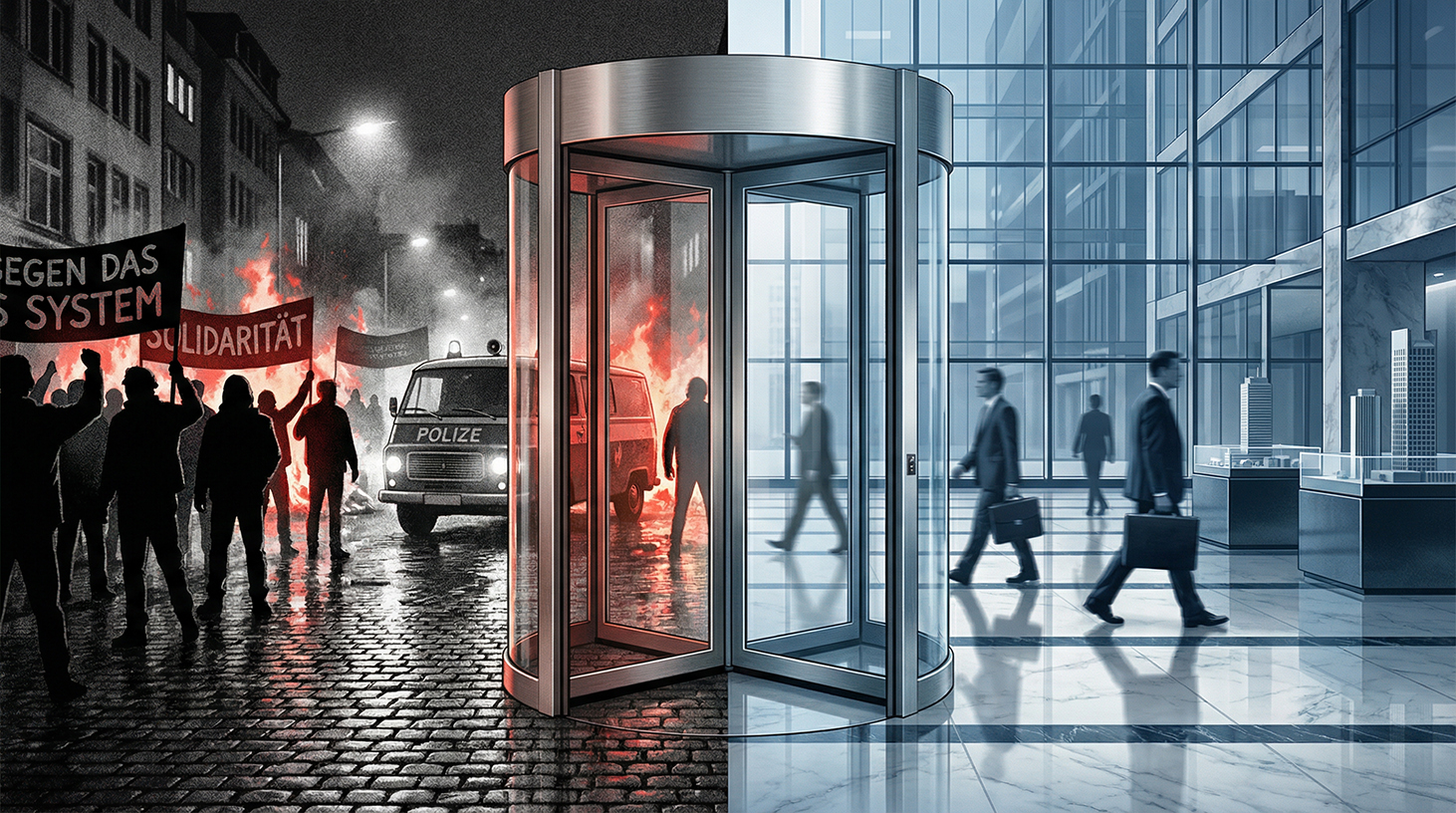
The dramatic transformation of Joschka Fischer: From left-wing street fighter to capitalist millionaire consultant – Image: Xpert.Digital
First stones thrown at police officers, then millions of corporations: The Joschka Fischer phenomenon
The Joschka Fischer case: How radical protest became a lucrative business model – Between idealism and capital
A life as a political paradox: How Joschka Fischer turned his political legacy into money
No other politician in the Federal Republic of Germany embodies the contradiction between revolutionary aspirations and systemic integration as vividly as Joseph Martin Fischer, known as Joschka. To tell this man's story is to recount several lives simultaneously: that of the street fighter from Frankfurt who attacked police officers with a helmet and club; that of the "sneaker minister" who achieved the impossible and transformed an anti-party party into a governing party; and finally, that of the highly paid management consultant who, for fees in the millions, leveraged his foreign policy network to advise corporations like RWE, BMW, and Siemens. This biography is more than just a gripping life story. It is a lesson in the logic of democratic systems, in the economics of political reputation, and in the question of whether radical change and personal integrity are compatible in the long run.
Fischer's career path cannot be seriously assessed without understanding the social and political context of his rise. He was born on April 12, 1948, in Gerabronn, the son of a butcher of German descent from Hungary. The family were among the displaced persons who sought a new home in Württemberg after the Second World War. The young Fischer dropped out of high school before graduating, began an apprenticeship as a photographer, which he also did not complete, and worked as a taxi driver and day laborer. A middle-class background? Non-existent. An academic career? Out of the question. And yet: This man without a degree would rise to become the Federal Foreign Minister of the world's third-largest economy, a visiting professor at one of the most prestigious universities in the United States, and a multi-millionaire in the global consulting market. Such a career cannot be explained by talent alone. It is explained by a unique historical moment, the political energy of a generation, and an extraordinary capacity for self-transformation.
Related to this:

The formative years of violence: Frankfurt in the early 1970s
To understand Fischer's later development, one must grasp the radical nature of his starting point. In the early 1970s, Frankfurt am Main was the epicenter of the German left. It was here that Andreas Baader and Gudrun Ensslin set fire to two department stores in 1968. It was here that the Revolutionary Cells emerged as Germany's second urban guerrilla movement. And it was here that the militant group formed which would later become famous as the "cleaning squad"—a term that, internally, stood for order and discipline in street fighting, and not for cleaning duties.
Fischer was the leader of this group. The cleaning crew trained systematically: they practiced hand-to-hand combat in the Frankfurt area, used captured police equipment for training exercises, and operated as the militant arm of the so-called Revolutionary Struggle. In April 1973, the clashes surrounding occupied houses on Kettenhofweg in Frankfurt escalated into open street battles. Photographs from that year, which only came to light in 2001, show Fischer wearing a black motorcycle helmet, punching a police officer lying on the ground. Fischer himself confirmed the authenticity of the photos, saying: "Yes, I was militant. We occupied houses, and when they were to be evicted, we resisted. We threw stones. We were beaten up, but we also fought back hard."
The "cleaning group" is believed to have played a key role in the attack on the Spanish Consulate General in September 1975, when around 200 masked individuals threw Molotov cocktails at police officers. A demonstration in May 1976 escalated to such an extent that a police officer suffered life-threatening burns covering 60 percent of his body. This was apparently the turning point for Fischer personally. Deeply affected by this violence, he publicly distanced himself from armed struggle and, at a congress during Pentecost 1976, advocated for a departure from militancy. The cleaning group subsequently ceased its activities. It was not the violence of the opposition that changed Fischer, but his own violence, which he could no longer justify. This moment marks the beginning of one of the most remarkable political metamorphoses in postwar German history.
The Rise of the Realist: Institutional Radicalism as a Political Strategy
After abandoning street activism, Fischer turned to what he and like-minded colleagues such as Daniel Cohn-Bendit interpreted as a "long march through the institutions": the acquisition of social power not despite, but through, the existing parliamentary system. This realism was highly controversial within the party. The Greens, founded in 1980 as an anti-party party, were engaged in a constant internal power struggle between the "Realos" and the "Fundis." The Fundis rejected any participation in government because they feared being co-opted by the system. The Realos, led by Fischer, argued the opposite: only those who participate in government can truly make a difference.
Fischer joined the Green Party in 1982 and won a seat in the Bundestag in the 1983 federal election. He became part of the first Green parliamentary group in the Bundestag and quickly rose to become its parliamentary manager. In 1985 came the historic moment: Fischer was elected as the first Green minister ever to the Hessian state government – as Minister for the Environment and Energy. His swearing-in ceremony in white sneakers, jeans, and a blazer became an iconic example of political spectacle: a deliberate provocation against the norms of bourgeois power. The nickname "Sneaker Minister" stuck with him from then on, a symbol of his unmistakable commitment to political nonconformity.
Fischer was always also an economically minded strategist. He recognized earlier than most of his party colleagues that lasting political influence requires an institutional foundation that goes beyond moral protest. While fundamentalists like Jutta Ditfurth defined the Greens as a movement party that preserved its political purity through non-cooperation, Fischer calculated the opportunity costs of constant provocation: A party that never governs cannot make laws. This sober realization was not a capitulation to capitalism, but a strategic decision regarding the most effective means of political influence.
Seven years as foreign minister: Power, contradictions and the limits of idealism
From 1998 to 2005, Fischer served as Federal Minister for Foreign Affairs and Vice Chancellor under Gerhard Schröder. These seven years were marked by dramatic decisions, each of which pushed the boundaries between political pragmatism and moral conviction to their absolute limits.
The first and most consequential test came in the spring of 1999, just a few months after taking office. NATO was planning a military intervention in Kosovo to protect the Albanian population from Serbian troops and paramilitaries. For the Greens, this was an almost unbearable affront: The party had emerged from the peace movement; its founding principle was resistance to nuclear rearmament and war. And now it was expected to give its own foreign minister the approval for the first German military intervention since the Second World War. At the special party conference in Bielefeld—before Fischer even began speaking, he was hit by a red paint bomb, his eardrum ruptured—Fischer delivered that historic speech in which he legitimized the Kosovo intervention by invoking "Never again Auschwitz." The argument was: Anyone who refrains from military intervention in the face of genocide is failing to draw any consequences from Auschwitz. The party conference gave its approval by a majority vote.
This decision was politically courageous and morally complex. The Kosovo intervention took place without a UN mandate and was controversial under international law. Fischer himself understood it as a humanitarian intervention in a borderline case where two fundamental principles—the prohibition of the use of force and the protection against mass atrocities—clashed. His argument was intellectually honest: he did not deny the contradiction, but rather named it and still made a decision. This is the essence of responsible action, as described by Max Weber: the willingness to bear the consequences of one's actions, even if they are inconvenient.
Iraq formed the counterpoint to Kosovo. When the US, under George W. Bush, increasingly advocated for military action against Saddam Hussein from 2002 onward, Fischer refused to follow suit. At the Munich Security Conference in February 2003, he addressed US Secretary of Defense Donald Rumsfeld directly and uttered the words that would become the most frequently quoted phrase in German foreign policy during the Schröder era: "Excuse me, I am not convinced." This statement, formulated in English to achieve maximum impact, signified more than personal skepticism. It signaled that Germany and France did not accept the claim of the sole remaining superpower to decide on war and peace. In retrospect, Fischer's assessment of historical developments proved correct. The Iraq War destabilized the Middle East for decades and cost hundreds of thousands of lives without achieving its stated objectives.
Fischer's foreign policy was not that of an ideological pacifist, but neither was it that of an uncritical Atlanticist. It followed a line that could be described as values-based realism: fundamental support for the transatlantic alliance, a readiness for military intervention in cases of the most serious human rights violations, and at the same time, resistance to the imperial arrogance that international legitimacy is dispensable. This line was consistent – even when it was politically inconvenient and led to conflicts with both the left wing of his party and with the ally, the USA.
Between ideology and industry: The economics of the political network
In September 2006, Fischer resigned his seat in the Bundestag and officially retired from politics. His promised retirement never materialized. His second career began immediately and, in its economic logic, was anything but surprising: at the age of 58, Fischer possessed political capital that commanded considerable value on the open market. He had an international network, credibility in foreign policy matters, a global network of heads of state, diplomats, and decision-makers – and a reputation for remaining fearless even under pressure.
It began with a visiting professorship at Princeton University, which he took up as the "Frederick H. Schultz Class of 1951 Professor of International Economic Policy" at the prestigious Woodrow Wilson School. There, he taught seminars on international crisis diplomacy and served as a Senior Fellow at the Liechtenstein Institute. The academic year at Princeton was more than just a respectable sabbatical. It was the opening of a transatlantic network at the university level, giving Fischer access to an elite group educated at top American universities who later work in government, corporations, and international organizations.
In 2009, Fischer founded the consulting firm Joschka Fischer & Company (JF&C) with former Green Party press spokesman Dietmar Huber, headquartered at Gendarmenmarkt in Berlin. The company, registered in the German Bundestag's lobby register, grew to over 15 employees and operated in close partnership with the Albright Group LLC, founded by the late US Secretary of State Madeleine Albright. This alliance proved strategically astute: it combined Fischer's German-European network with Albright's transatlantic influence, granting clients access to decision-making structures on both sides of the Atlantic.
The client list was as prominent as it was politically sensitive: The energy company RWE and the Austrian oil company OMV engaged Fischer as a special consultant for the Nabucco pipeline project, which was intended to transport natural gas from the Caspian Sea via Turkey to Europe and break Gazprom's monopoly. The engagement by RWE—a nuclear power plant operator that ran the Biblis nuclear power plant in Hesse—attracted particular attention. Fischer emphasized that he was working exclusively on the Nabucco project and would not discuss nuclear power with company representatives. For many observers, this was a casuistic distinction that did not resolve the fundamental conflict of interest: A former Green Party environment minister in the service of an energy giant that had not completely abandoned nuclear power to this day. Estimates of his annual fee for the Nabucco project, at nearly one million euros, circulated in the German media.
Further mandates followed: The automotive group BMW, Siemens, and the Rewe Group became clients. Fischer worked with Siemens alongside Madeleine Albright on foreign policy and corporate strategy issues. His advice was always tailored to the international political environment, not to operational management matters. Fischer didn't sell business expertise, but rather access, interpretive skills, and a network. He charged fees of up to €25,000 or €30,000 per speech for speaking engagements, and correspondingly more for consulting mandates. As a former foreign minister and vice-chancellor, Fischer also receives a monthly state pension of approximately €11,000. His total assets are estimated at several million euros; exact figures are not publicly available.
Our EU and German expertise in business development, sales and marketing

Our EU and German expertise in business development, sales and marketing - Image: Xpert.Digital
Industry focus areas: B2B, digitalization (from AI to XR), mechanical engineering, logistics, renewable energies and industry
More information here:
A thematic hub offering insights and expertise:
- Knowledge platform covering global and regional economies, innovation and industry-specific trends
- A collection of analyses, insights, and background information from our key areas of focus
- A place for expertise and information on current developments in business and technology
- A hub for companies seeking information on markets, digitalization, and industry innovations
Europe, power and morality: The symbolic significance of Fischer's post-political career
The revolving door effect and its democratic dimension
Fischer's post-political career is not an isolated case, but it is a particularly symbolically charged one. The so-called revolving door effect—the transition from top political positions to the private sector—is a systemic phenomenon in democratic market economies. It is not inherently corrupt, but it is structurally problematic. This is because it creates asymmetries: financially powerful companies can buy access to political networks that smaller actors, civil society groups, or ordinary citizens do not have. Lobbying watchdog organizations like LobbyControl have documented that twelve people from Schröder's second cabinet alone moved into lobbying activities.
Fischer is aware of this criticism and has consistently rejected it. His defense is that he is not selling government secrets, but rather foreign policy expertise that he has accumulated over decades and that is in demand on the open market. The Nabucco project, for example, was consistent with his long-standing political convictions: diversifying European energy supplies, reducing dependence on Russian gas, and supporting the sovereignty of Caspian transit states. He supported the project even before RWE hired him. This argument has a certain internal logic. However, it does not explain why this persuasive work warrants a standard market fee in the millions, rather than, for instance, voluntary work at a think tank.
The deeper contradiction lies less in the concrete activity than in the symbolic dimension. Fischer was the face of a political movement that arose from the rejection of capitalist exploitation logic. The Greens defined themselves as the party of sustainability, social justice, and resistance against the concentration of economic power. When their most prominent representative advises the very corporations that embody this logic, it is more than a personal inconsistency. It is a political statement about the limits of transformative politics within capitalism. Fischer is not the problem. The problem is that the system has provided an efficient market for political capital, making certain offers unavoidable.
Related to this:

The reluctant Atlanticist: A complicated relationship with the USA
The question of whether Fischer is a "friend of the USA" cannot be answered with a simple yes or no. It requires a nuanced approach, which Fischer himself has always demanded. Fischer is not an uncritical Atlanticist – he proved that in Munich in 2003. But he is also not anti-American. His fundamental foreign policy conviction is that of a committed multilateralist: The democratic order of the Western world is based on a network of institutions and alliances in which the USA should play a central, but not a unilateral, role.
The visiting professorship at Princeton was not merely an academic detour, but a programmatic statement. Fischer taught international crisis diplomacy at the same institution where Woodrow Wilson had developed the foundations of modern multilateralism. He toured American universities, explaining the importance of Europe to Americans. This activity was not lobbying for Europe, but persuasion: defending the thesis that a rules-based international order is in the long-term interest of the United States itself.
With Donald Trump's inauguration in 2017, and again since his return to the White House in 2025, Fischer's tone toward the US has noticeably hardened. He describes the US under Trump as an imperial power in a transformation process, evolving from a democracy to an oligarchy. The transatlantic alliance, he declared to the Handelsblatt newspaper in March 2026, must now be written off: "And with it, the West as a whole." America has passed its zenith and is accelerating its own decline through the self-elimination of the West under Trump. Europe must finally become independent: militarily, strategically, and politically. These words do not come from an enemy of the US, but from someone who profoundly understands the transatlantic project in its historical significance and, precisely for that reason, painfully perceives its current decay.
In this sense, Fischer can be characterized as a transatlantic European: his political identity has been shaped by the Atlantic alliance, but his normative conviction is not directed toward the United States as a nation-state, but rather toward the democratic West as a political project. If the US damages this project from within, his loyalty to Washington loses its foundation.
Europe as a central theme: Visions and limits of federalism
Besides the transatlantic relationship, Europe is Fischer's central intellectual project. As Foreign Minister, on May 12, 2000, he delivered his groundbreaking "Humboldt Speech" at Berlin's Humboldt University on the ultimate goal of European integration. In it, speaking personally—not as a minister—he advocated for the gradual transformation of the EU from a union of states into a genuine European federation with a real parliament, a government, and a constitution. The speech sparked weeks of European debate and became the foundation for a lecture series at Humboldt University. It shows Fischer at the height of his intellectual powers: clear in his vision, realistic in his analysis, and prepared to temporarily set aside his official duties to think the unthinkable.
In retrospect, the disillusionment is profound. The EU Constitution failed in 2005 due to referendums in France and the Netherlands. The Lisbon Treaty was a makeshift compromise. Instead of deepening the EU, the enlargement rounds often resulted in watering down. And now Europe – as Fischer stated in interviews in 2025 and 2026 – stands "alone," threatened from within by nationalism and from without by Russian aggression. Fischer describes Europe as "old, rich, and weak" and increasingly calls for military independence, a return to conscription, and a coherent common foreign policy. The aging statesman's language has become more alarmist, not more serene. In light of the war in Ukraine, the NATO crisis, and the democratic decline in the USA, the federal visions of the year 2000 appear as political science that no one has implemented with the necessary energy.
The publicist and his work: continuity and change in thought
Alongside his consulting work, Fischer has remained active as an author. His published work serves as a reliable seismograph of his political thought. In "The Red-Green Years" (2009), he reconstructed the foreign policy of the Schröder era, and in "I Am Not Convinced" (2011), he recounted the history of Germany's opposition to the Iraq War. "Is Europe Failing?" (2014) was an early warning about the disintegration of European integration. With "The Decline of the West" (2018), he provided a systematic analysis of the loss of significance of liberal democracy. "Welcome to the 21st Century" (2020) further developed his theses on climate policy and global transformation. "The Wars of the Present and the Beginning of a New World Order" (2025) analyzes the watershed of February 24, 2022—the beginning of the Russian war of aggression against Ukraine—as a turning point in history. His book "Who Are We?" will be published in May 2026. A new book on the question of German identity and role in the world.
This journalistic continuity is remarkable. Fischer is not a retiree who occasionally writes a guest column. He is a systematic political thinker who continually updates his analyses and maintains a consistent grand narrative: the West as a political project in a state of perpetual crisis, Europe as an unfinished promise, democracy as a fragile asset requiring active defense. Even those who do not share his specific recommendations cannot help but acknowledge the intellectual discipline with which this self-taught scholar, without a university degree, has contributed to the global debate on the international order for decades.
An overall economic assessment: What the Fischer case explains
From an economic perspective, Fischer's career is a textbook example of the theory of political human capital. Politicians invest over decades in skills, networks, and reputation that have considerable value in the open market. After the end of their political term, this capital is monetized, a process that is all the more efficient the higher the office held and the more specialized the network built.
The systemic problem here is twofold. First, there is a problem of prioritization: those who anticipate working in the consulting market later during their term in office may have an incentive to make official decisions in a direction that facilitates future contracts. Whether and to what extent this was the case with Fischer cannot be proven. But the structural incentive exists regardless of individual integrity. Second, an inequality of access arises: corporations that can afford a million-dollar fee for a former foreign minister have a different influence on geopolitical debates than civil society actors without such resources. This is not an accusation of corruption. It is an observation about the structural entanglement of economic and political power.
Fischer never fully resolved this contradiction. But he never denied it either. His statement that he is "a free man" who translates his convictions into a new form of activism is not an excuse. It is an honest description of the space in which he operates. Whether that is sufficient remains a normative question that must ultimately be answered by democratic societies themselves.
The question of whether Fischer is a traitor to his former ideals is presented in a highly simplified form. Those who occupied houses and fought against police in the 1970s did so because they considered bourgeois society unreformable. But those who then serve as foreign minister for precisely that society for two decades have clearly gained a different assessment of its reformability. And those who subsequently work in the consulting market have decided that the political capital they acquired within this system can also be used for economic gain. This is consistent – but it is a different kind of consistency than one would have expected from a revolutionary.
The transition from the streets to the State Chancellery and from there to the boardroom follows an internal logic that Fischer himself has always described as a learning process. The mistake of the early 1970s, he says, was believing that societal transformation could be achieved through violence. The insight of the 1980s was that parliamentary democracy is the superior instrument, even if it works slowly and is sometimes frustrating. The insight of the period after 2005 was that political expertise is marketable and that no moral principle obliges Fischer to ignore this market. Whether one considers this maturation or opportunism depends on what one deems the more likely cause: a change of conviction or a calculation of interests. To be both at the same time is humanly possible—and in Joschka Fischer's case, perhaps the most probable outcome.
Revolutionary legacy and structural impotence: What remains?
Fischer's personal legacy is ambivalent. He was the architect of Germany's participation in the Kosovo intervention—the first German military deployment since 1945—and thus crossed a red line in German foreign policy, the necessity of which historians still debate. He transformed the Greens from a protest party into a viable political force, thereby establishing an alternative to the two-party system of the postwar era. With his opposition to the Iraq War, he demonstrated that transatlantic loyalty and foreign policy independence need not be mutually exclusive. And with his Humboldt speech, he formulated a vision for Europe that, given current fragmentation trends, is more relevant than ever.
On the other hand, there is the open question of whether the price for these achievements was justified. The Greens, which Fischer transformed into a governing party, are today a party that, in some respects, is difficult to distinguish from the institutions against which its founding generation rose up. And Fischer himself, through his consulting work, set a standard that makes political capital, built up in the service of the public, marketable for private purposes – with all the structural consequences that this has for democratic institutions.
Fischer will be 78 years old in April 2026. He still gives interviews, publishes books, and contributes to the debate on Europe and the world order. In the current geopolitical crisis, his voice carries more weight than that of many sitting politicians—not because he is right, but because he recognizes the patterns that are now repeating themselves. The man who once punched a police officer became a staunch advocate of the rules-based international order. The fact that the same order he defends has afforded him a luxurious life after politics does not refute his arguments. It is the irony of a biography that encapsulates the 20th and 21st centuries in one person—with all the contradictions that inevitably entails.










