
AI deluge on WeChat: Why China's most important app is now pulling the plug – When millions of posts suddenly become questionable
Xpert Pre-Release

Available in 27 languages 📢
Prefer Xpert.Digital on GoogleⓘPublished on: July 17, 2026 / Updated on: July 17, 2026 – Author: Konrad Wolfenstein
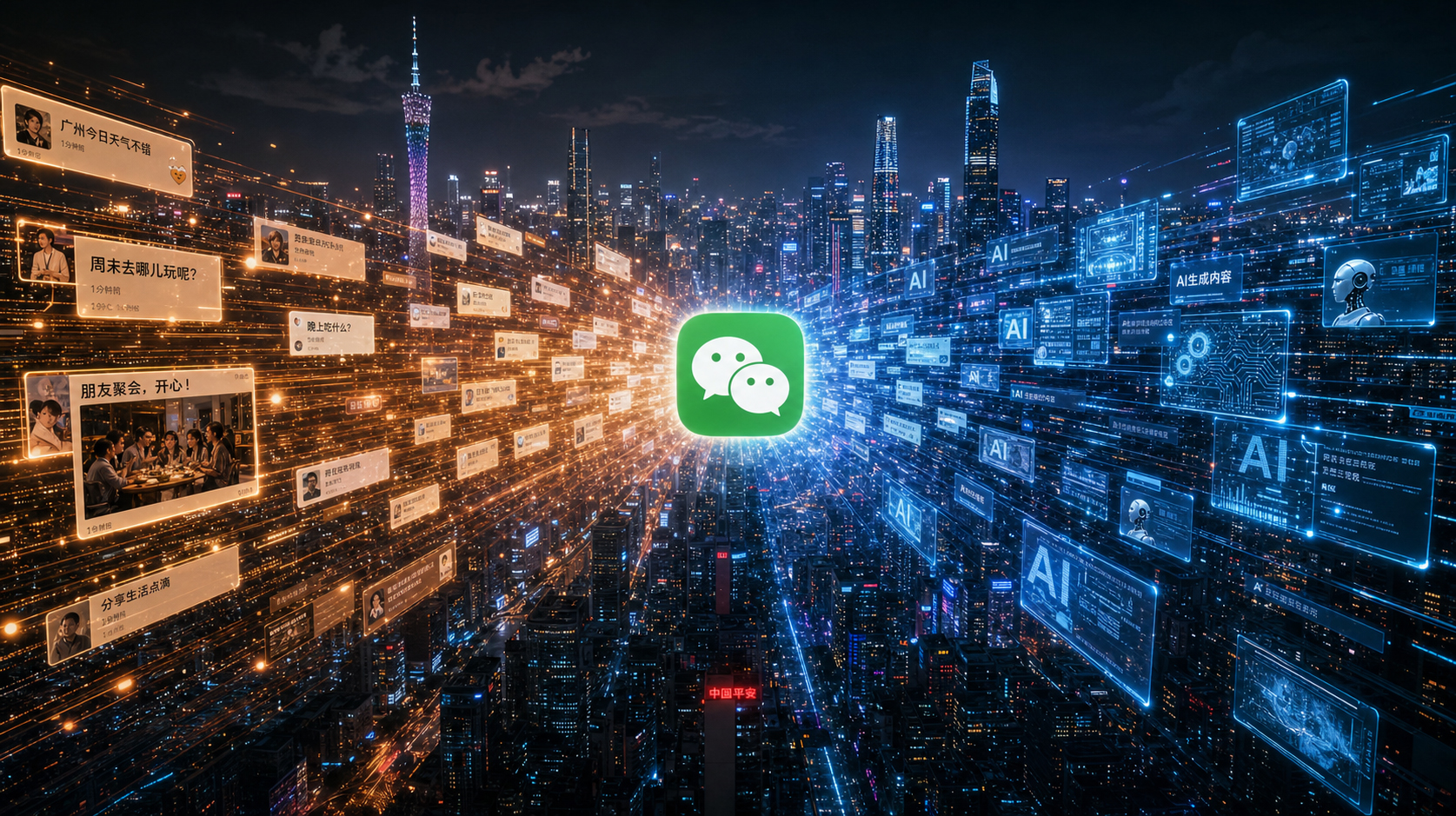
AI deluge on WeChat: Why China's most important app is now pulling the plug – When millions of posts suddenly become questionable – Image: Xpert.Digital
Fake or human? How the AI invasion of WeChat is destroying China's digital trust
From AI hype to "AI anxiety": Why China's tech miracle is suddenly showing cracks
850 articles per minute: How artificial intelligence is overrunning the world's largest network
WeChat is far more than just China's answer to WhatsApp – it's the digital nervous system of an entire nation. But with over 1.4 billion active users, this ecosystemic super-app is currently at the center of an unprecedented technological crisis: a flood of AI-generated content threatens to fundamentally destroy trust in the platform. Automated content farms produce countless articles every minute, increasingly blurring the line between human authorship and machine output. This development is not only forcing tech giant Tencent to take drastic countermeasures and delete accounts en masse, but has also long since drawn the attention of the Chinese government. From strict labeling requirements and tangible fears of downward mobility in the job market to an unexpected strategic U-turn by President Xi Jinping – China's approach to artificial intelligence is currently undergoing a radical transformation. The following analysis delves into how the AI invasion is changing WeChat, why Western platforms like LinkedIn are struggling with strikingly similar problems, and what the end of human authenticity means for our future digital communication culture.
Related to this:

WeChat in the AI age: Between automation mania and social upheaval
WeChat is more than a messaging app. With over 1.4 billion monthly active users worldwide, the platform, developed by Tencent, is the digital nervous system of Chinese society – connecting payments, government services, healthcare, news consumption, and social interaction in a single, ecosystemic super-app. And like no other social network in the world, WeChat is now at the center of a debate that extends far beyond technology: Who is really talking to whom anymore? How much of what appears on the platform daily is truly human? And what does it mean for a society when its digital public sphere is increasingly populated by algorithms – without users even realizing it?
The extent of AI takeover: What the numbers reveal
The sheer scale of the WeChat ecosystem makes the question of automation particularly critical. In 2023 alone, over 1.2 million articles were published daily on official accounts – those operated by companies, media outlets, influencers, and organizations – amounting to an annual volume of almost 450 million articles. Extrapolated, that's roughly 850 new posts per minute. A figure that, upon closer examination, far exceeds human capacity.
Precise, officially verified data on the proportion of AI-generated content on WeChat is not yet available – Tencent itself does not publish any such metrics. However, what is clearly documented are the platform's reactions to the visible flood of machine-generated content: In April 2026, WeChat fundamentally updated its code of conduct for official accounts, explicitly prohibiting the use of AI, scripts, APIs, or other automated methods as a replacement for human content creation. At the same time, according to reports from Chinese content operators, articles were removed from accounts in large numbers on a single day for violating the ban on non-human automation. This measure is not a preventative step – it is a reaction to a massive loss of control that has already occurred.
Analysts familiar with the phenomenon describe a system that was exploited industrially for months: Content farms scraped news from third-party sources, had it rewritten using AI—to circumvent copyright filters—and then published the results frequently to maximize advertising revenue through click volume. This practice was not an exception, but a widespread business model. A single account could theoretically publish dozens of posts daily that were nominally human-generated, but in reality were pure machine output.
Comparative data from related digital ecosystems support the plausibility of a significant degree of automation on WeChat as well. On Facebook, over 41 percent of longer posts were AI-generated by the end of 2024, compared to less than 5 percent before the introduction of ChatGPT. An analysis by Graphite, which examined 65,000 English-language websites, found that since the end of 2024, more than 50 percent of all newly published web articles have been created by AI. LinkedIn, the platform with the highest measured AI share among professional networks, shows an AI share of over 40 percent for posts longer than 250 words. For longer articles, corresponding figures rose to over 54 percent, according to a study by Originality.ai.
Official accounts versus private users: A structural difference
To accurately assess AI penetration on WeChat, a differentiation by user type is essential. WeChat fundamentally distinguishes between official accounts – Subscription Accounts and Service Accounts – and the private sphere, i.e., personal profiles with their friend posts (Moments), group chats, and direct messages.
Among official accounts—estimated at over 25 million active accounts—the level of automation is undeniably high. Here, commercial pressure, algorithm optimization, and the pursuit of increased reach converge with a plethora of readily available AI tools that can produce finished articles in minutes. A research paper on automation on WeChat describes the spectrum of available automation practices as comprehensive: automated responses to user queries, chatbots, auto-tagging, auto-grouping, and push messaging are standard tools for operators of official accounts. The open-source project AIWeChatauto, developed specifically for WeChat operators, combines large language models like Gemini and DeepSeek with AI image generation, automating the entire publishing process—from topic selection and writing to publication.
In the private sphere – the Moments and personal chats – the picture is different. Here, human content still dominates, although automation tools for bots exist in this segment as well, allowing them to automatically respond to friends' posts, publish their own content, and even send livestream comments. Nevertheless, the private communication space of WeChat is structurally less susceptible to industrial AI content than the public channels, as it is based on personal social networks, which make mass publications more difficult to scale without a loss of authenticity.
The real problem, therefore, clearly lies in the area of public content distribution. WeChat's ecosystem of official accounts is de facto a digital press market, and in this market, the industrial farming of AI content captured significant market share in 2024 and 2025. WeChat itself implies this indirectly: The new 2026 guidelines explicitly prohibit mass-produced, formulaic, or fragmented posts, as well as content generated, rewritten, or recompiled by AI without reflecting the original human intent.
China's government response: mandatory labeling and regulatory pressure
Compared internationally, China began regulating AI-generated content relatively early. As early as 2023, the Provisions on the Administration of Deep Synthesis of Internet-Based Information Services, one of the world's first regulations mandating the labeling of AI content, came into effect. This pioneering role was logically continued in March 2025: The Cyberspace Administration of China (CAC), the Ministry of Industry and Information Technology, the Ministry of Internal Affairs, and the National Broadcasting Administration jointly adopted the AI Labeling Measures. This regulation came into force on September 1, 2025, and required all major Chinese platforms – including WeChat, Douyin, Weibo, and Xiaohongshu – to visibly label all AI-generated content, supplemented by implicit metadata tags.
WeChat responded to the implementation with an official statement requiring users to label AI-generated content when posting it. At the same time, Tencent pledged to expand the platform's detection capabilities and automatically add warnings to suspicious AI-generated content. China is thus combining a user-mandated approach with an algorithmic monitoring layer – a model more ambitious than what most Western platforms have implemented so far.
Nevertheless, the implementation revealed its limitations shortly after its introduction. In April 2026, the CAC formally summoned three ByteDance products—including the popular video editing app CapCut—for violations of the labeling requirements and imposed sanctions. The agency emphasized that the labeling rules were not treated as a bureaucratic formality, but as enforceable law. At the same time, this highlights what distinguishes this regime from Western regulatory approaches: It is not solely about consumer protection or the integrity of discourse—it is also about state control over the information space. The CAC regulations explicitly link AI-generated content to the Chinese Cybersecurity Law and require that AI not produce content that “provokes social conflict.”.
WeChat's special measures from April 2026—the de facto ban on non-human automated content creation—go beyond the minimum legal requirements. Tencent is signaling that the platform value of its own ecosystem is threatened if AI-generated garbage undermines users' trust in content quality. Ultimately, this is an economic consideration: A feed full of interchangeable machine-generated prose generates less engagement, which reduces advertising effectiveness and, in the long run, erodes the business model.
The LinkedIn Paradox on WeChat: Structural Parallels and Systemic Differences
The situation on WeChat is strikingly similar to what has been documented for LinkedIn. The world's largest professional network is also struggling with a flood of AI-generated content: According to a study by Pangram Labs, more than 40 percent of longer LinkedIn posts were classified as entirely AI-generated – no other major social network has a higher measured AI share. LinkedIn itself was even partly responsible for this development, having integrated AI writing assistants into its user interface for years and actively promoted algorithm-driven content creation.
The structural parallels between LinkedIn and WeChat's official accounts are striking: In both cases, the platform's reward system—reach for consistency and volume—creates a strong incentive for automated mass production. In both cases, the communication is primarily public or semi-public, not private conversation. And in both cases, the operators are now responding with AI detection systems designed to curb the very problem their incentive structure created in the first place. LinkedIn has announced it will use an internally developed AI detection model intended to distinguish generic content from original output—with a stated detection rate of 94 percent. WeChat combines algorithmic detection with explicit bans and threats of sanctions.
Nevertheless, significant differences exist. First, WeChat's super-app status is a unique factor: those who are blocked or have their reach restricted on WeChat not only lose a social network, but potentially also payment functions, access to customer service, and crucial government communications. The platform's leverage on users' real lives is far greater than on LinkedIn. Second, WeChat operates in a state-monitored media landscape where content regulation is not merely private-sector quality assurance, but always also political control. The lines between plagiarism prosecution, quality control, and ideological filtering are blurred in China. Third, WeChat lacks the specific professional context that makes AI use particularly attractive on LinkedIn: the pressure to cultivate a personal brand and maintain a constant presence on the career network. On WeChat, AI content farming is driven by different motivations—primarily commercial monetization through advertising revenue and follower growth.
Another difference lies in society's handling of the phenomenon. While the "LinkedIn paradox"—the question of how a platform for professional authenticity could become a stage for generic machine output—is being hotly debated in Western media, the corresponding debate in China is taking place predominantly within the platform itself. The term "AI anxiety" is trending on WeChat, and the discussion about the quality crisis is happening on the very platform that caused the problem.
Authenticity as capital: How AI is changing digital communication culture
The widespread AI automation of content is changing not only the quantity but also the quality of all digital communication. For WeChat, this means an erosion of trust in what is being read. When users can no longer tell whether a post is written by a human or a script, the social function of reading and sharing loses its significance. Communication optimized by machines for machines—more precisely, for algorithms—loses its discursive character.
Scientific studies on automation in WeChat reveal the profound impact of AI on communication architecture: not only are texts automated, but also real-time translations, the conversion of voice messages to text, emoji reactions, and tagging processes. This means that even seemingly "human" communication on WeChat is supported and modified by AI layers that remain invisible to the recipient. The question is no longer simply "Was this article written by AI?", but rather "How many AI layers are embedded in this communication?".
This development coincides with a society that, according to international surveys, has higher rates of AI review compared to other countries—around 40 percent of Chinese respondents check AI-generated content—but is structurally dependent on trusting its digital infrastructure. In this context, the government's requirement for AI labeling is also an attempt to regain trust through transparency. However, the effectiveness of this approach depends on whether platforms are actually able to reliably detect and label AI content—a technically demanding task that even well-equipped platforms like WeChat still need to master.
Practitioners report unintended collateral damage: Even handwritten content is sometimes incorrectly classified as AI-generated by WeChat's recognition algorithms if it was imported via certain third-party formatting tools. This points to a fundamental epistemic challenge: The distinction between human and machine writing becomes increasingly difficult algorithmically as more people use AI for support and as more AI imitates human language. The boundary WeChat wants to draw is not a technically sharp line, but a gradual spectrum.
Our China expertise in business development, sales and marketing

Our China expertise in business development, sales and marketing - Image: Xpert.Digital
Industry focus areas: B2B, digitalization (from AI to XR), mechanical engineering, logistics, renewable energies and industry
More information here:
A thematic hub offering insights and expertise:
- Knowledge platform covering global and regional economies, innovation and industry-specific trends
- A collection of analyses, insights, and background information from our key areas of focus
- A place for expertise and information on current developments in business and technology
- A hub for companies seeking information on markets, digitalization, and industry innovations
FOBO instead of FOMO: Why China's workers tremble before AI
Is AI seen as a problem in China? Between government optimism and societal unease
The Western view of China as an AI-enthusiastic, almost carefree technology nation needs a fundamental revision. The Communist Party's public narratives—AI as a tool for national rejuvenation, AI leadership by 2030—are real and powerful. But they coexist with a social reality that is considerably more ambivalent.
Recent survey data paints a mixed picture. On the one hand, a 2026 survey by University College London revealed that 96 percent of Chinese respondents reported using AI weekly at work—an impressively high adoption rate. Fewer than 10 percent of these respondents expressed concern that AI would make job hunting more difficult. On the other hand, a parallel sample shows a contrasting trend: 59 percent of Chinese workers expressed concern at the beginning of 2026 about being displaced by AI—an increase from 49 percent in 2024. These seemingly contradictory figures can be explained by methodological differences: Those asked about general usage habits and attitudes respond differently than those directly confronted with their job security.
The term "FOBO"—Fear of Being Obsolete—summarizes the core problem more precisely than the Western "FOMO" (Fear of Missing Out), according to technology analyst Rui Ma of TechBuzz China. China is a society of intense performance pressure: university entrance exams, 72-hour workweeks in the tech industry, and an entrepreneurial landscape that functions like Darwinian selection. In this context, AI appears not as a liberation from arduous work, but as new competition that further intensifies the already exhausting competitive conditions. What observers initially interpreted as enthusiastic mass adoption of the AI agent "OpenClaw" turned out, upon closer analysis, to be more "career panic" than technological enthusiasm.
The reactions have become not only individual, but also collective and political. In Wuhan, a protest by taxi drivers against autonomous vehicles paralyzed the robotaxi system, with drivers booking and then canceling rides en masse. “Quiet layoffs”—the silent dismissal of employees who are replaced by AI tools—are documented in large Chinese internet companies. A court in Hangzhou ruled in a landmark decision that employees cannot be dismissed simply because AI can perform their work more cheaply. The Chinese government even hinted in official statements at including the term “investment in human capital” in its planning documents—a subtle admission that the narrative “AI creates more jobs than it destroys” no longer goes unchallenged in society.
Xi Jinping's about-face: When the state itself becomes critical
Particularly revealing is the recent shift in the official Chinese position. Just a few years ago, the narrative of unlimited possibilities dominated. But in July 2026, at the annual conference of China's leading scientists, Xi Jinping explicitly struck a cautionary tone: AI is a "double-edged sword," and high-tech research must be "closely coordinated with security." Analysts at the consulting firm Trivium China commented that Xi no longer views AI "as a risk in the future, but as a clear danger in the present.".
In parallel, the Chinese government plans to restrict access to domestic AI models for foreign users, citing national security concerns. Representatives from Alibaba, ByteDance, and other tech companies have been briefed on the planned restrictions by officials from the Ministry of Commerce. This shift signals that Beijing now places greater emphasis on the geopolitical dimension of AI models—the potential for its own AI applications to be used against Chinese interests—than on the soft power gains from the global proliferation of Chinese AI.
This official shift in policy has consequences for how AI is handled in the digital public sphere. The state-sanctioned narrative is no longer: "Use AI without restriction; it is the key to national advancement." The new message is more like: "Use AI—but under supervision, with labeling, without manipulation, and within the framework of socialist values." This is a considerably more nuanced stance than the AI enthusiasm that Western media have described for years as the standard Chinese narrative.
Job loss and structural change: The multi-million dollar problem behind the statistics
The concern about job losses due to AI in China is structural, not just psychological. Estimates suggest that up to 70 million Chinese jobs are at risk in the medium term due to AI-induced automation. The International Labour Organization and its methodology, which the Chinese Ministry of Labour cites, identify office and administrative occupations, certain manufacturing jobs, and low-skilled service jobs as being particularly vulnerable. Office workers receive a risk rating of 8.5 out of 10 in this assessment; machine operators in manufacturing are at risk from robotics, with a rating of 7.5 out of 10.
The Chinese government has responded with a national skills development initiative: A nationwide program running until 2027 aims to provide subsidized retraining for over 30 million people. The Ministry of Human Resources and Social Security has recognized 72 new job profiles in the past five years alone, more than 20 of which are directly related to AI. Autonomous driving is considered a prime example of successful retraining: Companies behind robotaxi services are specifically recruiting former taxi drivers for new roles as remote control safety operators or dispatch algorithm engineers.
Nevertheless, a deep societal tension persists. Academic research shows that higher levels of education in China correlate with lower AI-related job market anxiety—not only because highly skilled workers are employed in less exposed professions, but also because they can use AI more strategically as a work tool. Those with lower qualifications, on the other hand, experience AI as a threat, not a tool. The technologically induced widening of the gap in life chances—the “skill-biased technological change” in economic literature—is accelerated and exacerbated by AI. This is a global dynamic, but in China, it encounters a society where the promise of social mobility through education and hard work is particularly deeply ingrained.
The ethical dimension: Is there an AI debate in China?
A common Western misconception is that an AI ethics debate is not taking place in China because authoritarian systems do not allow for pluralistic discussion. This assessment is too simplistic. China does indeed have an AI ethics debate – it simply takes place within a different institutional framework. The Beijing AI Principles of the Beijing Academy of Artificial Intelligence explicitly call for respect for “human privacy, dignity, freedom, autonomy, and rights.” Academics and legal scholars publicly discuss copyright issues related to AI content, the societal costs of the automation revolution, and the limits of government use of AI.
The difference lies not in the absence of such a debate, but in its channel structure: it takes place less in independent media or politically organized civil society groups, and more in academic bodies, within state-protected expert structures, and increasingly on digital platforms like WeChat itself. This has consequences for the depth and reach of the discussion: positions that question the fundamental direction of the state's AI strategy are rarely heard more widely. What the public debate does address, however, are concrete consequences—job losses, questions of authenticity, algorithm manipulation—as long as these are not formulated as systemic criticism of the party regime.
The MERICS institute describes this situation as a tension between "lofty principles and conflicting incentives": The Chinese state formulates AI ethics principles that are internationally compatible, but sets priorities that ultimately serve to maintain the power of the Communist Party. This makes Chinese AI governance neither purely cynical nor purely principled – it makes it a hybrid that is difficult for external observers to categorize.
Regulatory architecture in comparison: China, EU and USA
In a global regulatory comparison, China occupies a unique position: it is simultaneously one of the world's earliest regulators of AI content and one of the most ambitious state promoters of AI. The Deep Synthesis Regulation of 2023 and the AI Labelling Measures of 2025 clearly demonstrate China's pioneering status in the field of AI content labeling. No comparable Western system currently obligates platforms to identify and label AI-generated content at the technical metadata level to such a comprehensive extent.
The EU has taken a different approach with the AI Act: a risk-based regulatory model that classifies AI systems according to their potential for harm and imposes corresponding transparency and safety obligations. It is more comprehensive in its technological scope but slower in its practical implementation and less explicit regarding content labeling. The US, on the other hand, relies primarily on voluntary industry commitments and only mandates regulations in certain safety-relevant areas.
What distinguishes China from both Western approaches is the integration of regulation and platform control into a tool of state power. WeChat's labeling regime simultaneously serves as consumer protection, quality assurance, and information control. It pursues legitimate goals while also maintaining state control over the digital sphere. This ambivalence is not a contradiction, but rather the structural characteristic of Chinese AI governance.
Between quality turnaround and systemic drift
What can now be predicted regarding the relationship between AI, communication, and trust on WeChat? In the short term, stricter enforcement of the new guidelines is to be expected: accounts based on industrial AI content farming will be penalized, algorithmic recognition will be improved, and the platform economy will have to shift towards quality-oriented publishing. The era of the simple "AI money printer" on WeChat, as one commentator calls it, will be structurally over after the measures implemented in April 2026.
In the long term, the question is more complex. WeChat has over 25 million active official accounts and a platform architecture based on continuous content production. The pressure to automate will not disappear as long as the reward system—reach, followers, advertising revenue—remains geared toward consistency and volume. The crucial factor is whether WeChat fundamentally changes its algorithm and rewards quality over quantity—a profound platform reform that could be economically painful in the short term.
China is facing a societal turning point: Will AI be seen as a productivity partner that complements and enhances human labor? Or will it remain primarily a cost-cutting tool that replaces human workers and creates social pressure? The answer to this question won't be decided solely on WeChat, but the world's largest digital platform will be a crucial indicator. The fact that the term "AI anxiety" is trending on WeChat is therefore more than just a snapshot – it's the pulse of a society on the cusp of a transformation it can neither fully control nor avoid.
🎯🎯🎯 Data-driven B2B industry hub as a quasi-in-house solution

The quasi-in-house solution: How Xpert.Digital closes operational gaps in B2B marketing and sales – Smart Content-Driven Business - Image: Xpert.Digital
Xpert.Digital is a data-driven B2B industry hub led by Konrad Wolfenstein . The company acts as an external, quasi-in-house solution for industrial partners, closing operational gaps in marketing, content, and sales – without requiring additional resources on the client side.
More information here:
Your global marketing and business development partner
☑️ Our business language is English or German
☑️ NEW: Correspondence in your native language!

Konrad Wolfenstein
I and my team are happy to be available to you as your personal advisor.
You can contact me by filling out the contact form here [email protected]:or simply call me at +49 7348 4088 965. My email address is
I'm looking forward to our joint project.





