

The incredible rise of Annalena Baerbock: Patronage or talent? Chancellor candidate, UN Secretary-General, Professor
Xpert Pre-Release

Available in 27 languages 📢
Prefer Xpert.Digital on GoogleⓘPublished on: August 25, 2026 / Updated on: August 25, 2026 – Author: Konrad Wolfenstein
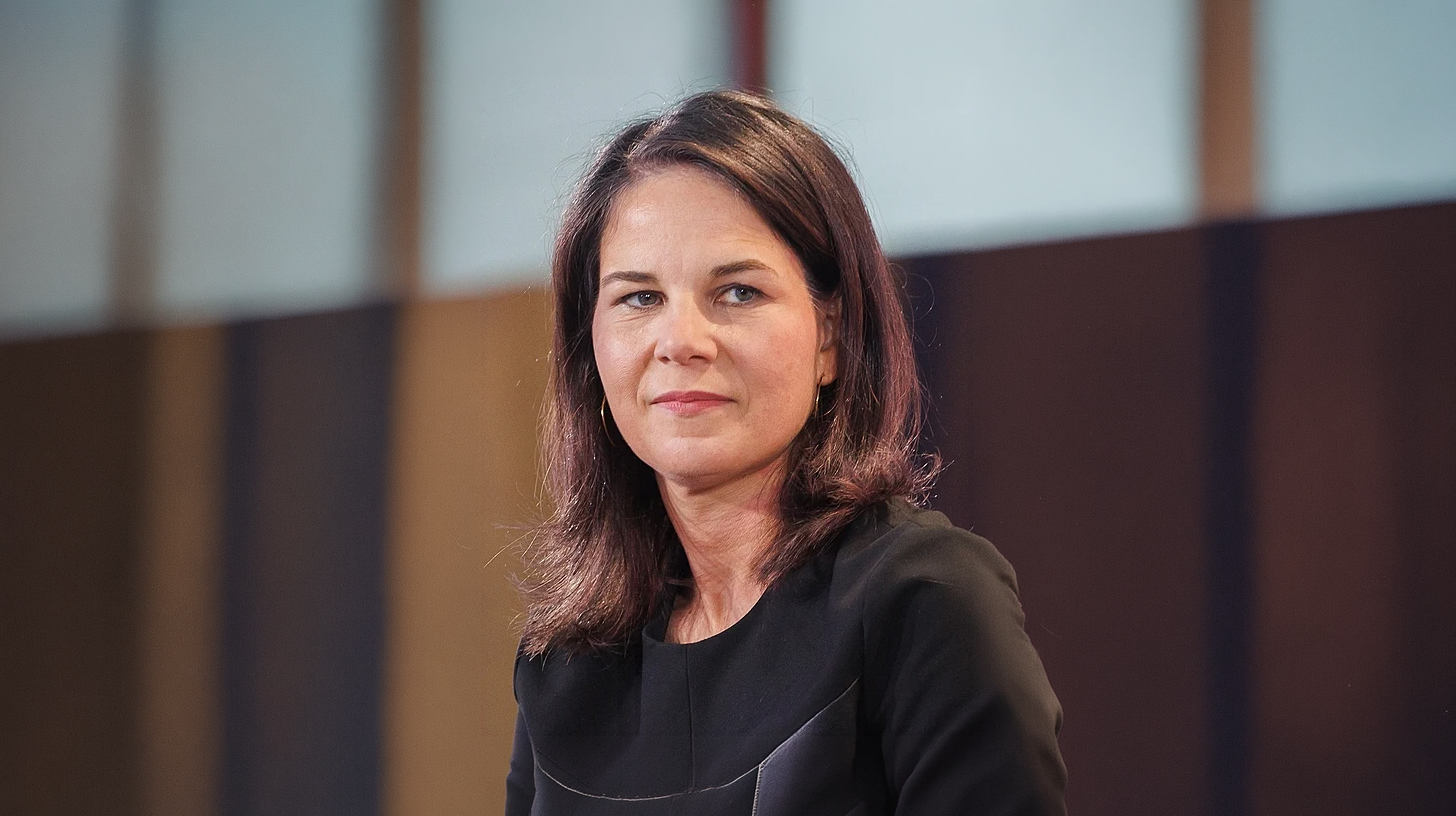
The incredible rise of Annalena Baerbock: Patronage or talent? Chancellor candidate, UN Secretary-General, Professor – Image: Steffen Prößdorf, 2024-05-27 Event, Conference, re-publica STP 5327 by Stepro (cropped), Image format adjustment with AI by Xpert.Digital, CC BY-SA 4.0
Patronage or talent? The real system behind Baerbock's career
New role at Columbia University: Baerbock's career coup sparks discussion
A meteoric rise without any official experience: Annalena Baerbock's career secret
She is undoubtedly one of the most controversial and fascinating figures in recent German history. Her journey from Green Party state politics to the international stage reads like an unprecedented political ascent – yet it raises profound questions. How does a politician manage to become Chancellor candidate, the Federal Republic's first female Foreign Minister, and ultimately President of the UN General Assembly without any prior executive experience? Is this rise the result of exceptional communication skills, or is it a symptom of a political system in which patronage, symbolism, and media visibility carry more weight than practical government experience?
This article takes an analytical, unflinching look at the stages of her career. It clearly differentiates between fact-based criticism of structural favoritism and targeted, misogynistic smear campaigns. At the same time, it illuminates the strategic irony of her latest career move: a professorship in "leadership skills" at the prestigious but crisis-ridden Columbia University in New York. It is an investigation into the interplay between principled conduct, procedural errors, and the structural incentives of modern politics.
From trampoline to global world politics: Annalena Baerbock's career polarizes like almost no other.
Annalena Baerbock embodies, like few other figures in recent German politics, the steep, almost accelerated rise from state-level political office to the international stage. Born in 1980 in Hanover and raised on a farm near the Lower Saxon capital, she initially pursued a career as a competitive trampoline athlete before finding her way into politics via an exchange year in the USA, studies in political science in Hamburg, and a master's degree in international law from the London School of Economics. This educational path alone demonstrates that Baerbock undoubtedly possesses a solid academic foundation. However, the crucial question that runs through her entire career concerns less her formal qualifications than the speed with which she was catapulted into positions of enormous consequence without having previously acquired any significant practical experience in government. Her political career began in 2005 with her joining the Green Party, led to her becoming the party's state chair in Brandenburg in 2009, and in 2013 to the Bundestag, where she served as the party's spokesperson on climate policy. As early as 2018, she was elected co-chair of the Green Party together with Robert Habeck – a position that gave her enormous media visibility, but did not provide any executive experience in ministries, administrations or international institutions.
Chancellor candidacy without prior office experience: The fundamental structural problem
The real turning point in Baerbock's public image came in 2021 when she became the first Green Party candidate for Chancellor, despite holding neither a ministerial post nor a position in a state government at that time. This fact alone would not be a scandal in a parliamentary democracy, but it became the focal point of a deeper debate about the criteria by which top political offices are awarded in Germany. While the Greens' poll numbers in the spring of 2021 temporarily reached as high as 28 percent, even surpassing the CDU/CSU, several scandals brought this surge to a halt: belatedly reported secondary income, a subsequently corrected CV containing inaccurate information about memberships in prestigious organizations such as the German Marshall Fund, and the accusation that she had copied entire passages from other sources without proper attribution in her book "Now: How We Renew Our Country," published specifically for campaign purposes. Plagiarism hunter Stefan Weber documented numerous passages that bore significant similarities to other people's works, severely damaging the public image of a meticulously prepared candidate. It is telling that this accumulation of errors coincided precisely with the moment when the Greens were first seriously considered as contenders for the chancellorship. This suggests that the party and its candidate were simply unprepared for this level of public scrutiny.
Between adherence to principles and a lack of governmental practice: The years in the Foreign Office
In December 2021, Baerbock became the first woman in the history of the Federal Republic of Germany to assume the office of Foreign Minister – a historic moment that, however, transformed into a period of constant crisis management just 78 days later due to Russia's war of aggression against Ukraine. Her term in office was characterized by a clear, values-based stance towards Russia. This approach earned her international recognition, but simultaneously drew domestic criticism for insufficient diplomatic sensitivity and excessive moral rhetoric in her foreign policy. Critics repeatedly pointed out a significant gap between the aspirations and reality of her so-called feminist foreign policy, for example, because her public support for women in Iran or Afghanistan was comparatively weak in relation to her rhetorical emphasis on this policy area. Even linguistic gaffes, such as her statement at the Council of Europe that Germany was fighting "a war against Russia and not against each other," became the target of international ridicule and Russian propaganda. At the same time, a pattern emerged during her tenure that runs through her entire career: Baerbock deliberately polarizes, seeking a clear stance. This very polarization, which secures her a loyal following, is also cited by observers both inside and outside the Foreign Office as the reason for her limited effectiveness in substantive policy work. At the end of her term, she was criticized for giving too many interviews and making too many public appearances that, despite their lengthy pronouncements, contained little concrete substance – a finding that aligns with the general criticism that her policies rely more on symbolism than on measurable foreign policy results.
The move to the UN General Assembly: A textbook case of partisan patronage
The real crux of the criticism surrounding Baerbock's career, however, lies not in her time as Foreign Minister, but in the process by which she became President of the United Nations General Assembly in the spring of 2025. The experienced German diplomat Helga Schmid, a woman with decades of multilateral experience and considered internationally a suitable and undisputed candidate, was originally slated for this post. Baerbock's eventual ouster was sharply criticized by numerous foreign policy voices. The former chairman of the Munich Security Conference, Christoph Heusgen, described the move as an "outrage" and Baerbock herself as a "relic of the past," while in a later interview with the magazine "Der Spiegel" he stated that the UN was "not a self-service store." This choice of words is noteworthy because it comes from an experienced diplomat and not from a partisan political opponent, which lends additional weight to the accusation. A second contradiction further damaged Baerbock's credibility: Just a few months before her nomination, she had publicly announced her intention to scale back her political involvement out of consideration for her family, only to then opt for a position that meant a complete move to New York and even more extensive international travel. A representative YouGov survey commissioned by the German Press Agency (dpa) revealed that 57 percent of respondents in Germany viewed the nomination negatively or rather negatively, while only around 28 percent rated it positively or rather positively. These figures demonstrate that the criticism was not a fringe opinion, but rather a widespread societal skepticism that transcended party lines.
When criticism of the issue becomes blurred with criticism of the person
However, fairness in this analysis also requires acknowledging that a significant portion of the hostility directed against Baerbock has little to do with her actual political achievements, but rather exhibits misogynistic and sometimes deliberately disinformation-driven characteristics. Journalists like Tina Hassel from Tagesschau have rightly pointed out that some of the massive rejection of Baerbock stems from Russian-controlled social media campaigns, which, for example, operated with the absurd argument that she should not be allowed to hold an international office because of her grandfather's Wehrmacht past. The fake nude photos circulating during her candidacy for chancellor, or the repeated, mostly unfounded accusations that she neglects her children, also belong to this category of personal, often misogynistic defamation, which must be clearly distinguished from substantive political criticism. A serious economic and political analysis must therefore distinguish between two lines of criticism: On the one hand, there is the justified, fact-based criticism of a lack of experience, of the strategic allocation of offices according to party-political calculations, and of the discrepancy between rhetorical claims and concrete results. On the other hand, there is an often gender-specific, sometimes coordinated smear campaign that can be instrumentalized to delegitimize any criticism as soon as legitimate objections are mixed with baseless personal attacks.
Columbia University: Symbolic politics meets elite education
With the end of her term as President of the UN General Assembly in September 2026, a new chapter begins for Baerbock, one that steers her career in a remarkable direction: a practice-oriented professorship at Columbia University in New York. There, she will serve as co-director of the Master of Public Administration in Global Leadership program at the School of International and Public Affairs. This ten-month program is explicitly aimed at executives with at least ten years of professional experience who wish to further develop their leadership skills and promises to offer learning from "global leaders." The irony of this situation lies in the fact that the very politician whose own rise has been repeatedly criticized for a lack of practical experience is now herself to serve as a role model for leadership competence. Added to this is the temporal and institutional context: In early 2024, Columbia University was at the center of violent pro-Palestinian protests, during which students occupied lecture halls, leading to massive police operations and ultimately the resignation of then-President Nemat Shafik in August of that year. Subsequently, the US government cut approximately $400 million in funding to the university, officially citing its inaction in the face of ongoing harassment of Jewish students. Against this backdrop, Baerbock's appointment can certainly be interpreted as a strategic move by the university, which is attempting to polish its tarnished image with an internationally renowned, decidedly left-liberal and Green politician, while simultaneously positioning itself against its internal critics with a personality who articulates a clear, values-based rhetoric. Whether this step actually contributes to a substantive examination of the allegations against the university or merely serves as a media distraction remains an open question that will only be answered over time.
A career caught between political talent and structural favoritism
Looking at Baerbock's entire career from a dispassionate, economically driven perspective of appointments, a recurring pattern emerges: she repeatedly attained positions that typically require years of professional expertise or practical administrative experience. However, the decisive factors in her advancement were less demonstrable merit than party-political calculation, media visibility, and the desire for symbolic renewal. This is not an isolated case in German and international politics, but in hardly any other figure in recent history can this pattern be traced so clearly across several successive career stages: from her candidacy for Chancellor without government experience, to her nomination as Foreign Minister immediately after this failed candidacy, to the ousting of a more qualified diplomat in the appointment to the UN post. At the same time, it would be an oversimplification to attribute Baerbock's successes solely to favorable circumstances. She undoubtedly possesses rhetorical talent, a strong media presence, and the ability to translate complex foreign policy issues into catchy phrases—a real strategic advantage in a political sphere increasingly shaped by social media. The crucial economic question arising from her career, therefore, concerns less her individual suitability than the structural incentives of a political system in which media visibility and party-political usefulness are often rewarded more highly than proven professional expertise and institutional experience. As long as top international posts, such as the presidency of the UN General Assembly, are effectively filled by national government interests rather than through a transparent, merit-based selection process, the accusation of political patronage remains structurally grounded and not merely a matter of individual antipathy toward a particular politician.





