
Historic UN debacle: How Baerbock's foreign policy cost Germany its seat
Xpert Pre-Release

Available in 27 languages 📢
Prefer Xpert.Digital on GoogleⓘPublished on: June 7, 2026 / Updated on: June 7, 2026 – Author: Konrad Wolfenstein
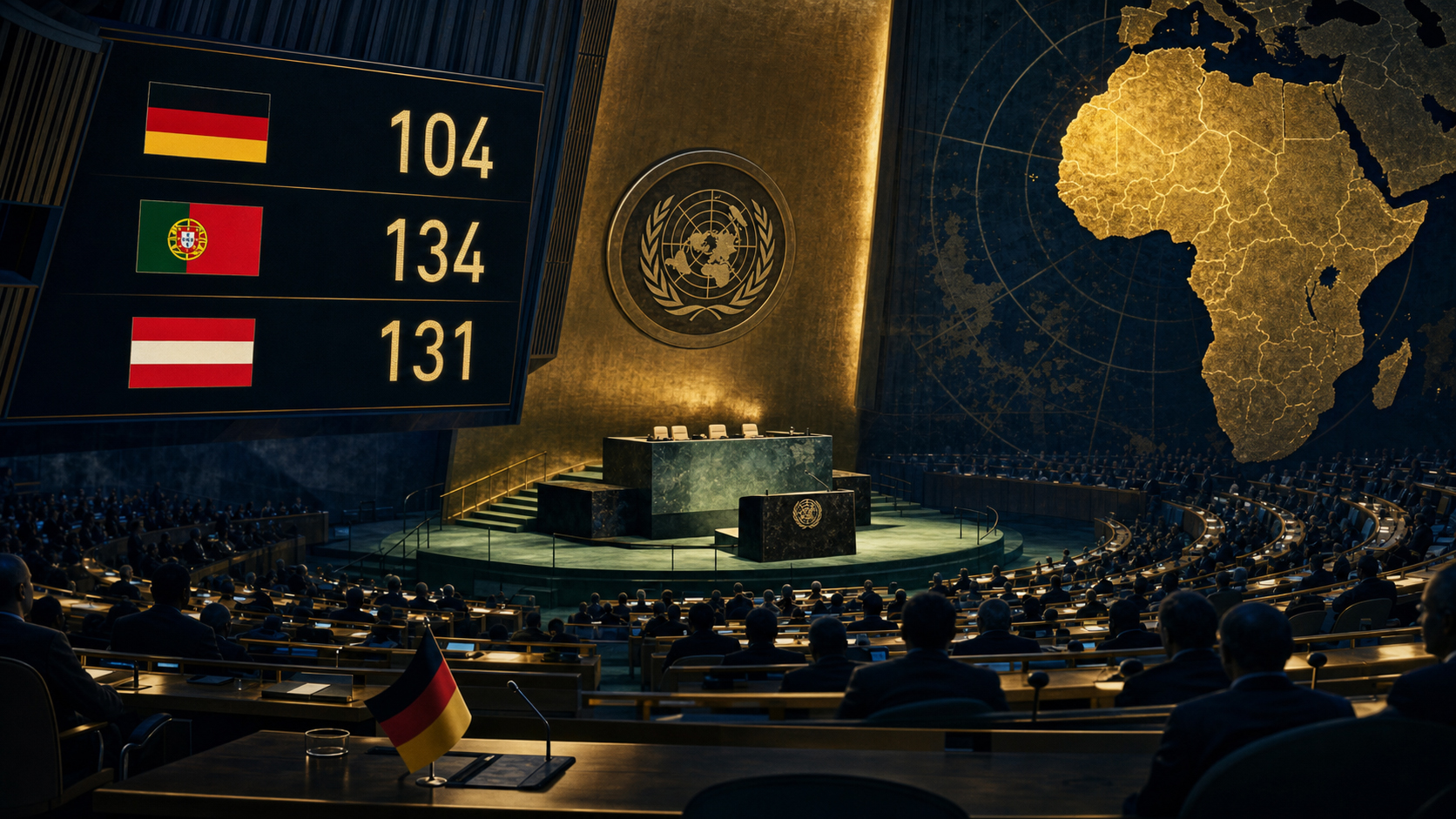
Historic UN debacle: How Baerbock's foreign policy cost Germany its seat – Image: Xpert.Digital
The elephant dispute backfires: Why Africa voted against Germany at the UN
The price for Germany's moral exceptionalism: Why its diplomacy failed worldwide
Punished! How “feminist foreign policy” became a diplomatic own goal
An unprecedented low point for German diplomacy: For the first time in the history of the Federal Republic, Germany has suffered a resounding defeat in its bid for a non-permanent seat on the UN Security Council. What appears on paper to be a surprising loss against significantly smaller states like Portugal and Austria, upon closer analysis reveals itself to be the bitter consequence of four years of a polarizing, morally charged foreign policy under former Minister Annalena Baerbock. Above all, the systematic alienation of the Global South – symbolized by the bizarre "elephant dispute" with Botswana and the perceived paternalism of a "feminist foreign policy" – cost Berlin the decisive votes. This is an in-depth analysis of a historic diplomatic debacle that now compels the new federal government under Chancellor Friedrich Merz to undertake a fundamental reorientation.
Diplomatic own goal: How Germany's values-driven foreign policy squandered its UN seat
When conviction becomes a liability – the cost of taking a morally exceptional path
On June 4, 2026, Annalena Baerbock, in her capacity as acting President of the UN General Assembly, announced the results of the vote on the non-permanent seats on the UN Security Council – and thus unintentionally delivered her own foreign policy reckoning. Portugal received 134 votes, Austria 131. Germany garnered only 104 votes, falling well short of the required two-thirds majority of 127. For the first time in the history of the Federal Republic of Germany, a German candidacy for a non-permanent seat on the most powerful body of the United Nations failed – a historic debacle that went far beyond a mere defeat in the vote.
This event reveals structural deficiencies in Germany's foreign policy over the past four years: a leadership style that prioritized proclaiming values over cultivating networks; a feminist foreign policy doctrine perceived as patronizing in the Global South; and a Berlin foreign policy culture that systematically underestimated international resonance. What was long celebrated in German media as "values-driven foreign policy" left deep rifts on the global stage—not least in Africa's view of Germany.
The election result and its geopolitical dimension
The stark figures of the vote tell a story that goes far beyond technical campaign errors. Of the 191 UN member states eligible to vote – Afghanistan and Venezuela were not – a mere 104 voted for Germany. This represents 54.4 percent of all valid votes. Portugal, a country with a population of only around ten million and a significantly smaller global presence than Germany, received 134 votes – a clear majority within the UN system. Austria, also a small European country, mobilized 131 votes.
What explains this dramatic discrepancy? Germany won its previous Security Council seat in 2019/2020 – at that time still under the foreign policy of the Merkel era. The bid for the 2027/2028 term was actively pursued subsequently, but fell within a politically turbulent period. The crucial groundwork for international majorities is not laid in the year of the vote, but over years through continuous diplomacy, strategic relationship building, and consistent representation in multilateral forums. This is precisely where the most critical gap in Baerbock's legacy lies: Multilateral vote mobilization requires quiet, patient, and often unspectacular relationship management – qualities that were only partially compatible with the former foreign minister's high-profile public persona.
German Foreign Minister Johann Wadephul described the defeat as a "real disappointment" and admitted a "bitter defeat." Chancellor Friedrich Merz, who had aimed to position Germany as a major global player, faced a significant setback. Internally, it quickly became clear that the real mistakes lay not with the current federal government, but with the coalition government between 2021 and 2025.
The voices of Africa: From diplomatic restraint to open criticism
Particularly noteworthy is the reaction from Africa – the continent that, with 54 states, constitutes the largest regional voting bloc in the UN system and can therefore determine the success or failure of every candidate. Official African diplomacy remains silent: no official account had publicly confirmed the criticism by midday after the vote. This silence itself is a diplomatic signal.
But from informal channels, the message was unmistakable. Botswana's former president, Mokgweetsi Masisi, made his opinion perfectly clear on the sidelines of a meeting of top African politicians in Nairobi. He told the Bild newspaper that Baerbock should have concentrated on her work as a German diplomat instead of telling Nigerians where to build their toilets and Africans how to handle elephants. The statement is politically explosive: it reveals how African leaders perceived Baerbock's approach – not as a partnership on equal footing, but as Western paternalism disguised as a European-green ideology.
Masisi went even further. He spoke of Germany's "condescending and disrespectful behavior" in recent years, which had fundamentally changed and shaped the perception of Germany held by Botswana and other African states. And he drew a personal conclusion, one rarely expressed in its directness: he felt better and more confident in relations with Germany now that Baerbock was out of office. When asked how Botswana had voted in the secret ballot in New York, he replied, "No comment"—a diplomatic non-denial that speaks volumes in itself.
Namibia's former Deputy Environment Minister Heather Sibungo also expressed criticism of German policies during Baerbock's tenure, though her remarks were more concise. Her statement, "That was not right," exemplifies the way many African politicians comment on bilateral tensions: reserved in tone, but unequivocal in substance.
The elephant dispute as a parable: Symbolic politics versus African reality
To understand the rift with Africa, one must reconstruct the so-called elephant dispute – that bizarre conflict which became a symbol for everything that went wrong with Berlin's Africa policy. Botswana is home to around 130,000 wild elephants – a population that, despite the country's size (roughly twice that of France), has long since become an ecological and social challenge. Elephants trample fields, devastate villages, and kill people; in just twelve months, 17 people lost their lives in elephant attacks. Botswana has therefore reintroduced elephant hunting to regulate the population and channel the revenue from hunting licenses into rural development.
The German Greens, led by Environment Minister Steffi Lemke, vehemently opposed this. She wanted to ban the import of hunting trophies from Africa to Germany – with the best intentions regarding animal welfare, but without any understanding of the realities in Africa. President Masisi responded with a masterful political maneuver: he offered to give Germany 20,000 elephants as a form of protest. The message was not merely sarcasm, but a fundamental objection: if European countries want to dictate to African states how they manage their natural resources, then they should also bear the consequences themselves.
What particularly angered Namibia in this context was that a country that had suffered greatly under German colonialism – the genocide of the Herero and Nama is among the darkest chapters of German history – now experienced German Green policies once again as the target of European self-righteousness. Namibia explicitly accused the German government of neocolonialism. The accusation struck a nerve: Germany, which sought postcolonial reparations through the 2021 Namibia Agreement, was simultaneously pursuing policies that were perceived as a new form of cultural dominance.
Baerbock had attempted to mediate the elephant in the room dispute – and met with Masisi in Berlin. However, the structural tension remained: A foreign minister whose party pursued a politically toxic position towards African partners could hardly simultaneously present herself convincingly as an advocate for African interests. The image that remained was that of a European politician lecturing Africans on morality.
Feminist foreign policy and its unintended collateral damage
In March 2023, Annalena Baerbock and Development Minister Svenja Schulze jointly presented their guidelines for a feminist foreign and development policy. The idea was ambitious in principle: three guiding principles – rights, representation, and resources – were to transform existing development cooperation. By 2025, more than 90 percent of the Development Ministry's funds were to be allocated to projects that pursued gender equality as a primary or secondary objective.
The project failed not because of its goals, but because of its communication and implementation in the international context. In many countries of the Global South, and particularly in Africa, feminist foreign policy was perceived as yet another attempt by Western countries to export universal values that are seen as imposed in local contexts. Conservative governments in Africa and other parts of the world explicitly reject concepts such as gender identity and sexual minority rights – and respond to their international promotion with resistance that is reflected in their voting behavior.
Furthermore, the claim to change power structures in the Global South and to address colonial ways of thinking clashed in practice with a communication strategy that remained trapped in precisely these ways of thinking. When Berlin dictates how African countries should manage their animal populations while simultaneously claiming to "decolonize" their power structures, a contradiction arises that is very clearly noted by African partners. Former Foreign Minister Sigmar Gabriel put it succinctly: Baerbock conducts foreign policy with a megaphone – but foreign policy successes don't come from high-profile pronouncements, but from patient diplomacy.
Attitude versus outcome: The fundamental ambivalence of the Baerbock era
The record of Baerbock's term in office is a genuine subject of political debate – and deserves a nuanced examination beyond partisan reflexes. On the positive side, there are undeniable achievements: Baerbock was one of the most consistent voices in Europe in supporting the invaded Ukraine. As a Green Party member, unlike Chancellor Scholz, she did not have to execute a U-turn in foreign policy. She positioned Germany clearly against Putin early on and persistently advocated for arms deliveries and sanctions. In a European diplomatic landscape rife with ambivalence, this was a remarkable accomplishment.
On the downside, however, the findings are mounting. She called Chinese President Xi Jinping a dictator – a statement that may not have been factually incorrect, but was diplomatically consequential, damaging Germany's most important trading partner without improving the human rights situation. Her conduct in the Iran context fell short of her own expectations: when Iranian women rose up against the mullahs under the slogan "Woman, Life, Freedom," the usually decisive foreign minister remained conspicuously silent. And the most important multilateral project of her term – securing a UN Security Council seat for Germany – lacks the crucial foundation: a broad, reliable network of partner countries.
The result can be quantified: In previous bids, all under Angela Merkel, Germany had always been successful. The defeat in 2026 doesn't reflect on a federal government that has been in office for a year, but on a foreign policy that has squandered voting power for over four years. Hesse's Minister for International Affairs, Manfred Pentz, put it succinctly: Baerbock had botched it during her time in office.
The nomination for UN General Assembly President: Coronation or collateral damage?
Among the most remarkable political maneuvers of the post-coronavirus coalition era was Baerbock's nomination as President of the UN General Assembly – a position she held from September 2025 to September 2026. The nomination was controversial from the outset: The experienced diplomat Helga Schmid was originally slated for the post. Schmid was Secretary-General of the OSCE, had negotiated the nuclear agreement with Iran, and possessed decades of multilateral experience. When Baerbock, following her party's defeat in the federal elections, initiated a last-minute maneuver and persuaded the German government to nominate her for the position instead, the diplomatic world reacted with rare candor.
Christoph Heusgen, former chairman of the Munich Security Conference and long-serving UN ambassador, called the decision an outrage and described Baerbock as outdated. Former Foreign Minister Sigmar Gabriel added that Baerbock could still learn a lot from Helga Schmid. In internal UN chat groups, ambassadors from other countries described Baerbock's move as disrespectful and accused Germany of self-enrichment in a key UN position. One said that Baerbock's appointment would reinforce the impression that powerful states misuse key UN positions for their own purposes. A YouGov poll revealed that 42 percent of Germans viewed the nomination negatively, and another 15 percent viewed it rather negatively – only 12 and 16 percent, respectively, considered it positive.
As President of the General Assembly, Baerbock faced a fundamentally different role: not to confront, not to polarize, but to moderate, to organize majorities, and to remain silent when those in power attacked the UN. She herself described the office as a challenge that required sitting and remaining silent. The paradox: a politician whose strength lay in public confrontation and clear commitment assumed an office that defined precisely these qualities as weaknesses. The fact that the General Assembly, under her presidency, did not contribute to Germany's election to the UN Security Council, but rather effectively sealed its failure, completes the picture of a structural mismatch.
Our global industry and economic expertise in business development, sales and marketing

Our global industry and economic expertise in business development, sales and marketing - Image: Xpert.Digital
Industry focus areas: B2B, digitalization (from AI to XR), mechanical engineering, logistics, renewable energies and industry
More information here:
A thematic hub offering insights and expertise:
- Knowledge platform covering global and regional economies, innovation and industry-specific trends
- A collection of analyses, insights, and background information from our key areas of focus
- A place for expertise and information on current developments in business and technology
- A hub for companies seeking information on markets, digitalization, and industry innovations
Between values-based politics and diplomacy: What Germany now needs to learn
Parliamentary consequences: The demand for accountability
In the German Bundestag, political discontent is growing following the UN defeat, with no intention of silently accepting the debacle. CSU foreign policy expert Stephan Mayer, a member of the Bundestag's Foreign Affairs Committee, demanded a full parliamentary investigation. The reasons for the embarrassing election defeat must be thoroughly examined, and it is imperative that Baerbock appear before the Bundestag's Foreign Affairs Committee to answer questions. Baerbock must explain specifically how and when her office undertook which measures to mobilize majorities for the German bid.
The demand is constitutionally legitimate: The Foreign Affairs Committee of the Bundestag is mandated by Article 45a of the Basic Law and exercises parliamentary oversight of the Federal Government's foreign policy. Questioning a former foreign minister about measures taken during her term is a normal instrument of parliamentary oversight. The political dynamic behind it, however, is also one of assigning blame: The CDU/CSU and CSU have an interest in clearly attributing the defeat to the "traffic light" coalition era in order to exonerate their own government.
The substantive question is nevertheless justified: What exactly did the Federal Foreign Office do between 2021 and 2025 to build the majorities necessary for a UN candidacy? When was which country courted, and with what means? Which signals from Africa or other regions of the world were ignored? These questions are not merely political ammunition, but substantive questions of foreign policy management to which Germany needs reliable answers in the interest of future candidacies.
Gaza, Iran, Venezuela: The unexpected influencing factors
Germany's losses in the polls were not limited to Africa. Observers identified several contributing factors: Germany's stance on the Gaza war was met with widespread incomprehension, as was its muted response to the Israeli attack on Iran and the US actions in Venezuela. In October 2023, Germany abstained from a UN resolution calling for a ceasefire in Gaza – a decision that was met with criticism from both Israel (which felt betrayed) and countries in the Global South (which had expected a clearer position).
The problem is structural: In an extremely polarized geopolitical situation, Germany attempted to simultaneously combine pro-Israel solidarity, humanitarian credibility, and bridge-building in the Global South. This failed not due to a lack of resources, but due to conceptual limitations. A country that tries to appease all sides in a crisis ultimately gains the trust of no one. This finding applies to Germany's Gaza policy as much as to the elephant question in Botswana or feminist foreign policy in conservative African societies.
Sascha Hach of the Leibniz Institute for Peace and Conflict Research described the vote as a major foreign policy defeat. Former German UN Ambassador Christoph Heusgen made it clear that the lack of mobilization of majorities in the crucial phase following the announcement of the bid was the central error. The network that Austria and Portugal had built up through years of quiet diplomacy could not compensate for Germany's failure on the decisive night of the vote.
What Germany must learn from this defeat
The political temptation is great to either reduce the defeat to a single person or to dissolve it into the complexity of geopolitical upheavals for which no one can be held responsible. Both would be analytically unsatisfactory. The truth lies somewhere in between: Baerbock's foreign policy leadership style has left its mark – but structural deficiencies in German foreign policy persist regardless of individuals.
The first lesson concerns the distinction between values-based policy and values proclamation. Baerbock's foreign policy was rich in moral pronouncements and poor in strategic silence. Values can be guiding principles for foreign policy – but they do not absolve one of the need to build trust, reach compromises, and think within the judgment categories of the other side. A foreign minister who publicly calls China's head of state a dictator, explains to Africans how animal welfare should work, and simultaneously seeks to mobilize multilateral majorities underestimates the strategic dimension of empathy as a diplomatic tool.
The second lesson concerns Africa. For decades, the continent has been structurally underestimated in German foreign ministries – despite rhetorical pronouncements about partnership and post-colonial reappraisal. A policy that treats Africa with development aid conditions, bans on trophy hunting, and feminist guidelines sends the signal: We know better what's good for you. This attitude generates resistance – silent, but consistent. When 54 African states vote unanimously against Germany or abstain, it is no coincidence, but the result of accumulated disappointments.
The third lesson concerns the relationship between media presence and diplomatic impact. Baerbock maintained an extremely high foreign policy profile – in interviews, on social media, and on talk shows. Nevertheless, her foreign policy influence on the floor of the UN General Assembly and in the backrooms of campaigning was limited. Foreign policy decisions are not made in front of microphones, but in conversations that never become public. Those who skew this balance in favor of publicity lose out on quiet effectiveness. Austria and Portugal have demonstrated this: with more modest media coverage, they achieved a more significant foreign policy outcome.
DISC personality analysis: Annalena Baerbock as a leader
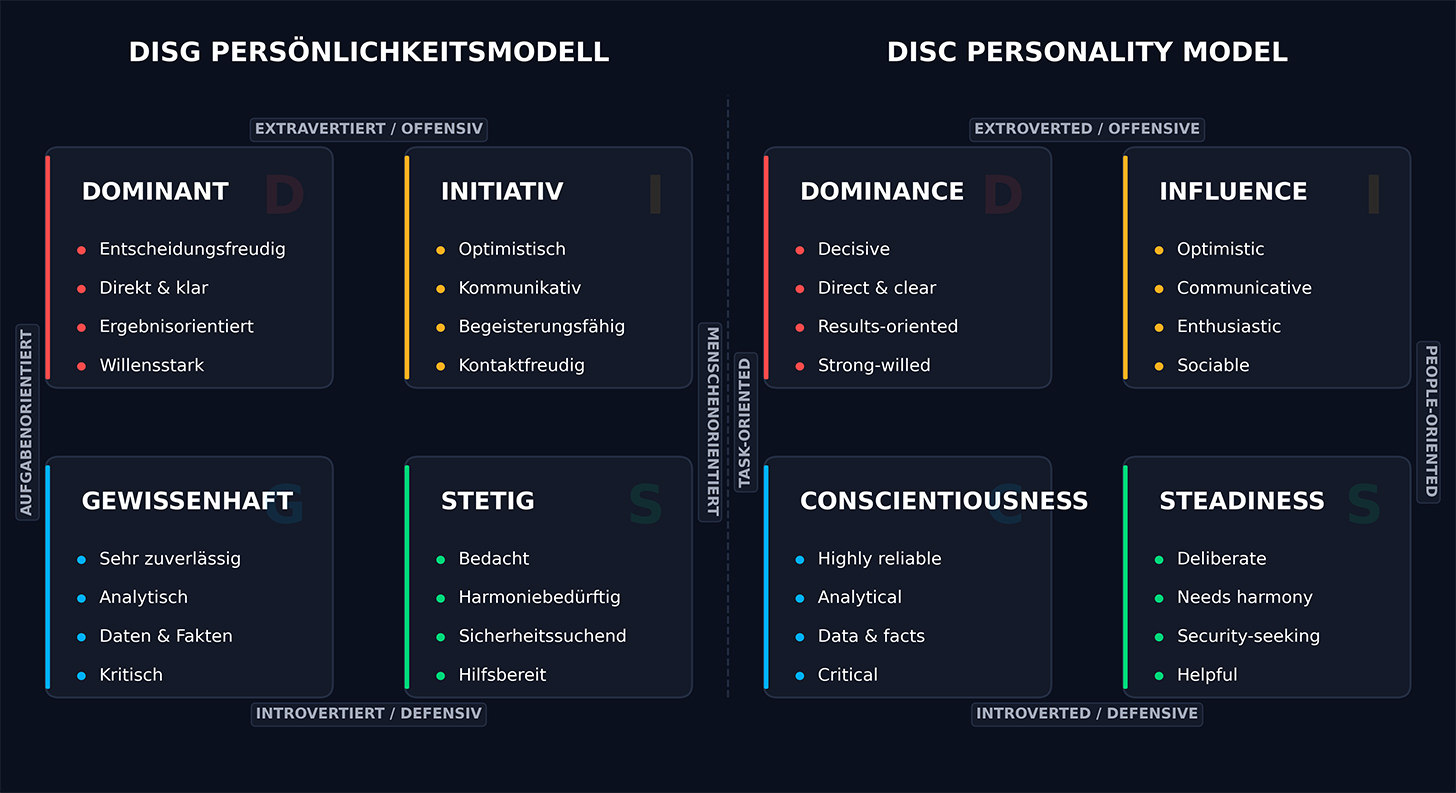
The DISC model as an analysis tool in detail – Image: Xpert.Digital
The DISC model provides a structured framework for systematically classifying Baerbock's leadership behavior. It distinguishes four primary behavioral traits: Dominance (D), Influence (I), Steadiness (S), and Conscientiousness (C). The following table analyzes Baerbock along these dimensions based on publicly documented behavior during her tenure as German Foreign Minister and as President of the UN General Assembly.
| criterion | Annalena Baerbock (D/I) |
|---|---|
| DISG profile | Dominant/Initiative – high drive, confrontational, vision-oriented; low levels of consistency and conscientiousness under pressure |
| Core strength | A clear stance even in the face of resistance; strong media communication skills; energy and perseverance in crisis situations (Ukraine context) |
| Leadership style | Visionary-directive: leads through persuasion and confrontation; enforces own positions, even against coalition partners and institutional resistance |
| Dealing with pressure | Intensifies communication, goes on the offensive; retreats into one's own convictions instead of realignment; tends towards escalation instead of de-escalation |
| communication | Expressive, striking, polarizing; megaphone principle; more focused on domestic political than international resonance; public sphere as a stage, not as a corrective |
| Historical Heritage | Germany's first feminist foreign policy doctrine; consistent stance on Ukraine; President of the UN General Assembly 2025/26; Germany's first historic UN Security Council defeat as collateral damage of her era |
| Greatest weakness | Systemic underestimation of quiet diplomacy; lack of empathy for the contextual worldviews of the Global South; confusion of media reach with diplomatic impact |
| What we learn | Value orientation without relationship capital does not work in the multilateral system; international majorities are formed through listening, not lecturing; the price of taking a public stance can be very high diplomatically |
| Ideal complement | Steady (S) type as a counterweight – an experienced, network-based diplomat with high empathy, patience and understanding of different cultural contexts (e.g., like Helga Schmid, whose repression itself became a symptom of the problem) |
The dominance-initiative combination is not inherently a disadvantage in foreign policy: it produces leadership in crises, clear positions in conflicts, and strong media presence. However, it becomes problematic when it operates in contexts that demand consistency and conscientiousness—that is, calm, network-based, empathetic, and long-term diplomacy. This is precisely what multilateral lobbying for UN bodies amounts to.
Germany's Africa policy at a crossroads
Regardless of Baerbock's personal circumstances, Germany faces the necessity of fundamentally rethinking its Africa policy. The continent has changed: African states have become more self-confident, have learned to navigate between China, Russia, the US, and Europe, and are increasingly less tolerant of being patronized. The anti-French sentiment in the Sahel, which led to the withdrawal of French troops from Mali, Niger, and Burkina Faso, is a warning signal not only for Paris, but for all of Europe.
After the First World War, Germany lost its colonies and, with them, the economic and personnel networks that other European countries had built up in Africa. This structural disadvantage was never fully compensated for. The governing coalition had begun to set new priorities with investment initiatives and the Namibia Agreement. At the same time, debates about banning trophy hunting, feminist foreign policy doctrines, and communication that treated African partner governments as recipients of Western moral instruction counteracted these efforts.
Masisi aptly described the situation: for him, Germany has stood for condescending and disrespectful behavior in recent years. This is a damning judgment – and it came not from an enemy of Germany, but from an experienced statesman who values Germany as a partner and explicitly welcomes the improvement in relations after Baerbock's departure. This judgment contains a constructive message: relations can be repaired – but only if Berlin is willing to listen instead of lecturing.
A historical finding and its lesson for the future
The UN Security Council defeat of June 4, 2026, is not an isolated event. It is the visible result of an accumulated foreign policy record that – despite many well-intentioned initiatives – has eroded Germany's strategic capital in crucial partner regions. The criticism from Africa is not the loud voice of an election campaign night, but rather the echo of years of estrangement.
For the current German government under Merz and Wadephul, this results in a clear mandate for action: Taking Africa policy seriously means learning to listen, understanding partnership as mutually beneficial, and consistently internalizing the difference between exporting morality and a development partnership. Foreign policy is not a competition of the purest intentions, but rather the craft of what is possible in the service of national interests and global stability.
Germany has shown throughout its history that it is capable of learning from defeats. The defeat of June 2026 offers this opportunity – provided the political class is prepared not to ignore the lesson, but to honestly accept it.
🎯🎯🎯 Data-driven B2B industry hub as a quasi-in-house solution

The quasi-in-house solution: How Xpert.Digital closes operational gaps in B2B marketing and sales – Smart Content-Driven Business - Image: Xpert.Digital
Xpert.Digital is a data-driven B2B industry hub led by Konrad Wolfenstein . The company acts as an external, quasi-in-house solution for industrial partners, closing operational gaps in marketing, content, and sales – without requiring additional resources on the client side.
More information here:
Your global marketing and business development partner
☑️ Our business language is English or German
☑️ NEW: Correspondence in your native language!

Konrad Wolfenstein
I and my team are happy to be available to you as your personal advisor.
You can contact me by filling out the contact form here [email protected]:or simply call me at +49 7348 4088 965. My email address is
I'm looking forward to our joint project.










