

2026 World Cup: Is Germany's football exit against Paraguay a reflection of our current economy?
Xpert Pre-Release

Available in 27 languages 📢
Prefer Xpert.Digital on GoogleⓘPublished on: June 30, 2026 / Updated on: June 30, 2026 – Author: Konrad Wolfenstein
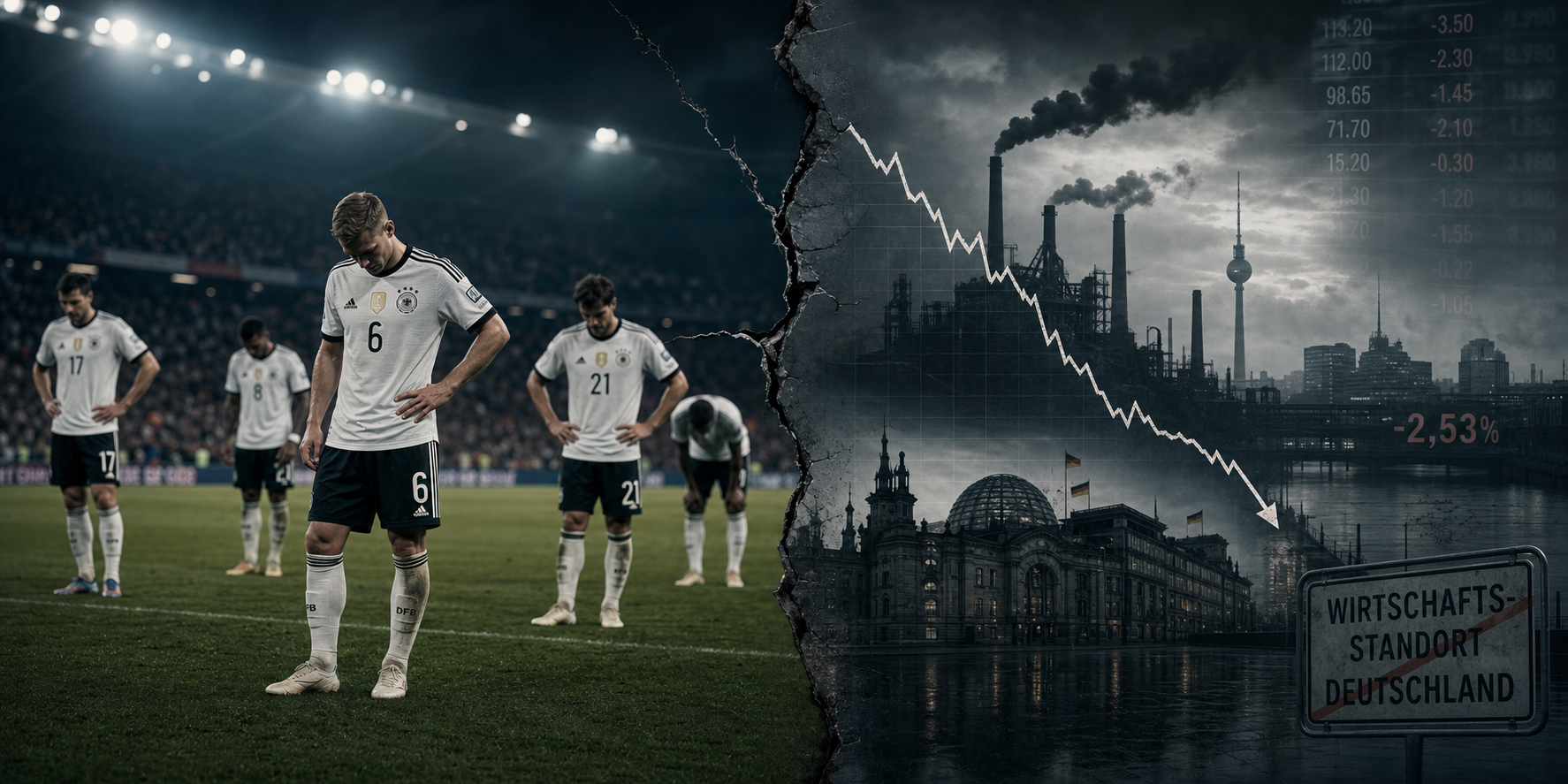
2026 World Cup: Is Germany's football exit against Paraguay a reflection of our current economy? – Creative image: Xpert.Digital
Or is the mirror showing what we don't want to see? No Plan B: How Nagelsmann's DFB tactics became a reflection of the German economic crisis
The 500 billion error: Why Germany's economic tactics are failing just like the German national football team
0.4% growth and 3 consecutive World Cup defeats: Is Germany now just mediocre?
The German national football team's bitter elimination in the penalty shootout against Paraguay at the 2026 World Cup is more than just a sporting disappointment – it's a painful metaphor for the state of an entire nation. Three missed penalties and the defeat against a passionately fighting but nominally inferior opponent raise an uncomfortable question: Has the DFB team become a reflection of German business? A closer look reveals alarming parallels between what happened on the pitch and in the boardroom. A clear pattern emerges between an ideological clinging to dysfunctional tactics, a dangerous overconfidence fueled by past successes, and a lack of pragmatic determination to win. Neither the national team nor Germany as an industrial nation suffers from a mere talent problem – they are plagued by structural inertia, a misplaced focus, and a lack of decisiveness in crucial moments. This is a stark analysis of a country that desperately needs a Plan B before the final whistle blows.
Related to this:

When penalty kicks and export quotas suddenly mean the same thing — or: Why Germany doesn't have a performance problem, but a priorities problem
On June 29, 2026, the German national football team lost 3-4 on penalties to Paraguay in the round of 32 of the 2026 World Cup. It was Germany's first ever World Cup defeat on penalties. Three missed penalties—Havertz, Woltemade, Tah—and the dream was over. Just a few hours later, the German media was dominated not only by sports coverage, but by a deeper, more unsettling question: Does this elimination exemplify what Germany as a whole is currently experiencing? A country with world-class potential that nevertheless fails. A nation that is its own worst enemy. An economy that believes it can overcome the gravity of global reality through morality, debate, and navel-gazing.
The answer to this question is: Yes — with all the important nuances.
Three consecutive World Cup defeats: Not a coincidence, but a pattern
The elimination against Paraguay is not an isolated sporting misfortune. It is Germany's third consecutive heavy World Cup defeat. In 2018, there was the group stage debacle in Russia. In 2022, the premature end in Qatar. And now, in 2026, the penalty shootout drama in Boston—this time at least they advanced to the next round, but the pattern is the same. The international press was merciless: The Spanish sports newspaper "Marca" wrote "Germany is no longer Germany," and the English "Daily Mail" succinctly headlined "The biggest shock of this World Cup so far.".
Germany had finished the group stage as winners of Group E. They had defeated Ivory Coast and were on track. Then came the defeat against Ecuador in the preliminary round—a setback that sowed seeds of doubt. And finally, Paraguay: a team that had struggled through the group stage, lost 1-4 against the USA, and compensated for its lack of talent with discipline and passion. This very combination—a lack of passion on the one hand, surprising determination on the other—aptly describes Germany's economic reality in 2026.
What Toni Kroos diagnosed in his TikTok show hits the nail on the head: "It has to be nasty to play against us for us to be able to defend well and nasty. We're not doing that yet." Replace the word "football" with "business," and the sentence describes the German situation with frightening accuracy.
The coach problem as a leadership metaphor: When ideas replace strategy
Julian Nagelsmann represents a specific leadership failure that extends far beyond the football pitch. Before the tournament, he emphasized that everyone knew their role—and then stuck to that despite obvious form problems. He changed personnel, but not his philosophy. He had an idea, but no Plan B. When Deniz Undav was relegated to the bench despite his excellent form, and then finally made the starting lineup—only to be substituted again after an hour—it was symptomatic: a communicative inconsistency that erodes credibility.
The analysis is clear: "Nagelsmann has an idea, but no Plan B. He changes personnel from time to time, but rarely his tactical approach." This sounds like a description of German economic policy over the last ten years. Political ideas are formulated—energy transition, digitalization, climate neutrality—but when the environment changes and the plan fails, it's not the plan that gets changed, but the personnel. Robert Habeck out, Katherina Reiche in. But the structural rigidity remains.
The analogy is illuminating: In business, management and political consultants play the role of the coaching staff. If a consulting concept doesn't fit a company's reality, if recommendations are mechanically adopted without adaptation to the context, the same distortions arise. Expensive, glossy strategy papers disappear into a drawer because management clings to its own preconceived notions. For years, Germany has made the mistake of making diagnoses and then stopping halfway through the treatment—be it reducing bureaucracy, accelerating approval processes, or reforming the pension system.
Related to this:

More possession, fewer goals: The illusion of activity
Germany had more possession against Paraguay, but hardly any scoring opportunities. Dominating the game and still losing – that's a paradox also familiar to German economic policy. Germany is active in many areas, producing an impressive number of reports, strategy papers, roadmaps, and summit communiqués, without any real economic progress resulting from them.
The Federal Statistical Office confirmed that in 2025 the German economy grew by a mere 0.2 percent—following two years of recession with declines of -0.9 percent (2023) and -0.5 percent (2024). This is the longest period of economic weakness in the history of the Federal Republic. For 2026, the federal government expects growth of at best one percent—with the German Economic Institute (IW) forecasting even lower figures of just 0.4 percent. And even this anemic growth is not indicative of a genuine economic recovery, but is largely driven by government investments financed by new debt.
It's reminiscent of a footballer who runs a lot, covers a lot of ground—but is rarely in the right place. Activity is no substitute for precision. And the same applies to competition between economies.
The Kimmich dilemma: The wrong position costs points
Playing Kimmich at right-back – Nagelsmann's decision was criticized by experts and fans alike. A world-class midfielder in a position that isn't his, because the system doesn't have a designated expert for that role. The result: weaknesses in the defense that the opponent can exploit.
The structural equivalent in the economy is the misallocation of talent and resources. Germany has excellent engineers, brilliant mechanical engineers, and first-class chemists—but often uses them in the wrong systems or loses them through emigration. According to a Deloitte study, more than 68 percent of German industrial companies are considering relocating parts of their production abroad. These aren't weaklings fleeing—these are the likes of Kimmich, whom Nagelsmann has placed in the wrong position: excessively high energy costs, too much bureaucracy, and insufficient planning certainty.
The shortage of skilled workers exacerbates this situation. In its #StandortUpgrade2026 analysis, the DIHK (Association of German Chambers of Industry and Commerce) identified ten areas of reform that companies believe urgently need to be addressed—including securing skilled workers, reducing bureaucracy, ensuring competitive energy prices, digitalization, and corporate tax reform. These are not new findings. They have been described for years. But the political will for consistent implementation is lacking—just as Nagelsmann knew that Kimmich was a problem as a right-back, yet still played him that way.
Structural change in the background: What Paraguay has in common with China
Paraguay sat deep, defended passionately, and ruthlessly exploited Germany's moments of weakness. In the global economy, China, and to some extent other emerging economies, have assumed a similar role: they don't stand still, they analyze, copy, improve—and then attack.
The figures are clear: German exports to China plummeted by 12.5 percent to €18 billion in the first three months of 2026. In 2025 as a whole, VW, Mercedes, and BMW together delivered only around 3.9 million vehicles to China—the lowest figure in 13 years. Volkswagen lost its former leading position and is now only the third-largest automaker in China, behind BYD and Geely. Mercedes recorded a 19 percent decline in its Chinese business.
This is the structural core of Germany's economic problem: The export model that secured Germany's growth and prosperity for decades no longer works in its old form. China was simultaneously its largest export market and a growing competitor. Now it is primarily the latter. And the German response to this has so far been too hesitant, too slow, too heavily influenced by old certainties—much like a football team that believes the name on the jersey is enough to win.
Added to this are the US tariffs under President Trump, which have burdened German exports to the US with a 15 percent tariff since 2025. The ifo Institute estimates that these tariffs could slow growth by up to 0.6 percentage points in 2026. Germany is thus caught in a vice: on the one hand, Chinese competition, which is encroaching on markets for key German industries, and on the other hand, American trade policy, which is making exports more expensive and difficult.
Deindustrialization is no longer a ghost
What economists and union representatives long dismissed as a scare tactic has become reality. In 2025, German industry lost 124,100 jobs—a decline of 2.3 percent. The automotive industry alone lost almost 50,000 jobs in 2025. Since the pre-crisis year of 2019, a total of 266,200 jobs have been lost in German industry—a decline of almost five percent. At the 2026 Hannover Messe, BDI President Peter Leibinger issued an unequivocal warning: “Industrial production in Germany has been declining since 2022. Stagnation threatens for 2026. The pressure on industry is growing. Bold structural reforms are needed now to make Germany competitive again.”
The insolvency figures paint the same picture. Between January and November 2025, almost 1,483 insolvency proceedings were opened for industrial companies – eleven percent more than in the same period of the previous year and the highest level since 2013. Compared to the COVID-19 year of 2021, the number of industrial insolvencies has almost doubled.
On the export side, Germany is losing added value that was tied to exports to China. On the import side, competitive pressure from Chinese products is increasing enormously, affecting not only export-oriented companies but industry as a whole. The automotive and mechanical engineering sectors are particularly hard hit. German exports of cars and car parts to China plummeted from a historic high of almost €30 billion in 2022 to just €13.6 billion in 2025—a decline of over 54 percent. This is not a cyclical downturn that will recover on its own. This is a structural break.
Moral victors instead of world champions: When symbolic politics displaces substantive politics
And here lies perhaps the real, most uncomfortable parallel between football and business. In recent years, Germany has talked more about rainbow armbands, kneeling gestures, and political statements on the football pitch than about tactical concepts and performance optimization. This is not a call for political abstinence in sports—political stances have their place. But the question is: Is the symbolic debate crowding out the objective discussion of performance? Is the energy needed for analysis, training, and tactical development being absorbed by endless meta-debates?
Matthias Sammer, former DFB sporting director, succinctly formulated this diagnosis in a Kicker interview: "We used to be a machine, now we're at best a little machine." This is not an attack on diversity or social commitment — it is a sober assessment of a decline in performance that needs to be explained.
Economic policy is familiar with the same phenomenon. Between 2020 and 2024, Germany invested enormous political resources in symbolic projects: climate protection packages whose complexity paralyzed rather than motivated businesses, supply chain due diligence laws that overwhelmed small and medium-sized enterprises with bureaucracy, and debates about gender-inclusive language in official forms, while permitting processes for industrial development took an average of seven years. The Federal Agency for Civic Education openly diagnoses this: the structural crisis of the German economy is not a temporary cyclical problem, but requires fundamental and far-reaching reforms in almost all areas of society.
This is not to say that morality is unimportant. It is to say that morality cannot replace the ability of the state to act. A country that does not reform its pension system, repair its highways, digitize its schools, and yet claims global climate leadership has a priority problem—not just an implementation problem.
Our EU and German expertise in business development, sales and marketing

Our EU and German expertise in business development, sales and marketing - Image: Xpert.Digital
Industry focus areas: B2B, digitalization (from AI to XR), mechanical engineering, logistics, renewable energies and industry
More information here:
A thematic hub offering insights and expertise:
- Knowledge platform covering global and regional economies, innovation and industry-specific trends
- A collection of analyses, insights, and background information from our key areas of focus
- A place for expertise and information on current developments in business and technology
- A hub for companies seeking information on markets, digitalization, and industry innovations
Paraguay's lesson for Germany: Discipline instead of nostalgia – a reform agenda
The 500 billion package: Debt as a tactical maneuver without a game plan
Political penalty shootout: Why determination is more important than big projects
After long insisting on the debt brake, the German government has approved a historic 500-billion-euro infrastructure package, primarily intended to finance public construction investments and defense spending. At first glance, this appears to be a bold U-turn. On closer inspection, it is the economic policy equivalent of Nagelsmann's policy shifts during overtime: plenty of activity, but without a clear strategic direction.
The Kiel Institute for the World Economy (IfW Kiel) has already warned that government investment alone will not change the fundamental structural problems. High levels of government spending merely serve to mask the unfavorable economic conditions. The growth projected for 2026 has come at a high price: without government investment financed by new debt, forecasts would be significantly lower. True competitiveness is not created through consumer subsidies, but through attractive conditions for private investment.
The paradox is palpable: German investments in private equipment and construction declined again in 2025. The export sector remains weak. Growth stems solely from increased consumer spending by private households and the government. This paints a picture of a country that stays afloat through consumption instead of building new strength through investment and innovation. In football terms, this is like a team that relies on counter-attacks because it can't manage a constructive build-up play—and then still loses in a penalty shootout.
Related to this:

Energy prices, bureaucracy, skilled workers: The Bermuda Triangle of the location
Anyone familiar with the German economy knows the three major obstacles to Germany's competitiveness that have been discussed for years but have rarely been addressed effectively: energy costs, bureaucracy, and the shortage of skilled workers. The ifo Institute identifies these as structural causes of declining competitiveness and warns that further erosion is imminent without substantial reforms.
Energy costs have risen dramatically since Russia's war of aggression against Ukraine and, despite some easing, remain significantly higher than those of many competitors. Energy-intensive industries in particular—chemicals, glass, paper, and steel—have suffered massive production declines. The capacity utilization of the chemical industry has reached a historic low of 70 percent. For a country that has built its prosperity for decades on energy-intensive industrial production and export surpluses, this represents a tectonic shift.
Bureaucracy is a systematic competitive disadvantage that few other industrialized nations experience to this extent. The German Chamber of Industry and Commerce (DIHK) lists reducing bureaucracy and simplifying procedures among the ten most urgent areas for reform. The German government's 2026 Annual Economic Report itself explicitly names "reducing excessive bureaucracy" as a reform goal. The problem isn't the diagnosis—that's common knowledge. The problem is the speed of the solution.
Meanwhile, the demographic time bomb is ticking loudly. The skills shortage is structural and not a short-term phenomenon. Well-trained engineers, programmers, and technicians are being poached internationally by countries with more attractive tax systems, easier immigration pathways, and more dynamic innovation ecosystems. Germany's Bermuda Triangle of talent is causing talent to disappear before it can have an impact—like a football talent who comes from the home academy and then makes his breakthrough in the Premier League because the conditions there are better.
The blind spot: Systemic overestimation of oneself
Perhaps Germany's most critical problem—in business as well as in football—is its systemic overconfidence. The reliance on its name. The conviction that historical prestige alone is enough to ensure survival. That German quality, German ingenuity, and German reliability will prevail if one is only patient enough.
On the football pitch, this was most recently evident in Nagelsmann's failure to adapt the 5-4-1 system flexibly and in the decision to favor Manuel Neuer despite his obvious form issues. In goal was a player who was supposed to "prevent goals simply through his presence and aura"—a concept that doesn't work in modern competitive football. In the business world, this is comparable to a company that relies on its brand history instead of innovating its product.
The Federal Agency for Civic Education puts it succinctly: The outdated model has failed. Germany has rested on its past prosperity for too long and delayed the transformation processes that should have begun back in the 2000s. Agenda 2010 was a catalyst for reform—but it hasn't found any successors. Instead, the prosperous years of the Merkel era were spent squandering resources: infrastructure was neglected, digitalization was missed, and energy policy was gambled away.
What Paraguay did right — and what Germany can learn from it
Paraguay didn't play against Germany to produce beautiful football. Paraguay played to win. With discipline, passion, a well-defined defense, a team that knew its limitations and understood how to get the most out of them. Coach Gustavo Alfaro had a simple but very clear game plan: sit deep, dominate physically, drive the opponent to impatience—and then strike at the decisive moment.
This is an economic policy lesson that Germany should heed. Not every problem requires a grand vision or a world-changing program. Sometimes reliability, consistency, and a willingness to make difficult decisions are enough. Germany doesn't need to become an aggressive low-wage location or a Chinese state capitalist system. But it must understand that quality alone is no longer a selling point when the competition has caught up.
The areas for reform are well-known. Opening up global markets, digitalization and infrastructure, securing skilled workers, competitive energy prices, reducing labor costs and social security burdens, cutting red tape, promoting innovation, accelerating business start-ups, ensuring a secure supply of raw materials, and corporate tax reform—these are the ten problem areas facing the German economy, as identified by the German Chamber of Industry and Commerce (DIHK) itself in 2026. It's not a complicated diagnosis. The question is whether the political will exists to address these problem areas consistently.
The Klopp Factor: Why external expertise alone is not enough
Jürgen Klopp watched Germany's World Cup elimination live at the stadium in Boston. British and German media immediately began speculating about whether the former Liverpool manager could be a potential successor to Nagelsmann. Klopp had warned before the match: "Football needs to be seasoned with passion, intensity, and emotion." The question remains whether a new coach alone can fix the structural deficiencies of German football.
This question also arises in the business world. New ministers, new advisors, new commissions—Germany is rich in institutional advisory bodies, but poor in consistent implementation. Katherina Reiche, the new Minister for Economic Affairs, emphasizes the need for reform. The cabinet has approved the 2026 Annual Economic Report with a declared commitment to reform. But in Germany, there is traditionally an implementation gap between resolution and reality, a gap that economists have been lamenting for years.
External expertise is valuable—but it doesn't replace internal willingness to change. This applies to a national football team just as much as to an economy. The best coach in the world can't buy victories if the team isn't prepared to overcome old habits. And the best economic consultant can't generate growth momentum if the political class and societal interest groups cling to the status quo.
The penalty shootout of economic policy: When determination counts
In a penalty shootout, tactics no longer matter. What counts is determination, composure, and the willingness to go into the decisive moment with complete conviction. Germany lost because Havertz, Woltemade, and Tah hesitated—or because the goalkeeper anticipated the right side. We'll never know for sure. But hesitation in a penalty shootout is fatal.
Germany faces a similar moment of decision in its economic policy. The 500 billion euro package has been approved. The reform agenda is on the table. The question is whether politicians will act with the necessary determination—or whether, here too, half-heartedness, coalition compromises, and institutional inertia will decide the outcome.
The ifo Institute has issued a clear warning: Pumping money into the bank is useless without structural reforms. The money must have a productive impact; it must mobilize private investment; it must flow into infrastructure that actually eliminates bottlenecks—and not into politically popular but economically marginal projects. Germany doesn't need another penalty shootout that it loses because the shooters were too nervous, the preparation too superficial, and the conviction too weak.
From myth to championship: What a real turnaround requires
The path back to the top—whether in football or business—does not lead through nostalgia or self-flagellation. It leads through a sober, honest assessment of the current situation and then through decisive action. Germany has the intellectual resources for this analysis. It has the economic substance to finance the transformation. It has companies like the pharmaceutical industry, which has bucked the trend and grown by 50 percent since 2015, as proof that growth is possible in Germany when the framework conditions are right.
The national football team has players like Wirtz, Musiala, and Havertz—absolute world-class. The economy has industries and companies that are global leaders. Neither of these is the problem. The problem is the system surrounding them: the decision-making structures, the setting of priorities, the willingness to change. Like in a football match, where individual world-class players alone don't make a world-class team.
The solution does not lie in a return to old certainties—the German economic model of the 20th century, in its original form, is beyond repair. Nor does it lie in blind activism. It lies in what Paraguay demonstrated against Germany: clarity about its own strength, discipline in its implementation, passion as a multiplier, and the willingness to stand firm even against overwhelmingly powerful opponents. With this attitude, Paraguay defeated the four-time world champions. With this attitude, Germany—in football as in business—could find its way back.
Related to this:

The mirror shows what we don't want to see
Being knocked out by Paraguay hurts—just like an economic forecast of 0.4 percent hurts. Both are unpleasant. Both are instinctively explained, downplayed, and contextualized. And both, if you look honestly, reveal the same pattern: a country standing on the threshold between yesterday and tomorrow, but lacking the courage to take the decisive step.
The international press has said it: "Germany is no longer what it once was." That doesn't have to be a judgment. It can be a starting point. But only if Germany stops covering the mirror with a cloth—and instead begins to use reflection as a guide. Not for self-pity. For change. That would be German. That would be what made this country great. And that is the only thing that will make it great again.
Your global marketing and business development partner
☑️ Our business language is English or German
☑️ NEW: Correspondence in your native language!

Konrad Wolfenstein
I and my team are happy to be available to you as your personal advisor.
You can contact me by filling out the contact form here [email protected]:or simply call me at +49 7348 4088 965. My email address is
I'm looking forward to our joint project.
☑️ SME support in strategy, consulting, planning and implementation
☑️ Creation or realignment of the digital strategy and digitization
☑️ Expansion and optimization of international sales processes
☑️ Global & Digital B2B trading platforms
☑️ Pioneer Business Development / Marketing / PR / Trade Fairs
🎯🎯🎯 Data-driven B2B industry hub as a quasi-in-house solution

The quasi-in-house solution: How Xpert.Digital closes operational gaps in B2B marketing and sales – Smart Content-Driven Business - Image: Xpert.Digital
Xpert.Digital is a data-driven B2B industry hub led by Konrad Wolfenstein . The company acts as an external, quasi-in-house solution for industrial partners, closing operational gaps in marketing, content, and sales – without requiring additional resources on the client side.
More information here:










