
The 2026 World Cup and the USA: When power gives the impetus – How Trump and Infantino are corrupting world football
Xpert Pre-Release

Available in 27 languages 📢
Prefer Xpert.Digital on GoogleⓘPublished on: July 6, 2026 / Updated on: July 6, 2026 – Author: Konrad Wolfenstein
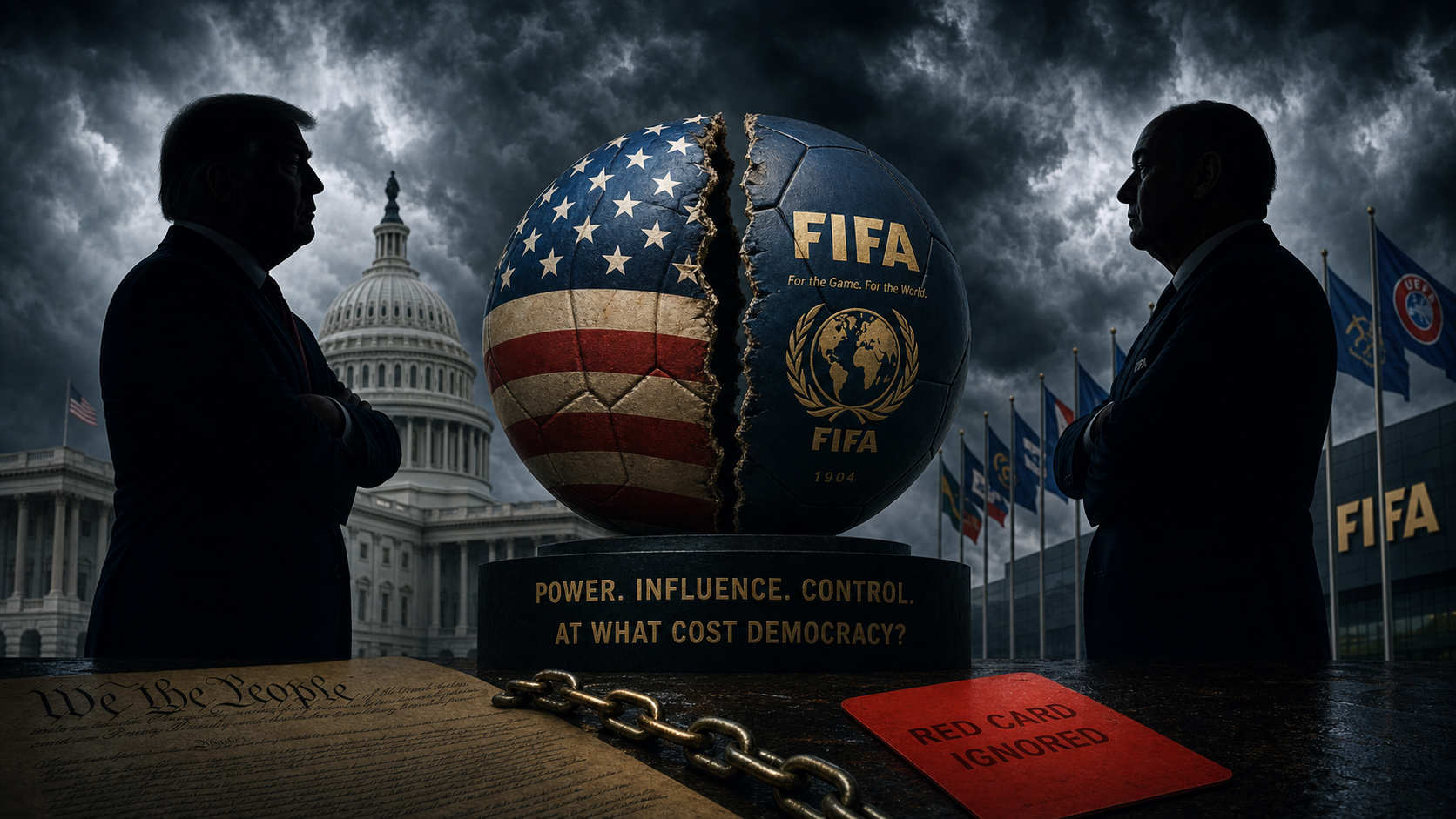
The 2026 World Cup and the USA: When power gives the impetus – How Trump and Infantino are corrupting world football – Image: Xpert.Digital
World Cup scandal 2026: How a single phone call shook football to its core
Red card overturned! The unprecedented World Cup scandal involving Trump and FIFA
Not just a favor: The dark truth behind Infantino's gift to Trump
At the 2026 World Cup in the USA, an unprecedented scandal erupted, shaking the very foundations of sporting competition: Following a justified red card for US striker Folarin Balogun, President Donald Trump picked up the phone and personally demanded that FIFA President Gianni Infantino overturn the suspension. Just four days later, the world governing body caved, effectively suspending its own rules. What at first glance appeared to be a legal sleight of hand revealed, upon closer inspection, a genuine scandal. It was the provisional culmination of a toxic symbiosis in which political power and economic greed definitively banished sporting fairness from the pitch – and exposed FIFA as a puppet of political interests.
The Balogun scandal is not an accident – it is the system
It was July 1, 2026, shortly after the final whistle in the USA's 2-0 victory over Bosnia-Herzegovina, when the most powerful man in the world picked up the phone. Donald Trump called Gianni Infantino – not as a private citizen, not as a football fan, but as the sitting President of the United States. His request was disarmingly direct: the red card shown to US striker Folarin Balogun in the 64th minute of the round of 32 match should be reversed, at least in its sporting consequences. Four days later, on July 5, 2026, FIFA did exactly what its president apparently felt was right: the Disciplinary Committee suspended the automatic ban for the 25-year-old striker – an unprecedented move in the 96-year history of the FIFA World Cup.
The New York Times, citing three people familiar with the conversation, reported that Trump had directly asked Infantino to review the suspension. Trump himself immediately announced on his platform, TruthSocial, that he thanked FIFA for doing the right thing and reversing a great injustice. The choice of words is telling: A sitting president is portraying a sports law ruling as a personal victory – and no one at FIFA is contradicting him. FIFA initially ignored all inquiries and, in its official statement, referred solely to Article 27 of the Disciplinary Code, which allows the Disciplinary Committee to suspend a suspension on probation.
What at first glance appears to be a legal technicality, upon closer inspection reveals itself to be what it is: a political decision disguised as sporting law. Article 9.6 of the 2026 World Cup tournament regulations had just shortly before unequivocally stated that no appeals were possible against referee decisions concerning game-related facts. And a FIFA spokesperson had explicitly confirmed after the match that no appeal could be lodged against the automatic suspension. Between this statement and the decision of July 5th lay four days and a phone call from the White House.
The foul on the pitch and the question of proportionality
To fully understand the significance of the incident, it's necessary to look at what actually happened in the match. Folarin Balogun, the US's top scorer at this World Cup with three goals, grazed the lower leg of Bosnian defender Tarik Muharemović and then stepped on his ankle. After lengthy review, the referee and VAR deemed the incident a straight red card. US coach Mauricio Pochettino stated that Balogun never intended to kick the player and that the foul should by no means have been judged as a red card. This assessment may be debatable from a sporting perspective. However, it is irrelevant to the fundamental question this incident raises.
The real issue isn't whether the red card was justified or not. Sporting decisions always involve a degree of interpretation, and VAR decisions are regularly the subject of controversy worldwide. The real problem is that a head of state believed he could influence a sporting sanction with a personal phone call to the federation president – and that this mechanism appears to be working. The historical context is also noteworthy: Balogun became the first player since 1962 to be eligible to play in the immediately following match after being sent off at a World Cup.
For comparison, it should be noted that the disciplinary commission applied the same rule under Article 27 in the case of Cristiano Ronaldo, which allowed the Portuguese player to participate in the first two World Cup matches. The procedure is therefore not entirely unfamiliar. The difference, however, lies in the alleged causality: In Balogun's case, a direct political intervention is suspected as the trigger, which necessitates a completely different qualitative assessment.
The Bromance of the Powerful: How Infantino Ingratiated himself with Trump
The decision of July 5, 2026, is not a spontaneous accident, but rather the result of a systematically cultivated relationship between Gianni Infantino and Donald Trump, a relationship that has intensified over years in a way that numerous experts consider highly problematic from both a legal and institutional perspective. Over the past few years, Infantino has gifted Trump virtually everything that football has to offer in terms of trophies: jerseys, balls, yellow and red cards, pennants, trophies, and medals. The symbolic culmination of this rapprochement was the presentation of the FIFA Peace Prize, created specifically for this occasion, to Trump at the World Cup group stage draw in December 2025 – shortly after Trump had been denied the Nobel Peace Prize, despite having publicly called for it.
The British human rights organization FairSquare subsequently filed an eight-page complaint with FIFA's Ethics Committee, accusing Infantino of four specific violations of the FIFA Code of Ethics, particularly Article 15, which obliges all officials to maintain political neutrality. In an Instagram post from October 2025, Infantino had written, in connection with the Israel conflict, that Trump undoubtedly deserved the Nobel Peace Prize for his decisive action. FairSquare argued that Infantino had repeatedly violated the obligation of neutrality by publicly expressing support for Trump. By the end of June 2026, 50 members of the European Parliament had joined this complaint in a letter to FIFA, urging the Ethics Committee to conduct a swift investigation. The Norwegian Football Federation had previously supported the complaint.
Political scientist Jules Boykoff described the relationship as symbiotic but asymmetrical: Infantino courts, visits, and showers gifts on Trump—not the other way around. The dominant force, he argued, is Trump, who has recognized the political potential of major sporting events and is using the World Cup to stage spectacular publicity, boost his approval ratings, and deflect political criticism. Boykoff calls it what it is: Trump is engaging in sportswashing. Sports economist Stefan Szymanski observed from an economic perspective that, despite his institutionally weaker position, Infantino clearly holds the upper hand when it comes to World Cup revenue—Infantino benefits more economically from the World Cup than Trump. This explains why he is willing to risk his institutional reputation for the goodwill of the US president: he needs Trump to secure the tournament's revenue.
The economic foundation: Why FIFA depends on Trump
The 2026 World Cup is the biggest and most financially ambitious football tournament in history. FIFA is targeting a revenue of US$13 billion for the 2023-2026 cycle – a significant increase compared to the US$7-8 billion generated by the World Cup in Qatar. Television rights are the largest source of income at over 50 percent, sponsorship accounts for approximately 30 percent, and ticket sales only around ten percent. Expanding the tournament from 32 to 48 teams and from 64 to 104 matches was an explicitly economically motivated decision, intended to generate more broadcast time, more sponsorship opportunities, and greater viewership.
The US market is of central importance. FIFA and the World Trade Organization estimated the tournament's contribution to US GDP at up to $17 billion, although independent sports economists like Christoph Breuer of the German Sport University Cologne pointed out that this amount represents a mere 0.05 percent of the US GDP of $30 trillion and is therefore barely measurable. The costs for the host countries paint a structurally unbalanced picture: the main revenues flow into FIFA's coffers, while infrastructure, security, and organizational expenses are largely financed by public funds.
In this economic context, Infantino's stance toward Trump can be explained strategically, without morally justifying it. A conflict-ridden World Cup in the US—for example, due to visa problems for foreign fans, security concerns, or political turmoil—could significantly impact FIFA's commercial revenue. Even before the tournament began, almost 80 percent of surveyed US hotels reported lower-than-expected occupancy rates, partly due to visa difficulties and the tense geopolitical climate. Infantino therefore has tangible economic motives to keep the host country and its president happy—a dependency that FIFA's internal critics have long described as a structural governance problem.
An association on the verge of losing its institutional credibility
The FIFA Ethics Committee, which was supposed to function as an independent oversight body, has long since become a symbol of institutional erosion. Since Infantino took office in 2016, the independent heads of the Investigatory Chamber and the Adjudicatory Chamber – Cornel Borbély and Hans-Joachim Eckert – have been dismissed after launching uncomfortable investigations against high-ranking officials. Eckert described the new Ethics Committee at the time as little more than a fig leaf. Anti-corruption expert Mark Pieth, a former FIFA reform officer, described Infantino as someone who acts very similarly to his predecessor Joseph Blatter, but even more brazenly plays the game of power.
The underlying system remains the same, one that FIFA governance experts have criticized for decades: whoever controls the controllers can essentially remain in power forever. Miguel Maduro, FIFA's former governance chief, described this mechanism as a system of control through fear – associations that take a stand against the president have to fear political repercussions. This explains the conspicuous silence of most national associations in the face of the Balogun affair: only Belgium dared to voice public dissent, and even there, a formal protest had yet to materialize by press time. The Royal Belgian Football Association expressed its dismay, declaring that FIFA was contradicting itself and referring to the FIFA circular of May 12, 2026, in which the world governing body had explicitly confirmed the automatic suspension following a red card for all participating associations.
Following the Balogun ruling, Nicholas McGeehan of FairSquare expressed the situation with a sharpness that perfectly captures the true extent of the matter: the rules were clearly broken in a way that benefits the political interests of the US president. National associations and politicians should demand answers from FIFA. If the host country used its political influence over the FIFA president to gain an unfair advantage, it would be a scandalous breach of the rules and manipulation of the competition. This finding stands, and FIFA has so far neither refuted it nor seriously commented on it.
Our US expertise in business development, sales and marketing

Our US expertise in business development, sales and marketing - Image: Xpert.Digital
Industry focus areas: B2B, digitalization (from AI to XR), mechanical engineering, logistics, renewable energies and industry
More information here:
A thematic hub offering insights and expertise:
- Knowledge platform covering global and regional economies, innovation and industry-specific trends
- A collection of analyses, insights, and background information from our key areas of focus
- A place for expertise and information on current developments in business and technology
- A hub for companies seeking information on markets, digitalization, and industry innovations
Infantino, Trump and the question of power: Is fair competition still possible?
MAGA and football: When a campaign slogan becomes a rule of the game
The slogan "Make America Great Again" was never intended as a sports philosophy – and yet it is unfolding its perhaps most disturbing effect on the world football stage. Trump recognized the political potential of major sporting events early on and treated the 2026 World Cup, the first to be held on American soil, as part of his political arsenal from the outset. The friendship with Infantino, the appointment of the FIFA president to the so-called Peace Council, the awarding of the FIFA Peace Prize – all of this fits into a pattern that political scientists call strategic sportswashing: the use of international sporting events for image cultivation and to distract from political controversies.
What is particularly disturbing about the Balogun affair, however, goes beyond image management. Not only was a World Cup tournament turned into a political stage, but the rules of a competition were changed mid-game to give a potential advantage to a team from the host country. This crosses a line unprecedented even in the long history of FIFA governance problems. Nick McGeehan calls it what it is: manipulation of the competition. The question of whether Trump actually interpreted the phone call in this way, or whether he simply wanted to do a favor for a friend, makes no legal difference, but a significant moral one.
The American values to which MAGA rhetorically appeals—fairness, equal opportunity, the rule of law, the idea of fair play in both the literal and figurative sense—are not strengthened by this process, but rather damaged. An America that demands special rules on the field because its president is on familiar terms with the head of the federation presents itself to the world as neither magnificent nor admirable. It is the image of a world power that believes rules apply to others. According to a representative survey conducted by the University of Hohenheim in 2026, around two-thirds of the German population rated FIFA's reputation negatively in connection with the 2026 World Cup, and trust in the world governing body's bidding processes and adherence to the rules had reached an all-time low.
The structural crisis of world football: More than a scandal
It would be convenient to treat the Balogun affair as an isolated slip-up—an unfortunate one-off in which an impulsive president and an opportunistic federation head briefly forgot their institutional boundaries. The reality is more complex and sobering. What became visible in recent days surrounding the US vs. Belgium World Cup round of 16 match is the tip of a structural iceberg.
Since 2016, FIFA under Infantino has systematically dismantled the institutional safeguards designed to guarantee independent oversight of the organization's leadership. Heads of ethics committees have been replaced, statutes amended, and new committees created to allocate more positions to loyal officials. Maduro warned that whoever controls this system can essentially remain in power indefinitely. And indeed, thanks to a 2024 amendment to the statutes, Infantino could remain FIFA president until 2031 – with all the structural influence that this office affords.
The pattern of power concentration is not a phenomenon unique to football. International sports organizations have always faced the structural challenge of preventing external political and economic influence when the control mechanisms are occupied by those they are meant to control. FIFA serves as a prime example of how an institution originally focused on non-profit goals can be gradually transformed into an instrument for securing power and optimizing the influence of its leadership. It is obvious that such a system is particularly vulnerable to political influence from powerful states. The 2026 World Cup will be held in the USA – the most economically significant host country in FIFA's history. The incentive to exploit this influence has rarely been greater.
The question that nobody asks out loud
At this point, at the very latest, an uncomfortable question must be asked: When and by whom will the boundaries be drawn? The teams participating in this World Cup depend on FIFA's rulebook. Their players accept suspensions, suffer setbacks due to VAR decisions, and fight for every inch of the pitch according to fixed rules – in the good faith that the same rules apply to everyone. When this faith is shaken, it's not just the sporting competition that is damaged. It's also the moral foundation of what makes sport a social phenomenon: the idea that on the pitch, performance, and not origin, status, or political connections, is what decides the outcome.
Belgium attempted to defend itself. Legal action was considered, and a statement from the federation expressed stunned incomprehension. However, legal action against a world governing body whose own ethics committee is structurally weakened and whose president has openly positioned himself as a close ally of the most powerful political figure in the host country is a laborious undertaking. Moreover, a formal internal FIFA protest would ultimately be decided by the same bodies whose independence is already questionable.
The real hope, therefore, lies not in a court ruling, but in public pressure. Football is a global mass phenomenon with an emotional mobilizing power that few other media possess. Around six billion people worldwide will follow the 2026 World Cup. They have a voice. Sponsors have a voice. National associations have a voice. And the media – above all, the reporting of journalists who have the courage to call things by their name – have a voice. Using these voices to demand that FIFA's rulebook remain free from political pressure is not only a matter of sports politics, but also a necessity for democracy.
Trust as the truly scarce resource
The conclusion of this analysis is one that extends far beyond the individual case of Balogun. What Donald Trump damaged with his phone call to Gianni Infantino cannot be repaired with a suspended sentence or a reprimand. It is the trust in the integrity of sporting competition – a value that is more fundamental to the economics of sports than any TV rights sum or sponsorship deal.
The University of Hohenheim, in its representative study on the 2026 World Cup, has documented that the German public's trust in FIFA has been declining for years and has not recovered. Around two-thirds of those surveyed rated the world governing body's reputation negatively. Nearly half of those questioned suspected that the tournament's expansion to 48 teams was primarily driven by financial motives. These are not random figures. They reflect a growing collective disillusionment that has built up over years of corruption scandals, opaque World Cup bidding processes, and the apparent dismantling of independent control mechanisms.
The Balogun affair adds to this loss of trust like another heavy stone on a scale already tipped heavily to the wrong side. And it does so at a particularly inopportune moment: in the middle of the tournament that FIFA had intended to stage as a demonstration of its global reach and economic power. Instead, the 2026 World Cup, in its first knockout phase, provides perhaps the clearest symbol of how political power can supplant institutional integrity – in a world governing body that no longer lives up to its own standards, and on the stage of a tournament that, according to its own propaganda promises, was supposed to be the greatest ever.
The most beautiful thing ever. It could have been so beautiful.





