
"I'm not thinking about the financial situation of Americans!" – This sentence becomes a mega-disaster for Trump
Xpert Pre-Release

Available in 27 languages 📢
Prefer Xpert.Digital on GoogleⓘPublished on: May 15, 2026 / Updated on: May 15, 2026 – Author: Konrad Wolfenstein
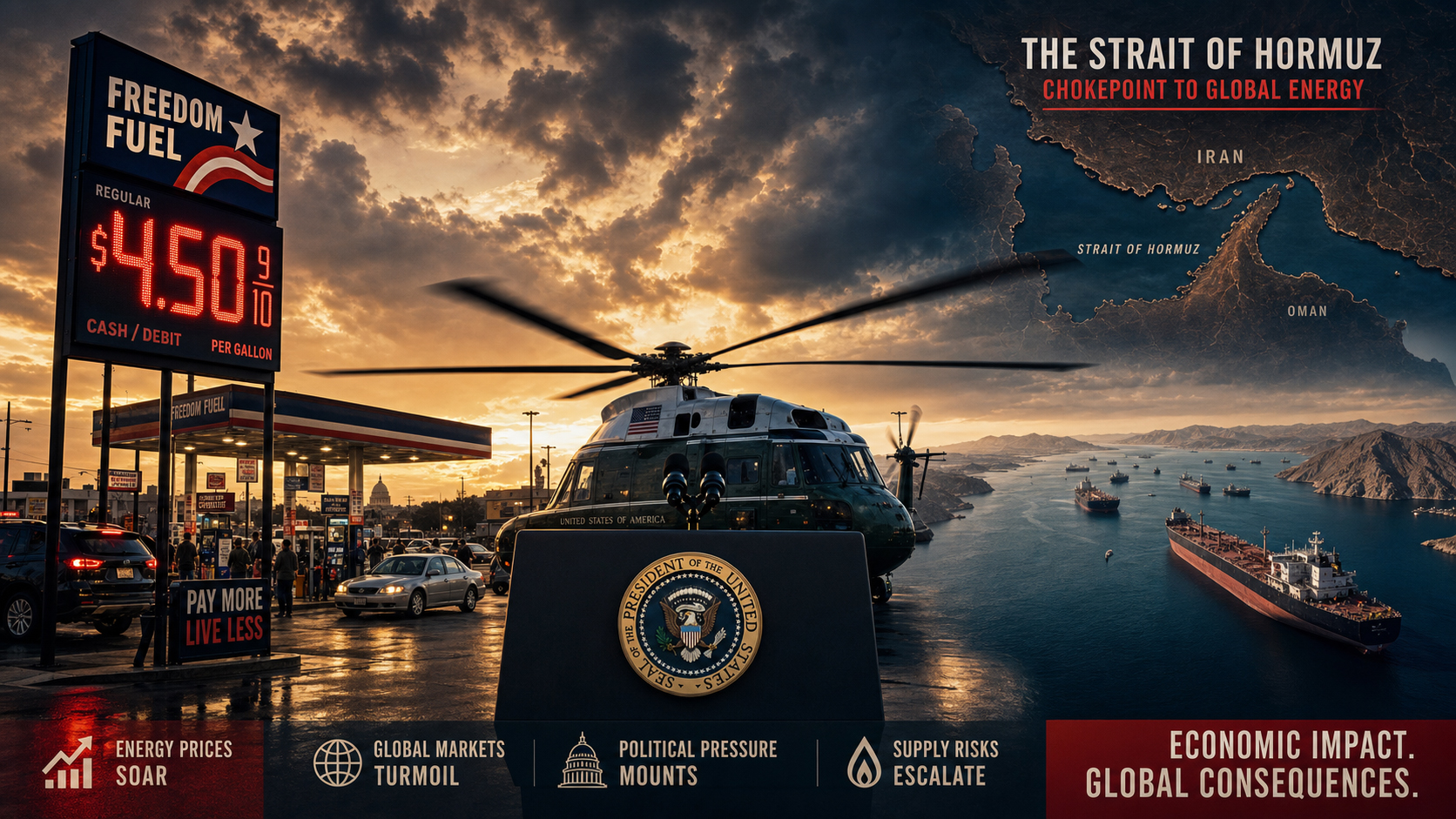
"I'm not thinking about the financial situation of Americans!" – This sentence becomes a mega-disaster for Trump – Image: Xpert.Digital
Global economy in danger: The devastating consequences of the Hormuz blockade
A historic mistake? Why Trump's arrogance could cost Republicans the election victory
Even US Vice President JD Vance has his doubts: Is the US government breaking apart due to the escalating Iran conflict?
It was just a fleeting moment on the White House lawn, yet its political impact is like an earthquake. In the midst of a stalled war with Iran and an escalating economic crisis in the spring of 2026, US President Donald Trump revealed a fatal set of priorities with a single sentence: When asked about the financial worries of ordinary citizens, he simply replied that he wasn't thinking about it "one little bit." While the Iranian blockade of the Strait of Hormuz is sending global energy prices soaring and the highest inflation in years is crushing the US middle class, Trump's support is crumbling dramatically. Not only is his once-loyal voter base turning away, but doubts are also growing within the administration about a war that is militarily at an impasse. Is Donald Trump knowingly steering himself toward an economic and political fiasco just before the crucial midterm elections?
Trump's Iran dilemma: When a single sentence shakes a presidency – and why a war could become economic suicide
It wasn't a grand speech, not a carefully staged appearance in the Oval Office. It was a fleeting moment on the South Lawn of the White House, the noise of rotating helicopter blades in the background, a reporter's question—and then those seven words that threaten to sear themselves into the political history of Trump's second term. Asked to what extent the financial situation of Americans influenced his decisions in the Iran negotiations, Donald Trump replied: "Not even a little bit." And then, as if to leave no room for doubt, he added: "I don't think about the financial situation of Americans."
What followed was what political observers in Washington call an echo earthquake: a sentence that spread through all news channels in seconds, was exploited by Democrats, feared by Republicans, and commented on with dismay by economic experts. White House Communications Director Steven Cheung attempted to repair what was virtually impossible to repair, explaining that Trump's paramount responsibility was the protection and security of Americans, and that was precisely why Iran could not acquire a nuclear weapon. It was a classic attempt at political damage control—and it came too late. The sentence had been uttered, documented, transcribed, and broadcast on a continuous loop.
Context is crucial to understanding the full explosive potential of this statement. Trump was en route to Beijing for a state summit with Chinese President Xi Jinping. The war against Iran—militarily launched at the end of February 2026—was mired in a perplexing stalemate. A fragile ceasefire was barely holding. Peace talks in Islamabad, led by Vice President JD Vance, had collapsed without an agreement in mid-April. The Strait of Hormuz, the 54-kilometer-wide waterway at the southern entrance to the Persian Gulf, remained effectively closed to regular shipping. And back home in the US, prices were rising—for gasoline, for food, for airline tickets, for almost everything that makes daily life expensive.
The Strait of Hormuz as a global economic pincer attack
To fully grasp the economic dimension of Trump's statement, one must understand the structural significance of the Strait of Hormuz. This narrow waterway between Iran in the north and Oman in the south is not a geopolitical abstraction—it is the lifeline of global energy supply. In peacetime, tankers carrying one-fifth of the world's traded crude oil pass through this route daily. In addition, a significant portion of the world's liquefied natural gas (LNG) trade passes through it. The five largest Gulf states together export goods worth approximately US$1.2 trillion annually through this strait, of which around US$800 billion are in the form of energy products alone.
Since the outbreak of war at the end of February 2026, shipping through the Strait of Hormuz has virtually ceased. Iran's Revolutionary Guard enforced the blockade with a combination of radio announcements, drone patrols, and the latent threat of military force. The consequences for global energy markets were immediate and brutal: crude oil prices rose worldwide, alternative routes such as around the Cape of Good Hope extended delivery times by weeks and significantly increased freight costs. The main customers of the Gulf states—China, India, and Japan—had to quickly reorganize, but the compensation through alternative suppliers remained incomplete.
A study by the Supply Chain Intelligence Institute Austria (ASCII), the Complexity Science Hub (CSH), and TU Delft modeled three scenarios: In the case of a one-month blockage, the macroeconomic damage would remain limited. With a three-month blockage, planned interest rate cuts by central banks would have to be postponed. In the event of a six-month interruption, global GDP growth could fall below the critical two percent mark, which economists consider to be de facto stagnation of the global economy. And energy economist Fyfe explicitly warned: In such a scenario, not only would interest rate hikes be possible—the global economy would be on the verge of recession. Even if the Strait of Hormuz were to be fully reopened in the short term, consumers could feel the effects well into 2027.
The inflation shock caught America off guard
The macroeconomic diagnosis for the US in spring 2026 is clear: The country is experiencing a classic supply-side inflation shock, triggered by a rise in energy prices as a result of the war. Consumer prices in April 2026 were 3.8 percent higher than the previous year – the highest level in almost three years. Compared to the previous month of March, prices rose by 0.6 percentage points, indicating a significant acceleration of inflationary pressures.
The composition of this inflation increase is particularly revealing. The energy sector alone accounted for more than 40 percent of the total monthly price rise. Gasoline prices were more than 28 percent higher than the previous year. The US Automobile Association (AAA) reported an average gasoline price of more than $4.50 per gallon in mid-May. By comparison, at the beginning of the Iran-Iraq War in late February 2026, the price was still at $2.98 – an increase of roughly 40 to 50 percent in just a few months.
But inflationary pressure extends far beyond fuel. Food prices rose by 0.7 percent in April 2026 compared to the previous month – the sharpest increase in almost four years. Airfares have increased by 20 percent within a year, and kerosene prices have risen by 60 percent since the start of the war. According to NBC News, several US airlines have therefore increased baggage fees and other surcharges. This particularly affects middle-class families who fly regularly. A key indicator that often determines economic sentiment is especially problematic: For the first time since 2023, inflation has outpaced wage growth. Average hourly wages recently rose by only 3.6 percent, while the inflation rate is at 3.8 percent. Adjusted for inflation, real wages fell by 0.3 percent in April. This means that for the majority of the working population, wages have de facto fallen despite nominal increases.
Core inflation, which excludes volatile energy and food prices, was still at 2.8 percent in April – a figure that actually suggests manageable price dynamics. This number is important because it shows that inflation is primarily driven by the war. But for the consumer at the gas station or supermarket, core inflation is an abstract statistic. What matters is what's left in their wallet at the end of the month.
Trump's credibility trap: The campaign promise and reality
Herein lies the real political dilemma that makes Trump's statement so explosive. Donald Trump was elected in November 2024, in part, on a clear economic promise: low energy prices, no new wars, and relief for the middle class after the inflation fiasco of the Biden years. "Drill, baby, drill" was a slogan aimed at energy independence and affordable fuel. This mandate from voters was clear, and it explains why Trump won back large swathes of the Midwest and the suburbs in 2024—voter groups that had suffered particularly under the energy prices of the Biden era.
Now, less than eighteen months after his second inauguration, America is experiencing the highest gasoline prices in four years, the highest inflation in three, and a president who declares in the same breath that the financial situation of his citizens is irrelevant to his foreign policy decisions. This is not just a political embarrassment—it is a breach of the social contract with the electorate that brought him to power. The Democrats didn't need to invent any creative points of attack. Trump had handed them a gift, as political strategists immediately recognized.
Chuck Schumer, the Democratic minority leader in the Senate, wasted no time. Trump's statement, he declared publicly, perfectly illustrates just how out of touch this administration is. The New Republic magazine described the remark as a political confession, a loud acknowledgment of what critics have long accused Trump of: that instead of thinking about ordinary families, he revolves around power, war, and his own political spectacle. Whether this criticism is justified or merely rhetorical exaggeration is politically secondary. What matters is that the statement confirms a narrative that Trump's opponents have long cultivated—and it could no longer be retracted.
Poll erosion: When the base crumbles
The poll data paints a worrying picture for the White House. Nate Silver, the renowned statistics and election analyst, published an update on his Silver Bulletin website on May 14, 2026: Trump's net approval rating had reached a new low of minus 18.9 points in his second term. Among general US adults, the net rating was even lower at minus 20.6 points, and around 48 percent of Americans expressed strong disapproval of Trump's performance in office.
For comparison: Trump began his second term in January 2025 with an approval rating of around 47 percent. Since then, that figure has fallen to 36 percent (Reuters/Ipsos, May 2026) – a drop of roughly eleven percentage points in less than a year and a half. Particularly alarming for Trump's domestic strategists: According to Nate Silver, the first signs of erosion are appearing within the traditionally loyal Republican voter base. Only 22 percent of Americans now have a strongly positive opinion of Trump – an indication that even core voters are beginning to waver.
In the CBS poll, only 38 percent of respondents approved of Trump's handling of the Iran crisis, while 62 percent disapproved. Even more drastically, two-thirds of those surveyed described the conflict as a freely chosen war that had not been necessary. And in the Reuters/Ipsos survey from early May 2026, two-thirds of US citizens said Trump had not clearly outlined the war aims in Iran. Sixty-three percent said that rising energy costs were significantly straining their household budgets. Sixty-five percent of voters blamed the administration for the price increases.
Our US expertise in business development, sales and marketing

Our US expertise in business development, sales and marketing - Image: Xpert.Digital
Industry focus areas: B2B, digitalization (from AI to XR), mechanical engineering, logistics, renewable energies and industry
More information here:
A thematic hub offering insights and expertise:
- Knowledge platform covering global and regional economies, innovation and industry-specific trends
- A collection of analyses, insights, and background information from our key areas of focus
- A place for expertise and information on current developments in business and technology
- A hub for companies seeking information on markets, digitalization, and industry innovations
Ammunition shortages, midterms and the oil war: Washington's geopolitical dilemma
Internal cracks: When the vice president has doubts
Another aspect that often remains under-examined in the public debate is the growing internal dissent within the administration. Reports in The Atlantic magazine, based on several high-ranking government officials, describe how Vice President JD Vance is increasingly expressing doubts behind closed doors about the Pentagon's narrative—particularly regarding available U.S. weapons stockpiles. Vance reportedly fears that Defense Secretary Pete Hegseth is systematically downplaying the drastic reduction in ammunition reserves caused by the war in Iran.
The Center for Strategic and International Studies (CSIS), a renowned Washington think tank, estimates that the four main types of ammunition held by the US armed forces may have shrunk by more than half since the start of the war. This is a strategically significant finding—not only for the Iran conflict itself, but for the entire US security architecture. Should ammunition reserves actually be depleted to this extent, the US's ability to credibly deter others in other regions—Taiwan, Europe, Korea—could be significantly impaired.
Vance had been skeptical of the Iran war from the outset. He led the American delegation at the failed Islamabad talks in April 2026 and later reported matter-of-factly that the Iranian side had shown no discernible willingness to make a long-term commitment to renouncing nuclear weapons. The fact that the Vice President himself is now questioning the Pentagon's official war narrative—at least internally—speaks volumes about the state of an administration that wants to project an image of unity to the outside world.
The failed negotiations: A structural problem
The diplomatic dimension of the Iran conflict is just as complex as the military one. Both sides are caught in a classic negotiating trap: The US demands, as a precondition for any agreement, a complete cessation of uranium enrichment and the opening of the Strait of Hormuz. Iran insists on war reparations, the lifting of all US sanctions, and security guarantees against further attacks. These positions are incompatible—at least not without substantial concessions from both sides.
The collapse of the Islamabad talks in April was symptomatic of this deadlock. After more than 21 hours of intensive negotiations, the US delegation left Pakistan without an agreement. Vance spoke of a proposal that he characterized as a final offer. Tehran, on the other hand, accused Washington of deliberately scuttling the talks with unacceptable demands. The truth probably lies somewhere in between: Neither side was prepared to take the politically painful first step. Iran could not agree to a nuclear renunciation without watertight security guarantees—that would not have been viable domestically. The US could not offer security guarantees without effectively legitimizing the regime.
The geopolitical situation makes a swift solution even more difficult. According to US intelligence, Iran still possesses approximately 70 percent of its mobile missile launchers and roughly 70 percent of its missile arsenal. This means that despite significant war damage, Iran is by no means militarily defeated. It still possesses sufficient deterrent capabilities to escalate the conflict. At the same time, it can use the Hormuz blockade as economic leverage—an instrument that becomes more effective as the war drags on, because the fiscal and political costs for the US increase.
Congress and the limits of executive warfare
A frequently underestimated aspect in European reporting is the constitutional dimension of the Iran war. The US Constitution explicitly grants Congress the right to declare war – but in practice, presidents since Vietnam have increasingly taken unilateral military action. The Democrats exploited the tense atmosphere to introduce war authorization resolutions in the Senate and the House of Representatives, which would have required Trump to obtain congressional approval for further military operations.
Both votes failed – but only narrowly. In the Senate, 53 senators voted against the resolution, 47 in favor – with one Republican defector in the person of Senator Rand Paul, who has long belonged to the libertarian wing of the party and is skeptical of foreign policy interventionism. In the House of Representatives, the result was also extremely close, with 219 votes to 212. These figures are politically significant: They show that Republican unity on the Iran issue is not a given. The longer the war lasts and the more the economic costs rise, the more Republican members of Congress, under pressure from their constituents, will question whether they can continue to support the president.
The midterm elections in November: The economic sword of Damocles
For the Republican Party, November 2026 will be a pivotal test. The starting point is complex: Republicans currently hold 222 seats in the House of Representatives—a majority that would collapse if they lost just five seats. In the Senate, they must defend 22 of the 34 seats up for election, a structurally unfavorable starting position. Prediction markets like Kalshi, in mid-March 2026, priced in an 85 percent probability of a Democratic takeover of the House. Polymarket gave a 48 percent probability of a complete Democratic sweep—that is, control of both chambers.
Nate Silver explicitly concluded in his mid-May analysis that current polling data indicated Democrats were headed for a strong showing in the midterm elections. This is not a surprising prediction—governing parties historically suffer from the so-called "midterm penalty," and when gas prices are at record highs and inflation of 3.8 percent is eroding real wages, it's the most toxic combination a campaign strategist can imagine.
Even within the Republican base, discontent is growing. Polls show that a majority of Republicans do not want US ground troops in Iran and prefer a diplomatic solution. Young MAGA voters, who elected Trump in 2024 expecting him not to start new wars, feel their "America First" expectations have been dashed. Potential candidates for 2028—according to Silver—are already beginning to publicly distance themselves from Trump, a sign that the Republican power elite is calculating how far they can follow the president without jeopardizing their own political future.
Economic rationality versus geopolitical ideology
At this point, a sober economic assessment, setting aside the day-to-day political turmoil, is worthwhile. Trump's prioritization—preventing Iran from acquiring nuclear weapons above all else—is not irrational from a security policy perspective. A nuclear-armed Iran would represent a fundamental disruption to the regional and global security architecture. The risk of nuclear proliferation in the Middle East—Saudi Arabia, Turkey, and other states would be under immense pressure to follow suit—is not an academic exercise, but a real strategic risk. From this perspective, Trump's statement is understandable: if the alternative is a nuclear-armed Iran, then gasoline prices do indeed seem less significant.
The problem, however, is twofold. First, the wording itself—"I'm not thinking about the financial condition of Americans"—violates fundamental norms of democratic leadership communication. A president can and must make complex trade-offs between national security and short-term welfare. But he must explain these trade-offs, not deny them. The message could have been: "The short-term costs are painful, but we are protecting America from an existential threat." Instead, Trump sent the signal that the concerns of ordinary households are simply irrelevant. This is not strategic communication—this is political failure at its most basic level.
Secondly, and this is economically crucial: there is no guarantee that the military strategy will actually achieve its intended goal – the end of the Iranian nuclear program. Intelligence reports indicating that Iran still possesses the majority of its missile arsenal, coupled with the failure of negotiations, demonstrate that a swift, decisive outcome is not in sight. This also prolongs the period during which the economic costs are incurred. And every additional month of the Hormuz blockade increases the risk of a global recession, which would hit the US hardest. Long-term economic rationale therefore favors a rapid diplomatic solution – even if it would be politically painful in the short term.
The global spillover effect on supply chains and industry
The effects of the Hormuz blockade are not limited to US gasoline prices. They are part of a global chain reaction whose end is not yet in sight. In Germany, inflation rose to 2.9 percent in April 2026 – the highest level since January 2024 – also primarily as a result of the Iranian oil price shock. German industry, while not directly dependent on Gulf oil, is suffering massively from increased energy costs and growing disruptions in supply chains for intermediate goods from Asia.
China, the world's largest oil importer, sources a significant portion of its energy from Gulf states that can no longer fully utilize their supply routes through the Strait of Hormuz. While Beijing has built up strategic oil reserves and begun developing alternative procurement strategies, massive increases in freight costs and significantly longer delivery times could severely impact Chinese industry in the medium term, despite its full energy reserves, and further dampen global growth. This very economic pressure explains why Trump was en route to Beijing when he made that fateful statement: China is a key power that could indirectly exert massive pressure on Iran—if it so desired. The question is, at what cost?.
The paradox of strength: When determination becomes weakness
The bitter irony of Trump's Iran policy lies in a classic geopolitical paradox: the attempt to demonstrate strength through maximum pressure and seemingly unwavering resolve has weakened the actual strategic position of the US – economically, diplomatically, and domestically. Economically, because the US itself is suffering from the energy price shock and inflation. Diplomatically, because the failed Islamabad negotiations show that maximum pressure alone does not produce a viable agreement. Domestically, because the president's popularity has reached a low point in his second term.
Added to this is the problem of credibility: Trump began the Iran war with the implicit message that it would be won quickly and decisively. This expectation has not been fulfilled. The war is in a stalemate that is not easily resolved militarily. Every month that passes without a clear result reinforces the narrative of a president who has dragged the US into a costly and counterproductive conflict—a narrative that Democrats intend to bolster with the clip of that one sentence.
Vance's internal doubts about the Pentagon, cracks in the Republican congressional caucus, eroding support in the MAGA base, forecasts pointing to massive losses in the midterms: The picture emerging for the second half of Trump's term is that of a president who has not yet won his most important foreign policy bet and who is running out of time – and domestic political support.
The statement that shook Washington was no slip of the tongue. It was a window into the decision-making logic of a president for whom geopolitical power games take precedence over the everyday concerns of his constituents. Whether this logic ultimately proves correct will be decided less at the Strait of Hormuz than at the ballot box in November 2026.
Your global marketing and business development partner
☑️ Our business language is English or German
☑️ NEW: Correspondence in your native language!

Konrad Wolfenstein
I and my team are happy to be available to you as your personal advisor.
You can contact me by filling out the contact form here simply call me at +49 7348 4088 965. My email address is [email protected]:or
I'm looking forward to our joint project.
☑️ SME support in strategy, consulting, planning and implementation
☑️ Creation or realignment of the digital strategy and digitization
☑️ Expansion and optimization of international sales processes
☑️ Global & Digital B2B trading platforms
☑️ Pioneer Business Development / Marketing / PR / Trade Fairs
🎯🎯🎯 Data-driven B2B industry hub as a quasi-in-house solution

The quasi-in-house solution: How Xpert.Digital closes operational gaps in B2B marketing and sales – Smart Content-Driven Business - Image: Xpert.Digital
Xpert.Digital is a data-driven B2B industry hub led by Konrad Wolfenstein . The company acts as an external, quasi-in-house solution for industrial partners, closing operational gaps in marketing, content, and sales – without requiring additional resources on the client side.
More information here:










