
“Wishful Software”: The new AI trend that is turning the entire IT procurement process upside down

Available in 27 languages 📢
Prefer Xpert.Digital on GoogleⓘPublished on: April 20, 2026 / Updated on: April 20, 2026 – Author: Konrad Wolfenstein
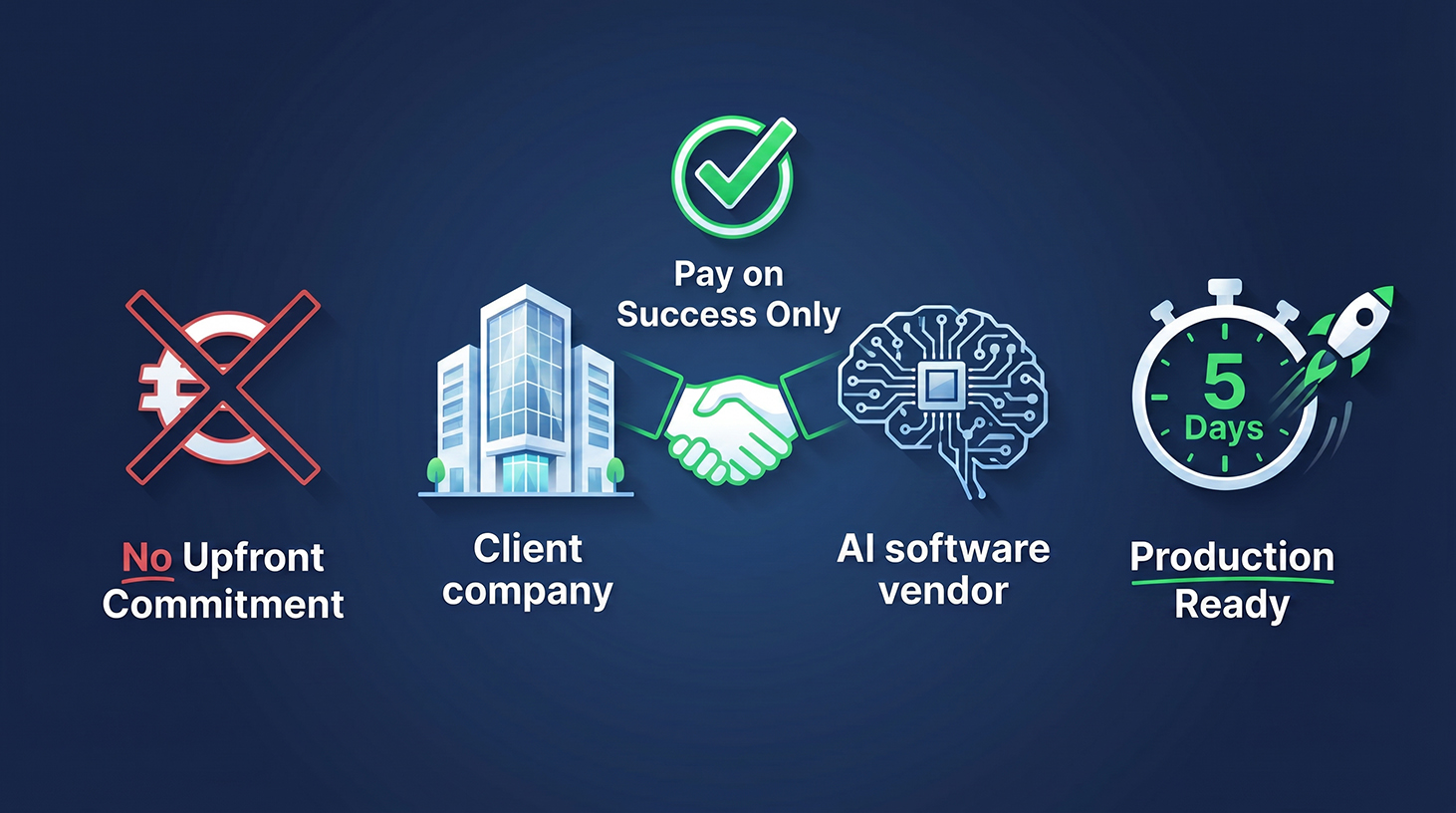
“Wishful Software”: The new AI trend that is turning the entire IT procurement process upside down – Image: Xpert.Digital
Outcome-Based Pricing in AI: A brilliant model or the most expensive illusion for companies?
AI solution in 5 days with no upfront costs: Revolution or pure marketing?
Pay only if successful: How the "pay-per-solution" model is changing the AI market
For years, companies have invested millions in promising AI projects – often driven by the fear of falling behind, and frequently with sobering results. This principle of hope, now ironically referred to in the industry as "wishful software," will reach its limits by 2025/2026 at the latest. Faced with a lack of measurable return on investment (ROI), CFOs and procurement departments are demanding an end to expensive upfront licenses and unpredictable implementation costs. The tech industry's response is a radical paradigm shift towards outcome-based pricing (OBP) or "pay-per-solution.".
In this model, companies only pay once an artificial intelligence has demonstrably and contractually defined solved a problem – be it a fully autonomously closed support ticket, a processed order, or a verifiable productivity gain. This shifts the financial and technical risk of implementation entirely from the buyer to the provider. But what initially sounds like the perfect deal for companies presents entirely new structural challenges for IT governance, procurement processes, and contract design. Added to this are highly attractive, but sometimes misleading, promises from providers to roll out production-ready AI solutions in just five days.
The following article takes an in-depth look at which pioneers already dominate this new market, where the hidden costs of these results-based models lurk, and how purchasing and IT strategies now need to fundamentally change in order to avoid falling into the cost trap.
“Wishful Software”: Business models where companies only pay for successful AI solutions
A fundamental paradigm shift is shaping the enterprise AI market in 2025/2026: Instead of high upfront payments for uncertain AI projects, outcome-based billing models are taking center stage, where companies only pay for proven results. This principle – sometimes referred to as "wishful software," sometimes as "outcome-based pricing," or "pay-per-solution" – shifts the implementation risk from the buyer to the provider, fundamentally changing how procurement and IT departments acquire, evaluate, and manage AI. At the same time, a new type of service provider is emerging, promising production-ready AI solutions in five to seven days – without any upfront commitment.
What is "Wishful Software"?
The term "wishful software" ironically describes the current procurement paradigm: companies buy expensive AI licenses and implementation projects based on promises and hopes – and pay regardless of whether the solution actually works. The alternative is the pay-per-solution model: customers only pay when an AI solution delivers a measurable, contractually defined outcome.
Outcome-based pricing (OBP) is not new – it has existed in the IT industry for decades in the form of success-based fees in consulting or results-oriented managed services. What has changed in 2025/2026 is that these models are being systematically rolled out for AI software products (SaaS, agents, automations) for the first time and are being positioned by leading providers as their primary go-to-market model.
Key characteristics of the model
Characteristics of the Traditional Model: Pay-per-Solution
Payment Upfront (License + Implementation) Only upon proven success
Risk Bearer Buyer (Company) Provider
Contract Structure Fixed Scope, Time & Budget Performance Metrics Defined in the Contract
Deployment Months to Years Days to Weeks
Budget Approval Capex/Opex Process Often no formal IT procurement required
Provider Relationship One-off/Transactional Ongoing/Partnership-based
Market pioneers and real business models
Zendesk: Resolution-Based Pricing
In 2024, Zendesk was one of the first major SaaS providers to introduce outcome-based pricing for AI agents: customers pay for each successfully resolved support request – not per seat or hour. This model, known as "resolution-based pricing," is considered an industry blueprint. Zendesk defines "success" as requests that are resolved without human intervention.
ThoughtFocus Build: Zero Upfront Fees, Guaranteed ROI
In 2025, ThoughtFocus Build launched a program with the explicit promise: "Zero Upfront Fees, Guaranteed ROI." The company undertakes AI workforce implementations without upfront payment and assumes all development risk. Payment is only made after demonstrating measurable productivity gains.
AffixedAI: Venture Partnership
AffixedAI positions itself as a “$0 Upfront AI-Powered Business” – the company develops AI-supported business models for customers at its own risk and participates in the resulting success via revenue-share models.
5 Day Sprint: Production readiness in five days
The "5 Day Sprint" model promises to bring AI business applications from concept to production-ready solution in five days. Similar offerings, such as Brightter's "AI Sprint," promise the transformation of product functions within a week. This promise relies on pre-built AI modules, low-code platforms, and standardized deployment pipelines that condense traditional project phases.
AWS: Agentic AI Outcome Pricing
Hyperscalers are also reacting: AWS explicitly documents “outcome pricing” structures for agentic AI in its Prescriptive Guidance – i.e., models in which agentic AI workflows are billed after successfully completed tasks.
Five days to a production-ready solution – reality or marketing?
The promise of a five-day deployment time is subject to certain conditions and is not universally valid.
What is realistic in five days
- Standardized use cases: document processing, email classification, simple chatbots, data extraction from known formats
- Low-code/no-code platforms: If providers have pre-configured modules available, deployment is possible in days
- Greenfield deployments: Without legacy integration, an AI agent can be production-ready in 3–5 days
Which realistically takes longer
- Enterprise system integration: Connecting to ERP, CRM or legacy databases typically requires 4–12 weeks
- Compliance and data protection: Especially in regulated industries (finance, healthcare), governance processes significantly extend the timeframe
- Data quality: Poor or inconsistent data is the most common reason for delays in AI projects
The five-day promise is credible for clearly defined, standardized use cases. For complex enterprise deployments, it is primarily a marketing signal that communicates low barriers to entry.
🤖🚀 Managed AI Platform: Faster, safer & smarter to AI solutions with UNFRAME.AI

Managed AI Platform - Image: Xpert.Digital
Here you will learn how your company can implement customized AI solutions quickly, securely and without high entry barriers.
A managed AI platform is your all-inclusive, worry-free solution for artificial intelligence. Instead of dealing with complex technology, expensive infrastructure, and lengthy development processes, you receive a ready-made solution tailored to your needs from a specialized partner – often within just a few days.
The key advantages at a glance:
⚡ Rapid implementation: From idea to ready-to-use application in days, not months. We deliver practical solutions that create immediate added value.
🔒 Maximum data security: Your sensitive data stays with you. We guarantee secure and compliant processing without sharing data with third parties.
💸 No financial risk: You only pay for results. High upfront investments in hardware, software, or personnel are completely eliminated.
🎯 Focus on your core business: Concentrate on what you do best. We take care of the entire technical implementation, operation, and maintenance of your AI solution.
📈 Future-proof & scalable: Your AI grows with you. We ensure continuous optimization and scalability, and flexibly adapt the models to new requirements.
More information here:
Outcome pricing for AI: Risks, pitfalls and real savings potential
Why the model is now gaining momentum
AI disillusionment after the euphoria
2026 is considered the "Year of Truth" for AI in businesses across the industry. After years of experimental investments without a clear ROI, CFOs and boards are demanding measurable results. According to a TTMS analysis, executives are increasingly asking: "Who is paying for the experiments from 2023 to 2025?" Outcome-based models provide a structural answer to this question.
Pressure on the supplier side
McKinsey describes how software companies must fundamentally rethink their business models to survive in the AI era. AlixPartners predicts in its Enterprise Software Predictions Report 2026 that vendors who fail to deliver demonstrable outcomes will lose market share to results-oriented competitors.
Agentic AI as an enabler
The rise of autonomous AI agents makes outcome pricing technically measurable: An agent that autonomously completes a task (resolving a ticket, processing an order, checking a document) generates a clear, digital success signal – ideal for transactional billing.
Impact on purchasing and IT strategies
Risk shifting as a strategic lever
The central promise of pay-per-solution is the transfer of implementation risk to the provider. For purchasing departments, this means:
- Elimination of traditional evaluation criteria (reference projects, certifications, preliminary demos)
- Contractual definition of KPIs and success metrics is becoming a core competency
- New questions: How is "success" measured? Who audits the results data? What happens in the case of partial delivery?
Purchasing: From license buyer to outcome manager
Traditional procurement processes (RFP, vendor scoring, price comparison) are unsuitable for outcome models. The procurement department must transform:
- Formulation of measurable AI success metrics (e.g. resolution rate, error reduction, time savings)
- Contract design for success fee structures and escalation mechanisms
- Control of the measurement infrastructure: Who measures success – the supplier or the buyer?
- Provider creditworthiness assessment: Can the provider financially bear the risk?
According to an analysis by Paterhn.ai, traditional procurement processes are blocking AI innovation: Lengthy RFP cycles, overly broad security requirements, and rigid budget categorizations prevent successful PoCs from going into production.
IT Strategy: Budget Approval and Governance
Pay-per-solution models are also changing how AI budgets are approved:
- No capex commitment: Since no upfront payment is required, business units (LOB) can often implement AI solutions without formal IT budget approval – leading to “shadow AI”
- CIO loss of control: When vendors work directly with business units and only bill upon success, they bypass traditional IT procurement paths
- Vendor lock-in risk: Outcome models can create long-term dependencies that only become apparent after data migration and process integration
Critical counter-argument: The most expensive illusion?
Forbes/Parloa warns: Outcome-based pricing can be more expensive for companies than traditional licensing models. Reasons:
- Premium prices for risk assumption: Providers factor their risk into the success rate – effectively, the customer pays a risk premium
- Definitional conflicts: What constitutes a "resolved ticket"? What constitutes a "successful delivery"? Unclear definitions lead to disputes
- Adverse Selection: Providers only select "simple" use cases for outcome models – difficult cases are excluded or charged at a higher rate
- Measurement asymmetry: Whoever controls the measurement controls the billing – without a neutral auditing body, a conflict of interest arises
Structural tension areas
Definition of "success"
The biggest unsolved problem in outcome pricing is the precise, tamper-proof definition of success. Impact Pricing refers to outcome-based pricing as the "holy grail of AI pricing"—but also as technically difficult to implement because AI outcomes are often delayed, causally ambiguous, or difficult to attribute.
Technical measurement infrastructure
True outcome pricing requires a robust, shared data foundation for success metrics. Many companies don't yet have this infrastructure. AWS recommends building dedicated outcome tracking pipelines for Agentic AI models as a prerequisite for fair billing.
Compliance and Contract Law
Legal requirements for AI contracts (EU AI Act, GDPR, industry-specific regulations) are complex in outcome-based models: When performance is success-dependent, new liability issues arise. MinterEllison explicitly recommends supplementing AI contracts with outcome definitions, audit rights, and escalation clauses by 2026.
Recommendations for action
For purchasing departments
- Build a KPI library: Define standardized success metrics for common AI use cases (e.g., "Resolution rate > 70% without human intervention")
- Ensure measurement independence: Contractually stipulate that success metrics are recorded by a neutral body or in-house systems
- Examine hybrid models: The combination of a base platform fee and a success bonus reduces the provider risk and thus risk premiums
- Assessing provider resilience: Outcome providers must be financially able to bear the risk
For IT departments / CIOs
- Establish shadow AI governance: Define clear rules on which outcome models business departments may use without IT approval
- Vendor lock-in assessment: Define data migration and exit clauses for every outcome contract
- Production readiness checklist: Define your own standards for "production-ready" – independent of supplier promises
- Procurement-IT alignment: Develop common processes for AI procurement that are fast enough for 5-day deployment promises, but also ensure governance
Market outlook
Futurum Research predicted as early as 2025 that outcome-based pricing would gain substantial traction in the AI market. This assessment has proven accurate: Zendesk, Salesforce, ServiceNow, and other major SaaS providers are integrating outcome-based components into their pricing models. According to Getmonetizely, by the end of 2026, hybrid models (platform fee + outcome fee) will dominate the market, while pure seat-based licensing models for AI agents will decline in importance.
For the German market, AI in procurement will no longer be a pilot project by 2026 – according to einkauf-ki.com, leading companies will be relying on autonomous procurement strategies in which AI agents independently select suppliers, negotiate prices, and place orders. The pay-per-solution model is both the procurement object and the procurement method – a self-reinforcing trend.
Consulting - Planning - Implementation

Konrad Wolfenstein
I would be happy to serve as your personal advisor.
contact me at wolfenstein ∂ xpert.digital
Just call me on +49 7348 4088 965 .





