
How AI detects supply bottlenecks before they happen: No more reactive procurement – Saving the supply chain

Available in 27 languages 📢
Prefer Xpert.Digital on GoogleⓘPublished on: April 7, 2026 / Updated on: April 7, 2026 – Author: Konrad Wolfenstein
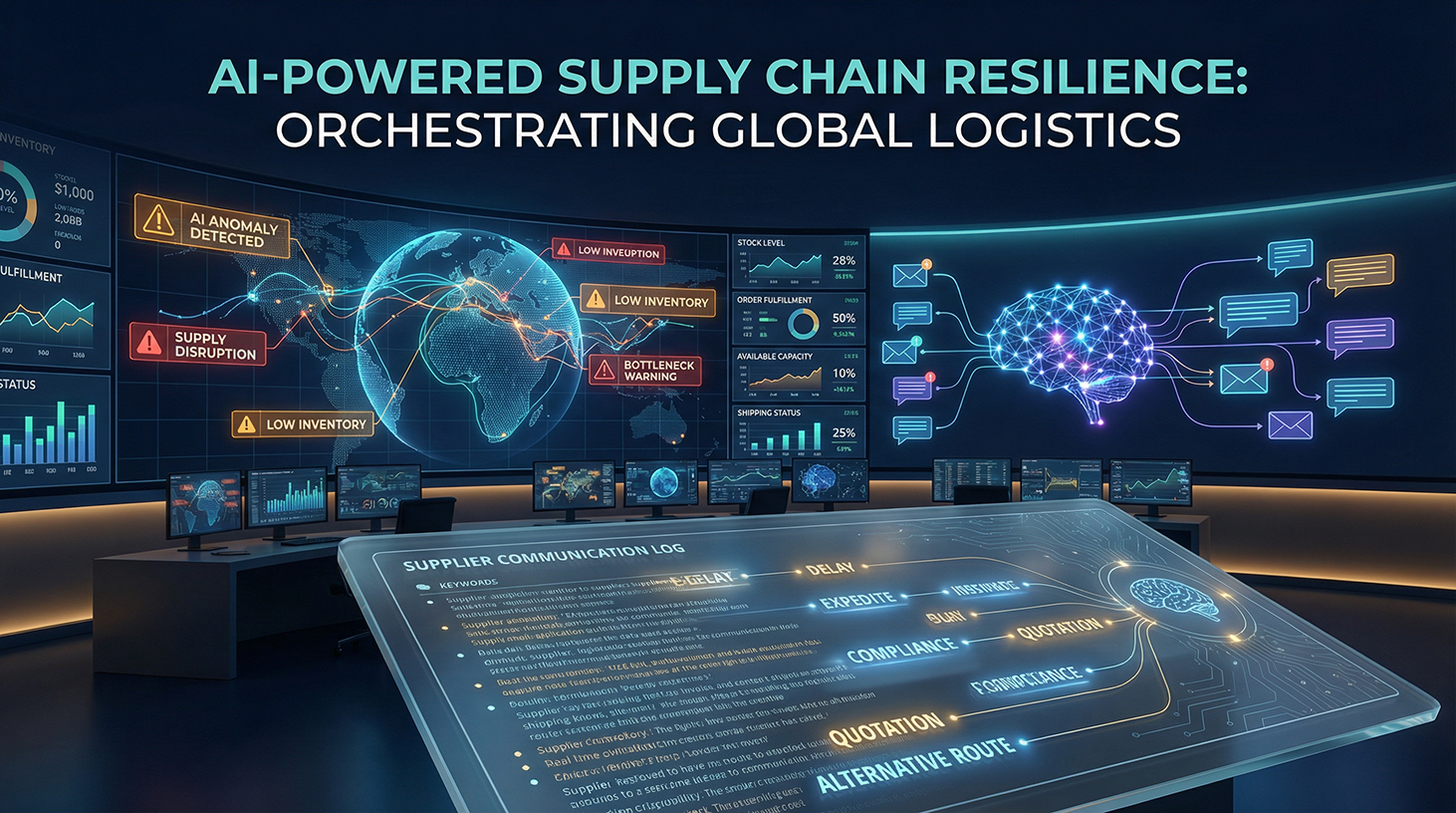
How AI detects supply bottlenecks before they happen: No more reactive procurement – Saving the supply chain – Image: Xpert.Digital
When the portal is silent, the AI speaks: Early warning systems for supply chain risks
Costly stock shortages: Why supplier portals are the problem – and how AI will finally solve it
Supplier portals are considered an indispensable standard in modern procurement – but they have a serious flaw: they only document the past. By the time a supplier portal indicates a critical delivery delay, the problem has usually already escalated in the background. The result is empty shelves, costly emergency procurement, and disgruntled customers. But what if you could identify risks before they officially materialize? The true, early warning signs of supply bottlenecks aren't hidden in structured portal entries, but rather in everyday, unstructured communication: a casual remark in an email, a different PDF attachment, or a vague wording in the order confirmation. Those who ignore these signals ultimately pay the high price of being too late. Learn why reactive status management is outdated and how AI-powered early warning systems (Natural Language Processing) decipher hidden clues in real time, stop the dreaded bullwhip effect, and fundamentally revolutionize the supply chain.
Related to this:

Reaction is not a strategy – why the status quo in procurement is structurally failing
Imagine this scenario: A dispatcher opens the supplier portal in the morning and discovers that a critical delivery date was quietly postponed three weeks ago. No escalation, no warning, no automatic notification to the planning department. And now the stock shortage hits home – with all the unpleasant consequences: empty shelves, disgruntled customers, an overpriced emergency purchase, and the obligatory awkward conversation with the merchandising team.
What sounds like an isolated incident is actually the daily operational reality for countless companies in the retail and distribution sectors. Supplier portals are valuable tools, but they reflect the past, not the future. They mirror what has already happened – after a supplier has made a decision, changed a status, and documented it. By that point, the damage to supply chain planning is often already done.
The structural failure doesn't lie with individual employees or flawed processes. It lies in the fundamental architecture of the systems themselves: portals process structured data that suppliers deliberately enter. The truly early warning signs—the vague reservations in an email, the slightly altered tone in an order confirmation, the attachment with a revised shipping plan—all of this flows through entirely different channels. It lands in inboxes, not in planning systems. It is read by people, not processed by algorithms.
The hidden costs of recognizing too late
Before understanding the solution, one must grasp the problem in its full economic scope. Out-of-stock situations are often perceived by the public as simply the lost individual revenue. The real costs are far higher and affect companies on multiple levels simultaneously.
According to an analysis, the direct costs of a single ten-day stock shortage for a product that sells 50 units daily at €50 each can potentially exceed €60,000 – when all indirect factors not reflected in a traditional profit and loss statement are taken into account. These include the erosion of customer lifetime value, retailer penalties and chargebacks, as well as emergency procurement costs with significant price markups. A Europe-wide study by the GMA puts the average out-of-stock rate in retail at 8.6 percent – for advertised items, it is even twice as high.
Consumer reactions to stock shortages are equally worrying for retailers: According to a study by DHBW Heilbronn, 29 percent of affected customers simply switch stores – and almost half of them then complete their entire remaining shopping trip at a competitor's. The revenue loss triggered by a single stock shortage thus far exceeds the value of the unsold product. When you add to all this the opportunity costs for the stock manager, who spends time tracking down stock and putting out fires instead of focusing on strategic planning, the full picture of the economic damage becomes clear.
The portal shows what has already happened
Supplier portals were built for a world where information is structured, timely, and completely integrated into digital systems. This world hardly exists in practice. The real supply chain works differently: A supplier struggling with internal production bottlenecks won't update their customers' portal first. They will communicate internally first, then perhaps send a short email, possibly attaching a revised delivery schedule – and update the portal, if at all, days or weeks later.
An IDC study of 1,800 supply chain executives worldwide reveals that only 17 percent of companies are able to respond to supply chain disruptions within 24 hours. The average crisis response time is a staggering five days – and two-thirds of respondents are explicitly dissatisfied with their own response speed. This isn't laziness or a failure of individual departments. It's a systemic problem: Signals arrive through channels that are simply not connected to planning systems.
In a comprehensive analysis of supply chain disruptions, the Fraunhofer Institute for Material Flow and Logistics identified precisely this pattern: Much risk information is already present within the organization at the time a damaging event occurs – however, it is not structured, not forwarded to the appropriate departments, and not linked to operational planning data. The gap is not informational; it is structural and technological.
Where the early signals really originate
The key takeaway is this: email always precedes the portal. Changes in supplier commitments almost never begin as an official portal entry. They start as informal communication: a contact person hinting at a production delay via email, a partial confirmation of a purchase requisition with a reservation in the third paragraph, a revised shipping plan as a PDF attachment.
Natural Language Processing (NLP)-based systems can detect these early signals long before they appear in structured systems. According to current findings from the application of such systems, they can generate an average of three to seven days of advance warning – compared to the status quo, where information is often not processed at all or is processed too late. This is not a marginal difference. In a procurement environment with long replenishment times, this lead time can mean the difference between a manageable problem and an existential emergency.
In practice, this works as follows: An AI-powered early warning system continuously monitors incoming supplier communication – emails, documents, confirmation replies – and analyzes it for language patterns that could indicate risks: delays, incomplete quantity information, unusually vague wording, abnormal response times to purchase requisitions. These unstructured signals are then combined with structured planning data – open orders, inventory levels, safety stock levels. This combination generates a risk score for each open item, alerting planners to critical deviations in real time.
🤖🚀 Managed AI Platform: Faster, safer & smarter to AI solutions with UNFRAME.AI

Managed AI Platform - Image: Xpert.Digital
Here you will learn how your company can implement customized AI solutions quickly, securely and without high entry barriers.
A managed AI platform is your all-inclusive, worry-free solution for artificial intelligence. Instead of dealing with complex technology, expensive infrastructure, and lengthy development processes, you receive a ready-made solution tailored to your needs from a specialized partner – often within just a few days.
The key advantages at a glance:
⚡ Rapid implementation: From idea to ready-to-use application in days, not months. We deliver practical solutions that create immediate added value.
🔒 Maximum data security: Your sensitive data stays with you. We guarantee secure and compliant processing without sharing data with third parties.
💸 No financial risk: You only pay for results. High upfront investments in hardware, software, or personnel are completely eliminated.
🎯 Focus on your core business: Concentrate on what you do best. We take care of the entire technical implementation, operation, and maintenance of your AI solution.
📈 Future-proof & scalable: Your AI grows with you. We ensure continuous optimization and scalability, and flexibly adapt the models to new requirements.
More information here:
Proactive supply chains: Preventing bottlenecks and strengthening resilience with AI signals
From reactive status management to predictive procurement
The paradigm shift enabled by AI-powered early warning systems is fundamental: from a system that reacts only when a problem is already documented, to a system that detects weak signals before the problem even officially exists. This might initially sound like a technological gimmick for innovation departments. In reality, it's a direct response to the structural gap that every supply chain organization knows but has long considered inevitable.
Specifically, this fundamentally changes the dispatcher's job profile. Instead of spending time daily manually checking portals, chasing suppliers by phone, and manually transferring status changes into planning tools, the dispatcher receives prioritized risk alerts with concrete recommendations for action: increase safety stock for item X, check alternative suppliers for SKU Y, review route Z due to increasing signal density. AI takes over the cognitive load of monitoring – the human can concentrate on decision-making and supplier relationships.
According to McKinsey data, companies using AI in supply chain processes have already achieved an average reduction in logistics costs of 12.7 percent and a 20.3 percent decrease in inventory. A BCG analysis concludes that AI applications enable cost reductions of up to 5 percent in direct procurement and even up to 15 percent in indirect procurement. These figures are not the result of a single factor, but rather the cumulative effect of improved forecasting, fewer emergency purchases, reduced overstocking, and greater planning accuracy.
Related to this:

The bullwhip effect as a systemic amplification machine
Anyone who wants to fully understand the rationale behind predictive procurement systems cannot ignore the bullwhip effect. This phenomenon, first described in the 1960s, illustrates how small fluctuations in consumer demand are exponentially amplified at the upstream stages of the supply chain: The retailer orders more as a precaution, the wholesaler reacts with even larger orders, the manufacturer in turn increases its production volume – and ultimately, massive overstocks are created at all levels, while the original change in demand was marginal.
The bullwhip effect is not just an academic concept. It causes measurable costs: increased inventory costs, unpredictable transportation and production costs, wasted capacity, and—when the pendulum swings in the other direction—sudden stockouts at all levels simultaneously. A simulation using open collaboration and shorter lead times has shown that supply chain costs can be reduced by up to 75 percent through these measures—proof of how much is structurally wasted in traditional supply chains.
AI-powered early warning systems address the bullwhip effect at its root: they shorten information latency. The faster a change in demand or availability is communicated through all levels of the supply chain, the less incentive there is to overreact. If a planner knows that a supplier is struggling, they can react in a targeted and measured way – instead of only acting when the emergency has already occurred and panicked bulk orders further increase the volatility.
Managed AI: Why the implementation approach is crucial
The introduction of AI into procurement processes often fails in practice not because of the technological concept, but because of the realities of implementation. AI systems that analyze unstructured supplier communication must be trained, calibrated, and integrated into existing ERP and planning systems. They must be familiarized with the company's specific communication patterns, be able to understand multilingual content, and minimize false positives to avoid undermining the trust of procurement managers.
The concept of Managed AI – AI solutions that are not operated as generic off-the-shelf tools, but rather as configured, maintained, and continuously optimized systems – addresses this reality. Managed AI bridges the gap between technological promise and actual deployment in a specific business environment. The provider handles not only the technical deployment, but also the ongoing maintenance of the model, its adaptation to changing communication patterns, and ensuring data protection compliance – an aspect that should not be underestimated, especially when processing supplier communications.
By 2026, 46 percent of companies will have implemented AI solutions in their supply chain processes, and 77 percent will be actively using or evaluating such technologies. The market for AI in procurement is projected to grow from $1.9 billion in 2023 to $22.6 billion by 2033 – an annual growth rate of 28.1 percent. These figures reflect not only a willingness to invest but also the growing realization that clinging to the reactive status quo model is becoming more expensive with each passing year.
Proactive action instead of subsequent damage control
The question supply chain managers should be asking themselves is not: Can I afford to implement an AI-powered early warning system? The more relevant question is: How long can I afford not to?
Planning teams that proactively identify delivery commitment risks share a common characteristic: They don't wait for the portal to notify them of changes. They have access to the signals that precede portal updates—the emails, documents, and communications containing the earliest indications of delivery delays, quantity reductions, and missing confirmations. This visibility allows them to proactively follow up with suppliers, adjust incoming plans before replenishment is affected, and make informed decisions rather than reactive ones.
The supplier portal isn't going anywhere – it remains an important part of the procurement ecosystem. But for managing critically important inbound deliveries, it can't be the first line of defense. The first line of defense is communication itself – and AI, which is capable of identifying risks in that communication even when they are still in the vague stages. The transformation from reactive to predictive procurement isn't a technological luxury. It's the logical consequence of the structural shortcomings of traditional supply chain management systems – and one of the most effective levers for increasing resilience, cost efficiency, and competitiveness in an increasingly volatile global procurement environment.
Consulting - Planning - Implementation

Konrad Wolfenstein
I would be happy to serve as your personal advisor.
contact me at wolfenstein ∂ xpert.digital
Just call me on +49 7348 4088 965 .





