
The end of software rental – Why companies are building their own systems again and the escape from software rental begins
Xpert Pre-Release

Language selection 📢
Published on: March 14, 2026 / Updated on: March 14, 2026 – Author: Konrad Wolfenstein
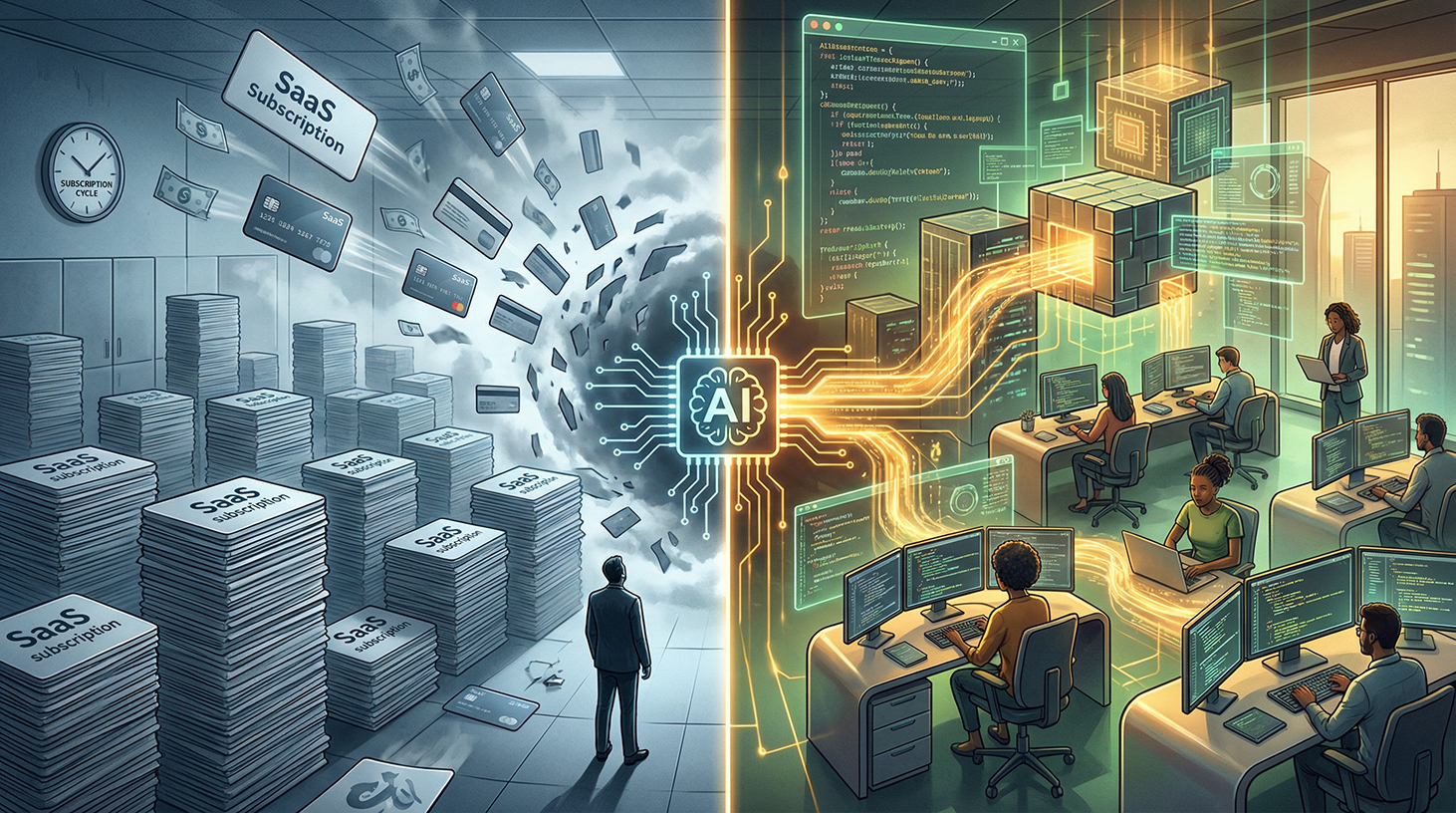
The end of software rental – Why companies are building their own systems again and the escape from software rentals is beginning – Image: Xpert.Digital
Price shocks in IT: This is why in-house software development is the big comeback of the year
SaaS subscriptions devoured budgets, vendor lock-in destroyed flexibility – and now AI is making DIY building cheaper than ever before
For years, an unshakeable mantra prevailed in boardrooms: software is conveniently rented from the cloud instead of being painstakingly and expensively programmed in-house. However, the initial euphoria surrounding SaaS (Software as a Service) models is increasingly giving way to profound disillusionment. Exploding license fees, hidden administration costs, and the dangerous dependence on so-called "vendor lock-in" are pushing the IT budgets of many companies to their absolute limits. It is precisely in this phase of maximum frustration that artificial intelligence is completely reshuffling the deck: AI assistants are automating programming to such an extent that in-house software development is faster, more efficient, and more cost-effective than ever before. This article examines why the "buy instead of build" paradigm is outdated, how the move away from purely standard solutions is progressing in practice, and why the future belongs to hybrid strategies where proprietary code once again becomes a genuine competitive advantage.
The great disillusionment: What happened to the SaaS euphoria
For years, the motto in boardrooms worldwide was considered irrefutable: buy instead of build, rent instead of develop, outsource instead of do it yourself. The promise of cloud-based software rental sounded enticing – predictable costs, rapid implementation, no need for in-house IT infrastructure. But reality has now caught up with these promises, and the backlash is mounting with increasing force.
The numbers speak for themselves. According to Gartner, the global SaaS market reached approximately $299 billion in 2025 – a growth of more than 19 percent compared to the previous year. While this is considered a success for providers like Salesforce, Microsoft, and SAP, it is causing increasing unease among subscribers of these services. The exploding licensing costs have put many corporate IT budgets under serious strain. A particularly drastic example is Broadcom's acquisition of VMware: By abolishing perpetual licenses and switching to purely subscription-based models, affected companies experienced price increases of over 1,000 percent. Since then, annual virtualization costs have ranged from €60,000 for small businesses to €6 million for large corporations.
Other SaaS providers followed suit: Docker increased the prices of its development tools by 67 to 80 percent, Pipedrive raised its CRM prices by 17 percent, and even comparatively moderate project management platforms like Jira charged eight percent more. The message these developments sent was clear: Those who had relied entirely on external SaaS solutions lost control of their budgets and were defenseless against the price dictates of their providers.
When dependency becomes a trap
In addition to exploding costs, a structural problem has manifested itself, which experts summarize under the term "vendor lock-in." This refers to the situation in which companies are so deeply integrated into the ecosystem of a single software provider that switching becomes virtually impossible – even if the provider raises prices, degrades service, or changes its strategic direction.
A study published in February 2026 by virtualization provider Parallels, surveying approximately 600 IT professionals from the US, UK, and Germany, revealed sobering findings: A full 94 percent of IT decision-makers expressed concerns about excessive vendor lock-in. Nearly half of these described their concerns as very pronounced. Key critical factors cited included unclear vendor roadmaps, a lack of predictability regarding future costs, and uncertainty about the long-term support of existing solutions. Particularly noteworthy: 87 percent of respondents plan to migrate parts of their workloads from the public cloud – a trend that underscores a more confident approach to cloud strategies.
At the same time, operating existing software environments ties up considerable internal resources: 95 percent of the surveyed companies invest up to ten hours per week in the pure administration of their cloud services. Beyond the actual license fees, the biggest hidden cost factors are security and compliance efforts, support and helpdesk services, and training costs for constantly changing interfaces and features. What was originally marketed as a way to reduce costs has turned into a hidden resource drain for many companies.
The shift back to self-build: data and dimensions
Against this backdrop, a strategic shift is taking place in the corporate landscape, reflected in concrete figures. A 2025 survey of 200 European companies conducted by the software company Modeso revealed that nearly 70 percent of respondents had opted for either fully or partially in-house developed software solutions – instead of relying solely on standard solutions. The distribution is interesting: 44.1 percent use a combination of both, 24.7 percent rely exclusively on custom software, and only 31.2 percent depend entirely on standard solutions. The assertion that the majority of corporate IT is dominated by SaaS products can therefore only be partially maintained for Europe.
At a global level, a survey by the market research company TechRepublic confirms that 75 percent of IT decision-makers consider bespoke software—that is, custom-developed, in-house solutions—to be superior and view it as a crucial competitive advantage. The global market for custom software development is estimated at around US$43 billion for 2024 and is projected to grow to over US$146 billion by 2030—at an annual growth rate of more than 22 percent. This growth is no longer a niche phenomenon; it represents a structural shift in the procurement thinking of global companies.
The crucial factor here is looking at the total operating costs over a longer period. A detailed cost comparison shows that while 30 to 35 percent of the total costs over five years are attributable to the initial development of in-house software, 60 to 80 percent of the IT budget is permanently allocated to maintenance, updates, and administration when purchasing standard software, which must be handled internally. In contrast, with in-house development, control over these cost items remains within the company.
A new dimension of digital transformation with 'Managed AI' (Artificial Intelligence) - Platform & B2B solution | Xpert Consulting

A new dimension of digital transformation with 'Managed AI' (Artificial Intelligence) – Platform & B2B solution | Xpert Consulting - Image: Xpert.Digital
Here you will learn how your company can implement customized AI solutions quickly, securely and without high entry barriers.
A managed AI platform is your all-inclusive, worry-free solution for artificial intelligence. Instead of dealing with complex technology, expensive infrastructure, and lengthy development processes, you receive a ready-made solution tailored to your needs from a specialized partner – often within just a few days.
The key advantages at a glance:
⚡ Rapid implementation: From idea to ready-to-use application in days, not months. We deliver practical solutions that create immediate added value.
🔒 Maximum data security: Your sensitive data stays with you. We guarantee secure and compliant processing without sharing data with third parties.
💸 No financial risk: You only pay for results. High upfront investments in hardware, software, or personnel are completely eliminated.
🎯 Focus on your core business: Concentrate on what you do best. We take care of the entire technical implementation, operation, and maintenance of your AI solution.
📈 Future-proof & scalable: Your AI grows with you. We ensure continuous optimization and scalability, and flexibly adapt the models to new requirements.
More information here:
Software for €25,000 instead of €100,000: How AI is pulverizing project costs
Why AI fundamentally changes the equation
The real explosive potential of current developments lies not only in the disillusionment with SaaS – it lies in the simultaneous revolution in software development through artificial intelligence. AI-powered development tools have fundamentally changed the mathematics behind the build-versus-buy decision.
The most striking evidence comes from a controlled experiment by GitHub and the Massachusetts Institute of Technology: Developers working with AI assistants like GitHub Copilot completed their tasks 55.8 percent faster than colleagues without AI support. The result was highly statistically significant, with a p-value of 0.0017 and a 95 percent confidence interval between 21 and 89 percent speed advantage. What sounds abstract translates into drastically altered project cost calculations: The development project that cost €100,000 yesterday might only cost €25,000 today—not because developers type faster, but because repetitive tasks like boilerplate code, standard integrations, and documentation are largely automated.
Leading figures in the tech industry have publicly quantified this development. Sundar Pichai, CEO of Alphabet, stated in an interview that 25 percent of all code at Google is now AI-assisted. Microsoft CEO Satya Nadella spoke of 20 to 30 percent in the company's active projects. These figures are not marketing hype, but rather indicators of a fundamental shift in the productivity structure of software development.
The new complexity: Build, Buy or Blend?
The simplification that the decision is binary – either buy or build – falls short. The software industry itself has begun to move beyond this dichotomy. An article from the trade publication Informatik Aktuell describes the evolution to a three-part discussion: Build, Buy, and Blend. This refers to a hybrid approach that combines the strengths of both models: Companies purchase standard solutions for core functions that are not relevant to differentiation and simultaneously develop proprietary software for those processes that create genuine competitive advantages.
This hybrid strategy is also reflected in the survey data: In the previously cited Modeso study, 79.2 percent of the companies surveyed stated that they collaborate with external software development partners for their in-house developments. In-house development, therefore, does not necessarily take place entirely internally – rather, it signifies control over the intellectual property and strategic direction of the software, even if external resources are carrying out the development.
A structured decision framework, such as the one described by the consulting firm PwC for the AI sector, makes a systematic distinction: In-house development offers more control over logic, data flows, and the technical roadmap – but carries the risk of technical debt and dependence on individual key developers. Purchasing reduces development risks but creates dependence on vendor roadmaps, pricing models, and integration quality. Both sides of this equation have changed due to AI – the development risk for in-house development has decreased, while the price risk for purchasing has increased.
The strategic core: Competitive advantage as a guiding principle
The decisive criterion for choosing between in-house development and purchase has emerged in management discussions: If the software function is central to the company's business model and creates a direct competitive advantage, then in-house development is generally the superior strategy. Studies show that companies investing in tailored, custom software can increase their process efficiency by an average of 20 to 30 percent.
Conversely, if a feature isn't revenue-generating or competitively differentiating, if established products with active ecosystems are available, and if time-to-value is measured in weeks rather than months, there's a strong case for buying it. That sounds like common sense – and it is. What's new, however, is that AI has drastically reduced the marginal costs of building, significantly expanding the scope where in-house development is worthwhile.
A logistics company in New York provided a compelling practical example: It replaced five unconnected standard applications with a unified, custom-built software solution focused on predictive analytics. Within six months, delivery accuracy increased by 41 percent, and revenue tripled – without hiring any new employees.
The limits of in-house development – what AI cannot solve
It would be naive to downplay the risks of in-house development. Historically, around 50 percent of all in-house IT development projects fail, and budget overruns and delays are part of the structural reality of this approach. The dependence on individual key developers—the so-called concentration risk—remains a real problem: If the developer who built the system leaves the company, the system understanding often goes with them.
Furthermore, while AI increases the speed of code production, it hasn't yet solved all known quality problems. AI-generated code still requires intensive review before production deployment, and security vulnerabilities in automatically generated code pose a serious risk. Even though the MIT study demonstrated a 55 percent increase in speed, real-world enterprise projects are more likely to see a 10 to 15 percent productivity increase through AI support—a solid, but not revolutionary, gain in everyday practice.
The new power dynamic: What this means for companies
The strategic conclusion to be drawn from this complex situation is sober and pragmatic: Neither a blanket commitment to SaaS nor blind faith in in-house development is an intelligent approach for 2025 and beyond. Instead, companies must make a context-dependent portfolio decision that strategically utilizes both options.
The standards are shifting. AI-driven cost reduction in in-house development, escalating licensing costs, and increasing vendor lock-in pressure all point to a significant expansion of in-house development capabilities. At the same time, purchasing proven standard solutions remains a sensible option where speed and product maturity are crucial and no differentiating requirements exist.
One thing is certain: The long-prevailing credo "Don't build, just buy" is no longer automatically true. The question today is more precisely: What makes us unique – and what doesn't? And for everything that makes us unique, it's worth seriously considering building our own in 2026.
Consulting - Planning - Implementation

Konrad Wolfenstein
I would be happy to serve as your personal advisor.
contact me at wolfenstein ∂ xpert.digital
Just call me on +49 7348 4088 965 (Munich) .









