
At the expense of small and medium-sized businesses: How large energy companies profit from the new policy
Xpert Pre-Release

Available in 27 languages 📢
Prefer Xpert.Digital on GoogleⓘPublished on: April 27, 2026 / Updated on: April 27, 2026 – Author: Konrad Wolfenstein
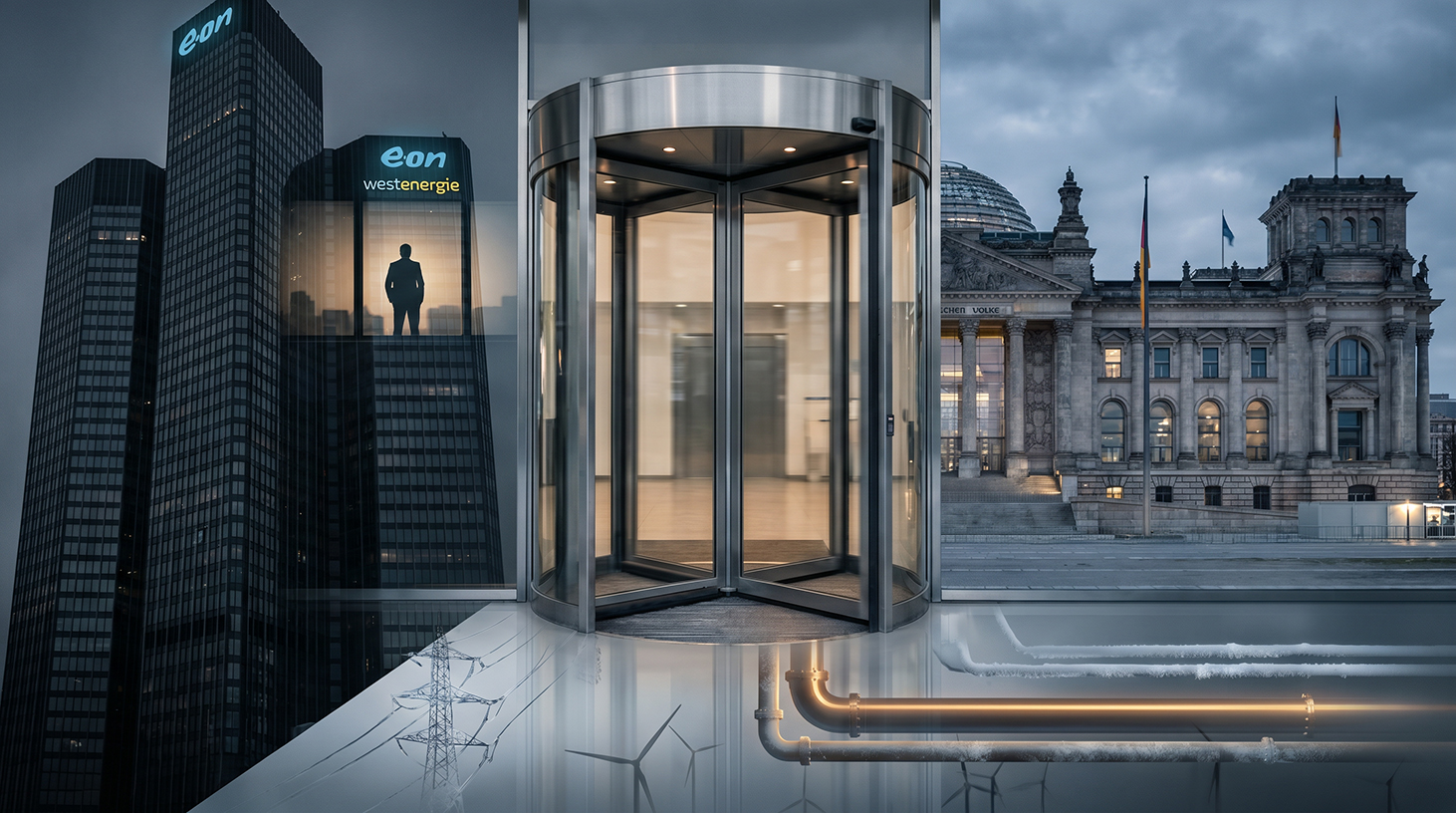
At the expense of small and medium-sized businesses: How large energy companies profit from the new policy – Image: Xpert.Digital
Corporate interests with ministerial credentials: Katherina Reiche's disastrous economic record
Despite exploding prices: Why the Minister of Economic Affairs is focusing on gas right now
Economics Minister under fire: Is Katherina Reiche making policy for her former company?
Katherina Reiche at the helm of the Federal Ministry for Economic Affairs and Energy – for some, a pragmatic new beginning after the Habeck era; for critics, arguably the biggest institutional conflict of interest in the recent history of the Federal Republic. The former CEO of the E.ON subsidiary Westenergie is under heavy fire: under the guise of "technological openness" and economic prudence, she is dismantling key pillars of the energy transition. The main victims of her controversial "grid package" and the radical reform of the Renewable Energy Sources Act (EEG) are German small and medium-sized enterprises (SMEs), citizen energy cooperatives, and private homeowners, for whom solar panels are becoming increasingly unprofitable. On the winning side, however, are the large fossil fuel energy companies, whose networks extend deep into the ministry. Instead of the promised economic upswing, there is a barrage of protests from the business community, plummeting growth forecasts, and accusations of cold-blooded cronyism. A thorough analysis reveals: the question is not whether the minister is incompetent – but rather, for whom she actually works.
Related to this:

The Minister of Economic Affairs for the fossil fuel industry: Why Katherina Reiche is the wrong woman in the wrong place — or perhaps the right one for the wrong people?
Katherina Reiche is not a bad minister. She is a competent manager who has learned to lead large organizations, make decisions, and navigate competing interests. The problem is not her incompetence. The problem is the structural conflict of interest between her professional background and the office she holds. A Federal Minister for Economic Affairs is responsible for the entire national economy—for all sectors, all company sizes, all future models. What Reiche actually delivers is something else entirely: a policy that is strikingly congruent with the interests of the corporations where she worked before taking office.
Related to this:

From corporate headquarters to the ministry: A biography full of conflicts of interest
Katherina Reiche has been Federal Minister for Economic Affairs and Energy in Friedrich Merz's cabinet since May 2025. Before taking office, she was CEO of Westenergie, a wholly owned subsidiary of the energy company E.ON, for several years. Westenergie is not just any energy supplier, but one of Germany's largest gas network operators, whose business model is fundamentally based on maintaining fossil fuel infrastructure. Previously, Reiche served as Managing Director of the Association of Municipal Enterprises (VKU) – an association listed in the lobby register of the German Bundestag, which, among other things, represents the interests of municipal gas suppliers.
This sequence of professional positions would, in many countries, raise significant legal and institutional hurdles for anyone transitioning to a ministerial post. In Germany, however, the so-called revolving door effect—the movement between a leading position in industry and political office—is politically tolerated, albeit increasingly viewed with skepticism. The crucial point is not that Reiche made such a move. The crucial point is what she did afterward.
In November 2024, Reiche—then CEO of Westenergie—published an article on LinkedIn recommending an energy policy agenda to the future German government. The core demands: abolishing feed-in tariffs for private solar installations, restricting grid connections for renewable energies in congested regions, and focusing on gas-fired power plants. This article has since been deleted from LinkedIn but is still accessible in the web archive. What's remarkable is not the content, but the fact that Reiche, as Minister of Economic Affairs, incorporated virtually every one of these demands into draft legislation. This isn't a coincidence; it's a deliberate strategy.
Related to this:

The network package as a political game-changer project
The so-called grid package, the draft of which was published in early 2026, is the centerpiece of Reiche's energy policy agenda. It represents a far-reaching reform of the Energy Industry Act, which deliberately weakens three key mechanisms of the energy transition. First, the priority grid connection for renewable energies, which has been in place for 25 years, is to be abolished. Since the introduction of the Renewable Energy Sources Act (EEG) in 2000, this priority has been the crucial steering instrument ensuring that wind and solar power could be fed into the grid preferentially. Second, the guaranteed 20-year feed-in tariff is to be reformed, fundamentally undermining the economic basis for investment decisions in renewable energies. Third, grid operators will in future be able to independently prioritize grid connections for plants with a capacity of 135 kilowatts or more—meaning that fossil gas power plants or energy-intensive data centers could theoretically be connected before renewable energy plants.
The industry reactions were strong and widespread. Within just a few days, almost 2,400 companies joined an appeal sharply criticizing the federal government's energy policy. In Lower Saxony alone—Germany's leading energy state—up to €32 billion in planned investments were at risk, according to the state's Renewable Energy Association. More than 440 citizen energy organizations delivered a joint appeal directly to the minister. Even the SPD, the junior partner in the governing coalition, expressed reservations.
The grid package is not a technical error. It is a fundamental shift in policy. Anyone who overturns the priority grid connection for renewables, who introduces construction cost subsidies, increases the cost of investing in private PV systems by up to €1,000, who eliminates feed-in tariffs while simultaneously expanding new gas capacity—that person is not pursuing neutral market policy. They are changing the rules of the game in such a way that those players who profit from the long lifespans of fossil fuel infrastructure gain a structural advantage.
The EEG reform and the end of technological neutrality as an argument
Reiche argues that her energy policy is an expression of technological openness and pragmatism. She laments that Germany has pursued an "internationally unique path" with its energy transition to date and questions whether electrification "at any price" is the right approach. This sounds like sound economic realism. In reality, it is a rhetorical device that serves a familiar function in the energy policy debate: it creates the framework for dismantling proven support mechanisms without having to openly declare this as an ideological decision in favor of fossil fuels.
The facts are clear. The share of renewable energies in German electricity generation already exceeded 60 percent in 2025. Despite all the bureaucratic hurdles, Germany has made considerable progress in expanding wind and solar energy in recent years. The solar industry is one of the few German sectors that still exhibits investment momentum despite the overall economic weakness. This momentum is not solely attributable to government subsidies, but also to lower technology costs, increased energy prices, and a growing entrepreneurial conviction that transformation is not an option, but a necessity.
Reich's reform of the Renewable Energy Sources Act (EEG) calls this very dynamic into question. The announcement to abolish feed-in tariffs for photovoltaic systems up to 25 kilowatts primarily affects private homeowners and small businesses that have invested in their own electricity generation in recent years. According to a representative survey, more than 53 percent of the population reject this step as "clearly wrong" or "rather wrong." That this measure simultaneously contributes to strengthening the market model of large, centralized energy companies is no coincidence—it is the result of a policy that cloaks corporate interests in the guise of sound economic policy.
The communication style: cued notes instead of dialogue
A minister is not judged solely on her laws, but also on how she carries out her duties. And here a second structural weakness of Reiche's becomes apparent: her disconnect from dialogue with those economic actors most affected by her policies.
Robert Habeck wasn't always successful as Economics Minister, but he was open to dialogue. He held personal talks with companies, associations, and trade unions—even with critical partners. He demonstrated a rapid learning curve in technical matters, despite having little prior experience in the energy sector. This willingness to engage in dialogue fostered trust—not with everyone, but with enough stakeholders to push through reforms and gradually reduce skepticism.
The opposite is true for Reiche. Industry representatives report that the minister frequently delegates appointments to state secretaries, often relies on notes for content, and lacks technical depth in discussions. Berlin political scientist Johannes Hillje aptly describes this style: Reiche communicates coldly, technically, and with little empathy. The promised shift in economic policy sentiment has failed to materialize, partly due to this style of politics. Habeck had reduced skepticism through dialogue—Reiche, through a lack of dialogue, has only created skepticism towards herself.
This isn't just a critique of soft skills. It's a structurally significant observation. In a Ministry of Economic Affairs tasked, among other things, with shaping the energy transition, dialogue with practitioners is not optional, but essential. Startups, citizen energy cooperatives, medium-sized businesses, architects, installers, municipal utilities—they are not marginal players in the German economy, but its backbone. If they feel unheard, constructive reform processes will fail to materialize. Instead, mistrust, reluctance to invest, and political opposition will emerge.
The real economic policy question is: Who benefits from this policy?
The core question arising from Reiche's policies is not ideological, but economic. Cui bono—who benefits? The dismantling of the EEG subsidy system, the abolition of priority grid access for renewables, the construction of new gas-fired power plants with up to 20 gigawatts of capacity—all these are measures that strengthen the market model of large, integrated energy corporations.
Companies like E.ON, RWE, and the municipal energy suppliers in the VKU association benefit from an energy system that continues to rely on centralized, grid-connected generation. Every kilowatt-hour generated decentrally from a rooftop or a community wind farm is one less kilowatt-hour flowing through the grids of established utilities. Every reduction in subsidies for private solar installations benefits the business model of the large corporations. Furthermore, the grid expansion linked to the grid package creates regulatory revenue streams for established grid operators.
The Institute for Energy Economics at the University of Cologne, which Reiche commissioned to produce an expert report on the state of the energy transition, was largely financed by E.ON and RWE. This is not proof of manipulation—but it is an indication of how closely intertwined the intellectual networks are from which Reiche's energy policy draws its conceptual foundations.
At the same time, it must be emphasized that the criticism of Reiche does not mean that all of his diagnoses of the problems are wrong. There is indeed a synchronization problem between the expansion of renewable energies and the expansion of the electricity grid. The system costs of German electricity have totaled over 36 billion euros annually. These problems deserve a serious political response. The question is whether Reiche's answers will solve the problems or use them as a pretext to advance a fossil fuel agenda.
Our EU and German expertise in business development, sales and marketing

Our EU and German expertise in business development, sales and marketing - Image: Xpert.Digital
Industry focus areas: B2B, digitalization (from AI to XR), mechanical engineering, logistics, renewable energies and industry
More information here:
A thematic hub offering insights and expertise:
- Knowledge platform covering global and regional economies, innovation and industry-specific trends
- A collection of analyses, insights, and background information from our key areas of focus
- A place for expertise and information on current developments in business and technology
- A hub for companies seeking information on markets, digitalization, and industry innovations
Fossil fuel policies, expensive consequences: The wealthy caught between lobbyists and the state
Growth forecasts in freefall: The economic failure of a minister without a direction
Economic policy is ultimately measured by its results. And here, too, Reiche's record after roughly a year in office is sobering. In the fall of 2025, she revised her predecessor Habeck's growth forecast upwards from 1.0 to 1.3 percent—a demonstrative signal of a new beginning. In January 2026, she had to backtrack to 1.0 percent. In April 2026, she halved the forecast again to 0.5 percent of gross domestic product, citing the Iran war as an external shock.
The external shocks are real. The war in Iran is driving up energy prices on the world market. But here a bitter structural irony is revealed: shortly before the Iran war, Reiche had declared the coalition government's heating law obsolete and rejoiced that oil and gas heating systems would once again be permitted for a longer period. Four days later, the first missiles struck Tehran. Since then, global energy and commodity prices have skyrocketed. An economic policy that relies on more gas and less renewable energy self-sufficiency does not make Germany more resilient in such a situation—it makes it more vulnerable.
The paradox is obvious: Reiche justifies its shift away from renewables, among other things, with the goal of lowering energy prices. At the same time, its continued reliance on fossil fuels increases dependence on volatile global market prices, which are regularly driven up by geopolitical shocks. Wind and solar power won't become more expensive because of a war with Iran.
Related to this:

The heterogeneous business lobby: Who benefits, who loses
A nuanced economic analysis must acknowledge that the business lobby is not a homogeneous group. It would be analytically imprecise to speak of "industry" as if all companies shared the same interests. In fact, there are significant tensions within the German economic structure—tensions that Reich's policies exacerbate instead of resolving.
On the winning side are the large, integrated energy companies and grid operators. They benefit from the strengthening of the centralized energy model, from state-funded gas-fired power plants, from grid expansion projects with regulated returns, and from the weakening of decentralized competition. Energy-intensive industries such as chemicals, mechanical engineering, and steel also welcomed the announced focus on cost reduction and security of supply—at least as long as the delivery promises hold true.
On the losing side is the broad middle class. Craft businesses, installation companies, roofers, electricians, municipal utilities that have invested in the decentralized energy transition—they all suffer from the planning uncertainty created by wealth. According to the German Renewable Energy Federation, around 276,000 people worked directly in the renewable energy sector in 2023. The Bertelsmann Foundation counted more than 372,500 job openings for energy transition-related professions in 2024. These jobs don't exist in large corporations—they are created in craft businesses, project developers, and engineering firms, which are organized as medium-sized enterprises.
The German Association of Small and Medium-Sized Businesses (BVMW) explicitly complained that the reforms implemented so far by the Merz government had primarily benefited large corporations. Small and medium-sized enterprises (SMEs) feel insufficiently represented. Significantly, the appeal signed by nearly 2,400 companies against Reiche's energy policy includes not only energy companies, but also medical practices, advertising agencies, architectural firms, and tourism businesses—stakeholders that are not directly connected to the energy sector, but understand that affordable, clean energy is the foundation of their economic future.
The structural imbalance is thus clear: The most powerful lobbies in the energy sector—the corporations with their associations, institutional networks, and access to political decision-makers—benefit from Reiche's policies. The numerically far larger, but institutionally weaker, small and medium-sized enterprises (SMEs) bear the costs. This is not economic policy for Germany. This is economic policy for a specific sector.
Pseudo-technological openness as a strategic instrument
Reiche uses the term "technological neutrality" as a central rhetorical concept. Behind this lies the idea that the state should not favor certain technologies, but rather let the market decide. This sounds liberal and reasonable. In practice, however, technological neutrality in Reiche's version means something very concrete: the preferential treatment of technologies operated and controlled by fossil fuel companies, under the guise of market neutrality.
Because true technological openness would mean subjecting all technologies to a level playing field. Instead, new gas-fired power plants are to be built with billions in subsidies—a massive state intervention in favor of fossil fuel technology. The power plant strategy negotiated by Habeck, which envisioned 10 gigawatts of capacity and had already been agreed upon with Brussels, was unnecessarily reopened by Reiche, resulting in months of delays and ultimately a marginally modified agreement of 12 gigawatts. This is not an increase in efficiency—it's bureaucratic navel-gazing with considerable transaction costs.
Furthermore, there is the decision to commission expert reports on the status of the energy transition from an institute co-financed by E.ON and RWE. This may be legally sound, but it is institutionally problematic because it fuels the suspicion that the political outcomes are already predetermined before the scientific basis has been established.
The fossil fuel backbone: Why the rich stay in power
Despite all the criticism—despite the polls, the corporate appeals, the declining growth forecasts, despite the publicly revealed lobbying allegations—Reiche remains relatively politically entrenched. This has structural reasons that extend beyond her personal circumstances.
Firstly, the CDU as a party has traditionally been closely linked to the major energy companies. The Ministry of Economic Affairs under Reiche is continuing a policy that, in its essential features, corresponds to what the CDU demanded of Habeck's energy policy when it was in opposition. Internal criticism from within the party is therefore muted.
Secondly, wealthy companies benefit from the fact that the fossil fuel industry has exceptionally well-organized lobbying structures. From the German Association of Energy and Water Industries (BDEW) and the Association of Municipal Enterprises (VKU) to the individual corporate lobbies – communication channels to the ministries are short and well-established. The decentralized renewable energy sector, the energy cooperatives, the community wind projects – they are more institutionally fragmented and therefore less effective in day-to-day politics.
Thirdly, the Iran war and the associated energy price developments are drawing public attention to short-term supply issues, where the demand for more gas capacity sounds plausible at first glance — even if it exacerbates import dependency and increases costs for consumers in the medium and long term.
The wider industry is grumbling—as evidenced by corporate appeals, criticism from the startup association, and the growing dissatisfaction of small and medium-sized enterprises (SME) associations. But the wealthy will be able to absorb this dissatisfaction as long as the fossil fuel industry heavyweights in the economic lobby support them. It's the classic pattern of concentrating advantages in the hands of a few organized interests at the expense of distributing costs among many unorganized stakeholders.
What a different economic policy could achieve
It would be unfair and analytically imprecise to criticize solely without outlining potential alternatives. The energy policy challenges facing Germany in 2026 are real. Grid expansion is lagging behind the expansion of renewable energy. The system costs of electricity are high. Energy-intensive industries need competitive prices. And security of supply must be guaranteed, even in times of geopolitical turmoil.
These problems, however, do not call for a reversal of the energy transition—they call for its deepening and better organization. Accelerated grid expansion with significantly simplified permitting procedures would solve the synchronization problems without overturning the priority given to renewables. Market-based flexibility of the electricity system through intelligent control and storage would reduce system costs without subsidizing new gas-fired power plants. An industrial electricity price—which Reiche has been promising for months but has yet to deliver—would help energy-intensive industries without damaging the fundamental architecture of the energy transition.
According to model calculations by the Institute for Employment Research, Germany will need around 157,000 additional workers by 2030 solely for the expansion of renewable energies. This is a signal. It shows that the market wants the transformation—provided policymakers maintain stable framework conditions. What the market doesn't need is a minister who destroys planning certainty, unsettles investors, and dismantles proven support mechanisms.
The ministry as an extended corporate headquarters?
The real question Reiche needs to answer isn't: Why do you prioritize gas capacity? She can offer arguments for that. The question is: How do you explain that your policies as Minister for Economic Affairs align with the agenda you outlined as a corporate executive in a LinkedIn article—before you knew you would become a minister?
Reiche denies having worked in the gas lobby. However, the transparency platform Abgeordnetenwatch pointed out that the VKU (Association of Municipal Enterprises) is a lobby group registered in the lobby register that explicitly represents gas interests. Reiche's claim that he had no connection to gas at Westenergie contradicts the fact that Westenergie, through its subsidiary Westnetz GmbH, is one of the country's major gas network operators. These statements have been publicly refuted—not by political opponents, but by fact-checkers based on publicly accessible registers.
This is not about denying the personal integrity of the wealthy. It's about naming what is happening structurally: A minister who, for significant parts of her professional career, has been linked to the interests of fossil fuel companies, pursues a policy that serves precisely these interests—and calls it technology-neutral, pragmatic economic policy.
This is not economic policy. This is corporate interest with a ministerial badge.
Balance sheets don't lie: What ultimately matters
At the end of an economic policy analysis, we arrive at the numbers. The growth forecast for 2026 is 0.5 percent. A year ago, Reiche promised more growth, more investment, more dynamism. What she delivered were declining forecasts, growing investment uncertainty in the renewables sector, mass appeals from companies, a delegated dialogue style, and draft legislation that cloaks corporate interests in the guise of the common good.
The climate catastrophe, which the wealthy are accelerating with their fossil fuel-based policies, can wait politically—it's not on the immediate agenda of a government focused on quarterly reports and opinion polls. But the economic balance sheet can't wait. Investments in renewable energies that aren't made today will be missing in ten years. Skilled workers who see no future in the energy transition today will migrate to other sectors or countries. Planning certainty, which is being destroyed today, cannot be restored by ministerial decree.
Katherina Reiche may not be the worst minister Germany has ever had. But she is the wrong minister for the task at hand. Not because she is incompetent, but because she is structurally bound—to a past, to networks, to a worldview that considers fossil fuels the norm and renewables the exception. And as long as this bias shapes the policies of the Ministry of Economic Affairs, Germany will pay the price—in the form of missed investments, increasing dependence on imported energy, delayed energy transition, and a population that overwhelmingly wants a different energy future.





