
Tim Cook is stepping down: Who is the new man at the top of Apple? Can John Ternus pull off the next big Apple miracle?
Xpert Pre-Release

Available in 27 languages 📢
Prefer Xpert.Digital on GoogleⓘPublished on: August 24, 2026 / Updated on: August 24, 2026 – Author: Konrad Wolfenstein
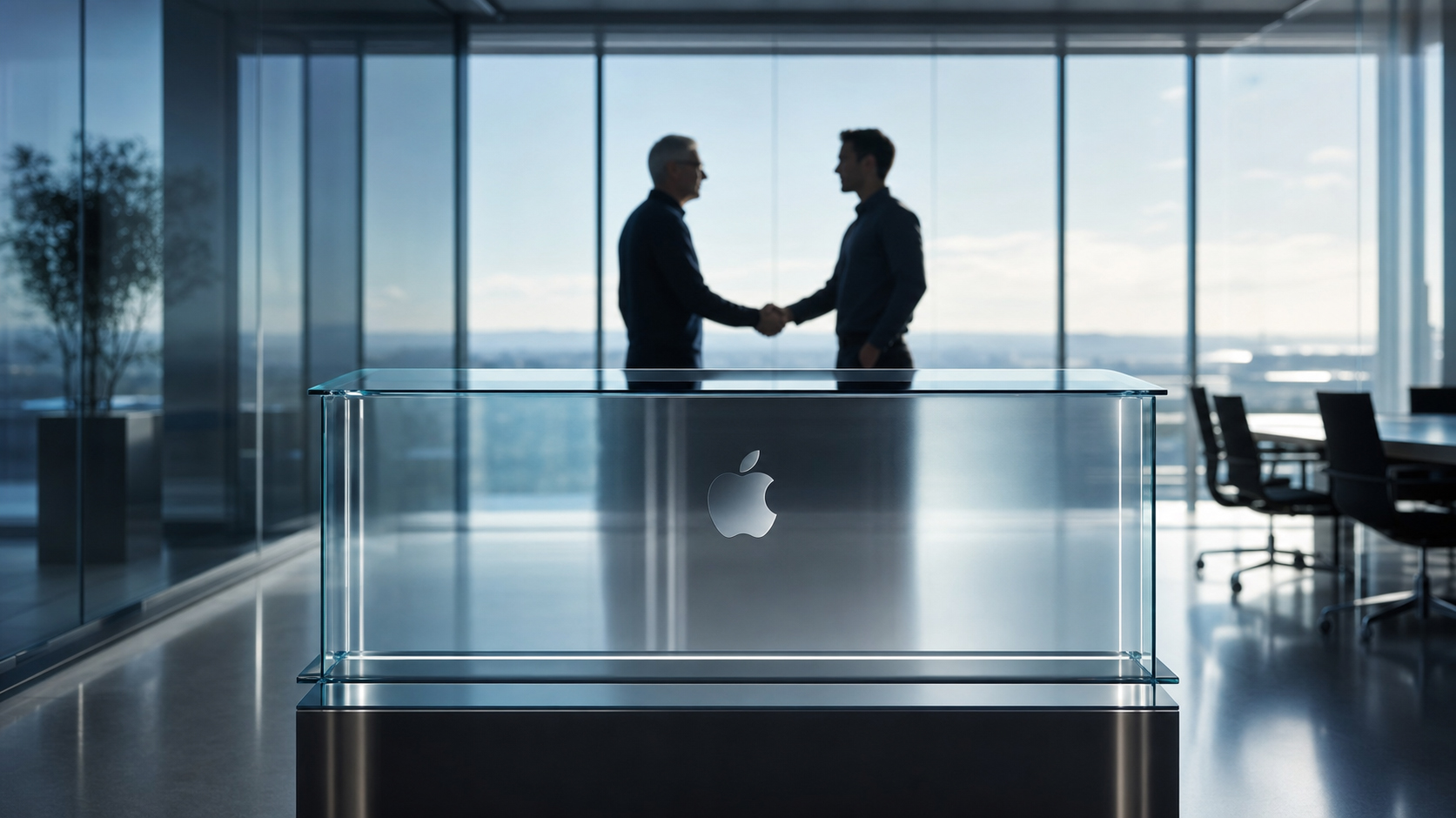
Tim Cook is stepping down: Who is the new man at the helm of Apple? Can John Ternus pull off the next big Apple miracle? – Image: Xpert.Digital
The end of an era: Tim Cook leaves – leaving behind a $4 trillion legacy
Apple's new CEO has been chosen: Why a hardware expert is set to lead the iPhone company through the AI race
After the Vision Pro flop: How Apple's new CEO John Ternus has to restructure the tech giant
On September 1st, one of the most defining eras in recent technological history comes to an end: Tim Cook, who increased Apple's market capitalization by an almost unimaginable $3.6 trillion in nearly 15 years, is stepping down as CEO. His successor will be the current hardware chief, John Ternus – an Apple veteran who now faces arguably the most difficult task in Silicon Valley. Despite gigantic profits and a perfect logistics machine, Apple stands at a historic turning point. The rapid rise of artificial intelligence dominates the industry, the company's dependence on the iPhone remains dangerously high, and its latest prestige project, the Vision Pro, revealed painful strategic limitations. Can a hardware expert successfully lead the iconic Cupertino corporation into the next future, driven by software and AI? Or is the world's most valuable company in danger of losing its visionary appeal in the long run? An assessment of the Cook era – and a look ahead at Apple's risky relaunch.
Apple after Tim Cook: An era in review and the question of power in the AI age: The administrator who became the greatest value creator in the company's history
On September 1st of this year, one of the most remarkable leadership episodes in recent business history came to an end. Tim Cook stepped down as CEO of Apple and transitioned to the role of Executive Chairman on the Board of Directors, while John Ternus, Senior Vice President of Hardware Engineering since 2011, assumed operational leadership of the company. The announcement had been long anticipated, as Ternus had been considered the internal favorite for the position for years, and it also marked the end of a nearly fifteen-year tenure that ranks among the most successful in the history of American capitalism. To grasp the sheer magnitude of this achievement, one must consider that Cook increased Apple's market capitalization by approximately $3.6 trillion during his time at the helm, a sum that exceeds the economic output of entire industrialized nations. This, regardless of any debates about his strategic vision, establishes Cook as one of the most value-creating leaders ever to head a company, and this sobering financial fact puts much of the criticism leveled against him over the years into perspective.
An heir in the shadow of a genius
Few leadership changes in the company's history have been met with greater skepticism than the one in August 2011, when Tim Cook succeeded Steve Jobs. Jobs wasn't just any company founder, but a cult figure who had literally saved Apple from bankruptcy in the 1990s and subsequently reinvented a whole range of product categories with the iPod, the iPhone, and the iPad. The expectations of the public, analysts, and the company's own employees were correspondingly high, and many observers predicted a gradual decline in Apple's relevance after the departure of its charismatic leader. Cook himself was the exact opposite of his predecessor: not a visionary inventor, but a disciplined, analytically minded operations expert who, as Chief Operating Officer, had previously optimized the company's global supply chains down to the last detail. It was precisely this level-headedness and restraint, in contrast to Jobs' eccentric personality, that was the very quality Jobs had recognized as crucial in his successor, and history would impressively confirm this assessment.
How a logistics expert became the world's most valuable business leader
It is one of the central ironies of recent economic history that the very capability initially considered less glamorous became Apple's crucial growth engine. Cook's expertise as a supply chain architect enabled the company to scale to an extent that would have been virtually unimaginable under Steve Jobs's purely product-focused vision. Under his leadership, Apple built a network of suppliers, manufacturing partners, and logistics providers that allowed the company to produce and distribute hundreds of millions of devices annually with remarkable precision and cost efficiency. This operational excellence was not an end in itself, but rather the necessary infrastructure upon which the explosive growth of the iPhone, iPad, Mac, Apple Watch, and the ever-expanding services business could even unfold. Without this logistical masterpiece in the background, Apple could never have reached the scale that characterizes the company today, and this structural achievement is often underestimated in the public eye because it is less spectacular than a new product being unveiled on a stage.
From one trillion to four times that amount: The bare figures of an exceptional achievement
The financial figures of the Cook era speak for themselves and leave little room for doubt about the company's economic success story. In 2018, under his leadership, Apple became the first company in history to surpass the one trillion US dollar mark in market capitalization, a symbolic milestone that made headlines worldwide. This valuation has since quadrupled to approximately four trillion US dollars, making Apple one of the world's most valuable companies. Simultaneously, the company's revenue and profit have increased many times over under Cook's leadership, and in the last fiscal year, Apple broke the symbolically significant one hundred billion US dollar mark in net income for the first time in its history. This figure alone illustrates the scale of the company's achievements: No other technology company in the world generates comparable profit margins on such a high absolute revenue base, and this financial success is largely due to the combination of Cook's operational discipline and the enduring brand power of the product portfolio that Jobs originally created.
Administrator or strategic architect? The debate surrounding Cook's innovative power
Despite these impressive figures, Tim Cook faced a persistent criticism throughout his tenure, one that followed him until his final day at the helm: that he lacked the visionary power to lead Apple into fundamentally new technological territories, that he was more of an excellent administrator of the existing product line than a true innovator of new categories. This criticism stems primarily from the observation that the iPhone, the product Steve Jobs unveiled to the world in 2007, remains by far the company's most important source of revenue and profit. While Cook did introduce new product lines, including the Apple Watch, which became one of the world's most successful wearables, and AirPods, which have become ubiquitous in urban environments, none of these products achieved the disruptive, category-defining impact once attributed to the iPhone. This observation has fueled the debate for years about whether Apple, under Cook, still possesses the innovative drive that once distinguished the company.
The failed experiment: What the Vision Pro reveals about Apple's limitations
Perhaps the clearest example of this structural challenge is the Vision Pro, the mixed-reality headset unveiled in 2023 with which Apple once again claimed to be establishing an entirely new product category. Despite its technologically impressive features and enormous development effort, the device fell far short of commercial expectations, primarily due to its exceptionally high price and the resulting lukewarm consumer demand. This relative failure is significant because it demonstrates that even a company with Apple's financial and technological resources cannot create arbitrarily large new mass markets simply by launching another high-priced niche product. The Vision Pro thus remains a symbol of the limitations of pure engineering without the disruptive price point and mass-market access that Jobs once achieved with the iPhone, and it also provides important clues as to the strategic lessons Apple's future leadership must draw from this endeavor.
A dignified farewell: Cook's own words on the end of an era
In the official statement announcing the leadership change, Tim Cook spoke with evident emotion about the end of his tenure, describing leading Apple as the greatest privilege of his life, coupled with the trust placed in him to lead such an extraordinary company. Regarding his designated successor, Cook had only praise and personal words, describing John Ternus as having the mind of an engineer, the soul of an innovator, and a heart that leads with integrity and honor. These phrases are more than mere courtesy in a corporate statement; they signal that Cook views his successor as someone who should consistently continue the core cultural values he himself established over a decade and a half, without making the fundamental course correction that some external observers believe is necessary.
Our US expertise in business development, sales and marketing

Our US expertise in business development, sales and marketing - Image: Xpert.Digital
Industry focus areas: B2B, digitalization (from AI to XR), mechanical engineering, logistics, renewable energies and industry
More information here:
A thematic hub offering insights and expertise:
- Knowledge platform covering global and regional economies, innovation and industry-specific trends
- A collection of analyses, insights, and background information from our key areas of focus
- A place for expertise and information on current developments in business and technology
- A hub for companies seeking information on markets, digitalization, and industry innovations
Apple's leadership change: What John Ternus's rise means for the future of AI
The eternal runner-up in the race: John Ternus and his rise to crown prince
The decision to promote John Ternus, a man from within the company, continues a remarkable pattern of continuity in Apple's corporate culture, as Ternus will be the eighth CEO in the company's history to be promoted from within the leadership team rather than recruited from outside. Ternus has been with the company for approximately 25 years and, as head of hardware development, played a pivotal role in revitalizing the Mac business and shaping key products such as the iPad and AirPods. This selection signals to the market that Apple's leadership prioritizes continuity and institutional expertise over a radical cultural shift, which can be interpreted both as a sign of strategic stability and as an expression of a certain risk aversion toward external, potentially more disruptive leaders. It is also noteworthy that Cook himself is not completely leaving the company, but will continue to exert influence as Executive Chairman and closely support Ternus during the transition phase, while Arthur Levinson, the previous non-executive chairman, will assume the role of Lead Independent Director.
Why Apple is putting a hardware guy at the top right now
The timing of this personnel decision is particularly revealing, as it comes at a time when the entire technology industry is being fundamentally transformed by the rapid rise of artificial intelligence – an area in which Apple has been considered significantly more reserved and less progressive compared to competitors like Microsoft, Google, or OpenAI. The decision to appoint a hardware veteran, rather than a software or AI specialist, to the top position can be interpreted in different ways. On the one hand, it could be seen as a commitment to Apple's core competency: the ability to develop physical devices of exceptional build quality and seamless user experience, while the actual AI integration is perhaps intended to be managed more through strategic partnerships and software teams below the CEO level. On the other hand, this choice also fuels the concerns of critical observers that Apple is once again installing a leader primarily focused on optimizing existing product lines, rather than setting a radically new technological agenda, which would be necessary to avoid falling permanently behind in the AI race.
Structural dependence on the iPhone as a strategic risk
A key structural characteristic that has consistently defined Cook's tenure and will also be passed on to his successor as the greatest challenge is the company's continued heavy reliance on the iPhone business. Even after a decade and a half of diversification efforts that have led to the introduction of the Apple Watch, AirPods, the steadily growing services segment, and various other product lines, the smartphone remains by far the company's single highest-grossing product. This concentration carries a significant strategic risk, as it makes Apple particularly vulnerable to fluctuations in demand in a global smartphone market that has already reached a high degree of saturation in many developed economies. While Apple has thus far successfully countered these saturation tendencies through skillful pricing, regular product cycles, and a growing ecosystem of digital services, the fundamental question of how such an iPhone-centric business model can grow in the long term remains one of the key strategic challenges for the next generation of leadership.
The service sector as an underestimated growth engine
While the debate surrounding a lack of product innovation often dominates media headlines, another, economically equally significant structural change is frequently overlooked: the steady shift in the business model from a pure hardware seller to an increasingly service-based company. Under Cook's leadership, Apple has continuously expanded its range of digital services, including music and video streaming, cloud storage, payment services, and a growing portfolio of subscription models, which together form a segment with excellent margins and recurring revenue. While this strategic shift doesn't completely eliminate the cyclical dependence on hardware sales, it creates an additional, more stable revenue base that is less susceptible to individual product cycles than traditional device sales. From a financial analysis perspective, this service business represents one of the most important value drivers of the past decade, as it structurally increases the overall profitability of the corporation and simultaneously further cements customer loyalty to the closed Apple ecosystem.
Between regulatory pressure and geopolitical tensions
Another often underestimated aspect of Cook's tenure concerns the increasing regulatory and geopolitical headwinds Apple has faced in recent years. In Europe, the company has had to make significant concessions in the wake of antitrust disputes and new digital market regulations, such as opening its App Store ecosystem to alternative payment providers and distribution channels. At the same time, Apple's deep roots in Chinese manufacturing facilities have made it particularly vulnerable to geopolitical tensions between the United States and China, affecting both supply chain security and potential tariff risks. Cook himself has navigated this diplomatic tightrope walk with remarkable skill over the years by cultivating close personal relationships with political decision-makers in both Washington and Beijing—a skill he is expected to continue to leverage in his new role as Executive Chairman after stepping down as Chief Operating Officer, by focusing more on engaging with policymakers around the globe.
What the leadership change means for Apple's future strategic direction
The transition from Cook to Ternus thus does not mark a radical strategic break, but rather a conscious continuation of the existing course with the stated goal of preserving the operational precision and product quality that have distinguished Apple over the past decade and a half. For investors and market observers, the crucial question is whether this continuity is sufficient to defend Apple's market leadership in a period of accelerated technological change, or whether a bolder, more disruptive course correction would have been necessary right now. The initial reactions of the financial markets to the announcement of the leadership change were comparatively muted; Apple's stock declined only slightly, suggesting that institutional investors perceive the decision as an orderly, well-prepared succession plan and are not signaling any immediate uncertainty about the company's future profitability.
The real test is yet to come for Ternus
Ultimately, the true success of this leadership transition will only become apparent in the coming years, when John Ternus must prove whether he is truly capable of striking the balance between operational excellence and technological innovation that his predecessor only partially achieved. If he succeeds in consistently translating Apple's enormous financial resources and loyal user ecosystem into a compelling response to the challenges of artificial intelligence, the Ternus era could bring back the disruptive innovation that has been somewhat lacking in the company since Steve Jobs' death. However, if he fails, Apple, despite its unprecedented financial strength, risks becoming, in the medium term, merely a custodian of its own historical success, while technologically more aggressive competitors dominate the next major platform shift. This open question—whether continuity in turbulent times signifies strength or weakness—will be the crucial benchmark against which John Ternus's tenure will be measured in the years to come.
🎯🎯🎯 Data-driven B2B industry hub as a quasi-in-house solution

The quasi-in-house solution: How Xpert.Digital closes operational gaps in B2B marketing and sales – Smart Content-Driven Business - Image: Xpert.Digital
Xpert.Digital is a data-driven B2B industry hub led by Konrad Wolfenstein . The company acts as an external, quasi-in-house solution for industrial partners, closing operational gaps in marketing, content, and sales – without requiring additional resources on the client side.
More information here:
Your global marketing and business development partner
☑️ Our business language is English or German
☑️ NEW: Correspondence in your native language!

Konrad Wolfenstein
I and my team are happy to be available to you as your personal advisor.
You can contact me by filling out the contact form here [email protected]:or simply call me at +49 7348 4088 965. My email address is
I'm looking forward to our joint project.










