
Power shift at Apple: Tim Cook hands over to John Ternus – why Apple's riskiest personnel decision might be the smartest
Xpert Pre-Release

Available in 27 languages 📢
Prefer Xpert.Digital on GoogleⓘPublished on: April 21, 2026 / Updated on: April 21, 2026 – Author: Konrad Wolfenstein
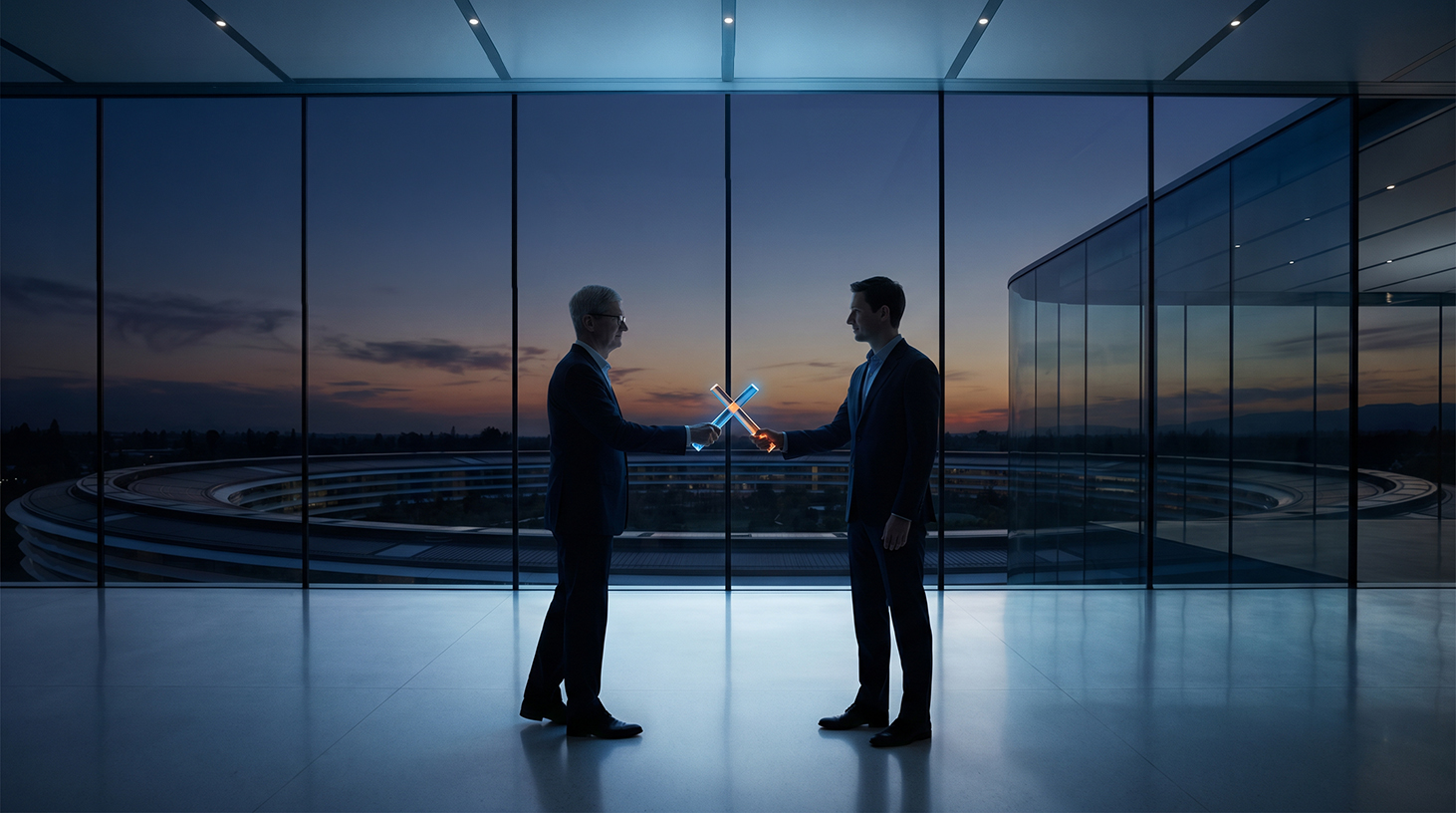
Change of power at Apple: Tim Cook hands over to John Ternus – why Apple's riskiest personnel decision might be the smartest – Image: Xpert.Digital
Apple's new era: Who is John Ternus – and why is he Tim Cook's smartest decision?
The silent earthquake in Cupertino: Apple gets a new CEO – with a radical plan
A historic power shift is shaking Silicon Valley: After 15 years at the helm, Tim Cook is handing over the reins as Apple CEO to former hardware chief John Ternus. While Cook, during his tenure, drove the company's market capitalization to over four trillion US dollars and revolutionized its services business, his successor inherits a technology empire at a crossroads. Ternus, a brilliant engineer and architect of Apple's in-house silicon chips, faces enormous challenges. He must not only implement the most ambitious iPhone roadmap in history – including the first foldable iPhone – but also solve Apple's most pressing problem: its dangerously low position in the global AI race. Can this detail-oriented logistics expert make the leap to visionary leadership and continue Apple's success story into a completely new era?
An announcement that no one expected – and yet was inevitable
On the evening of April 20, 2026, Apple released a press statement that sent shockwaves through the tech industry: Tim Cook, CEO of Apple since 2011 and thus one of the longest-serving business leaders in Silicon Valley, was stepping down as Chairman of the Board. His successor would be John Ternus, currently Senior Vice President of Hardware Engineering, who was scheduled to take over the position on September 1, 2026. Cook would transition to the role of Executive Chairman – remaining with the company but relinquishing operational leadership.
The timing is surprising for several reasons. As recently as March 17, 2026, Cook had dismissed all rumors of his resignation as simply fabricated in an interview with ABC News. "That's a rumor that's circulating. I didn't say that," he stated publicly at the time, and only a few weeks later, the decision had been made. Bloomberg reporter Mark Gurman, known for his reliable insider information about Apple, had stated as recently as November 2025 that he would be "shocked" if Cook were to step down before mid-2026. The final announcement thus came significantly faster than most observers expected—and yet it was the result of a long-term succession process unanimously approved by the board of directors.
The announcement was accompanied by two internal memos addressed to employees by Cook and Ternus, as well as a personal community letter from Cook to Apple users. A town hall meeting at the Steve Jobs Theater was scheduled for the following day to round off the internal communication. Even rarer than the announcement itself was the emotional openness with which Cook wrote his letter: In it, he recalled the moment 15 years earlier when Steve Jobs asked him to take on the role of CEO and spoke of the values that define Apple – simplicity, excellence, and the determination to enrich users' lives.
From Alabama to Cupertino: The unlikely legacy of Tim Cook
To fully understand the significance of this power shift, one must appreciate the magnitude of the era Cook is leaving behind. When he succeeded Steve Jobs in 2011, Apple faced a critical juncture: Skeptics predicted a bleak future for the company without its charismatic founder. Cook, born in Alabama, trained in industrial engineering at Auburn University, and holding an MBA from Duke University, was the antithesis of a Silicon Valley visionary—he was a master of operational efficiency, a logistics expert by passion.
The results speak for themselves. Under Cook's leadership, Apple's market capitalization rose from approximately $348 billion to over $4 trillion. The stock increased by 1,932 percent during his tenure, far outperforming the S&P 500, which grew by 504 percent over the same period. Annual revenue quadrupled from $108 billion in 2011 to more than $416 billion in fiscal year 2025. In 2018, Apple became the first U.S. company with a market capitalization of $1 trillion; in 2020, it surpassed the $2 trillion mark, and in 2022, the $3 trillion mark.
What is often overlooked is that Cook earned a total of $2.5 billion in compensation during his tenure – roughly $2.4 billion of which was as CEO alone. This figure is not merely a measure of personal enrichment, but an indicator of the extent to which Apple has redefined the benchmarks for corporate performance in the technology industry. The increase in shareholder value under Cook even surpasses that achieved under Steve Jobs, which is remarkable from a historical perspective.
Cook's strategic achievement lies in building the services business. The services division—comprising the App Store, Apple Pay, iCloud, Apple Music, Apple TV+, and other subscription services—generated nearly $108.6 billion in revenue in fiscal year 2025. This alone equates to annual revenue exceeding that of Disney, Tesla, or Tencent. Services now account for roughly 25 percent of total revenue but contribute about half of total profits. Cook has thus transformed Apple from a device manufacturer into a hybrid platform and technology company—a strategic transformation whose consequences are still underestimated. The App Store recorded over 850 million average weekly active users worldwide in 2025, and developers have earned more than $550 billion through the platform since 2008.
The man behind the products: Who John Ternus really is
Most commentary on Ternus's successor focuses on the obvious: he's an engineer, not a visionary in the Jobs sense; he's a quiet manager, not a charismatic speaker. But this assessment falls short. John Patrick Ternus, born in 1975, studied mechanical engineering at the University of Pennsylvania—and was not only an academically outstanding student there, but also a competitive athlete. He is the university's all-time letterwinner on the swim team, making him one of the institution's most historically distinctive athletes. His thesis project was emblematic of his character: he developed a robotic arm that quadriplegics could control simply by moving their heads—a project that combined technical precision with a social application.
After graduating, Ternus initially worked as an engineer at Virtual Research Systems, where he focused on VR headsets and related accessories. This early experience with immersive technology shaped him and was likely one of the prerequisites for his later key role in the development of the Apple Vision Pro. In 2001, he joined Apple and began working on the Apple Cinema Display. Early on, he worked extensively with Asian suppliers – an experience that provided him with a deep understanding of Apple's manufacturing philosophy and supply chain logic.
Cook's decision to additionally grant Ternus oversight of Apple's design teams at the end of 2025 was, in the view of many observers, the most unambiguous signal of his candidacy. Whoever holds design control in Apple's leadership culture holds the company's DNA in their hands. Bloomberg correspondent Mark Gurman described this move as "crystal clear" of Ternus's status as the frontrunner. Within Apple, Ternus is considered "charismatic and popular," according to numerous reports—no small feat in Apple's notoriously sensitive culture.
What has been less reported is that Ternus's leadership style is not without controversy internally. Employees told the New York Times that under his leadership, taking risks was difficult and budgets for genuine innovation projects were kept tight. A former Apple manager put it bluntly: Ternus is exactly the right person "if you want to release an iPhone every year"—but the question of whether he can create groundbreaking new categories remains open. This tension between operational excellence and disruptive vision will decisively shape Ternus's first term as CEO.
The true architect of the modern Apple: Ternus and the Silicon legacy
One of the least discussed aspects surrounding the leadership change is that John Ternus is considered the true architect of one of the most significant technological decisions of the last two decades: the migration of the Mac from Intel processors to Apple's own ARM-based Silicon chips. When Apple announced this decision at WWDC 2020, the industry's reaction ranged from skepticism to disbelief. The simultaneous development of in-house chips and the complete overhaul of a computer architecture are considered exceptionally risky projects within the industry.
What followed was one of the most impressive industrial sprints in technological history: Within three years, Apple had migrated virtually its entire Mac product line to its own ARM architecture. The M-series chips not only redefined the Mac's performance promise—they forced the entire semiconductor industry to rethink its assumptions about mobile computing performance. According to independent benchmarks, the first M1 MacBook Air outperformed Intel machines that cost twice as much, while offering significantly longer battery life. Ternus understood the chip architecture not as an abstract engineering project, but as a core product promise to the end user—and this mindset explains why the M-series achieved commercial success in its very first generation.
Before the Intel takeover, Ternus was instrumental in the development of all iPad generations, AirPods, the iPhone 12, and the Apple Watch. What's economically remarkable is that the strategic decision to integrate the LiDAR scanner exclusively into iPhone Pro models is attributed to Ternus personally. This seemingly minor differentiation decision had massive economic consequences—it established the Pro line as a separate premium segment and secured significant margin gains for Apple. It's the kind of structured profitability focus that Cook expects from a successor.
The silent earthquake: The internal reorganization and what it reveals
Parallel to the CEO appointment, Apple undertook a profound internal restructuring that largely went unnoticed in public reporting. Johny Srouji, previously Senior Vice President of Hardware Technologies, has been appointed Chief Hardware Officer, effective immediately – a completely new role. Srouji thus assumes responsibility for both the existing Hardware Engineering division, previously overseen by Ternus, and the Hardware Technologies organization, which reported directly to him.
The resulting hardware organization will be divided into five areas: Hardware Engineering, Silicon, Advanced Technologies, Platform Architecture, and Project Management. This consolidation is strategically significant: Apple is thus uniting its entire hardware development—from physical products to its own processors—under a single leader. Srouji, who joined Apple in 2008 and previously worked at Intel and IBM, is considered one of the driving forces behind Apple's Silicon strategy. Cook praised him as one of the most talented people he has ever worked with.
What this reorganization means economically: Ternus, as CEO, is relieved of day-to-day hardware-related decisions. He can focus on strategic priorities, while Srouji ensures operational excellence. It's a stability architecture designed to prevent Apple's hardware strength from being undermined by the CEO change – and at the same time gives Ternus the freedom to explore areas that are new to the former hardware chief: services, AI strategy, geopolitics, and regulatory issues.
Our EU and German expertise in business development, sales and marketing

Our EU and German expertise in business development, sales and marketing - Image: Xpert.Digital
Industry focus areas: B2B, digitalization (from AI to XR), mechanical engineering, logistics, renewable energies and industry
More information here:
A thematic hub offering insights and expertise:
- Knowledge platform covering global and regional economies, innovation and industry-specific trends
- A collection of analyses, insights, and background information from our key areas of focus
- A place for expertise and information on current developments in business and technology
- A hub for companies seeking information on markets, digitalization, and industry innovations
The geopolitical and technological clock is ticking: What investors need to know about Ternus
Three years of iPhone transformation – and why Ternus is the key player
A context often missing from analyses: John Ternus is the architect of what Bloomberg reporter Mark Gurman has called "the most ambitious iPhone roadmap in the product's history." This roadmap, developed under Ternus's direct leadership, spans three crucial years:
In September 2025, the redesigned iPhone 17 Pro with an aluminum casing and the iPhone Air, the thinnest iPhone ever, were released. Apple plans to launch its first foldable iPhone in September 2026 – currently in production preparation. Finally, a special 20th Anniversary iPhone is planned for 2027, featuring a seamless curved glass design and an under-display camera. Internally codenamed iPhone Fold, this foldable iPhone is expected to have a 5.5-inch display when closed and a 7.8-inch display when open. Apple is using a dual-layer ultra-thin glass structure to make the fold line virtually invisible – a technological achievement far exceeding what Samsung or Huawei have accomplished so far.
This product strategy has immediate economic relevance. The foldable iPhone is launching at the very moment Ternus officially assumes the role of CEO. Should the product be a success, it would send a strong signal to investors that the transition is proceeding smoothly. If it fails—either technically or in the market—Ternus would immediately face enormous pressure. Analysts at Prediction Markets assessed the probability of a foldable iPhone launch before 2027 at 77 percent.
The AI deficit: Apple's greatest strategic vulnerability
The area that will give Ternus the most headaches is also the one in which he has the least experience: artificial intelligence. Apple lost considerable ground in the global AI race between 2023 and 2025. While Microsoft, Google, Amazon, and Meta are investing hundreds of billions of dollars annually in building new data centers and AI chips, Apple has pursued a much more cautious course. Apple Intelligence, the AI framework introduced in 2024, received mixed consumer feedback. Siri—originally the first commercial AI assistant—is now the ridiculed underdog in a field dominated by ChatGPT, Gemini, and Claude.
Perhaps the least discussed consequence of this weakness: In January 2026, Apple entered into a multi-year partnership with Google, through which Google's Gemini model will serve as the foundation for the next generation of Siri—at an estimated cost of one billion US dollars annually. This is a strategic capitulation that stands in stark contrast to Apple's "own the stack" philosophy, according to which the company has always relied on its own technologies. For a company that has built its competitive advantage on the integration of hardware, software, and services, external AI dependency represents a structural risk. In December 2025, Apple reorganized its AI leadership, replacing the previous AI chief with a Google veteran.
At the same time, there's an important nuance here that's often overlooked in reporting: Apple, with over two billion active devices, sits on the world's largest consumer-facing hardware ecosystem. Ternus himself, and this is his central thesis, argues that the real winner of the AI age won't be the company that builds the best model – but rather the one that controls the most valuable "last mile" to the consumer. Hardware as a gatekeeper for AI adoption: This logic isn't irrational. With the iPhone – in combination with Apple Silicon, the Neural Engine, and the dense ecosystem of apps and services – Apple is better positioned than any competitor to control, monetize, and differentiate AI experiences.
The planned launch of three new AI wearables underscores this strategy: smart glasses (codenamed N50) with dual cameras and voice control, slated for production in December 2026; AI AirPods with embedded cameras for environmental perception, potentially appearing later in 2026; and an AI counterpart—a clip-on device serving as a permanent visual interface to Siri, conceptually reminiscent of the failed Humane AI Pin, but entirely iPhone-centric. These three products could mark the beginning of a new post-iPhone product category emerging under Ternus—territory that remained largely unexplored under Cook.
The data privacy dilemma: Cook's most valuable legacy under pressure
Tim Cook has made Apple one of the most outspoken advocates for data privacy in the tech industry – and this positioning wasn't mere marketing, but a strategic differentiation with measurable impact. Apple Intelligence primarily processed AI queries on the device itself and relied on "Private Cloud Compute" for more complex tasks, an infrastructure that ensures no user data is permanently stored on servers. This fundamentally distinguished Apple from Google and Meta, which built their business models on data monetization.
The partnership with Google for Siri now puts this promise under considerable pressure. While there are technical mechanisms to protect privacy in this collaboration, the fundamental tension remains: AI personalization requires data access, and data access contradicts the principle of data protection. Ternus will have to decide whether Apple maintains its privacy-focused brand as an absolute strategic value or becomes willing to compromise in the competition for AI relevance. This is perhaps the most profound cultural decision of his tenure, one that extends far beyond technology.
The geopolitical time bomb: China, supply chains and Trump's tariffs
Beyond the AI issue lurks a second structural risk that hardly any media outlet has adequately analyzed. Apple manufactures an estimated 90 percent of its iPhones in China. Over 220 million iPhones are sold annually. The current trade policy of the US government under President Trump has raised tariffs on certain Chinese imports to as high as 245 percent – although smartphones and computers were temporarily exempted, this protection can be revoked at any time. During Trump's first term, Tim Cook demonstrated extraordinary skill in protecting Apple from these risks – not least through personal relationships with political decision-makers and strategic investment announcements in the US.
Apple signaled this continuity by explicitly stating in its CEO announcement that Cook, as Executive Chairman, would continue to engage with “political decision-makers worldwide.” This is a remarkable formulation: Cook is to remain the geopolitical insurance policy, while Ternus takes over the operational and technological steering. Ternus himself has accumulated extensive experience working with Asian suppliers throughout his career—but whether this operational supply chain expertise is sufficient to replace the diplomatic role Cook assumed during geopolitical crises remains to be seen. Apple’s pledge to invest $600 billion in the US to mitigate tariff risks and secure political support was made under Cook’s leadership.
Market reaction: Nervousness, but no shock
The immediate market reaction to the announcement was mutedly negative: Apple's stock fell by about one percent to $273.05 in after-hours trading. This is surprisingly little given the magnitude of the news. It shows that the market is not interpreting the change as a crisis of confidence, but rather as a calculated risk. Wedbush analyst Dan Ives, one of the most prominent Apple watchers on Wall Street, explicitly supported the choice of Ternus, but warned of the considerable pressure the new CEO will face, particularly in the area of AI. The stock has barely gained ground so far in 2026 – a reflection of investor uncertainty about Apple's AI strategy.
There's a historical parallel that's instructive here: When Tim Cook succeeded Steve Jobs in 2011, the stock also initially fell. The skeptics were wrong. In the following 15 years, Cook led Apple from $348 billion to $4 trillion in market capitalization – an increase of over 1,900 percent. Whether Ternus can achieve the same feat remains to be seen. The crucial difference from the situation in 2011 is that Cook handed over a company with a clearly defined operational position. Ternus is acquiring a company that is financially excellent, but strategically on the defensive in one of today's most important technology fields – AI.
The Cook legacy and the Ternus contract: What the numbers conceal
Tim Cook's annual revenue of over $416 billion, more than a billion active iPhones, and a services business that generates half of the profit margin are impressive figures. But they mask a growing strategic challenge: Apple's growth slowed noticeably. In 2025, the stock lost around 16 percent while the competition pulled ahead. The AI delays, particularly with Siri, became a narrative crisis. Analysts and commentators began to publicly question whether Apple, under Cook, had lost control of the strategic discourse.
At an internal all-hands meeting in the summer of 2025, Cook himself delivered a rare emergency speech, urging Apple to prioritize AI development and comparing AI to the importance of the internet, smartphones, and cloud computing. It was an admission that the company was in danger of falling behind. Cook's response was to accelerate partnerships, acquire smaller AI companies, and significantly increase capital expenditures on data centers and AI infrastructure. Simultaneously, starting in 2025, Apple reportedly pursued potential acquisitions of Perplexity AI and Mistral to enable it to operate its own Foundation Models.
Ternus is thus inheriting a strategic gamble: Apple is investing heavily in hardware AI wearables, Siri upgrades based on third-party models, and its own server infrastructure using Apple Silicon. The theory behind this is plausible – Apple's best path into the AI era lies in its unique hardware control. However, its execution is far from guaranteed. Competition from Meta with its Ray-Ban smart glasses, from OpenAI with its own hardware project in collaboration with former Apple design chief Jony Ive, and from Google with Android-integrated AI wearables is real and growing rapidly.
The swimmer who has to navigate Apple's next tide
John Ternus is taking over Apple at a moment that, in some ways, recalls the turn of the millennium: The company is financially stronger than ever, but technologically in a phase of transformation whose outcome is uncertain. Ternus is 51 years old – exactly the same age at which Cook took the helm in 2011. He brings with him 25 years of living and breathing Apple identity, a deep understanding of manufacturing processes, and a track record of success in some of the most important product decisions in the company's history.
What distinguishes him from Jobs and Cook—and what might qualify him for the current phase—is his grounding in the tangible. In an era where AI is increasingly understood as a disembodied, software-first phenomenon, Ternus maintains that hardware remains the decisive differentiator. His experience with VR headsets in his first job before Apple, the development of the Vision Pro, the Silicon Transition, the iPhone roadmap to 2027—all of this coalesces into a consistent worldview: technology only unfolds its full potential when it can be physically experienced.
The real question isn't whether Ternus is a good manager. He demonstrably is. The question is whether he can be a visionary—or whether Apple even needs one in its next phase. Tim Cook proved that a company can achieve historic value increases without the mythical founding spirit if it's operationally brilliant. Ternus could prove that the combination of engineering depth and strategic hardware focus is what makes the difference in a world where everyone has an AI model. The swimmer from Pennsylvania—disciplined, tenacious, and detail-oriented—is poised to shape Apple's next era. The starting line is September 1, 2026.
Your global marketing and business development partner
☑️ Our business language is English or German
☑️ NEW: Correspondence in your native language!

Konrad Wolfenstein
I and my team are happy to be available to you as your personal advisor.
You can contact me by filling out the contact form here or simply call me at +49 7348 4088 965. My email address is : [email protected]
I'm looking forward to our joint project.










