
Criticism on the topic | Jane Enny van Lambalgen: Free trade zone with India will cost up to three million industrial jobs in Germany
Xpert Pre-Release

Available in 27 languages 📢
Prefer Xpert.Digital on GoogleⓘPublished on: January 29, 2026 / Updated on: January 29, 2026 – Author: Konrad Wolfenstein
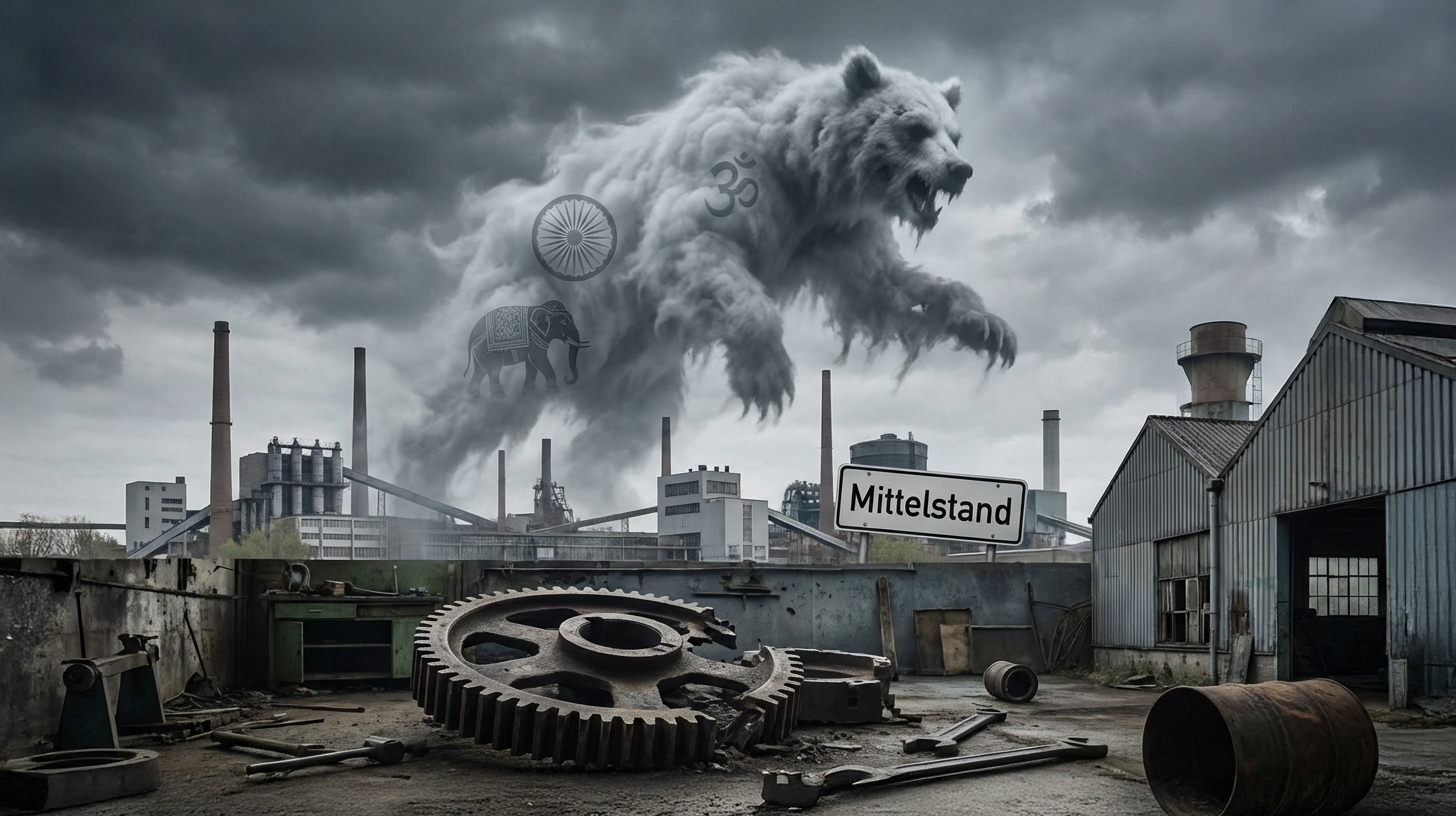
Criticism on the topic | Jane Enny van Lambalgen: Free trade zone with India will cost up to three million industrial jobs in Germany – Image: Xpert.Digital
Expert Commentary: Job-Killer Free Trade Agreements? Expert Alarm or Fearmongering? Why the Gloomy Industry Forecast is Wobbly
A specter is haunting German SMEs: Will the upcoming free trade agreement with India threaten us with the loss of up to three million industrial jobs?
Production relocation to India: Between real danger and dramatized escalation
This drastic figure has been circulating since Jane Enny van Lambalgen, CEO of Planet Industrial Excellence and an experienced interim manager, warned of the consequences of the agreement in a recent press release. The thesis is highly explosive: it suggests that opening the markets will not bring growth, but rather massively erode Germany's industrial core. But how well-founded is this catastrophic prediction? Is it a valid economic forecast or a strategic worst-case scenario?
To properly assess the significance of these statements, it's worth taking a closer look behind the headline. What at first glance appears to be a sober analysis, upon closer inspection reveals itself to be a rhetorical exaggeration that is not supported by either official EU studies or calculations from renowned economic institutes such as the Kiel Institute for the World Economy. While economists tend to speak of moderate growth effects and a strategic diversification away from China, van Lambalgen paints a picture of an existential threat.
The following article therefore not only sheds light on the alarming figure of three million jobs at risk, but also critically examines it. We distinguish between justified warnings about real cost pressures and exaggerated scaremongering. Even if the "apocalyptic formula" rests on shaky empirical ground, it contains a kernel of truth about the creeping mechanisms of production relocation, which small and medium-sized enterprises (SMEs) cannot ignore. Read here what really awaits German industry – beyond reassurances and hysteria.
Foreword: Between justified warning and dramatized escalation
The press release from Jane Enny van Lambalgen, CEO of Planet Industrial Excellence, joins a series of alarmist articles about the future of German industry and small and medium-sized enterprises (SMEs). She claims that the new free trade agreement between the EU and India will cost “up to three million SME industrial jobs” in Germany – a figure that is not supported by reliable studies or official impact analyses from the EU or independent institutes. What is presented here is less a sober assessment of the consequences than a rhetorically exaggerated worst-case scenario designed to generate maximum attention.
To properly contextualize these statements, it's helpful to look at the person and their professional background. Jane Enny van Lambalgen is a prominent interim manager specializing in international operations, production, supply chain, and logistics. Her business model encompasses precisely the situations described in bleak terms in the press release: plant closures, production relocations, turnarounds, and crisis transformations. As co-author of the book "Economic Transformation Now!", she belongs to a network of interim managers who have been warning for years about the looming deindustrialization of Germany while simultaneously advocating solutions in the form of profound restructuring and radical adaptation strategies.
Against this backdrop, it is clear: Van Lambalgen speaks not as a neutral academic, but as a practitioner whose professional role is closely linked to crisis scenarios, structural breaks, and profound disruptions in organizations. Her perspective is informed by projects in which she is typically only brought in when things have already "burned out": when factories are closed, production is relocated, supply chains are restructured, or companies in precarious situations need to be stabilized. This selection of cases inevitably leads to a view of industry that is more strongly influenced by extreme cases and crisis situations than by average developments or gradual adjustments.
The political and economic reality of the EU-India free trade agreement is considerably more complex than the press release suggests. Official statements from the European Commission and independent media emphasize, on the one hand, the strategic nature of the agreement—diversification away from China, strengthening rules-based trade structures, and improved market access for European companies—but, on the other hand, also that short-term growth and employment effects will be limited. Model calculations from renowned institutions such as the Kiel Institute for the World Economy predict moderate positive GDP effects and a significant expansion of bilateral trade, but not macroeconomic shockwaves that would wipe out millions of jobs in a single country.
Precisely for this reason, it is important not to read van Lambalgen's statements as an "objective forecast," but rather as an interest-driven, deliberately dramatizing intervention. The figure of three million jobs at risk remains unexplained in the press release, without any explanation, without a time horizon, without sectoral differentiation, and without reference to established macroeconomic models. Moreover, it directly contradicts empirical experience with previous free trade agreements and offshoring waves, where the actual employment effects—both positive and negative—were orders of magnitude smaller than suggested by this exaggerated claim.
This does not diminish the value of her observation that the cost pressure on industrial SMEs is real and could be exacerbated in certain segments by the agreement. As an operational expert in production relocation and supply chain realignment, she describes concrete mechanisms that are often underestimated in strategic discussions: the combination of labor cost advantages in low-wage countries, the elimination of tariffs, and the possibility of initially keeping functions such as administration, sales, and engineering in high-wage countries, so that the actual structural changes occur "below the radar" for a long time. These micro-dynamics are highly relevant for industrial SMEs – but they do not justify a blanket apocalyptic pronouncement.
This preface therefore aims to achieve two things: It acknowledges the operational experience and practical reality check that an interim manager like Jane Enny van Lambalgen brings to the debate. At the same time, it clearly defines the limitations of her statements: The press release uses unsubstantiated large figures, ignores the counter-effects of the free trade agreement (export opportunities, opening up of the service sector, skilled worker mobility, productivity gains), and overlooks the fact that the root cause of Germany's industrial problems lies in homegrown structural deficiencies (bureaucracy, investment backlog, energy prices, demographics) – not in a single agreement with India.
📈🔵 Ambidexterity or doom: The only management concept that still works in the triple crisis💡

When proven strategies fail: Organizational adaptability in the digital transformation of ambidexterity - Image: Xpert.Digital
We are currently experiencing a period of economic turmoil that differs fundamentally from previous recessions. A deceptive silence prevails in the boardrooms of European and international companies – broken only by the sound of failing strategies that were considered a guarantee of success just yesterday. This is not merely a cyclical downturn, but a profound structural break. The tools with which companies achieved growth for over two decades simply no longer work.
More about it here:
Press releases | Jane Enny van Lambalgen: “The industrial SMEs are basically forced to relocate their production to India in order to compete on costs.”
Frankfurt, January 29, 2026 – “The new free trade agreement between the EU and India will cost a massive number of industrial jobs in Germany,” fears Jane Enny van Lambalgen, CEO of the consulting and management firm Planet Industrial Excellence. The industry expert explains: “Some of the industrial SMEs are using the newly gained freedoms to relocate production to India and, thanks to the new agreement, can import the goods manufactured there into the EU duty-free. This reduces costs by more than 50 percent.” According to its own statements, Planet Industrial Excellence is directly involved in such projects.
Jane Enny van Lambalgen explains the process: “Companies have their goods manufactured in India instead of Germany and import them into the EU duty-free. This is worthwhile because manufacturing costs in India are practically half of what they are here for all industrial products.” She points out that labor costs in India are only about 25 to 30 percent of the wage level in Germany, highlighting the business calculations from a company perspective. Since headquarters, administration, marketing, and sales usually remain in Germany, the relocation of production goes largely unnoticed. “Of course, only the employees notice when they receive their notice of termination,” says Jane Enny van Lambalgen sadly. Regarding product development, she has observed: “The engineering remains in Germany for the time being, until the Indian team is adequately trained to take over that as well.”
The move to India is unavoidable from a business perspective
From the perspective of the industry expert, the move to India or other low-wage countries is economically unavoidable for many German mechanical engineering companies in order to avoid having to compete with Indian manufacturers on the market due to the high cost levels of German production. "The already enormous cost pressure from India will be dramatically intensified by the new free trade agreement," Jane Enny van Lambalgen is certain.
For medium-sized industrial companies, the only options are often "stay here and go under, or relocate production to India and save the company." In the latter case, "at least some administrative, marketing, and sales jobs would remain in Germany." However, according to the expert, these represent, at best, 40 percent of all employment. A good 60 percent of jobs in a medium-sized manufacturing company are in production. "We're talking about up to three million medium-sized industrial jobs that will be lost here and created in India as a result of the new free trade zone," estimates Jane Enny van Lambalgen.
India as an alternative to China
Based on project experience, the CEO of Planet Industrial Excellence knows: “German industrial jobs have been migrating to China for years. But the geopolitical tensions between Beijing and Washington have recently made many executives hesitant to take this path. The new free trade agreement with India offers a way out of this dilemma, which many medium-sized companies will use.”
She clarifies: "The Indian alternative is not only cost-effective for mass production, but also for small production batches, right up to special machine construction." According to her experience, Indian companies and skilled workers in mechanical manufacturing can easily compete with German know-how.
Jane Enny van Lambalgen analyzes: “Currently, two factors in particular are still securing industrial jobs in Germany: India’s relatively slower pace of innovation and the slower adoption of new technologies. Furthermore, India is still heavily dependent on imports of key raw materials and intermediate products such as semiconductors and printed circuit boards. However, this situation will change. India is working rapidly to develop into a modern industrial nation. In the long term, German industrial jobs can therefore only be secured through technological excellence and highly qualified specialists.”
Jane Enny van Lambalgen is Founding Partner and Managing Director of Planet Industrial Excellence and a member of United Interim, the leading community for interim managers in German-speaking countries, and the Diplomatic Council, a global think tank with consultative status at the United Nations (UN). She works as an interim manager for companies in the areas of strategy, operational excellence, turnaround management, supply chain management, and digital transformation. As a temporary manager, she assumes positions as CEO, Managing Director, COO, board member, supervisory board member, and advisory board member in medium-sized businesses. Her work focuses on international operations assignments with an emphasis on production, supply chain, and logistics. She was recognized for her achievements as a "Top Interim Manager 2026." Jane Enny van Lambalgen is co-author of the book "Economic Transformation Now!", in which she and other industry experts describe how Germany can overcome the current economic crisis.
Your global marketing and business development partner
☑️ Our business language is English or German
☑️ NEW: Correspondence in your national language!

Konrad Wolfenstein
I would be happy to serve you and my team as a personal advisor.
You can contact me by filling out the contact form or simply call me on +49 7348 4088 965 (Munich) . My email address is: wolfenstein ∂ xpert.digital
I'm looking forward to our joint project.
☑️ SME support in strategy, consulting, planning and implementation
☑️ Creation or realignment of the digital strategy and digitalization
☑️ Expansion and optimization of international sales processes
☑️ Global & Digital B2B trading platforms
☑️ Pioneer Business Development / Marketing / PR / Trade Fairs
🎯🎯🎯 Benefit from Xpert.Digital's extensive, five-fold expertise in a comprehensive service package | BD, R&D, XR, PR & Digital Visibility Optimization

Benefit from Xpert.Digital's extensive, fivefold expertise in a comprehensive service package | R&D, XR, PR & Digital Visibility Optimization - Image: Xpert.Digital
Xpert.Digital has in-depth knowledge of various industries. This allows us to develop tailor-made strategies that are tailored precisely to the requirements and challenges of your specific market segment. By continually analyzing market trends and following industry developments, we can act with foresight and offer innovative solutions. Through the combination of experience and knowledge, we generate added value and give our customers a decisive competitive advantage.
More about it here:
📈🔵 Order acquisition and organizational development: From classic sales to a strategic business function💡

Order acquisition and organizational development - Image: Xpert.Digital
Xpert.Digital supports companies in this complex transformation, whether it's building a modern order acquisition function from the ground up or optimizing existing processes. With comprehensive expertise in marketing, sales, data analysis, digital transformation, and organizational development, we guide your company toward strategic repositioning. Our approach is holistic: We not only optimize processes but also develop the people and organizational culture necessary to achieve sustainable, measurable success.
More about it here:










