
AI chips, cloud computing, and China: The US tightens AI chip regulations – Why data centers worldwide are under pressure
Xpert Pre-Release

Available in 27 languages 📢
Prefer Xpert.Digital on GoogleⓘPublished on: November 17, 2026 / Updated on: November 17, 2026 – Author: Konrad Wolfenstein
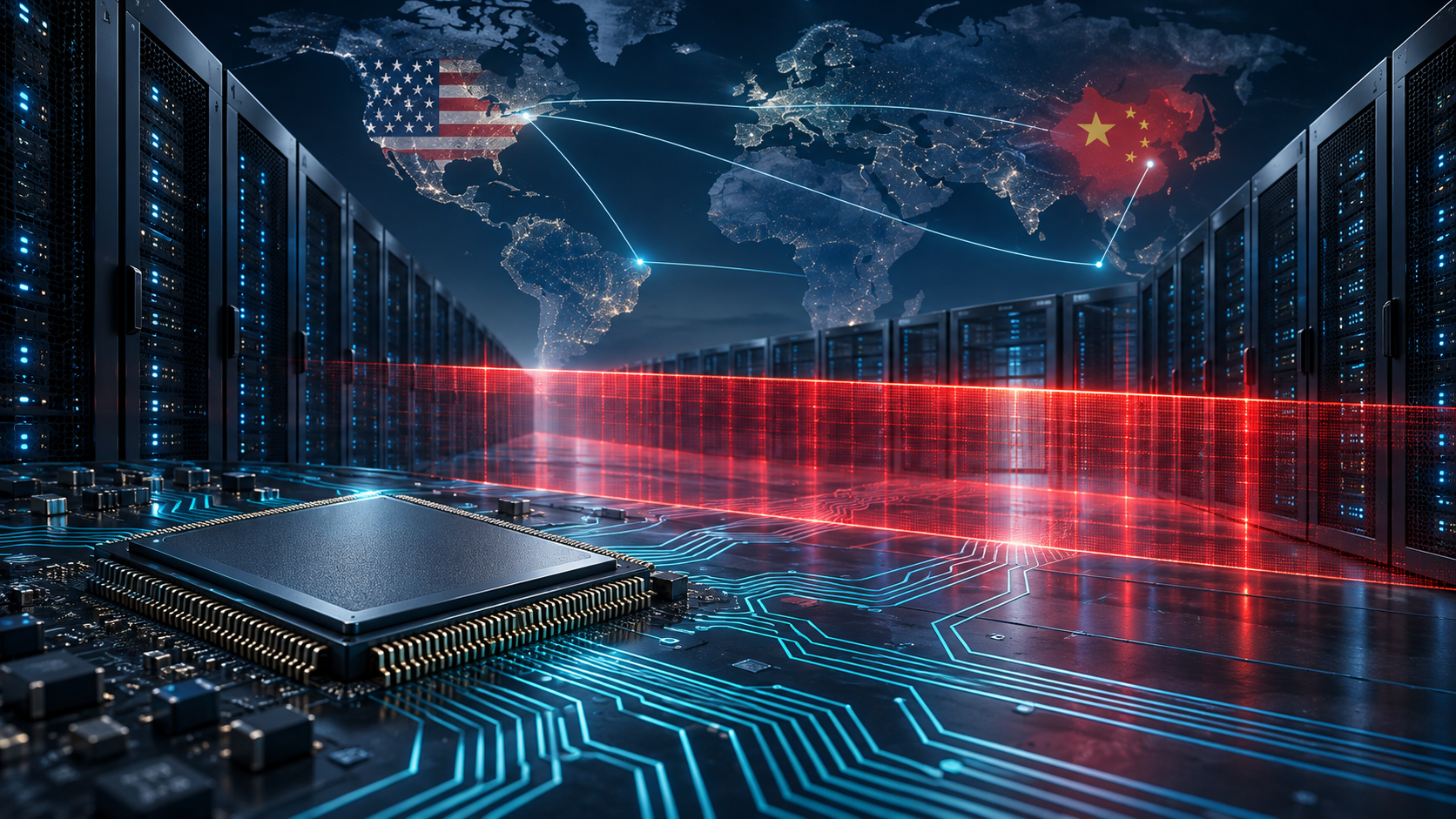
AI chips, cloud computing, and China: The US tightens AI chip regulations – Why data centers worldwide are under pressure – Creative image on the topic, featuring AI: Xpert.Digital
Washington is increasingly controlling who can use computing power – these countries and companies are affected
It's not just the chip that counts: How the US controls access to AI computing power
The US is tightening export controls: Will access to AI computing power become a tool of power?
The United States is tightening its control over the international artificial intelligence market. Certain shipments of high-performance AI chips to Singapore, Malaysia, Thailand, Indonesia, and Brazil will require US approval in the future. At the same time, the US aims to prevent Chinese companies from accessing computing power via foreign data centers, power that would otherwise be denied to them through direct export restrictions. This shifts the focus from the location of a chip to the question of who can actually use its computing power.
The new regulations could have far-reaching consequences beyond the semiconductor trade. They affect the business models of international cloud providers, the financing of new data centers, and the location strategies of emerging digital economies. The competitive landscape is also changing: Exceptions are planned for companies headquartered in the US and certain commercial referral schemes, while other operators may require additional permits.
From Washington's perspective, the rules are intended to make existing technology restrictions against China more effective. At the same time, they threaten additional costs, delays, and unequal competitive conditions. The crucial question, therefore, is whether the strategic benefits outweigh the economic consequences – and whether the regulations can be reliably implemented without unnecessarily hindering legitimate business.
The servers are located abroad – but the USA decides on their use
The United States is tightening its control over the international artificial intelligence market. Certain shipments of high-performance AI chips to Singapore, Malaysia, Thailand, Indonesia, and Brazil will now require US licenses. At the same time, the government aims to prevent Chinese companies from accessing computing power via foreign data centers, power that would otherwise be denied to them through direct export restrictions. This shifts the focus of American technology policy: the emphasis is no longer solely on the physical location of a semiconductor, but also on who can actually utilize its computing power. Licenses will be reviewed on a case-by-case basis. Exceptions are planned for companies headquartered in the US and for certain commercial referral schemes.
Economically, this step has considerably more far-reaching consequences than an additional trade restriction on individual products. It affects the business model of international cloud providers, the financing of new data centers, the location strategies of emerging digital economies, and the competitive landscape between American and non-American infrastructure operators. What appears to be a purely technical export issue becomes a question of economic power: Who controls access to a resource that is becoming increasingly important for research, industrial automation, and the development of new business models?
The central perspective is therefore this: The new rules are understandable as an attempt to make existing technology restrictions against China more effective. At the same time, they create additional costs, unequal competitive conditions, and incentives to build alternative technology ecosystems. Whether the strategic benefits outweigh the drawbacks depends less on the political forcefulness of the announcement than on the actual feasibility, the predictability of approvals, and the alternative options available to the affected companies.
Chip control becomes control of digital usage
Traditional export controls are based on a relatively straightforward transaction: a manufacturer delivers a specific good to a buyer in a specific country. Authorities can examine product characteristics, recipients, transport routes, and intended uses. However, this approach is insufficient when faced with powerful AI systems.
A company doesn't need to own a high-performance processor to reap its economic benefits. It can rent the necessary computing power from a cloud provider. The chip then remains, for example, in a Southeast Asian data center, while the calculations performed on it benefit a customer in China. The new American regulations address precisely this separation between hardware location and economic use. In addition to requiring further permits for certain chip shipments, they are also tightening requirements for foreign data centers that provide significant computing capacity to Chinese companies.
This fundamentally changes the logic of control. Exporting a processor is a one-off event. Providing cloud services, on the other hand, is an ongoing process. Customers can switch providers, contracts can be extended, and computing resources can be shared between different applications. Therefore, a hardware delivery that was initially permissible does not permanently answer the question of whether every subsequent use is also permissible.
For economic analysis, it's also important not to equate a licensing requirement with a complete prohibition. Authorization can be granted, made conditional, or denied. However, the very necessity of a case-by-case decision alters the calculations: companies must factor in additional time, documentation, and regulatory uncertainty. Even a project that is approved later can become more expensive as a result.
The scale explains why computing power becomes a question of power
The market this policy impacts has reached a scale that extends far beyond a specialized technology sector. Nvidia generated revenue of approximately $215.9 billion in fiscal year 2026, which ended on January 25, 2026. This represented year-over-year growth of 65 percent. Its data center business contributed roughly $193.7 billion, growing by 68 percent. This accounted for nearly nine-tenths of the company's total revenue. While these figures do not represent the entire AI infrastructure market, they illustrate the economic significance of its most important publicly traded equipment supplier.
In addition, there is the energy-related dimension. Global electricity consumption by data centers was estimated at 415 terawatt-hours in 2024, or about 1.5 percent of global electricity consumption. A baseline scenario projects an increase to approximately 945 terawatt-hours by 2030. These figures encompass data centers as a whole and should not be confused with the electricity consumption of artificial intelligence alone. AI, however, is a significant driver of this growth.
Export controls are therefore not just about the sale of chips. They affect investment chains comprising servers, network technology, cooling, buildings, power supplies, and digital services. If individual links in this chain become regulatoryally uncertain, the impact can spread to the entire project.
At the same time, the scale of the impact should not lead to overly broad conclusions. Without information on affected orders, approval rates, and customer structures, no reliable estimate of revenue loss can be derived from the new rules. Likewise, not every announced data center construction project is immediately at risk. The crucial factors are the hardware to be used, who the commercial end user is, and which exceptions actually apply.
Five countries caught between location policy and technology control
The fact that Singapore, Malaysia, Thailand, Indonesia, and Brazil are explicitly included initially signifies a regulatory risk assessment by Washington. The US government sees an increased risk of the unauthorized transfer or use of advanced semiconductors in these countries. However, this does not mean that all companies in these countries are involved in circumvention schemes. Such an equation would be factually incorrect and economically misleading.
However, this presents a problem for location policy. A data center location is not only evaluated based on land prices, electricity costs, or network connections. Equally important is whether the required technology can be reliably procured and used throughout the project's economic lifespan.
If a country falls under a stricter regulatory regime, this can reduce the attractiveness of certain investments without eliminating the general location advantages. An existing cloud business for local companies may still be viable, while a project tailored to a few large foreign AI clients becomes significantly riskier. The impact therefore depends more on the business model than on the country name alone.
This results in an uncomfortable shift in the scope of influence for governments. They can expand power grids, expedite approval processes, and promote skilled workers. However, they cannot decide for themselves on the approval of certain high-performance American chips. National digital strategies thus become partly dependent on the foreign policy decisions of another state.
Singapore and Malaysia face different adaptation challenges
Singapore's role as an international business and finance hub is particularly relevant. In cross-border technology transactions, the legal buyer, invoice recipient, operator, and actual user can be different entities. A company might be based in Singapore, while the infrastructure is operated elsewhere and used by customers in multiple countries. Therefore, the economic structure behind a transaction is crucial for oversight.
The new regulation could lead to a greater differentiation between American-controlled providers and local or other foreign operators. While exceptions are provided for certain US companies, other market participants will face additional permitting requirements. For Singapore, this makes the ownership structure of an infrastructure project an even more important competitive factor.
From an economic perspective, Malaysia faces a related, but not identical, challenge. For any data center location geared towards growth, land, energy supply, buildings, and hardware must be coordinated over time. If the delivery of crucial accelerators is delayed, other project components may remain unused.
This does not automatically mean that investments already made become worthless. Buildings and network connections can potentially be used for other digital applications. However, a facility designed for highly dense AI systems cannot simply be used differently to generate the same returns. The economic viability of a project therefore increasingly depends on its ability to serve different customer groups and technical applications.
Thailand, Indonesia and Brazil need to recalculate their AI ambitions
For Thailand and Indonesia, the key question is how to reconcile national digitalization goals with a more tightly controlled international technology market. The restrictions apply to specific advanced semiconductors and relevant applications, not to all data centers or digital services across the board. This distinction is crucial: building a general cloud infrastructure is not economically or regulatory equivalent to operating large training clusters for high-performance AI models.
A single location can therefore continue to grow within the normal cloud business, while individual large-scale AI projects become more difficult. For policymakers, it would consequently make little sense to lump every additional server capacity under the banner of a national AI industry. What matters is the actual value creation: local software development, industrial applications, research, or simply the leasing of imported hardware.
Brazil's inclusion also underscores that the American strategy is not limited to Southeast Asia. Regulation follows the perceived risk of unauthorized use, not solely a regional security logic. Even a location geographically far removed from China can be targeted if Washington identifies corresponding risks of circumvention.
This results in the same strategic challenge for all three countries: A resilient digital economy should not rely solely on the availability of a specific generation of foreign chips. Business models that derive their value from expertise, customer proximity, software, data quality, and industry-specific integration will become more attractive. Such capabilities do not replace computing power, but they make local value creation less dependent on mere access to hardware.
The exception for US companies changes the competitive landscape
Of particular economic significance is the proposed exemption for companies headquartered in the United States. It allows certain American operators to supply data centers in the aforementioned countries with the covered chips under more favorable regulatory conditions than comparable non-American companies. The specific details of the requirements remain crucial for its practical application.
This can create an unequal competitive environment within the same country. Two operators might have similar land costs, the same electricity prices, and comparable customers. Nevertheless, their investment risk differs because one of them requires an additional American permit.
This difference isn't only relevant when a license is denied. Even an uncertain processing time can be significant for banks, investors, and large clients. A client who needs computing capacity by a specific deadline might value the security of its provision more highly than a slightly lower price.
From an American perspective, the exception can be justified by the need for better oversight. Authorities can more easily obtain information and enforce compliance with regulations from companies within their own jurisdiction. However, from an economic standpoint, this same rule could favor market concentration in favor of large American providers.
Local operators could respond by seeking partnerships with US companies or by changing their role. Instead of procuring chips and marketing computing power themselves, they could focus more on providing buildings, energy, and technical services. This can facilitate investment but potentially shifts some control over customer relationships and digital value creation abroad.
Recommendation systems highlight the difficult boundary between everyday life and high technology
The exception for certain commercial recommendation systems is also revealing. Systems that select product recommendations for online retailers or content for social networks are not to be treated in the same way as particularly sensitive AI applications. The American regulation thus attempts to differentiate between different types of use, rather than subjecting every AI calculation to the same level of scrutiny.
From an economic perspective, this differentiation makes sense because a blanket classification of all AI applications could affect very large parts of the digital economy. However, a practical problem arises: the same technical infrastructure can perform different tasks. Accelerators can, in principle, be used for different models and applications.
The crucial question, therefore, is how clearly privileged use must be demonstrated. If an operator offers both recommendation systems and other sophisticated AI services on the same platform, a clear technical and organizational separation becomes more important.
This can lead to additional costs. Separate systems may be easier to audit, but allow for less flexible hardware utilization. A shared infrastructure can be more cost-effective, but requires more sophisticated documentation of actual usage.
This exception illustrates a fundamental problem of modern technology regulation: Economic efficiency often relies on the flexible use of universally applicable systems. Security control, on the other hand, frequently requires clear allocation, limitation, and traceability.
🎯🎯🎯 Data-driven B2B industry hub as a quasi-in-house solution

The quasi-in-house solution: How Xpert.Digital closes operational gaps in B2B marketing and sales – Smart Content-Driven Business - Image: Xpert.Digital
Xpert.Digital is a data-driven B2B industry hub led by Konrad Wolfenstein . The company acts as an external, quasi-in-house solution for industrial partners, closing operational gaps in marketing, content, and sales – without requiring additional resources on the client side.
More information here:
Impact of export controls on global investment flows
For Nvidia, it's not just about how much is sold, but to whom
For Nvidia and other affected vendors, this initially results in additional requirements for sales and customer due diligence. An order can no longer be evaluated solely based on the product, buyer, and delivery address. Ownership structure, operating model, and intended economic user also become more important.
The immediate impact on revenue, however, remains unclear. A new licensing requirement could prevent, postpone, or redirect sales to other customers. If a non-US operator receives less hardware, but a privileged US cloud provider expands its capacity in the same country, the manufacturer will not necessarily lose the same amount of revenue. Market shares within the downstream infrastructure sector can change more dramatically than overall chip demand.
Given Nvidia's data center revenue of approximately $193.7 billion in fiscal year 2026, this distinction is crucial. Furthermore, the business unit encompasses more than just individual AI chips. Therefore, its size does not allow for a direct calculation of either the value of the specific shipments affected or any potential loss.
In the long term, manufacturers face a more difficult balancing act. Stricter controls can make their products indispensable within a politically protected market. At the same time, limited availability for excluded customers increases the incentive to develop alternative hardware and software environments.
Short-term sales and the long-term position of a technology ecosystem can therefore diverge. A company can profit from high demand today and yet risk that key customer groups systematically reduce their dependence over the years.
Data centers bear the risk of investments that are poorly timed
The economic vulnerability of AI data centers lies not only in the high purchase price of the hardware. Crucially, many investment components must be coordinated. Land, buildings, power supply, cooling, network technology, servers, and customer contracts must all be usable as simultaneously as possible.
A delay in obtaining permits can disrupt this coordination. The building is finished, the power connection is available, and the staff is hired, but the central computing equipment is still missing. Conversely, existing hardware may be underutilized economically if certain customer groups can no longer be served or can only be served after additional approval.
A simplified calculation illustrates the scale of the costs, without claiming to represent an actual project timeline. For a plant with an electrical connection capacity of 100 megawatts, an annual operating time of over 8,000 hours corresponds to an electricity consumption of 800 gigawatt-hours. Assuming a price of €0.08 per kilowatt-hour, this would amount to €64 million per year. The actual costs will depend on factors such as operating time, electricity contract, and efficiency.
A delay does not mean that all these electricity costs will still be incurred. Without running servers, consumption decreases. However, financing costs, personnel expenses, space costs, and certain contractual obligations may continue. In addition, there are lost profit margins.
Especially with rapidly aging hardware, lost time is economically significant. A later start of operations may shorten the window of opportunity in which particularly high prices can be achieved for a new chip generation.
Permitting uncertainty impacts financing and company values
Investors assess not only expected profits, but also their probability and timing. An additional licensing requirement can therefore change the value of a project, even if its revenue remains unchanged in the best-case scenario.
The first impact is the delay. Revenues that are generated later are worth less from today's perspective. The second is the uncertainty surrounding the eligible customer group. If a large potential customer becomes problematic due to regulatory issues, the expected utilization rate may decrease. The third concerns the resale value of the hardware if a later sale is also only possible to a limited extent.
Banks can respond to such risks with stricter conditions. These could include higher equity capital requirements, shorter loan terms, additional collateral, or the requirement of binding approvals before disbursement. Whether and to what extent this occurs depends on the specific project and is not an automatic consequence of every new regulation.
Business models that combine high debt with a few large customers are particularly vulnerable. If one of these customers is lost for regulatory reasons, the economic foundation can erode rapidly. A broad customer base and various permissible applications, on the other hand, offer more flexibility.
This has an important consequence for valuations: Two technically identical data centers do not necessarily have the same economic value. Legally secured access to hardware and customers can become just as crucial an asset as the building itself.
The dispute in Washington is a conflict of differing cost calculations
The political origins of the regulation point to a fundamental conflict of objectives. Treasury Secretary Scott Bessent and the National Security Council pushed for stricter regulations. Bessent had accused the Commerce Department of not enforcing existing restrictions rigorously enough. Reports of internal disputes also describe delays in taking further action against suspected trafficking. Such allegations must be distinguished from definitively established legal violations.
Behind the institutional dispute lie various economic and security cost calculations. A stricter approach places a heavy emphasis on the potential strategic damage if Chinese companies can access cutting-edge American technology despite formal restrictions. A more cautious approach might focus more on revenue, international market share, and retaining foreign customers on American platforms.
Both perspectives capture real interests, but with different time horizons. Access that is restricted today may be desirable for security reasons, while simultaneously promoting the development of competing systems in the long term. Conversely, a sale permitted today may be economically attractive, while its strategic benefits for the recipient will be difficult to reverse later.
The crucial economic question, therefore, is not whether security or trade is fundamentally more important. It is which specific capabilities are actually delayed by a restriction and what economic costs this entails. Without this comparison, the debate easily remains mired in political symbolism.
China will choose between more expensive access and greater independence
For Chinese companies, restricting foreign cloud access initially increases the number of obstacles. If direct purchases are limited and, at the same time, the use of powerful systems in third countries is more tightly controlled, the scope for accessing certain American technologies shrinks. This interplay of both control mechanisms is precisely the aim of the new regulation.
However, this does not mean that Chinese AI development will come to a complete standstill. Companies can try to better utilize existing systems, make models more efficient, use different hardware, or adjust their development goals. Which of these responses will suffice depends on the specific task at hand.
Economic adaptation is likely to involve costs. A hardware change may require software adjustments, new tools, and additional development work. Technical alternatives may not immediately offer the same performance, availability, or cost-effectiveness. At the same time, restricted access strengthens the political and commercial incentive to develop such alternatives in the first place.
This creates a dynamic conflict of objectives. In the short term, restrictions can slow technological progress. In the long term, they can accelerate the emergence of independent supply chains. Both effects can occur simultaneously.
A snapshot in time is therefore insufficient for evaluating American policy. Successful implementation in the first year says little about whether the dependence of Chinese companies on American technology will be greater or lesser after five or ten years.
Customer data becomes an integral part of the security architecture
Controlling remote access requires more knowledge about customers than a simple billing address check. Foreign data centers are expected to more accurately determine who is using their services and whether there are any relevant connections to restricted countries. Direct and indirect ownership structures can also play a role in this process.
This necessitates an organizational restructuring for operators. Sales, legal, IT security, and technical operations must collaborate more closely. A one-time review at the time of contract signing may be insufficient if ownership, scope of use, or the actual purpose of the property changes later.
These checks cost money. Large providers can distribute the necessary systems across many customers. Smaller companies may incur higher costs per contract. Therefore, regulation can create an additional economies of scale, regardless of the explicit exemptions.
At the same time, more rigorous auditing should not be confused with complete traceability. Ownership structures can be complex, customers can resell services, and economically linked companies can be spread across multiple jurisdictions. The more the focus of control is on actual usage rather than physical delivery, the greater the significance of information that is difficult to verify.
The effectiveness of the system therefore does not depend solely on strict regulations. Equally important are clear definitions, practical evidence, and a proportionate approach to unavoidable uncertainties. Otherwise, a situation risks arising in which cautious providers avoid legitimate business, while particularly complex structures remain difficult to detect.
Electricity and networks remain scarce, even if chips are politically controlled
The new export policy masks a second bottleneck: the physical supply of data centers. The expected increase in the global electricity consumption of these facilities from 415 terawatt-hours in 2024 to approximately 945 terawatt-hours in 2030 makes it clear that energy supply and grid infrastructure remain key growth drivers. This is a projection, not a fixed demand figure.
The combination of these two bottlenecks results in a more complex location analysis. A country with cheap energy is not automatically attractive if the necessary chips are difficult to obtain. Conversely, privileged access to hardware is of little use if power connections are lacking or operation is uneconomical.
For energy suppliers and infrastructure investors, this can change the valuation of power purchase agreements. A planned large electricity customer is only sustainable in the long term if its own business model is financed and regulatory-compliant. The political availability of IT equipment thus indirectly becomes a risk factor in the energy sector.
Shifts in demand are also conceivable. If a project stalls in one country while another is accelerated, the demand for electricity, cooling, and grid connections will shift. Globally, such a shift might not reduce overall AI demand. Locally, however, it could create significant differences in investment and capacity utilization.
The competition for AI locations will therefore not be decided by a single advantage. Success is more likely to come from combinations of energy availability, legal reliability, technical expertise, and guaranteed access to technology.
Europe can learn from this development, but it cannot automatically benefit
For European companies, the most important lesson is not that every restriction on other locations automatically creates a European advantage. Such a conclusion would be too simplistic. Investments don't simply migrate to where a particular permitting requirement doesn't apply. They also require competitive costs, available energy, suitable sites, and sufficient customer demand.
More significant is the question of actual control over digital infrastructure. The geographical location of a data center, in itself, says little about who can determine hardware deliveries, software, customer relationships, or operating conditions.
For companies in industry, logistics, and other data-intensive sectors, a multi-layered approach is therefore advisable. Critical dependencies can lie with the cloud provider, the chip ecosystem, proprietary software, or individual operational services. A European server location does not automatically eliminate these dependencies.
Economically viable independence, however, does not mean having to manufacture every component in-house. Such a requirement could incur enormous costs. More important are realistic alternatives, transferable data, adaptable software, and a clear allocation of particularly critical applications.
The American rules thus illustrate a general principle: technological dependence becomes particularly costly when a change has to be made under time pressure. Precautionary contingency plans can have economic value, even if they initially remain unused during normal operations.
Three development paths will determine the long-term consequences
One possible first course of action is a controlled adjustment. Permitting requirements become sufficiently clear, legitimate projects receive swift decisions, and particularly risky uses are effectively limited. In this case, the costs of regulatory compliance increase without fundamentally disrupting the international infrastructure market.
A second scenario would involve competitive consolidation. Large American providers could leverage their regulatory and organizational advantages, while smaller non-American operators grow more slowly or focus on downstream services. Global AI investment could continue to increase, despite the shifting distribution of control and revenues.
A third scenario would be accelerated technological fragmentation. Affected states and companies would invest more heavily in alternative hardware, proprietary software environments, and regional supply chains. In the short term, this could lead to duplication of effort and inefficiencies. In the long term, it could diminish the US's ability to control access to AI computing power through a few central providers.
These development paths are not mutually exclusive. They can occur simultaneously in different regions and market segments. Large international providers may adapt relatively smoothly, while individual national projects fail and alternative technology platforms emerge in parallel.
Therefore, a reliable assessment should not be based solely on export figures. Equally relevant are permitting times, the utilization of existing facilities, customer concentration, financing costs, and the actual performance of available alternatives.
What matters is not the number of licenses refused, but the effect
The success of export controls cannot be measured by the number of rejected applications. A high rejection rate can indicate effective controls, but it can also suggest that legitimate business is being unnecessarily hampered. A low rate can signify a lenient approval process or simply show that risky applicants are not even present.
A more meaningful question would be whether restricted actors actually have less access to strategically relevant capabilities. Equally important is what costs this incurs for authorized users and whether problematic activities are merely shifted to other structures.
For the countries concerned, what matters is whether announced investments are actually built, equipped, and operated profitably. A high number of political declarations of intent is not yet proof of a high-performing AI economy. Only productive use, sustainable utilization, and local value creation demonstrate the economic benefits.
The distribution of the benefits also deserves attention. A country can gain additional data center capacity while key decisions, customer access, and profits remain abroad. Conversely, a smaller infrastructure market with specialized applications can be more economically valuable than a large but underutilized collection of imported servers.
A dispassionate analysis must therefore distinguish between installed technology, usable computing power, economic value creation, and strategic control. These factors are related, but by no means identical.
The new frontier of globalization runs through the cloud
The stricter American regulations mark a fundamental shift: Digital services are now being assessed more according to their strategic impact, not just the location of their technical infrastructure. The combination of additional licenses for certain chip shipments and controls on relevant remote access is intended to prevent physical export restrictions from being rendered ineffective by cloud models.
From a security policy perspective, this approach closes a clear gap. From an economic perspective, however, it expands the scope of politically driven uncertainty. It influences investment timing, financing, customer choice, and competitive structures. Particularly consequential is the fact that not all operators are subject to the same conditions.
The overall assessment is therefore twofold. Control focused on clearly defined high-performance applications can be more effective and less economically damaging than a blanket approach against the entire digital infrastructure. However, its benefits diminish if unclear rules, lengthy decision-making processes, and broad categories of suspicion burden the legitimate market more than the actually problematic use itself.
In the long term, Washington will face a strategic boundary: the more the United States leverages its technological influence for access control, the greater the incentive for other actors to resist this influence. While this short-term leverage may be effective, it can simultaneously weaken its own long-term foundation.
For companies and states, the key economic consequence is therefore not that international AI infrastructure becomes impossible. It becomes more political, more challenging to finance, and more dependent on the question of who not only owns the servers but also has the long-term right to decide on their use.
📈🚀 From visibility to trust 👀🤝 Your scalable path with Xpert.Digital

From visibility to trust: Your scalable path with Xpert.Digital - Image: Xpert.Digital
In industrial B2B, sustainable business relationships rarely emerge overnight. They develop step by step – through visibility, professional relevance, recurring touchpoints, and growing trust. Xpert.Digital's 4-stage model addresses precisely this: It offers a structured path that begins with a manageable entry point and can evolve into deeper collaboration in business development if needed.
Instead of relying on loud marketing promises, this model puts the relationship at the forefront. Companies start with clearly defined, easily calculable measures and then decide, based on their own experience, how far they want to expand the collaboration. A key factor for this undisturbed trust-building process: The platform completely avoids annoying advertising ads, so the editorial focus remains solely on the companies' expertise.
More information here:
Your global marketing and business development partner
☑️ Our business language is English or German
☑️ NEW: Correspondence in your native language!

Konrad Wolfenstein
I and my team are happy to be available to you as your personal advisor.
You can contact me by filling out the contact form here [email protected]:or simply call me at +49 7348 4088 965. My email address is
I'm looking forward to our joint project.