
The Illusion of the Cloud: AI Boom vs. Impending Copper Shortage – Why Data Centers Are Making Resources Scarce
Xpert Pre-Release

Language selection 📢
Published on: May 18, 2026 / Updated on: May 18, 2026 – Author: Konrad Wolfenstein
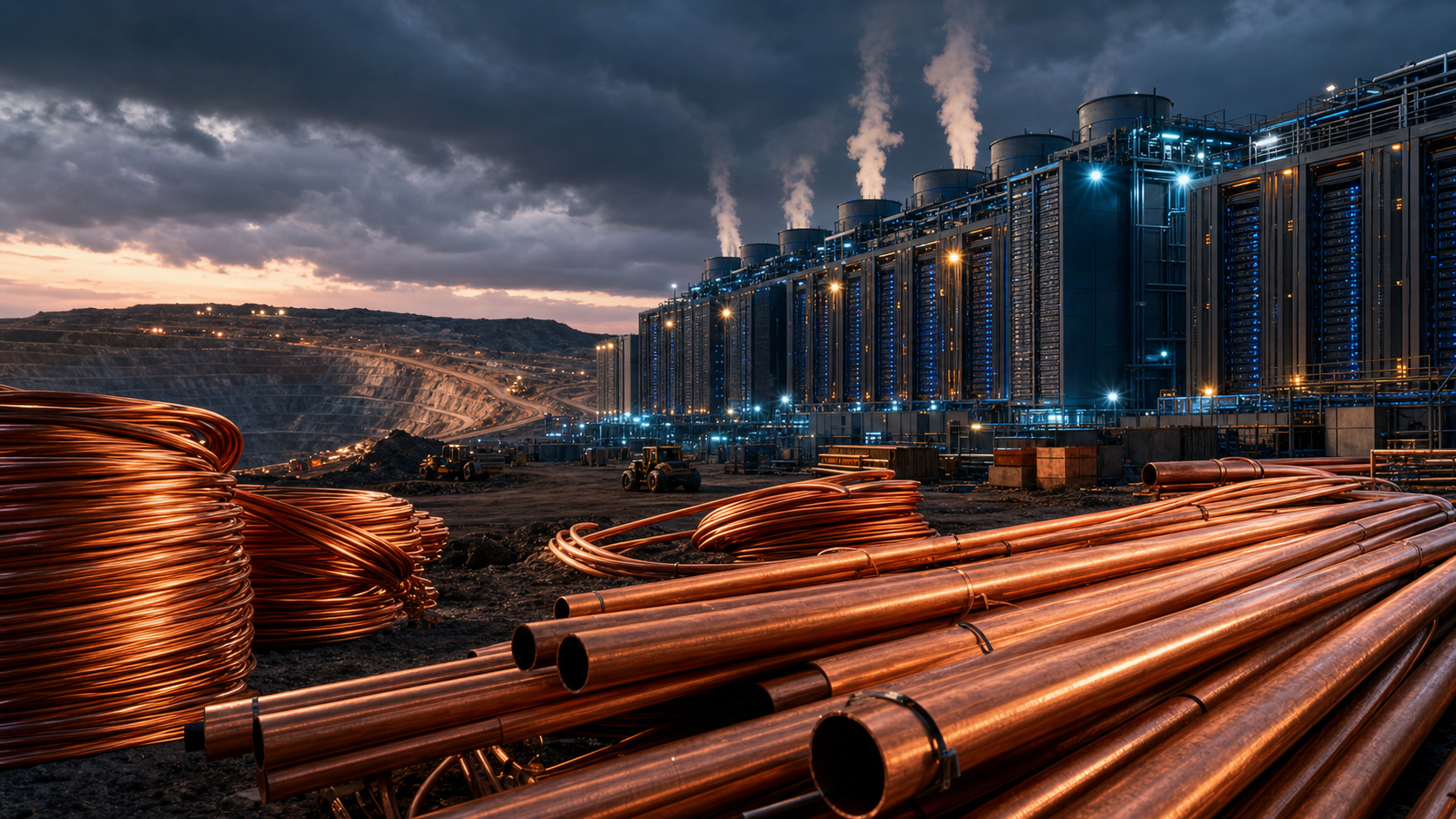
The Illusion of the Cloud: AI Boom vs. Impending Copper Shortage – Why Data Centers Are Making Resources Scarce – Image: Xpert.Digital
16 years too late: The alarming copper problem of artificial intelligence
AI vs. Energy Transition: The merciless battle for the raw material that powers our world
The red gold of tech giants: Why data centers are causing copper prices to explode and why AI and electric cars are driving the next copper shortage
The cloud isn't weightless, and artificial intelligence doesn't exist in a vacuum. While the world watches with bated breath as increasingly powerful language models emerge and debates the software of the future, a very real physical resource crisis is looming in the background. The gigantic data hunger of modern AI data centers is colliding with a global raw materials market already stretched to its absolute limits by electromobility and the energy transition. At the center of this perfect storm is a metal that has shaped humanity's technological progress for millennia: copper. Without this reddish element, there would be neither power distribution nor cooling for the gigantic server farms of the tech giants. But because it takes an average of over 16 years from the discovery of a mine to its extraction, the digital boom is now threatened by a brutal physical bottleneck. Why the price of copper is rising inexorably, how geopolitical conflicts are exacerbating the situation, and why recycling alone won't save us – an in-depth analysis of the true, very material price of the AI revolution.
Related to this:

Silicon Valley's blind spot: Without this metal, the AI revolution is threatened with stagnation
The public debate surrounding artificial intelligence revolves almost exclusively around algorithms, training costs, and the question of whether language models will soon surpass human intelligence. What is systematically overlooked is the sheer physical substance without which not a single AI model could ever answer a single query: copper. The reddish metal, which has accompanied humanity's technological progress since the Bronze Age, is once again at the center of a supply crisis – this time triggered not by wars or natural disasters, but by the insatiable data hunger of an entire industry that likes to see itself as immaterial and purely digital.
The connection is as obvious as it is consistently ignored: copper conducts electricity more efficiently than virtually any other economically viable material. It transfers heat, forms the backbone of every power distribution system, and is indispensable for the functionality of high-performance cooling systems. And yet, AI data centers, by far the most energy-intensive computer systems ever built, are consuming the metal to an extent that surprises even experienced commodity analysts. The consequence is a structural shortage that will intensify into a tangible economic bottleneck over the coming years – with far-reaching consequences for the energy transition, the arms industry, and, not least, the entire narrative of progress surrounding AI.
Copper in the data center: Numbers that shift the scale
To understand the scope of the problem, one must first grasp the enormous difference in material requirements between conventional data centers and AI-optimized facilities. A conventional data center, considered standard just a few years ago, consumes between 5,000 and 15,000 tons of copper for its entire infrastructure. AI data centers, on the other hand, fundamentally exceed these standards: A single large AI data center can consume up to 50,000 tons of copper – three to ten times more than a conventional facility.
The technical explanation for this dramatic increase in demand lies in the architecture of modern AI systems. Analyses of copper consumption by infrastructure component show that the demand is distributed across several layers: power distribution systems require between 12,000 and 15,000 kilograms of copper per megawatt of installed capacity, cooling infrastructure adds another 8,000 to 10,000 kilograms per megawatt, server hardware and network connections require 4,000 to 6,000 kilograms, and emergency power supply alone accounts for 2,000 to 3,000 kilograms per megawatt. In total, this results in a copper intensity of around 27 tons per megawatt of installed capacity – a figure three to four times higher than that of conventional data centers.
Furthermore, a development that truly illustrates the sheer scale of the problem is underscoring this: While traditional cloud infrastructures typically calculated for a power consumption of 5 to 10 megawatts per campus, modern AI clusters now require between 100 and 500 megawatts of continuous power. The Microsoft data center in Chicago, a project with an investment volume of approximately 500 million US dollars, alone required 2,177 tons of copper – and this is already considered a medium-sized project within the industry. According to estimates by JPMorgan, AI data centers alone could generate around 110,000 tons of additional copper demand by 2026.
When three sectors compete for the same metal
The real explosive potential lies less in the absolute need than in the simultaneity of demand from three structurally independent but resource-dependent sectors: The energy transition with electric vehicles and wind turbines, the nationwide expansion of electricity grids, and the explosive expansion of AI data centers all require the same metal at the same time – and together exceed what the global copper market can supply.
The shift to electric mobility alone has fundamentally changed the demand for copper in the automotive industry. A combustion engine vehicle requires around 23 to 24 kilograms of copper, a hybrid vehicle already uses 40 to 60 kilograms, and a purely battery-electric car consumes up to 83 kilograms. Extrapolated to global production targets for the coming years, this sector alone will generate a surge in demand that will put sustained pressure on copper markets. The report by the International Energy Forum (IEF) states that demand will rise to dizzying heights due to the expansion of electric vehicles, wind turbines, and solar panels. To meet the automotive industry's electrification targets alone, up to 55 percent more new copper mines would have to be brought into production for vehicle applications than currently planned.
At the same time, global grid expansion is entering its largest historical phase. Smart grids, high-voltage lines for North Sea wind farms, submarine cables for intercontinental energy distribution – all of this is copper-intensive, and demand is expected to double within the next few years. Into this already strained market environment bursts the AI boom with a demand dynamic that dwarfs all previous projections. According to forecasts by the Öko-Institut (Institute for Applied Ecology) commissioned by Greenpeace Germany, the global electricity consumption of AI data centers will increase elevenfold, from 50 billion kilowatt-hours in 2023 to around 550 billion kilowatt-hours in 2030. The International Energy Agency (IEA) predicts that the total electricity consumption of all data centers will more than double to around 945 terawatt-hours by 2030 – a figure roughly equivalent to Japan's current annual electricity consumption.
When geology doesn't make curves: The 16-year delay
Perhaps the most dramatic and consistently underestimated problem lies not in the geology itself, but in the time frame between discovery and production. A new copper mine cannot be established within a quarter of a year when the market demands it. The reality is sobering: On average, 16.2 years pass between the discovery of an economically viable copper deposit and commercial production – according to a comprehensive analysis by S&P Global Market Intelligence, which examined 127 mines in the Western world.
Broken down into phases, the true extent of the problem becomes clear: almost 12.4 years are spent solely on exploration and the preparation of economic feasibility studies. Only then does the phase of the actual investment decision begin – a process that takes another 1.5 years or so. The construction itself, the phase perceived by the public as the real problem, lasts comparatively short, averaging 2.3 years. The consequence of this time-management approach is brutally simple: the copper mines intended to meet the rising demand of 2030 should have been discovered as early as 2014 and fully financed by 2015 at the latest. This did not happen – due to a combination of reluctance to invest, falling commodity prices in the second half of the 2010s, and a systematic underestimation of the growing demand.
While there has been increased exploration activity and new project announcements since 2022, the year the AI boom began with the public launch of ChatGPT, even if all necessary investments were to flow from today and all permitting processes proceeded smoothly—a near-utopian assumption given the regulatory and environmental requirements in Western countries—the first mine from the current exploration cycle could not reach production readiness until around 2038 or 2040 at the earliest. The time window between the exploding demand for AI and the ramp-up of new supply capacity is structurally unbridgeable.
Price fever: What the market knows about the scarcity
The price of copper clearly illustrates what political debates and technology conferences often overlook. In 2025, the price of copper on the London Metal Exchange rose by more than 43 percent – the best annual performance since 2009. At the beginning of 2026, the price broke through the $13,020 per ton mark for the first time and reached an interim all-time high of $13,273.81.
In early January 2026, Goldman Sachs raised its copper price forecast for the first half of 2026 from $11,525 to $12,750 per ton, citing a scarcity premium due to limited inventories outside the United States. Goldman Sachs' average forecast for the full year 2026 is $12,650 per ton. Bank of America goes even further: For 2027, the institution forecasts $13,501 per ton and considers a peak of $15,000 per ton possible. Traxys, a leading commodities trading firm, also cites $15,000 as a realistic price target for the next two to three years.
At the same time, the analytical community is divided: Goldman Sachs itself warned at the end of 2025 that a persistent global supply surplus would likely prevent copper prices from permanently exceeding the $11,000 mark in 2026, forecasting a surplus of 500,000 tons in 2025 and a further 160,000 tons in 2026. This discrepancy between short- and long-term price expectations is not an analytical failure, but rather reflects the fundamental peculiarity of the copper market: In the short term, situational surpluses arise when inventory build-up and trade policy distortions create illusory effects. In the long term, however, the picture is clear: Structural demand dynamics far outweigh supply growth. BloombergNEF estimates the annual copper deficit by 2035 at a total of six million tons – more than the entire annual production of Chile, the world's largest copper producer.
Chile, Mantoverde and the fragile geography of copper supply
Copper is not a ubiquitous commodity. Roughly half of global mining production is concentrated in a few countries, all of which are under pressure from geopolitical, social, or climatic risks. Chile, by far the largest producer with a share of over 20 percent of global production, has halved its growth forecast for 2025 from an initial three percent to 1.5 percent – triggered by production disruptions at the large Escondida (BHP) and Collahuasi mines. The state copper commission, Cochilco, also warned that a fatal mine collapse at Codelco's El Teniente mine poses a significant risk of supply disruptions.
The labor dispute at Capstone Copper's Mantoverde mine in northern Chile, 70 percent owned by the Canadian company and 30 percent by Mitsubishi Materials, was particularly noteworthy. In early January 2026, approximately 645 members of Union #2 went on strike after negotiations failed. The situation escalated when strikers occupied the desalination plant, located 40 kilometers away and the mine's only water source, bringing sulfide production to a complete standstill. During the strike, production operated at only about 55 percent of normal capacity. The strike ended in early February 2026 after a new three-year collective bargaining agreement was negotiated, including a one-time payment of approximately US$17,500 per employee.
This case illustrates a systemic weakness in the global copper supply: The infrastructure of major mines often relies on single critical points—such as a single desalination plant in the desert—that can be completely disabled by targeted actions from third parties. In a market where any production disruption immediately impacts global inventories, this technical vulnerability is an independent price driver. Added to this are record-low treatment charges, which are putting pressure on Chinese smelting capacity and forcing major producers to reduce their 2026 capacity by more than 10 percent. The combination of mine disruptions, strikes, and processing capacity cuts is hitting a market that already has no buffers.
🎯🎯🎯 Global Sourcing & Commodity Trading with integrated logistics

Raw materials, global procurement & trade - Image: Xpert.Digital
State-of-the-art cargo planes, optimized transport routes, and multimodal logistics chains are interchangeable—they can be bought, leased, or outsourced. What money can't buy are direct contacts with producers in Peruvian mines, reliable supply relationships in the CIS countries, and years of built-up trust in markets that are unfamiliar to outsiders. The decisive competitive advantage in global commodity trading lies not in transporting the good from A to B, but in knowing where the good comes from, who produces it, and how to gain access before others even know the market exists. Whoever owns the network sets the price. Everyone else pays it.
More information here:
Why AI and electric cars are driving the next copper shortage
US trade distortion and its global side effects
A particularly important and hitherto insufficiently considered dimension of the copper market crisis is the trade policy dimension under the Trump administration. The US government initially placed copper on the list of critical minerals – a signal that underscores the metal's strategic importance for the economy and national security. At the same time, the White House announced import tariffs of up to 50 percent on copper, which were to be phased in starting in August 2025.
The consequence of this tariff policy was a massive market distortion with global repercussions. As importers attempted to bring stockpiles into the US before the tariffs took effect, significant quantities of the world's available copper reserves migrated across the Atlantic, while stockpiles outside the US fell to critically low levels. Goldman Sachs explicitly justified its upward revision of its forecast for early 2026 with a scarcity premium resulting from this regional distribution of inventories. Analysts at Sprott Bank describe a situation in which US inventories are elevated, while availability outside the US is tighter than global totals would suggest. For Europe and Asia, this means that even if the global copper balance still shows a moderate surplus, the actual availability for their own industries is, in fact, more limited than the figures indicate.
S&P Global warned in an analysis paper that the tariffs will put US markets in a difficult position, as the main trading partners for copper will find other markets. The US produced 908,000 tons of refined copper in 2024 but consumed 1.62 million tons – a gap of almost 700,000 tons that can only be filled by imports, 70 percent of which come from Chile. High tariffs on Chilean copper would therefore primarily hurt the domestic industry. This trade policy inconsistency – classifying copper as national security-relevant on the one hand, and on the other hand making imports more expensive with tariffs – is a pattern that appears to be systematic in the Trump administration, but it plunges commodity markets into considerable uncertainty.
The supply problem is not a temporary bottleneck
A common misconception is to view the copper shortage as a cyclical problem that can be solved in the foreseeable future through increased investment. This view fundamentally underestimates the structural depth of the problem. S&P Global forecasts that global copper demand will rise from around 28 million tons today to 42 million tons by 2040 – a 50 percent increase in just 14 years. Without substantial new investment in mining and recycling, an annual deficit of up to ten million tons is looming.
AI data centers alone could increase copper demand by 127 percent by 2040, adding 2.5 million tons to annual demand. The BloombergNEF analysis estimates the copper requirements of new data centers for the next ten years at an average of 400,000 tons per year, peaking at 572,000 tons in 2028. The total amount of copper required for these data center constructions alone will be 4.3 million tons in a single decade.
On the supply side, the picture is devastating, reflecting years of underinvestment. Since the high metal prices of the commodity supercycle years around 2011, major mining companies have systematically reduced their exploration and development spending. The reason was understandable: after the price collapse of 2012 to 2016, returning capital to shareholders was considered more important than growth investments. The result is a virtually empty pipeline, with hardly any new large-scale projects in advanced stages of development. What wasn't discovered and financed in the 2010s won't be available to the world as production volume until the 2030s at the earliest. For the critical period from 2026 to 2032, when AI investments are expected to reach their maximum growth, there is no significant supply reserve that could be activated.
Recycling as a source of hope – and its structural limits
If the mining industry cannot react quickly enough, the circular economy emerges as the obvious answer. Copper has a truly unique property: it loses no quality during recycling and can theoretically be recycled an unlimited number of times. In Germany, the recycling rate is already well over 50 percent, and worldwide, around one-third of copper is recovered from secondary raw materials. Taking into account the long-term use of copper storage and an average service life of around 33 years, this results in an effective recycling rate of up to 80 percent.
Nevertheless, the idea that recycling can close the structural gap fails due to a fundamental mathematical problem: recycling can only return what was previously produced. In a market growing by 50 percent, where new applications like AI data centers and electric vehicles incorporate copper into durable products that only re-enter the secondary cycle after decades, the available scrap material is simply insufficient. British scientists have demonstrated in a study published in "Resources, Conservation & Recycling" that, despite all recycling efforts, the proportion of recycled copper will not be enough to compensate for the growing primary demand. Copper recycling is necessary and economically sound because it is also significantly less energy-intensive than primary production. However, it is not a replacement for new mines – but rather a complementary, indispensable component in a system that needs both.
A structural obstacle to higher recycling rates lies in the design of modern products: AI servers, electric vehicles, and high-performance cables are designed in such a way that copper is closely bonded to other materials, requiring complex separation. Recycling technology must advance significantly faster than currently planned if the secondary share of the copper market is to grow substantially. And even if it does grow, the products being installed today will not be available as recycled material for another ten to thirty years. This means the current window of opportunity for scarcity cannot be closed.
Geopolitics of Scarcity: Europe's Underestimated Vulnerability
The European Union is particularly exposed in this raw materials situation. A report by the European Court of Auditors found that the EU is entirely dependent on imports for ten of the 26 raw materials classified as critical, without any significant diversification of supply chains in recent years. Particularly low recycling rates in the single-digit percentage range for several critical metals further hinder sustainable self-sufficiency.
Copper ranks in a category that is indispensable for both the energy transition and the digital transformation. The EU has created a legal instrument with the Critical Raw Materials Act intended to reduce dependence on third countries – but according to the Court of Auditors, progress has been disappointingly slow. According to the latest forecasts, up to 33 percent of global copper demand could go unmet in the future, as mining and the development of new deposits are not keeping pace with demand. For Europe, this means that dependence on a few supplier countries such as Chile, the Democratic Republic of Congo, and Canada is becoming entrenched, while at the same time US tariff policies are redirecting global trade flows to protect its own supply security.
China's role in this context is particularly complex. As by far the largest consumer of copper – accounting for roughly 60 percent of global copper consumption – and simultaneously dominant in copper processing, Beijing holds a crucial lever. Chinese smelters process a significant portion of the global copper concentrate, and production cutbacks at these plants – such as those currently enforced by record-low treatment charges – directly impact the global availability of refined copper. The geopolitical rivalry between the US and China thus adds an extra strategic dimension to the copper market crisis, making price forecasts inherently difficult.
The strategic response: Deregulation, investments and their pitfalls
In light of increasingly aware supply risks, the Trump administration in the US devoted considerable political energy to accelerating domestic raw material production. Copper was placed on the list of critical minerals, and permitting processes for mining projects were systematically expedited through the National Energy Dominance Council. Rio Tinto's Resolution Copper project in Arizona received accelerated environmental impact assessment and could produce up to 400,000 tons of copper per year—roughly 25 percent of total US demand. Tax incentives for production facilities built before 2029 are intended to further increase the incentive for investment.
These policy measures are fundamentally correct, but their effectiveness is limited by the inherent time dimension of mining. Even an accelerated permitting process reduces the time to production by a few years at most, not by a decade. Resolution Copper, the largest undeveloped copper project in the US, has been embroiled for years in environmental and property rights disputes with Indigenous communities, disputes that cannot be easily resolved through political pressure. The structural problem—too few projects in the pipeline, excessively long lead times—cannot be overcome in this way within the timeframe relevant for AI expansion.
What remains is a sobering realization: Policymakers can improve framework conditions and create investment incentives, but they cannot create a new geology or override the laws of time. The mines of 2030 are not yet built. And those of 2040 will not be completed in time without the massive exploration successes of today, combined with a politically stable and predictable regulatory environment in the key producing countries.
When the AI boom depletes its own raw material
There is a fundamental irony in the current situation: the very technology sector that repeatedly promises the dematerialization of the economy is proving to be one of the biggest drivers of a very real, tangible raw material shortage. AI is not a cloud – it is copper cables, cooling pipes, high-voltage lines, and transformers. Every query a user makes to a large language model is the result of electricity being conducted through kilometers of copper, of cooling systems that would be useless without the metal, and of infrastructure whose construction will put global copper markets under structural pressure for a decade or more.
The economic consequence is clear: copper will remain more expensive than historically considered normal. The question is not if, but when and by how much. Bank of America considers a peak price of $15,000 per ton realistic. Traxys cites the same figure. And even Goldman Sachs, the firm with the most nuanced view of short-term oversupply situations, estimates the long-term price anchor at values far above the historical average. Copper is therefore not just a raw material for the energy transition or electromobility – it is a fundamental bottleneck of the digital transformation itself.
For investors, industrial companies, and political decision-makers, this sends an unambiguous message: Securing a strategic copper supply is not a secondary issue in raw materials policy, but a core condition for the success of the most ambitious technological and ecological transformation projects of the coming decades. Those who ignore this connection risk the digital age failing due to a problem as old as civilization itself: too little of the red metal that holds the world together.
Your contact for raw materials ⛏️ Global sourcing 🚢🌐 & trading 📦

Dmitry Kovalenko
I would be happy to serve as your personal advisor.
Dmitry Kovalenko
Tel: +49 7348 4088 961
Your contact for raw materials ⛏️ Global sourcing 🚢🌐 & trading 📦

Konrad Wolfenstein
I would be happy to serve as your personal advisor.
Konrad Wolfenstein
Email: [email protected]
Our global industry and economic expertise in business development, sales and marketing

Our global industry and economic expertise in business development, sales and marketing - Image: Xpert.Digital
Industry focus areas: B2B, digitalization (from AI to XR), mechanical engineering, logistics, renewable energies and industry
More information here:
A thematic hub offering insights and expertise:
- Knowledge platform covering global and regional economies, innovation and industry-specific trends
- A collection of analyses, insights, and background information from our key areas of focus
- A place for expertise and information on current developments in business and technology
- A hub for companies seeking information on markets, digitalization, and industry innovations





