
The end of the transatlantic illusion: How America used Europe for decades
Xpert Pre-Release

Available in 27 languages 📢
Prefer Xpert.Digital on GoogleⓘPublished on: May 3, 2026 / Updated on: May 3, 2026 – Author: Konrad Wolfenstein
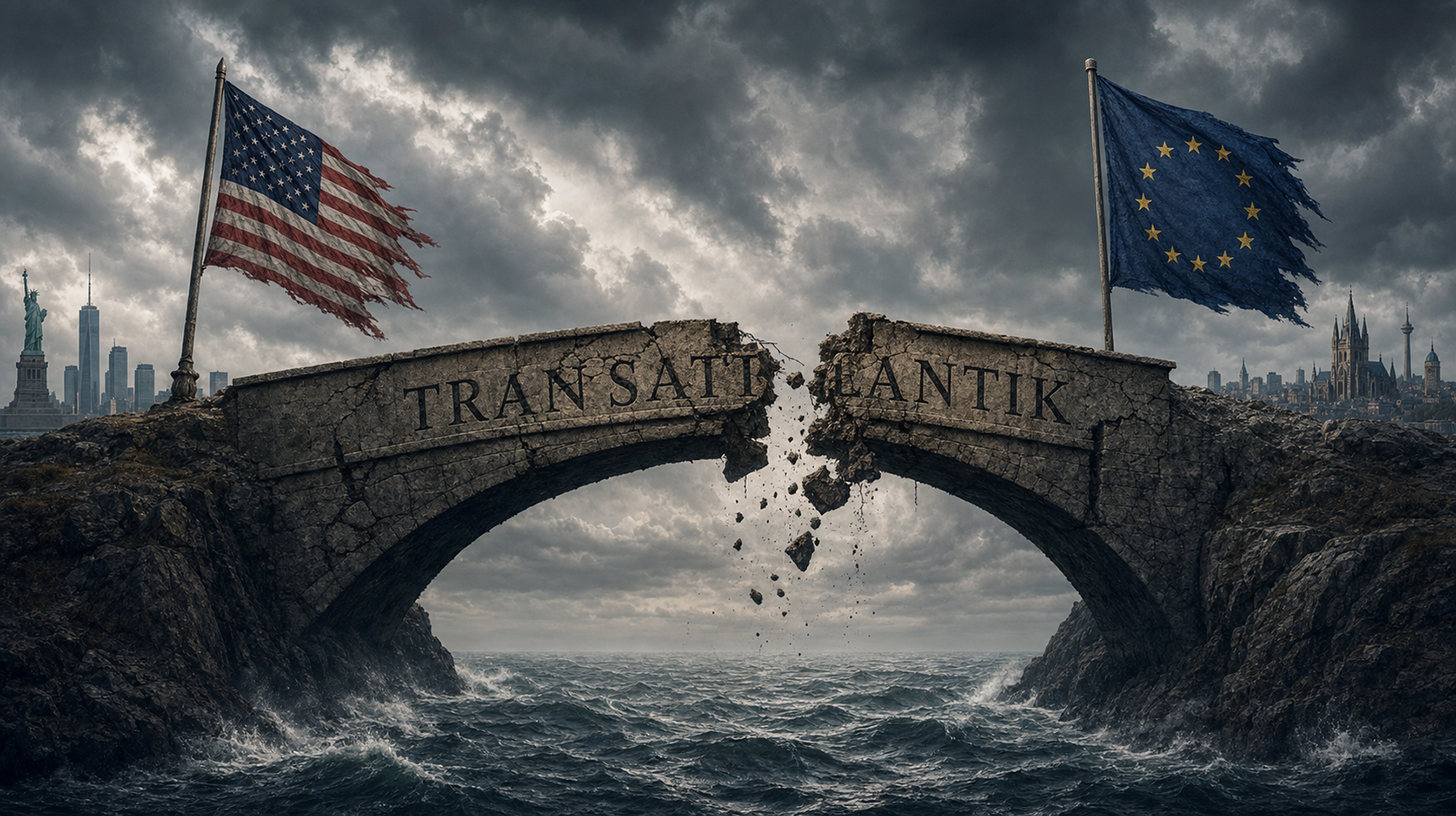
The end of the transatlantic illusion: How America used Europe for decades – Image: Xpert.Digital
Not a partner, but a hegemon — it's time to speak the truth
Blackmail, tariffs, troop withdrawal: Why Europe's break with the US is now inevitable
After the Trump and Merz scandal: Germany is now paying the price for its foreign policy naiveté
For decades, the transatlantic friendship was considered the unshakable foundation of German and European security policy – but this narrative is increasingly proving to be a convenient illusion. At the latest with the massive geopolitical and economic upheavals under US President Donald Trump, Washington has shown its true colors: Europe is not an equal partner, but a strategic resource unconditionally subordinated to American power interests. From arbitrary troop withdrawals and extortionate tariffs on German cars to the instrumentalization of allies in the Ukraine war – the US is acting as a hegemon that demands loyalty but no longer offers reliable protection. Faced with dwindling export surpluses and massive technological and military dependence, Germany stands at a historic turning point. The painful but inevitable break with American hegemony could be the urgently needed impetus to finally build genuine strategic autonomy. It is time to acknowledge this bitter reality and set the course for a sovereign Europe.
Related to this:

From protective gesture to war buffer
For decades, the relationship between the United States and the Federal Republic of Germany was considered the foundation of the Western community of values. Politicians of all stripes invoked the transatlantic friendship, institutions like the Atlantik-Brücke e. V. fostered dialogue between the elites of both countries, and NATO was portrayed as the symbol of a common security architecture based on mutual trust and shared values. This narrative was always convenient—and it was always a half-truth.
A dispassionate analysis of the geometry of American security policy during the Cold War leads to a sobering conclusion: Germany and Western Europe were primarily strategic buffer zones, not allies in need of protection. The logic of NATO's defense concept stipulated that, in the event of a conflict, it would be fought on European soil, while the American continent remained out of reach. US military bases in Germany—most recently housing around 38,000 soldiers spread across Rhineland-Palatinate, Bavaria, Hesse, and Baden-Württemberg—served primarily as outposts of American power projection, not as an altruistic protective shield for German civilians. Ramstein Air Base handled US military operations in Afghanistan and Iraq, while the headquarters in Stuttgart coordinated American forces in Europe and Africa. Germany was not a protected territory—it was a preferred theater of operations.
The network of consent
That this reality could be suppressed for so long had an institutional reason: the systematic cultivation of transatlantic elite networks. The Atlantik-Brücke e. V., founded in 1952 and today supported by representatives of all established political parties, the business community, and labor unions, functioned, according to historian Anne Zetsche, as a central hinge connecting diverse social groups to the transatlantic consensus. Its function was less about cultivating friendships than about structurally shaping public opinion: it blurred the lines between public and private interests, thereby creating an environment in which the self-evident nature of Germany's Western orientation appeared as a quasi-natural fact. The result was a foreign policy culture in which Germany's membership in NATO and its close ties to the USA were hardly ever seriously questioned—apart from Germany's rejection of the Iraq War in 2003, which proved the exception.
This structure was not neutral. It created a systematic bias in favor of American interests and made it difficult to identify the true asymmetry of the relationship. Anyone who criticized Germany's alignment with the West was considered naive, left-wing radical, or dangerous. Yet an unbiased look at American foreign policy over the past decades—from Vietnam to Nicaragua to Iraq—would have long since revealed a country whose geopolitical actions are primarily driven by national power interests, not universal values.
The Ukraine debacle as a reflection of reality
Few events in recent history have revealed the nature of American alliance policy more ruthlessly than the US's handling of Ukraine since 2022. For years, the United States strategically built up Ukraine, supplied it with weapons, encouraged its NATO membership, and thereby systematically provoked Russia—a strategy that even critical American security experts describe as a global strategic error. As the war escalated, Ukraine became a proxy for American geopolitical interests: it fought and died while Washington supplied weapons but risked no soldiers of its own. When Trump returned to the White House, even the arms aid was temporarily suspended, and the rhetoric shifted abruptly from solidarity to a willingness to negotiate at the expense of Ukrainian territory.
What this behavior reveals is structural, not personal: The US acts as a geostrategic actor that instrumentalizes allies as long as it serves its purpose and abandons them as soon as the strategic calculations change. The Ukraine experience is not an isolated incident in this sense, but rather a particularly visible pattern of a foreign policy that has consistently operated according to the principle of national interest for decades. This realization should serve as a lesson for Germany and Europe—one that, however, is only now slowly being internalized under the pressure of Trump's brutally open policies.
Withdrawal of soldiers as a political tool
Recent events in the spring of 2026 have taken the erosion of transatlantic relations to a new level. Following the public falling-out between US President Donald Trump and German Chancellor Friedrich Merz over the Iran-Iraq War, US Defense Secretary Pete Hegseth ordered the withdrawal of approximately 5,000 US troops from Germany—with a six- to twelve-month implementation period. Just one day later, Trump doubled down, announcing that the number would be "far more than 5,000." The message was unmistakable: military presence is not an expression of solidarity, but a bargaining chip.
Even Republicans in the US Congress criticized the move—not out of solidarity with Germany, but because some lawmakers feared such a signal could increase Russia's willingness to escalate military action. The geopolitical debate in Washington thus revolves exclusively around American interests. Germany is not mentioned as an ally worthy of protection, but at best as a strategic location—and even this status appears to be up for debate. Trump conveniently omits the fact that parts of the US military are stationed in Germany because no other base in the world costs American taxpayers more and because it forms the basis for US operations from Africa to Central Asia.
A rift within their own camp: When Republicans turn against their president
What reveals the full extent of this decision is not just the European outrage—but the resistance from within Trump's own party. Just one day after the Pentagon announcement, Senator Roger Wicker of Mississippi and Representative Mike Rogers of Alabama—chairmen of the Senate and House Armed Services Committees, respectively, and thus two of the most influential Republican security policy experts in the country—released a joint statement openly confronting their president. "We are deeply concerned about the decision to withdraw a U.S. brigade from Germany," they stated unequivocally. Germany had responded to Trump's demands for increased defense spending, and U.S. forces were receiving seamless access to German bases for ongoing operations—thus fulfilling Germany's alliance obligations.
Wicker and Rogers further warned that any significant change to the US troop presence in Europe would have to be coordinated with Congress and allies—an indirect but clear rebuke to the president, who had made the decision unilaterally and without consultation. Their central argument was strategic: A premature withdrawal would undermine NATO's deterrence capabilities and send the wrong signal to Vladimir Putin, whose full-scale invasion of Ukraine was now entering its fifth year. The fact that Trump was simultaneously considering canceling the planned deployment of Tomahawk cruise missiles in Germany—an agreement reached under Biden and Scholz—further heightened these concerns.
This internal party revolt is no accidental slip-up. It reflects a deep rift within American security policy between those who see the US's global leadership role as a core American interest and a president who treats international commitments as bothersome expenses. For Germany and Europe, this division has a twofold significance: First, it shows that Trump's course need not be the final word on American foreign policy—and second, it demonstrates how fragile and dependent on personalities the alliance framework, once lauded as stable, actually is. A security partnership that can be frozen with a tweet doesn't deserve the name.
Our global industry and economic expertise in business development, sales and marketing

Our global industry and economic expertise in business development, sales and marketing - Image: Xpert.Digital
Industry focus areas: B2B, digitalization (from AI to XR), mechanical engineering, logistics, renewable energies and industry
More information here:
A thematic hub offering insights and expertise:
- Knowledge platform covering global and regional economies, innovation and industry-specific trends
- A collection of analyses, insights, and background information from our key areas of focus
- A place for expertise and information on current developments in business and technology
- A hub for companies seeking information on markets, digitalization, and industry innovations
Between dependence and new beginnings: How Europe can gain its economic sovereignty
Tariffs as a weapon: The betrayal of the trade agreement
Parallel to the military withdrawal, Trump escalated the trade confrontation with Europe in a new way. Just in August 2025, Trump and EU Commission President Ursula von der Leyen had agreed in a framework agreement on a 15 percent tariff on most EU goods imports into the US—explicitly including cars and car parts. In return, the EU committed to eliminating tariffs on US industrial goods and facilitating market access for American agricultural products. It was a painstakingly negotiated balance that both sides could have used as a basis for a stable trading relationship.
Nearly nine months later, Trump announced on his platform TruthSocial that he would raise tariffs on European cars and trucks to 25 percent starting the following week, claiming the EU had violated the existing agreement. He did not specify what this alleged breach of contract entailed. This is no longer trade policy—it is political blackmail using economic means. For the German automotive industry, which already suffered a 17.5 percent decline in exports of motor vehicles and motor vehicle parts to the US in 2025, another tariff increase represents a further structural burden that jeopardizes thousands of jobs.
Related to this:

Germany's economic vulnerability
The figures are sobering. From January to November 2025, Germany exported goods worth approximately €135.8 billion to the United States—a decline of 9.4 percent compared to the same period of the previous year. The German trade surplus with the US fell to €48.9 billion, the lowest figure since the pandemic year of 2021. Germany Trade & Invest anticipates a decline of eight to nine percent in German exports to the US for the full year 2025 and a further decrease of around five percent in 2026. Despite these declines, the US remained the country with which Germany achieved the highest global trade surplus in the first eleven months of 2025—highlighting the structural dependency, even if it is gradually diminishing.
The German economy as a whole is in a fragile phase. After two years of recession, the Bundesbank forecasts growth of just 0.6 percent for 2026, while the DIW Berlin is slightly more optimistic at 1.3 percent—however, two-thirds of this upswing is based on debt-financed government spending, particularly on defense and infrastructure. The German government plans to spend over €108 billion on defense alone in 2026. Germany is rearming—and thus indirectly paying for a defense that, after decades, it now has to prove to itself that it can function without American assistance.
Related to this:

What “America First” really means
Trump's new national security strategy, published at the end of 2025, provides the ideological framework for this policy. Europe is described as a continent in economic decline, suffering from "civilizational annihilation." Previous security strategies, it claims, neglected core US national interests and offloaded the defense of other countries onto American taxpayers. The document makes it unequivocally clear: the US pursues exclusively national interests, and European allies are evaluated based on their usefulness to this goal. Those who meet American expectations, like Israel, Poland, or the Baltic states, receive "special favor"—those who fail to catch up lose protection.
This logic is not new—it is simply now articulated quite openly. What was previously hidden behind diplomatic formulas and institutional networks, Trump now states openly. This is at least more honest than the hypocrisy of previous administrations, who bought European loyalty with promises of perpetual solidarity while waging wars in Afghanistan, Iraq, and Syria that plunged Europe into refugee crises. European reactions to Trump's strategy oscillated between indignant rejection and obsequious appeasement—EU High Representative Kaja Kallas emphasized that the US was "still our greatest ally." This knee-jerk de-escalation itself reveals a problem: Europe's inability to respond from a position of strength.
Strategic autonomy: Wishful thinking or necessity?
The German Institute for International and Security Affairs (SWP) concluded in its analysis: "In no other area is Europe's dependence on the US as pronounced and one-sided as in defense." This dependence extends far beyond the military: Europe lags structurally behind the US in critical technologies such as semiconductors, artificial intelligence, and cloud computing, creating economic and security risks. The Draghi report estimates that Europe needs an additional 750 to 800 billion euros in annual investment to close this gap.
The concept of "strategic autonomy" has been circulating in Brussels for years without any substantial political action following it. The sobering assessment of the think tank "Der Pragmaticus" at the end of 2025 was: "In reality, Europe in 2025 is more strategically dependent on Washington than ever before." This diagnosis is brutal, but accurate. Decades of neglecting its own defense industry, fragmented European procurement markets, a lack of common command structures, and the political unwillingness to genuine sovereignty transfers at the European level have created a situation in which Europe's declaration of independence from Washington is more of a pious hope than a realistic possibility.
The path to independence: Painful, but inevitable
The withdrawal of American troops, the termination of trade agreements, and the verbal humiliations by the Trump administration are painful—but paradoxically, they could be the impetus Europe needed. Anyone dependent on a patron who despises them has only one rationally justified response: to build their own capacity for action. In the long run, this entails considerable costs. It means a European defense union with common structures that extend beyond NATO. It means diversifying trade relations, building technological independence, and strengthening the European single market as the foundation of economic resilience. It also means recalibrating strategic relationships with other world powers—without reproducing naive dependencies.
Germany bears a special responsibility in this regard and simultaneously faces a historic opportunity. With the special fund of over €500 billion and the massively increased defense budgets, the German government has taken a first step—but this step remains reactive and short-sighted as long as it is not accompanied by a coherent strategy for European sovereignty. Building up its own capabilities will take years, if not decades, and will leave economic scars. However, the alternative—continued dependence on a hegemon that now openly expresses its contempt for its allies—is no longer a politically or morally justifiable option.
The transatlantic illusion didn't just shatter today. It was never as stable as it seemed. What's happening now is simply that the facade is crumbling—and that Europe is forced to face the unvarnished truth. That's uncomfortable. But it's also a liberation.
Your global marketing and business development partner
☑️ Our business language is English or German
☑️ NEW: Correspondence in your native language!

Konrad Wolfenstein
I and my team are happy to be available to you as your personal advisor.
You can contact me by filling out the contact form here simply call me at +49 7348 4088 965. My email address is [email protected]:or
I'm looking forward to our joint project.
☑️ SME support in strategy, consulting, planning and implementation
☑️ Creation or realignment of the digital strategy and digitization
☑️ Expansion and optimization of international sales processes
☑️ Global & Digital B2B trading platforms
☑️ Pioneer Business Development / Marketing / PR / Trade Fairs
🎯🎯🎯 Data-driven B2B industry hub as a quasi-in-house solution

The quasi-in-house solution: How Xpert.Digital closes operational gaps in B2B marketing and sales – Smart Content-Driven Business - Image: Xpert.Digital
Xpert.Digital is a data-driven B2B industry hub led by Konrad Wolfenstein . The company acts as an external, quasi-in-house solution for industrial partners, closing operational gaps in marketing, content, and sales – without requiring additional resources on the client side.
More information here:










