
Europe faces unexpected benefits from Trump
Xpert pre-release

Available in 27 languages 📢
Prefer Xpert.Digital on GoogleⓘPublished on: August 7, 2025 / Updated on: August 7, 2025 – Author: Konrad Wolfenstein
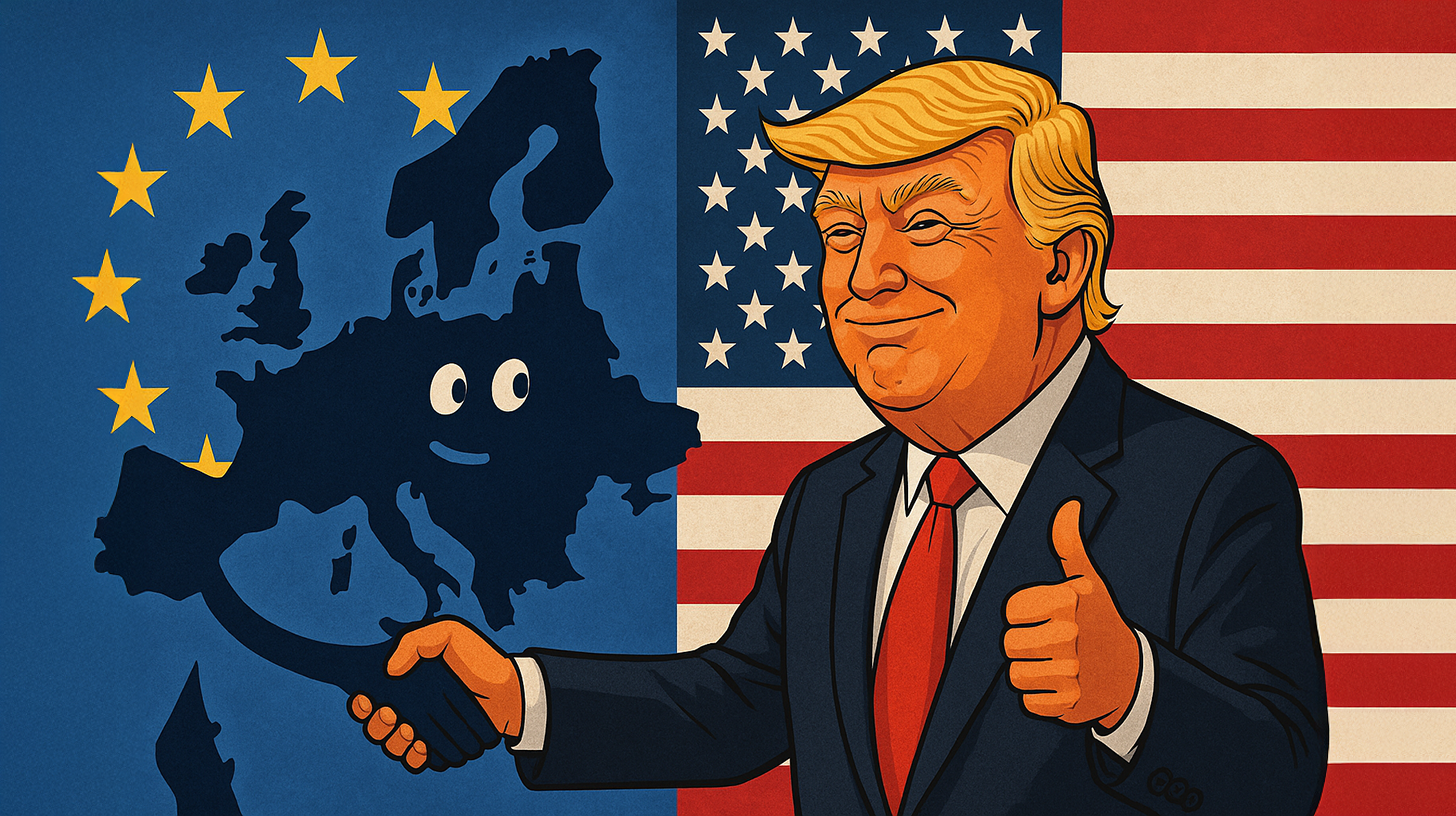
Europe faces unexpected benefits from Trump – Image: Xpert.Digital
What is the current status of the EU-US trade agreement?
EU-US trade redefined: The impact of the 15 percent tariff
The European Union and the United States reached a trade agreement on July 27, 2025. The agreement was reached between EU Commission President Ursula von der Leyen and US President Donald Trump at the latter's golf resort in Turnberry, Scotland. The new deal stipulates that the US will impose a base tariff of 15 percent on most EU imports, a significant change from the previously applicable tariff rates.
The agreement came after months of tension and uncertainty. Trump had previously threatened tariffs of up to 30 percent if no agreement was reached. The now agreed-upon rate of 15 percent is significantly lower than this threat, but still represents a significant increase compared to historical tariff rates, which averaged only 1 percent before Trump's second term.
Suitable for:

What specific customs arrangements were agreed?
The core of the agreement is a uniform tariff rate of 15 percent, which will be applied to the majority of EU exports to the US. This rate applies to several key sectors, including automobiles and auto parts, semiconductors, and pharmaceutical products. The EU Commission emphasizes that this is an "all-inclusive" rate, a ceiling, and cannot be combined with other tariffs.
However, there are important exceptions to this base tariff rate. Steel and aluminum remain subject to a 50 percent tariff, although the exact details of a potential quota system are still being negotiated. On the other hand, a full tariff exemption has been agreed for certain product categories. These include aircraft and aircraft parts, certain chemicals, selected agricultural products, some generic pharmaceuticals, semiconductor equipment, and critical raw materials.
How does the deal affect the German automotive industry?
The German automotive industry is particularly affected by the new tariff regulations, but is experiencing mixed reactions. While the agreed tariff rate of 15 percent is lower than the previously applicable 27.5 percent (25 percent special tariff plus 2.5 percent basic tariff), it still represents a sixfold increase compared to the historic 2.5 percent before Trump's term.
Hildegard Müller, President of the German Association of the Automotive Industry (VDA), expressed relief at the agreement, but emphasized that the tariff rate would cost companies billions annually. Mercedes-Benz welcomed the agreement as "urgently needed relief," while Audi stated that the tariffs had already cost the company €600 million in the first half of 2025 alone.
Interestingly, German premium manufacturers such as BMW and Mercedes-Benz, which already have large production facilities in the US, could benefit from the new regulation. In return, the EU will lower its tariffs on US car imports, meaning that German SUVs produced in the US can be exported to Europe at lower prices.
Why is it claimed that Europe profits on “secondary battlefields”?
Despite the obvious disadvantages of higher tariffs, there are areas where Europe could benefit from the deal. The full tariff exemption for aircraft and aircraft parts is particularly significant for the European aviation industry, especially Airbus. The exemptions for certain chemicals, agricultural products, and critical raw materials could also provide competitive advantages for European exporters in these sectors.
The agreement also creates a degree of planning security for European companies. After months of uncertainty about potential tariffs of up to 30 percent, the deal now provides a clear basis for business decisions. Some experts argue that by waiving retaliatory tariffs, the EU is protecting its consumers from higher prices that would have resulted from an escalating trade war.
To what extent could the deal trigger a reform process in the EU?
The trade deal with the US could indeed serve as a catalyst for necessary reforms in the EU. The confrontation with Trump's aggressive trade policy has exposed the weaknesses of Europe's position and could now strengthen the political will for fundamental change.
The deal clearly demonstrates that the EU, in its current form, lacks the necessary negotiating power to negotiate with the US on an equal footing. This could increase pressure to advance European integration in areas such as defense, digitalization, and energy independence. The commitments to energy imports and investment contained in the deal could, paradoxically, generate the funds needed for these reforms.
The experience with Trump could also intensify the discussion about European strategic autonomy. EU member states could recognize that they need to reduce their dependence on individual trading partners and strengthen their own industrial base.
How will Trump unintentionally push the EU through the deal?
Trump's aggressive trade policy is serving as an inadvertent wake-up call for the EU. The threat of high tariffs and the unilateral demands have highlighted the need for a stronger and more unified European position. This could trigger several positive developments.
First, external pressure could help overcome internal differences within the EU. The shared threat of US tariffs could prompt member states to put their national interests aside in favor of a common European position. Second, the experience could motivate the EU to strengthen its own economic power and become less dependent on exports to the US.
The agreed LNG imports from the US, although costly in the short term, could reduce energy costs for German industry in the long term while simultaneously reducing dependence on Russian gas. This would strengthen Europe's energy sovereignty.
Why does Trump have a valid point with his tariffs?
From the American perspective, the trade deficit with the EU is indeed a legitimate concern. In 2024, the EU recorded a trade surplus of approximately €50 billion in goods trade with the US, which the US perceives as an unfair trade relationship.
The problem is complex because, while the US has a deficit in goods trade, it has a significant surplus in services trade, particularly in digital services. However, the US argues that goods trade is more important for creating manufacturing jobs.
The German economy's high dependence on exports makes it particularly vulnerable to protectionist measures. Trump is exploiting this weakness to exert pressure on the EU and achieve better conditions for American companies.
Suitable for:

What role do digital services play in the trade deficit?
A crucial aspect that was largely ignored in the negotiations is the US's massive surplus in digital services. In 2023, the EU's deficit with the US in digital services amounted to approximately €110 billion. US tech giants such as Google, Meta, Amazon, and Microsoft generate billions in profits in Europe every year.
These digital services include cloud services, streaming services, digital advertising, and platform businesses. Large US technology companies pay minimal taxes in Europe – on average less than 10 percent of their profits, while other companies pay around 23 percent.
Many economists and politicians criticize the EU for failing to use this important negotiating leverage. A digital tax or stricter market access rules for US corporations could have been effective leverage in the negotiations. Instead, the discussion focused almost exclusively on traditional trade in goods.
Why were the tech giants not addressed in the negotiations?
The exclusion of digital services from the trade talks was apparently a deliberate strategic decision. The Trump administration deliberately focused its arguments on the deficit in goods trade, ignoring the significant surplus in the services sector. This allowed Trump to paint a distorted picture of the trade relationship.
The EU under Ursula von der Leyen failed to bring this imbalance into the negotiations. Possible reasons for this could be fear of further escalation or pressure from individual member states such as Ireland and Luxembourg, which benefit from low tax rates for tech companies.
The missed opportunity to use a digital tax as a bargaining chip is viewed by many as a strategic mistake. Such a tax would not only have generated additional revenue for the EU but also strengthened its negotiating position with the US.
Suitable for:

🎯🎯🎯 Benefit from Xpert.Digital's extensive, fivefold expertise in a comprehensive service package | R&D, XR, PR & SEM

AI & XR-3D-Rendering Machine: five times expertise from Xpert.digital in a comprehensive service package, R&D XR, Pr & SEM – Image: Xpert.digital
Xpert.Digital has in-depth knowledge of various industries. This allows us to develop tailor-made strategies that are tailored precisely to the requirements and challenges of your specific market segment. By continually analyzing market trends and following industry developments, we can act with foresight and offer innovative solutions. Through the combination of experience and knowledge, we generate added value and give our customers a decisive competitive advantage.
More about it here:
Europe's strategy in the trade conflict: Winners or losers of the Trump era?
What is the actual situation of the German automotive industry?
Contrary to some fears, the situation of the German auto industry must be viewed in a differentiated manner. While the higher tariffs undoubtedly represent a burden, German manufacturers have already built up significant production capacity in the US. In 2023, German manufacturers produced more than 844,000 vehicles in the US, about half of which were exported.
The reduction of EU tariffs on US car imports could even open up new business opportunities. German manufacturers could use their US production for exports to Europe and thus benefit from the lower tariffs. However, this could come at the expense of German locations, as production in the US becomes more attractive.
The varying degrees of impact are also evident among manufacturers. While BMW and Mercedes-Benz, with their large US plants, can respond more flexibly, Volkswagen Group brands such as Audi and Porsche, which primarily produce in Europe, are more severely affected by the tariffs.
Who ultimately bears the cost of tariffs?
The economic reality is that tariffs are ultimately borne by consumers. If European products are subject to a 15 percent tariff in the US, importers have two options: They can bear the costs themselves and reduce their profit margins, or they can pass the costs on to American consumers.
Calculations by Yale University's Budget Lab show that current US tariffs could lead to a price increase of 1.8 percent, equivalent to an average income loss of $2,400 per American household. The irony is that Trump's policies to strengthen the American economy ultimately burden its own citizens.
For the U.S. government, however, the additional tariff revenue could help reduce the budget deficit. This partly explains Trump's motivation, as tariffs provide a source of revenue without having to raise direct taxes.
Did von der Leyen really negotiate so badly?
The assessment of Ursula von der Leyen's negotiating skills is mixed. Critics accuse her of making too many concessions, particularly regarding the commitments for energy imports and investments totaling $1.35 trillion over three years. The fact that Trump calls it a "gift" from the EU reinforces this impression.
On the other hand, one must consider the initial situation. Trump had threatened tariffs of up to 30 percent, and the EU was in a weak negotiating position. Internal differences among member states and dependence on the US market significantly limited the room for negotiation.
From a pragmatic perspective, one could argue that von der Leyen made the best of a bad situation. The agreement prevents a further escalation of the trade conflict and creates at least temporary planning certainty for European companies.
Why do some see Europe as the big winner of the Trump era?
This optimistic assessment is based on several considerations. First, external pressure from Trump could accelerate long-overdue reforms in the EU. The confrontation with the US could force Europe to improve its own competitiveness and become more independent.
Second, the agreed energy imports from the US could, paradoxically, strengthen Europe's energy security. Diversifying energy sources away from Russia is a strategic goal of the EU, and LNG imports from the US could help with this, even if they are expensive in the short term.
Third, the experience with Trump could strengthen European unity. Historically, a shared external threat has often led to greater integration. If the EU emerges from this crisis stronger and overcomes its structural weaknesses, it could actually benefit in the long run.
Suitable for:

What are the long-term implications of the deal?
The long-term consequences of the trade deal are still difficult to assess. On the one hand, it could lead to a realignment of global trade flows. European companies could increasingly seek alternative markets and reduce their dependence on the US. This could intensify trade relations with Asia, Africa, and Latin America.
On the other hand, the deal could put transatlantic economic relations on a new footing. The enforced proximity through energy imports and investments could paradoxically lead to closer integration, even if this occurs under unequal conditions.
The greatest uncertainty is whether the deal will even stand. Trump has already indicated that he could increase tariffs to 35 percent if the EU fails to keep its investment commitments. The fact that the $600 billion involves letters of intent from private companies, which the EU Commission cannot guarantee, makes the agreement particularly fragile.
How are other economic actors reacting to the deal?
The business community's reactions have been largely muted. While the immediate relief from avoiding 30 percent tariffs is palpable, concerns about the long-term effects outweigh this. The Federal Association of Wholesale, Foreign Trade and Services warns against exaggerating expectations of falling prices.
The financial markets initially reacted positively. Shares of European automakers rose by as much as three percent at the start of trading. However, this short-term relief does not necessarily reflect the long-term challenges facing the companies.
Politicians from various parties were particularly critical. SPD parliamentary group vice-chairman Armand Zorn sees the agreement as a positive signal: no further escalation. However, he warns that the agreement serves as a reminder of the need to advance strategic autonomy at the European level.
What does the deal mean for the future of the EU?
The trade deal with the US marks a turning point for the European Union. It bluntly exposes the EU's weaknesses in a world increasingly characterized by great power rivalries. The inability to negotiate with the US on equal terms demonstrates that the EU must deepen its economic and political integration.
At the same time, the deal could serve as a catalyst for necessary reforms. The experience of its own weakness could strengthen the political will to advance Europe's strategic autonomy in areas such as defense, technology, and energy. The EU faces a choice: either it uses this crisis as an opportunity for fundamental reforms or it risks being crushed between the superpowers of the US and China.
The real test will be whether the EU learns from this experience and takes the necessary steps to act as an equal partner in the future. The deal with Trump could, in retrospect, be seen either as the moment when Europe recognized and overcame its weakness, or as the beginning of a slow decline as a global economic player.
Your global marketing and business development partner
☑️ Our business language is English or German
☑️ NEW: Correspondence in your national language!

Konrad Wolfenstein
I would be happy to serve you and my team as a personal advisor.
You can contact me by filling out the contact form or simply call me on +49 7348 4088 965 (Munich) . My email address is: wolfenstein ∂ xpert.digital
I'm looking forward to our joint project.











