
The Fairness Fallacy: Why Europe and China are completely talking past each other in the trade war
Xpert Pre-Release

Available in 27 languages 📢
Prefer Xpert.Digital on GoogleⓘPublished on: July 5, 2026 / Updated on: July 5, 2026 – Author: Konrad Wolfenstein
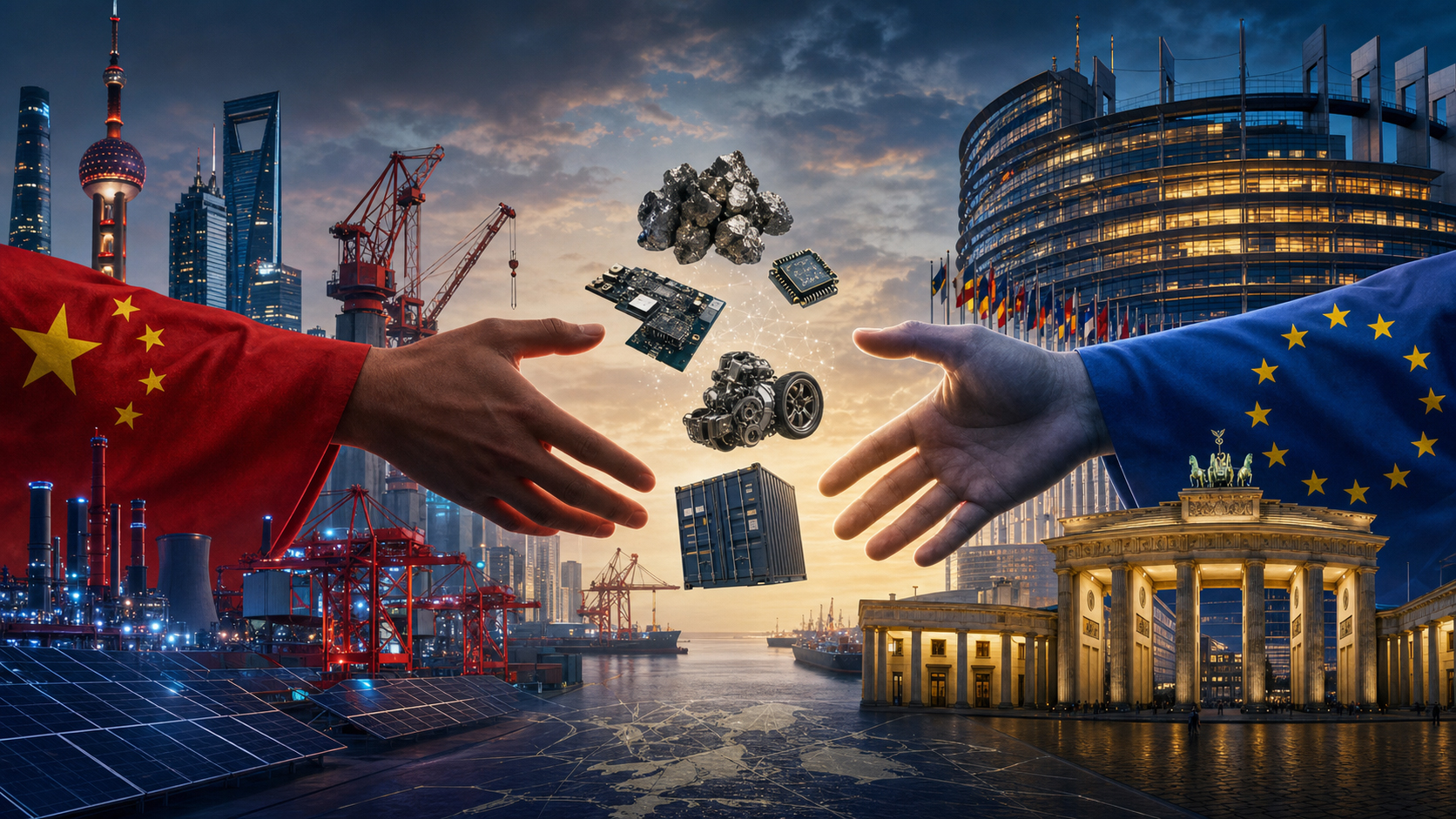
The Fairness Fallacy: Why Europe and China are completely talking past each other in the trade war – Image: Xpert.Digital
The air conditioning boom reveals the dilemma: Europe's fatal dependence on China
Caught between the fronts: Why China is pinning its hopes on Germany in the trade dispute
One word, two incompatible worlds: When Europe and China negotiate fair trade today, they view reality through completely different lenses.
While the European Union, faced with an escalating trade deficit of €360 billion and artificially cheapened imports, shields its own markets with protective tariffs, Beijing suspects unfair protectionism. For China, its massive export success in electric cars, solar panels, and air conditioners is the logical result of superior efficiency and a smart, long-term industrial policy. For Europe, however, it is the epitome of unfair distortion of competition through billions in state subsidies. The dispute over market share, export controls on rare earth elements, and the fear for Europe's strategic independence has long since become more than just an economic dispute. It reveals a deep systemic rift between free market economies and state-directed capitalism. This is an in-depth analysis of why both sides are firmly convinced they are in the right—and why Germany plays a highly complex and key role in this conflict.
China urges fairness – Europe demands reciprocity
Two worldviews clash: Who decides what is fair in global trade?
When the spokesman for the Chinese Ministry of Commerce, He Yadong, declares in Beijing that Germany and China should support free trade, expand mutual market access, and create a fair, open, and non-discriminatory business climate, it sounds at first glance like a commitment to the same values that Western trade policy has been promoting for decades. And yet, this very statement elicits frowns and, at times, outright incomprehension in Brussels and Berlin. How can the same word—fairness—be demanded by two sides simultaneously, even though both sides perceive the situation fundamentally differently? The answer lies not in the question of who is right. It lies in the differing historical experiences, systemic logics, and geopolitical self-conceptions from which each side derives its position.
The meeting that makes a conflict visible
At the end of June 2026, Brussels welcomed Chinese Commerce Minister Wang Wentao to a meeting whose symbolism could hardly have been more powerful. On one side sat EU Trade Commissioner Maroš Šefčovič with a list of specific complaints: a trade deficit of €360 billion in 2025—averaging one billion euros per day—and a European loss of market share in China that is accelerating across several sectors. On the other side stood Wang, who had recently spoken with German Federal Minister for Economic Affairs Katherina Reiche and now unequivocally articulated China's position: Beijing hopes for an active role from Germany in the EU to persuade Brussels to adopt a rational stance on trade policy.
The topics were clearly defined: China's export controls on rare earth elements and magnets made from them, which have been impacting the supply chains of European industrial companies since April 2025, were on the agenda, as were the looming European tariffs on Chinese imports. Wang assured Šefčovič that the existing export controls would not affect EU supply chains—however, the specifics of this assurance remained unclear. Both sides agreed to begin new trade and investment consultations and to re-establish a bilateral committee that had been dormant for years.
It is precisely at this diplomatic moment that two perspectives clash, both of which can be understood as expressions of a profound economic and political self-understanding. Neither the Chinese nor the European perspective arises in a vacuum. Both have their history, their logic, and their blind spots.
The Chinese Fairness Narrative: Catch-up Right and Systemic Logic
From starvation wages to world power: Why China considers its path legitimate
To understand the Chinese perspective, one must go back more than half a century. China did not enter the global market as an established industrial nation with its privileges to defend, but as a country that had endured decades of isolation, internal upheaval, and economic backwardness. When Deng Xiaoping initiated the gradual opening-up process in 1978 and China joined the World Trade Organization in 2001, the People's Republic was still far from the industrial weight it possesses today. Western trade policy at the time opened up to China in the expectation that economic integration would eventually lead to political liberalization—an assumption that would prove false, but one that significantly facilitated China's entry into global free trade.
From Beijing's perspective, China has done precisely what the global free trade framework allowed: it has invested massively in education, infrastructure, and industrial capacity. It has used state intervention not as an exception, but as a fundamental principle of economic organization. And over decades, it has built up manufacturing capacities that today represent global market leadership in sectors such as solar energy, battery technology, electric vehicles, and shipbuilding. Beijing does not fundamentally deny that state support played a significant role in this. What China disputes is the assessment that this is inherently unfair. The comparison is obvious: European countries, too, have supported their industries with subsidies for decades. The US also supports its chip industry with the CHIPS Act and renewable energies with the Inflation Reduction Act, with hundreds of billions of dollars. Why is state industrial policy considered legitimate in Washington and Berlin, but distorting competition in Beijing?
The trade balance is an expression of competitiveness, not of systemic failure
The Chinese Ministry of Commerce has repeatedly responded to EU criticism of its export surpluses with an argument that, analytically speaking, has some merit: Chinese exports are growing because Chinese companies simply deliver better products at lower prices. This may sound provocative, but it contains an uncomfortable truth for European industry associations. Particularly in the photovoltaic sector, where Chinese manufacturers have reduced unit costs by more than 90 percent within just a few years, and in the electric vehicle sector, where BYD and other Chinese manufacturers have caught up technologically and undercut prices, the question is justified as to how much of the European unease actually stems from unfair practices and how much simply from a lack of competitiveness.
From a Chinese perspective, the European trade deficit is not a symptom of a politically distorted system, but rather the result of comparative advantages—China produces certain goods more efficiently and cheaply than Europe, and European consumers choose these products. This, they argue, is the essence of free trade. The call for fairness, therefore, is directed, from Beijing's point of view, against what China perceives as a new form of protectionism: the use of trade defense instruments, anti-subsidy investigations, and additional tariffs as a means of keeping Chinese competitors out of European markets, even though these markets are officially considered open.
Rare earths as a strategic lever: reaction or escalation?
A particularly sensitive point in the current dispute is China's export controls on rare earth elements. Beijing originally introduced these measures in April 2025 against the backdrop of the escalating trade conflict with the US. From a Chinese perspective, this is a legitimate response to the use of trade weapons by Western sides: if the US and the EU use tariffs and sanctions to disadvantage Chinese companies, then China also has the right to use its natural resources strategically. Rare earth elements, in which China holds a globally dominant market position—almost 100 percent of European imports of these raw materials come from the People's Republic—are the most effective countermeasure that Beijing possesses.
The fact that only 19 out of 141 applications for export licenses for rare earths were approved is viewed internally by China as an exercise of sovereign control over its own raw materials—even though the European Parliament condemned this practice as weaponizing supply chains. Against this backdrop, Wang Wentao's assurance that existing controls would not affect EU supply chains is a tactical concession, not a fundamental shift in position. Beijing is calculating: as much relaxation as necessary to avoid European tariffs, but as much room for maneuver as possible for future negotiations.
Germany's special role: Beijing's preferred interlocutor in Europe
China's explicit hope that Germany will play an active role in the EU in pursuing a rational trade policy is no coincidence. Germany is considered by Beijing to be the most pragmatic and closely intertwined major EU member state with China. Bilateral trade volume exceeds €250 billion annually. Companies such as Volkswagen, BASF, Siemens, and BMW maintain extensive production and distribution networks in China and depend on market access. Berlin has therefore traditionally played a mediating role in EU-China disputes and has often been more restrained in imposing punitive tariffs than France or other EU members.
China derives its expectations from this dependency structure: Germany, so the calculation goes, has tangible self-interests that prevent it from fully following Brussels' lead in escalating measures. When Economics Minister Reiche demands reciprocity in Beijing but simultaneously emphasizes cooperation and economic committees, she sends a signal from the Chinese perspective that leaves room for maneuver—a signal that Beijing interprets as an invitation to exert further influence.
The European perspective: Structural asymmetries and a belated response
The trade deficit as a symptom, not as a cause
For Europe, the situation has become an increasingly urgent existential industrial policy issue in recent years. The trade deficit with China grew to €360 billion in 2025—a record high, having stood at €305 billion in 2024. For the first time, all 27 EU member states are experiencing a trade deficit with China. At the same time, the market share of European companies in China is shrinking: EU exports to China fell by 6.5 percent in 2025, while imports from China increased by 6.4 percent. Šefčovič called the deficit simply unacceptable.
The mere existence of a deficit is not in itself proof of unfairness—trade balances are not zero-sum games. European concern stems from more specific observations: the increase in imports increasingly encompasses not only labor-intensive goods, but also technologically advanced products—electric vehicles, solar panels, industrial robots, battery systems. Half of the EU's imports from China are now technology products. This is a fundamental shift. If Europe is no longer able to remain competitive in its own areas of strength, then it is no longer a question of structural change, but of a potential erosion of its industrial base.
The subsidy problem: When market prices are no longer market prices
The strongest empirical evidence supporting European criticism is found in OECD data on Chinese industrial subsidies. According to an OECD analysis published in May 2026, Chinese companies in 15 key industrial sectors received, on average, three to eight times more government support than their competitors in OECD countries between 2005 and 2024. In 2024 alone, government aid in these sectors amounted to $108 billion—the highest level since the global financial crisis. Photovoltaics, semiconductors, aluminum, steel, and shipbuilding received particularly strong support. The OECD also found that almost 60 percent of the global market share gains of Chinese companies can be attributed to this government assistance.
The resulting structural problem can be precisely described: If prices are not the result of productivity, wages, and capital costs, but are artificially lowered through government transfers, then they are no longer market signals. European companies that have to manage without comparable government support cannot compete at these prices—not because they have inferior engineers, but because they do not receive comparable cross-subsidization. From a European perspective, this is the core unfairness: Not the outcome of competition, but its preconditions are distorted.
To make matters worse, Chinese state-owned enterprises and state-influenced private companies in many sectors do not go bankrupt when they incur losses—local governments and state-owned banks keep them afloat, thus structurally preserving overcapacity. The EU Chamber of Commerce in China has explicitly addressed this phenomenon: Of the approximately 150,000 state-owned enterprises and around 140 car manufacturers in China, many would have to go bankrupt in a genuine market—but this does not happen because of local subsidies.
Overcapacities as a global deflationary problem
The problem of Chinese industrial overcapacity is not exclusively a European concern. It affects economies worldwide and has its own dynamics. When a sector produces more than domestic demand can absorb, the surplus is sold on foreign markets—often at prices below full cost. In the solar industry, module prices have fallen due to Chinese overcapacity to a level that has driven European manufacturers out of the market. The situation is similar in the steel sector: The EU has just tightened steel import quotas and raised the tariff on quantities exceeding the quota to 50 percent. China has long responded to this criticism by arguing that overcapacity is not a Chinese invention and that the market will regulate it in the long run. EU analyst Gabriel Wildau of the consultancy Teneo aptly put it: It is now clear that Beijing does not intend to unilaterally combat what Brussels considers rampant industrial overcapacity.
Market access as a one-way street
Closely linked to the issue of subsidies is the problem of market access. At the EU-China summit in Beijing in July 2025, EU Commission President Ursula von der Leyen pointed out that 14.5 percent of total Chinese exports go to the European Union, while conversely, only 8 percent of EU exports flow to China. This asymmetry is not accidental. European companies report structurally more difficult conditions in the Chinese market: requirements for joint ventures, opaque approval processes, discriminatory tendering practices in public procurement, technology transfer obligations, and regulatory uncertainties that systematically disadvantage foreign competitors. While Chinese car manufacturers and technology companies can—in principle—operate in Europe under the same conditions as European companies, the reciprocal rights for EU companies in China are limited.
Federal Economics Minister Reiche has declared reciprocity a guiding principle: comparable market access and competitive conditions for companies in both countries. This is not a protectionist demand, but a demand for symmetry—for the same rules of the game that China demands for its companies in European markets, but does not grant to European companies in its own market.
Our China expertise in business development, sales and marketing

Our China expertise in business development, sales and marketing - Image: Xpert.Digital
Industry focus areas: B2B, digitalization (from AI to XR), mechanical engineering, logistics, renewable energies and industry
More information here:
A thematic hub offering insights and expertise:
- Knowledge platform covering global and regional economies, innovation and industry-specific trends
- A collection of analyses, insights, and background information from our key areas of focus
- A place for expertise and information on current developments in business and technology
- A hub for companies seeking information on markets, digitalization, and industry innovations
How Chinese air conditioners are making Europe's trade policy sweat
The air conditioning episode: A metaphor for deeper dependencies
When heat waves explain trade policy
In the midst of Brussels trade negotiations, a historic heat wave hit Europe in the summer of 2026, driving demand for air conditioners to unprecedented levels. Sales figures from the Chinese company Midea illustrate the full extent of the problem: For its PortaSplit unit alone—a portable air conditioning system specifically designed to meet European building regulations—Midea reported orders for over 200,000 units by the beginning of July 2026, double the figure for the same period the previous year. A website created by a German developer, displaying real-time stock levels of Midea units in Germany, went viral on social media—and showed almost everywhere: sold out.
This moment is symbolic because it reveals the contradictions of the European position. Europe is calling for trade talks to reduce the deficit, while at the same time European consumers are buying Chinese products in droves—not because they are forced to, but because no European manufacturer offers a comparable product at a comparable price. None of the five best-selling air conditioner brands in Europe belongs to an EU company. The Chinese corporations Haier, Gree, and Midea together hold around 32 percent of the European market by unit volume.
Midea's PortaSplit is more than just a product—it's a textbook example of Chinese product development thinking: The outdoor unit is mounted with a window bracket, requires no drilling, and is classified as furniture under building regulations, thus circumventing facade alteration restrictions in cities like Paris. The refrigerant is dosed at 1.99 kilograms, just below the French two-kilogram limit—regulatory intelligence as a competitive advantage. This isn't government subsidization. This is innovation.
Dependence as a strategic vulnerability
When resource control becomes geopolitical
Since April 2025, China's export controls on rare earth elements have struck a nerve that runs deeper than any trade balance statistic. Rare earth elements are not exotic minerals on the fringes of industrial production—they are the very fabric of the energy transition. Permanent magnets made of neodymium and dysprosium are found in wind turbines, electric motors, and sensors. Without them, European electromobility would grind to a halt. The European Parliament, in a resolution adopted with 523 votes in favor, stated that China is weaponizing its supply chains. China, however, maintains that export controls are a standard instrument used by other countries as well, and that the measures are a response to escalating Western pressure.
According to the European Commission, the EU imports almost 100 percent of its rare earth elements from China. Of 141 applications for export licenses, only 19 were approved—an approval rate of approximately 13 percent. The fact that controls were initially suspended for one year following the US-China trade agreement of October 2025 has provided European industrial companies with a temporary respite, but it does not solve the fundamental problem: the strategic dependency remains. And China has made it clear that it is aware of this dependency and is prepared to exploit it if necessary.
The European Commission has therefore begun to accelerate the implementation of the regulation on critical raw materials and to promote diversification strategies—mining projects in Australia, Canada, and African countries are intended to create alternatives in the medium term. However, building alternative supply chains takes years, even decades. In the meantime, Europe remains vulnerable.
Euronews findings: Five key industries with no alternative
A report published in May 2026 highlighted the extent to which the EU is structurally dependent on China in five key sectors: solar energy, rare earth elements, industrial robots, battery technology, and telecommunications infrastructure. In these sectors, Chinese companies are either the main or sole suppliers. The fear of a new China shock—similar to the deindustrialization wave triggered by the opening of the Chinese market in Western countries from the 2000s onward—is no longer an abstract concern for European economic policymakers, but a pressing challenge of the present.
Half of the EU's imports from China are now technology products—ranging from automobiles to complex machinery. Denis Depoux, global managing director of the consultancy Roland Berger, described this as a reversal of past decades, one that is frightening for European industries and could become a systemic financial problem for the Union.
Why both perspectives arise: Systemic differences as a barrier to knowledge
Two economic models, two definitions of market
The crucial reason why China and Europe talk past each other on the word fairness lies in a fundamental difference in their economic systems and the resulting beliefs about what a market is and how it should function.
The European market economy—even in its socially mitigated version—is based on the principle that prices are determined by competition, that companies that consistently incur losses exit the market, and that government intervention is the exception, requiring justification. Subsidies are permitted, but limited and subject to rules. A company that sells below its own costs through government transfers violates this principle and harms competition among other market participants. When the EU speaks of fairness, it means: a level playing field, transparent rules, and no distortion through government transfers.
China, on the other hand, understands its economic system as a socialist-oriented market economy with Chinese characteristics—a formulation that goes beyond mere political rhetoric. The state is not an outsider intervening in markets from the outside, but rather an active shaper of economic development. Industrial policy is not a necessary exception, but the standard steering instrument. Long-term national development strategies such as "Made in China 2025" or the Fourteenth Five-Year Plan define which sectors capital should flow into, regardless of short-term market signals. From this perspective, state support is not a competitive advantage that needs correcting, but a legitimate instrument of national development policy.
These systemic differences create a kind of tunnel vision on both sides: Europe views Chinese industrial policy through the lens of its own principles and interprets deviations as rule violations. China views European tariffs through the lens of its own catch-up process and interprets restrictions as an attempt to hinder its development.
Historical mistrust as a constant undertone
Underlying the economic debate is a historical mistrust, fueled on both sides. China has not forgotten the experience of colonial interference, forced trade openings, and asymmetrical treaties in the 19th and early 20th centuries—the so-called centuries of humiliation are deeply ingrained in the collective memory of the Chinese leadership. When Western demands for market liberalization or systemic change arise, Beijing sometimes hears echoes of forced concessions. This makes any external pressure for reform particularly difficult to justify politically—even when it could be objectively justified on economic grounds.
Europe, in turn, carries with it the experience of a trade policy based on the trust that economic integration would have a politically stabilizing effect. The failure of this expectation—China's political system has not opened up as hoped, and the state's influence on the economy has increased rather than decreased—has left behind a sense of disappointment that now resonates in trade rhetoric. When Europe speaks of unfair competition, it is also speaking of a strategic calculation that has proven to be a mistake.
Between turning point and dependency trap: The strategic situation
There's no going back to naivety
China analyst Gabriel Wildau of the consultancy Teneo has succinctly captured the current mood among European heads of state and government: the sense of urgency in the face of the threat to European industry has reached a turning point. This is a significant diagnosis. It means that the era of unrestricted engagement with China—in the hope of mutual benefit without fundamental discussions about systemic differences—has come to an end. Brussels has already implemented this internally: EU Industry Commissioner Séjourné announced plans to extend trade defense measures to entire industrial sectors. From July 1, 2026, a flat tariff will apply to low-value online packages—a direct measure against platforms like Temu and Shein. Protective tariffs for plug-in hybrids are being considered.
At the same time, economic dependence remains a real issue. EU Commissioner von der Leyen spoke at the summit of a crossroads: for trade to remain mutually beneficial, it must become more balanced. This is a sobering assessment that does not mean withdrawing from trade with China, but demands a different quality of engagement.
The dilemma of Germany's mediating role
Germany finds itself in a particularly difficult structural position. China is Germany's most important trading partner, with a bilateral trade volume exceeding €250 billion annually. Corporations such as Volkswagen, BMW, BASF, and Siemens have linked significant portions of their value chains to the Chinese market and cannot, in their own self-interest, support an escalation of the trade conflict. At the same time, Berlin cannot permanently act as an obstacle to European protectionist policies without damaging its credibility as an EU partner.
Beijing's explicit hope for a mediating role from Germany in the EU is, given this situation, a strategically astute calculation: it addresses precisely the intersection of economic self-interest and European loyalty obligations in which Berlin operates. Reiche has attempted to reconcile both requirements: to enshrine reciprocity as a principle without abandoning the willingness to cooperate—a balancing act that is hardly sustainable politically if structural tensions continue to intensify.
The Kiel Institute: Between justified criticism and self-inflicted problems
In an analysis published in May 2026, the Kiel Institute for the World Economy posed a question that is often neglected in the European debate: How much of Europe's competitiveness problems is actually attributable to unfair Chinese practices—and how much is homegrown? High energy prices, excessive regulation, insufficient investment in research and development, sluggish digitalization, and demographic change are structural European problems that are brought to light by competition with China, but cannot be solved by protective tariffs alone. A trade policy that focuses exclusively on defense treats the symptom, not the disease.
This nuanced assessment does not alter the legitimacy of European countermeasures against proven distortions of competition. However, it does mitigate the political temptation to attribute all the economic difficulties of European industry solely to Chinese misconduct. Fairness, one might say, demands a self-critical examination on both sides.
Tangible Results by October 2026
Diplomatic timetable under pressure
Following the meeting between Wang and Šefčovič, both sides agreed on a roadmap: By October 2026, trade disputes, export controls, and market access issues should yield tangible results. Šefčovič stated that this would allow sufficient time for negotiators from both sides. A bilateral working group to monitor trade flows has been established. This sounds like progress, and indeed, the fact that a joint communiqué was issued at all—the first in several years—should be seen as a positive sign.
Whether substantial results will be available by October remains to be seen. Alicia García Herrero, chief economist at Natixis, described the Chinese concessions made so far as mere smoke and mirrors—a tactical gesture to deter Europe from further protective measures, without offering concrete import quotas or implementation mechanisms. Wildau's analysis, in turn, shows that the structural overcapacities cannot be eliminated without genuine political will from Beijing—and this will is not yet apparent.
Delayed reciprocity as a possible way out
Roland Berger expert Denis Depoux has introduced the concept of delayed reciprocity: Instead of short-term tit-for-tat negotiations, European and Chinese companies could merge or cooperate in the long term to compete together in global markets, rather than fighting for market share. This is a perspective that goes beyond the current logic of escalation—but it presupposes that both sides are willing to prioritize strategic interests over short-term negotiation gains.
The European Commission has clarified that broad, blanket import tariffs are not on the agenda—measures will be targeted at sectors where either serious damage to critical industries is threatened or where there is a significant risk of dependency that China could use as leverage. Rare earths, chemicals, automobiles, and heavy machinery are the identified priority areas.
The deficit problem cannot be solved in the short term. If a European heat wave sells hundreds of thousands of Chinese air conditioners within weeks because no European manufacturer can offer a competitive product, then this demonstrates the depth of the structural gap—and the limits of what is achievable with trade policy alone.
A rift that cannot be closed with appeals for fairness
The mutual accusations of unfairness in Sino-European trade are not a misunderstanding that can be resolved through better communication. They are the visible expression of two fundamentally different economic systems, historical backgrounds, and strategic calculations, each with its own internal logic. China is calling for fairness because it perceives protectionism in the new European measures, which it believes will hinder its development and exclude its industries from markets that have already delivered on their economic promise. Europe demands fairness because it sees Chinese industrial policy as distorting competitive conditions, ultimately eroding its own economic strength.
Both perspectives are understandable. Both are consistent in their respective logic. And that is precisely what makes the conflict so difficult to resolve: because it is not based on a mistake by one side, but on a systemic contradiction arising from the encounter of two very different economic models in a globalized market. Anyone who tries to gloss over this contradiction with the term "fairness" will find that the word is on both sides of the table—and both sides claim it for themselves.
Your global marketing and business development partner
☑️ Our business language is English or German
☑️ NEW: Correspondence in your native language!

Konrad Wolfenstein
I and my team are happy to be available to you as your personal advisor.
You can contact me by filling out the contact form here [email protected]:or simply call me at +49 7348 4088 965. My email address is
I'm looking forward to our joint project.
☑️ SME support in strategy, consulting, planning and implementation
☑️ Creation or realignment of the digital strategy and digitization
☑️ Expansion and optimization of international sales processes
☑️ Global & Digital B2B trading platforms
☑️ Pioneer Business Development / Marketing / PR / Trade Fairs
🎯🎯🎯 Data-driven B2B industry hub as a quasi-in-house solution

The quasi-in-house solution: How Xpert.Digital closes operational gaps in B2B marketing and sales – Smart Content-Driven Business - Image: Xpert.Digital
Xpert.Digital is a data-driven B2B industry hub led by Konrad Wolfenstein . The company acts as an external, quasi-in-house solution for industrial partners, closing operational gaps in marketing, content, and sales – without requiring additional resources on the client side.
More information here:





