
When algorithms take over: Logistics between efficiency revolution and skills collapse
Xpert Pre-Release

Available in 27 languages 📢
Prefer Xpert.Digital on GoogleⓘPublished on: March 12, 2026 / Updated on: March 12, 2026 – Author: Konrad Wolfenstein
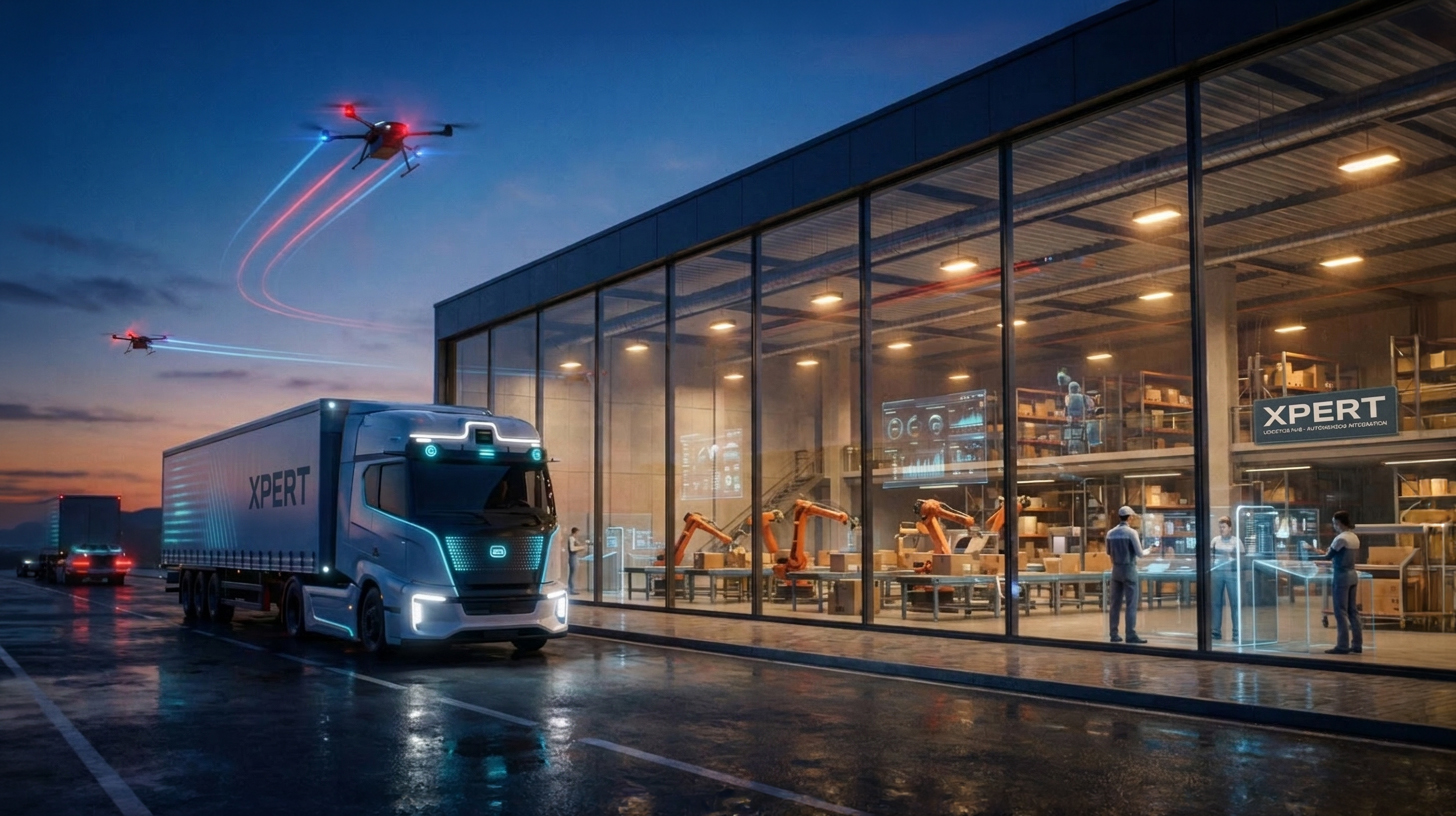
When algorithms take over: Logistics between efficiency revolution and skills collapse – Image: Xpert.Digital
A warning to logistics executives: Why emotional intelligence is suddenly more important than technical knowledge
Human vs. machine? Who will win – and who will lose – in automated logistics in the future?
Autonomous trucks on the highways, drones in the sky, and AI-driven supply chains – the global logistics industry is currently undergoing a technological revolution of unprecedented scale. But while smart algorithms and smart machines are ushering in a new era of efficiency, an unexpected and dangerous paradox is emerging: the more intelligent the technology becomes, the more urgently it depends on highly qualified people. Faced with tens of thousands of unfilled positions, the disappearance of entry-level jobs, and drastic demographic changes, the industry is threatened with a fatal skills collapse. An in-depth analysis shows that those who want to survive in the future cannot simply invest in machines, but must completely reassess the potential of their employees.
Between autonomous trucks and empty driver's cabs, the industry faces its biggest paradox: the more intelligent the machines become, the more urgently it needs humans
The global logistics and transportation industry is undergoing a watershed moment, the full impact of which will only become apparent in the coming years. Autonomous vehicle systems, algorithmically controlled supply chains, and unmanned aerial vehicles are not only transforming operational processes but also the entire employment architecture of an industry that employs around three million people in Germany alone. Cornerstone's Skills Economy Report 2026, based on more than 28 terabytes of real-time labor market data from over 200 countries and encompassing more than 50,000 different skills, presents a sobering assessment. The central finding is as simple as it is alarming: Automation and AI generate significant efficiency gains but simultaneously exacerbate a structural skills gap that jeopardizes the future viability of entire companies.
A multi-billion dollar market in flux: These 3 tech trends are completely redefining our supply chains
The three tectonic shifts in the transport and logistics sector
Three developments are driving the transformation of the logistics industry with particular force and creating a tension between technological progress and personnel reality.
The first issue concerns an apparent paradox: despite the rapid rise of autonomous technologies, the demand for drivers remains consistently high. In Germany, there is already a shortage of more than 70,000 truck drivers, with roughly one in three professional drivers in road freight transport being over 55 years old. Every year, between 30,000 and 35,000 drivers retire, while only 15,000 to 20,000 new drivers enter the profession. Across Europe, the gap could soon grow to over 500,000 missing drivers. Business associations such as the BDI, HDE, and BGL have called on the German government in a joint letter to take countermeasures before logistics chains and security of supply are seriously jeopardized.
The second shift concerns the massive investment surge in autonomous delivery and transportation solutions. The global market for autonomous trucks was valued at approximately $42.9 billion in 2025 and is projected to grow to $107.7 billion by 2034, representing an annual growth rate of 11 percent. Technological advancements in LiDAR, AI algorithms, and sensor technology have enabled successful Level 4 pilot projects along Texas freight corridors to already double trailer throughput and reduce labor-related per-mile costs by over 35 percent. Studies predict that autonomous trucks could account for up to 30 percent of new commercial vehicle registrations by 2035. Logistics companies are already redesigning their networks with autonomous mainline routes supplemented by human-driven last-mile loops.
The third driving force is drone logistics, which is evolving from a niche phenomenon into a multi-billion dollar market. The global market for drone logistics and transport reached a volume of over US$2.52 billion in 2025 and is projected to exceed US$147 billion by 2035. The drone parcel delivery sector alone was estimated at US$3.47 billion in 2025 and is expected to grow to nearly US$21 billion by 2034. Companies like Amazon are driving commercial aerial delivery with programs such as Prime Air and the MK30 drone, while EU-wide regulations have provided a regulatory framework for commercial drone use since 2021.
Competency profiles in flux: Who wins, who loses
The consequences of these three megatrends for the labor market are significant and asymmetrically distributed. According to the Cornerstone report, demand for certain skill sets is growing disproportionately: fleet managers for autonomous vehicles are experiencing a 200 percent increase in demand, drone pilots 150 percent, and AI analysts for supply chains 82 percent. The job profile of the fleet manager itself has fundamentally changed. While previously primarily responsible for the procurement and management of vehicles, the focus has shifted to strategic aspects that balance costs, sustainability, and new technologies. A Deloitte study shows that over 75 percent of fleet managers already use specialized software or telematics in their daily work.
On the other hand, traditional job profiles are under considerable pressure. Dispatchers are facing a 55 percent drop in demand, and delivery drivers a 40 percent decline. This trend is not limited to long-haul transport. A recent survey by the German Freight Forwarding and Logistics Association (BGL) revealed that 64 percent of freight forwarding companies are unable to fill open dispatcher positions, while over 60,000 warehouse logistics positions were vacant in 2025. The cause lies in a twofold shift: On the one hand, manual routines are being digitized, and on the other hand, new requirements are emerging for which qualified personnel are lacking.
Why humans are becoming irreplaceable in the automated world
One of the report's most remarkable findings concerns the rise of genuinely human skills in an increasingly machine-driven world of work. Cornerstone refers to this phenomenon as the "Great Skills Merge," the fusion of technical and human skill requirements in hybrid job profiles. For the first time in over a decade, the demand for AI implementation skills has surpassed communication skills as the most sought-after qualification worldwide, with a 245 percent increase.
At the same time, the demands on skills that algorithms cannot replicate are increasing. Emotional intelligence is experiencing a 95 percent increase in demand, resilience and flexibility 42 percent, leadership and social skills 28 percent, and creative thinking 18 percent. The Workday 2025 report confirms this trend: More than 80 percent of the companies surveyed rate skills such as self-awareness, empathy, and relationship management as essential future competencies.
This has very concrete implications for the logistics industry. Because automation takes over many routine tasks, the remaining human work focuses on situations that require complex thinking, situational decision-making, communication, and coordination. An autonomous truck can drive the route, but it cannot negotiate a delayed delivery with a customer, creatively solve an unforeseen logistics problem, or lead a team through a restructuring. Logistics companies therefore increasingly need hybrid competency profiles that combine technical process understanding with these human skills.
🎯🎯🎯 Benefit from Xpert.Digital's extensive, five-fold expertise in one comprehensive service package | BD, R&D, XR, PR & Digital Visibility Optimization

Benefit from Xpert.Digital's extensive, five-fold expertise in a comprehensive service package | R&D, XR, PR & Digital Visibility Optimization - Image: Xpert.Digital
Xpert.Digital possesses in-depth knowledge across various industries. This allows us to develop tailored strategies precisely aligned with the requirements and challenges of your specific market segment. By continuously analyzing market trends and monitoring industry developments, we can act proactively and offer innovative solutions. The combination of experience and expertise generates added value and provides our clients with a decisive competitive advantage.
More information here:
Robots are not the only solution: These four strategies will secure the future of logistics
The ticking time bomb: Why entry-level jobs are disappearing and there's a lack of new talent
Behind the optimistic promises of efficiency offered by automation lies a structural problem that could destabilize the industry in the long term. The Cornerstone report shows that over 30 percent of typical entry-level tasks in logistics can be automated. What sounds like a productivity gain at first glance turns out, upon closer inspection, to be a threat to the entire talent pipeline. Entry-level positions are traditionally the learning platforms where young employees gain practical experience, build industry knowledge, and qualify for more demanding roles. If these positions disappear, the talent pipeline collapses.
The problem is exacerbated by a speed discrepancy: autonomous systems, AI-powered route optimization, digital freight planning, and last-mile innovations are developing faster than reskilling can keep pace. The HR Report 2025 makes it clear that while upskilling is well-established in German companies, reskilling lags significantly behind. Companies prefer to invest in deepening their employees' existing skills but shy away from the more complex retraining programs for entirely new fields of work. According to a Randstad study, only 28 percent of logistics workers worldwide received AI training last year, even though more than 60 percent of all job profiles in the industry are expected to change due to AI and automation.
Demographic erosion as an accelerant
Demographic change is further exacerbating this situation, transforming a serious problem into a potentially existential crisis. According to a projection by the Institute for Employment Research, Germany's potential working-age population will shrink by 11.7 percent from 45.7 million to 40.4 million by 2060. The EU Commission forecasts a loss of 57.4 million people of working age across the entire European continent by the end of the century. In many countries, the working-age population will decline by around 30 percent by 2060, and while Germany will partially compensate for this through immigration, it will not be able to reverse the underlying trend.
For the logistics sector, which already suffers from a chronic shortage of skilled workers, this has a twofold consequence. On the one hand, the pool of potential employees is shrinking in absolute terms. On the other hand, the sector is competing with other sectors for the same qualified professionals who combine technical and interpersonal skills. While the ifo Institute reported at the beginning of 2026 that the shortage of skilled workers had fallen to a five-year low, it explicitly warns that the current figures reflect not so much a structural easing of the situation as the economic weakness. The structural problems caused by demographic effects and new qualification requirements remain entirely intact.
The equation that logistics managers must solve: Four strategic imperatives
In light of these converging challenges, the Cornerstone report formulates four strategic recommendations for action, the consequences of which go far beyond traditional personnel development.
First, companies must strategically use HR and skills analytics as an early warning system. Identifying skills gaps early, making skills attrition visible, and systematically planning for future needs is no longer an optional extra, but a business necessity. The Cornerstone platform SkyHive analyzes labor market data in real time and continuously records more than 50,000 skills, illustrating the level of data depth required today for sound workforce planning.
Secondly, it is essential to systematically develop AI expertise and digital logistics skills. Since AI implementation skills have become the most sought-after skill worldwide, with a growth of 245 percent, employees increasingly need data-, technology-, and AI-related skills. Cybersecurity skills are increasing by 31 percent, expertise in green technologies by 156 percent, and sustainable management by as much as 180 percent. These figures underscore that the skills development initiative must be broadly based and not limited to purely technical areas.
Thirdly, the report recommends the implementation of practice-oriented learning. Simulation environments and realistic training that enable the development of new skills in autonomous and digitized transport environments are crucial. The Mecalux-MIT study confirms that investments in AI in warehouse logistics typically pay for themselves within two to three years, with an average of 11 to 30 percent of the warehouse technology budget allocated to AI projects. More than 90 percent of warehouses that rely on AI or advanced automation have already achieved a high level of operational maturity.
Fourth, companies should manage their skills development like an investment portfolio. This means not only measuring efficiency but also evaluating skills building, resilience, and adaptability as key performance indicators. A Korn Ferry study estimates that by 2030, the world will face a shortage of 85.3 million skilled workers, which could cost the global economy $8.5 trillion. Companies that view skills development as a strategic investment rather than a cost factor will prevail in this competitive landscape.
The real risk is not the machine, but inaction
A comprehensive economic analysis of the logistics sector reveals a transformation of historic proportions. It would be a mistake to dismiss these developments as a distant vision of the future. The market for autonomous trucks is growing at a double-digit rate annually, drone logistics could increase fortyfold within a decade, and the integration of AI into warehouse processes has already reached operational maturity. At the same time, the working-age population in Europe is shrinking, the shortage of skilled workers remains a structural problem, and investments in further training are not keeping pace with the rate of change.
The logistics industry is thus facing a fundamental decision. Companies that invest now in hybrid skill sets, base their workforce planning on data, and approach reskilling with the same seriousness as their technology investments will be the winners of this transformation. Those who believe that automation alone is the answer to the skills shortage, however, misunderstand basic economic logic: even the most intelligent machine needs people to develop, control, monitor, and complement it in complex situations. The greatest danger for the logistics industry is not autonomous technology itself, but the inability to prepare people for working with it in a timely manner.
Your dual-use logistics experts

Dual-use logistics experts - Image: Xpert.Digital
The global economy is currently undergoing a fundamental transformation, a watershed moment that is shaking the foundations of global logistics. The era of hyper-globalization, characterized by the relentless pursuit of maximum efficiency and the "just-in-time" principle, is giving way to a new reality. This new reality is marked by profound structural breaks, geopolitical power shifts, and increasing fragmentation of economic policy. The once taken-for-granted predictability of international markets and supply chains is dissolving and being replaced by a period of growing uncertainty.
Related to this:
Your container high-bay warehouse and container terminal experts

Container terminal systems for road, rail and sea transport in the dual-use logistics concept of heavy-lift logistics - Creative image: Xpert.Digital
In a world marked by geopolitical upheavals, fragile supply chains, and a new awareness of the vulnerability of critical infrastructure, the concept of national security is undergoing a fundamental reassessment. A state's ability to guarantee its economic prosperity, the provision of essential goods and services to its population, and its military capability increasingly depends on the resilience of its logistical networks. In this context, the concept of "dual-use" is evolving from a niche category of export control to a broader strategic doctrine. This shift is not merely a technical adjustment but a necessary response to the "paradigm shift" that demands a profound integration of civilian and military capabilities.
Related to this:










