
Germany's digital levy: Tax plan for Google, Meta, Amazon & Co. provokes Trump – Are we now facing a trade war?
Xpert pre-release

Available in 27 languages 📢
Prefer Xpert.Digital on GoogleⓘPublished on: October 3, 2025 / Updated on: October 3, 2025 – Author: Konrad Wolfenstein
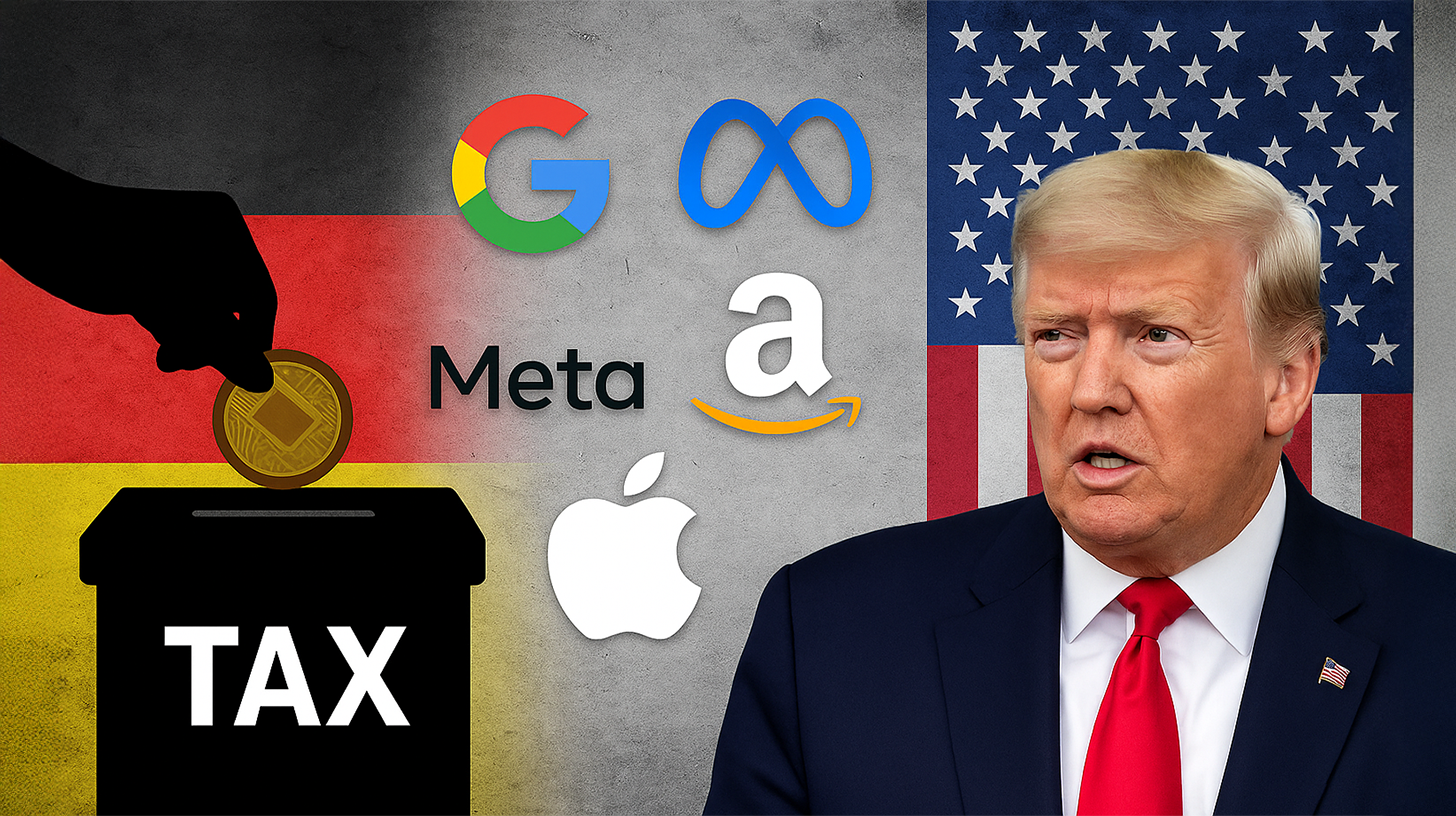
Germany's digital levy: Tax plan for Google, Meta, Amazon & Co. provokes Trump – Are we now facing a trade war? – Image: Xpert.Digital
Austria is leading the way: How Germany wants to save its media with a digital levy
Battle for interpretive power: Why the government now wants to make Big Tech pay
Germany is planning a far-reaching step toward regulating tech giants: the introduction of a ten percent digital levy for companies like Google, Meta, and Amazon. Driven by Minister of State for Culture Wolfram Weimer, the initiative aims to limit the growing market power of these platforms, increase tax fairness, and specifically strengthen Germany as a media center. The concept is based on the Austrian model, which is already successfully generating revenue, but is intended to be significantly stricter, with a levy rate twice as high.
But the proposal is causing considerable controversy and sparking a complex debate. There is considerable resistance not only within the German government, especially from the Ministry of Economics, but also international trouble looms. The US, under Donald Trump in particular, has already threatened severe countermeasures should Germany attempt such a national solo effort, fueling fears of an escalating trade dispute. The discussion thus touches on core issues of digital sovereignty, competitive fairness, and transatlantic relations and raises the crucial question: Can Germany prevail in the struggle with Big Tech and the US, or is the project doomed from the start?
What is the planned digital levy and who is behind it?
The German federal government is planning to introduce a so-called digital levy for large tech companies such as Google, Meta, and Amazon. The project is being spearheaded by Minister of State for Culture Wolfram Weimer, a non-partisan politician who plans to present a concrete outline paper in the fall of 2025. Weimer proposes structuring the payment as a levy rather than a tax, which has different legal and political implications.
The Minister of State for Culture justifies his initiative with the growing market power of Big Tech platforms. "We cannot allow Big Tech platforms to gain the power of interpretation and we can no longer democratically control this," Weimer told the RedaktionsNetzwerk Deutschland (RND). He sees the digital levy as a tool to limit the dominant positions of companies like Google in information dissemination while simultaneously strengthening Germany as a center of media.
The concept is based on the Austrian model, but goes beyond it. While Austria has levied a five percent digital tax on online advertising services since 2020, Germany plans to impose a ten percent levy. This tax is intended to focus on platform operators with billions in revenue that use media content—including not only journalistic but also cultural content.
What experience has there been with similar taxes in Europe?
Austria serves as an important reference point for Germany's plans. The neighboring country introduced a digital tax on January 1, 2020, requiring large online platforms to pay five percent of their advertising revenue. Austrian experience shows a steady, and at times, erratic, development of tax revenues. In 2024, the Austrian Ministry of Finance generated €124.1 million from the digital tax, an increase of 20 percent over the previous year.
These figures illustrate the significant volume of digital advertising revenue. The €124.1 million digital advertising tax represents an outflow of advertising revenue from Austria to international online platforms totaling a good €2.48 billion. At the same time, tax revenues from the traditional advertising levy are stagnating and declining, highlighting the structural change in the advertising market.
France was already a pioneer in introducing a national digital tax in 2019, albeit with a lower rate of three percent. The French digital tax explicitly targeted the so-called "GAFA" companies Google, Amazon, Facebook, and Apple and covered three main areas: online advertising revenue, the sale of user data, and the brokering of business relationships via digital platforms. The French Minister of Economy expected annual revenues of €500 to €600 million upon its introduction.
Italy and Spain also introduced digital taxes, albeit with different approaches and rates. Italy has levied a three percent tax on revenues from advertising on digital platforms since 2020, while Spain introduced a two percent digital tax on large digital corporations with annual revenues exceeding €750 million in May 2021.
How do the various political actors react to Weimer’s proposal?
Political reactions to Weimer's digital levy plans have been mixed, even within the governing coalition. Weimer himself sees broad support from the CDU/CSU, SPD, and the Greens, but the reality paints a more nuanced picture.
Federal Minister of Economics Katherina Reiche of the CDU categorically rejects a digital tax for US technology companies. "We should not be talking about more, but about fewer trade barriers," Reiche told the RedaktionsNetzwerk Deutschland (RND). She argues that, at the same time, the competitive conditions for German and European digital companies must be improved so that they have a chance in international competition. The Ministry of Economics emphasizes that Reiche's opposition was formulated in the context of ongoing talks between the EU Commission and the US administration.
Jens Spahn, the CDU parliamentary group leader, also expressed caution, though not entirely opposed. "Amazon and the like do a lot of business here, but pay little tax. That's not fair. The question of whether we should introduce a tax is open," the CDU politician told Stern magazine. Spahn emphasized, however, that the outcome also depends on the negotiations with the US: "A spiral of escalation benefits no one. If in doubt, it harms Europe above all."
There is disagreement within the CDU. While North Rhine-Westphalia's Finance Minister Marcus Optendrenk warns of risks and considers a digital tax counterproductive, other CDU politicians are more open. The deputy chair of the CDU/CSU parliamentary group, Anja Weisgerber, supports the move as an interim solution to an EU-wide tax directive.
The SPD fundamentally welcomes Weimer's initiative. Martin Rabanus, media policy spokesperson for the SPD parliamentary group, stated that the SPD welcomes the fact that the Minister of State for Culture is "now swiftly implementing the introduction of a levy for online platforms, as enshrined in the coalition agreement." The levy would also create the necessary budgetary flexibility to invest specifically in expanding and strengthening the media location.
The Greens are also generally supportive, but criticize the timing and call for a joint European approach. Deputy parliamentary group leader Konstantin von Notz said they welcome the fact that the Union has recognized the need for a digital tax, but that a joint European approach is more important than ever, especially with regard to the US.
What role does the trade dispute with the USA play?
The trade dispute with the US under President Donald Trump poses a key challenge to Germany's digital levy plans. Trump has repeatedly threatened retaliation should countries impose digital taxes on US corporations. "Digital taxes are all designed to harm or discriminate against American technology," Trump wrote on his Truth Social platform. He threatened significant additional tariffs on exports from the respective countries to the US and export restrictions on US technology and chips.
Concerns about escalation are justified, as the example of Canada demonstrates. In June 2025, the Canadian government withdrew a planned three percent digital tax after Trump threatened trade sanctions. This tax would have been retroactive and would have resulted in a bill of two billion dollars for US companies at the end of June. Canada's withdrawal illustrates the enormous pressure the US can exert.
Weimer himself is aware of the problem. When asked what would happen if Trump increased tariffs in return, he said: "It's possible that I'll have to give in. Unfortunately, Europe isn't strong enough to reach the desired results on an equal footing with the Americans." This statement highlights the dilemma of European digital tax plans in the context of American market power.
The EU Commission is currently negotiating with the Trump administration on trade issues, with potential measures against the US services sector also part of the negotiating package. A planned "reciprocal trade agreement" between the US and the EU could even put the enforcement of the Digital Markets Act on hold for US companies such as Alphabet, Meta, and Apple.
What would be the concrete impact of the digital levy?
The planned German digital levy would follow the Austrian model, but with a higher rate. It would affect companies that exceed certain revenue thresholds both worldwide and in Germany. In Austria, this threshold is €750 million in global revenue and €25 million in national online advertising revenue. Germany is likely planning similar criteria.
The assessment basis would be the fee that online advertising providers receive from clients, with expenses for advance services provided by other online advertising providers being deductible. The levy would be designed as a self-assessment levy, payable monthly.
Weimer argues that experience from Austria shows that end customers would not notice any significant price change as a result of such a levy. Nevertheless, it is controversial whether the costs would be passed on to users. Google had already announced in 2020 that it would pass the Austrian digital tax on to its advertising customers as a five percent fee.
The revenue generated by the digital levy is intended to be used to strengthen Germany's media scene. Weimer doesn't provide specific figures, but simply speaks of a "significant amount." Based on Austrian experience and the size of the German economy, the revenue could well be in the billions.
Our global industry and economic expertise in business development, sales and marketing

Our global industry and business expertise in business development, sales and marketing - Image: Xpert.Digital
Industry focus: B2B, digitalization (from AI to XR), mechanical engineering, logistics, renewable energies and industry
More about it here:
A topic hub with insights and expertise:
- Knowledge platform on the global and regional economy, innovation and industry-specific trends
- Collection of analyses, impulses and background information from our focus areas
- A place for expertise and information on current developments in business and technology
- Topic hub for companies that want to learn about markets, digitalization and industry innovations
Fight for advertising money: Why publishers are pushing for a levy
What technical and legal challenges exist?
The implementation of a digital levy entails considerable technical and legal complexity. A key issue is the definition of taxable services. Online advertising services are considered to be advertising on a digital interface, particularly in the form of banner advertising, search engine advertising, and similar advertising services.
The geographical allocation of services presents a further challenge. An advertising service is considered to be provided domestically if it is received on the device of a user with a domestic IP address and is aimed at domestic users in terms of content and design. The place of provision may be determined based on the IP address or other geolocation technologies.
The distinction from existing tax systems is legally problematic. The digital levy is to be levied alongside regular taxation, which could lead to double taxation. There is also a risk of collateral damage for companies that are not primarily part of the large tech corporations but could nevertheless be affected by the levy.
The self-assessment levy requires affected companies to make monthly payments by the 15th of the second month following the tax liability arising. An electronic annual return must be submitted by March 31 of the following year. This administrative burden could be particularly problematic for smaller companies.
Why does Weimer see Google as particularly problematic?
Weimer's argument focuses heavily on Google and its role as a disseminator of information. He calls for Google to be subject to German press law and its associated liability. Google claims that it is not a media company and is therefore not subject to the logic of media and press law. Weimer contradicts this: "If you can get information and classifications in seconds via a Google search, you're dealing with a media outlet."
As a concrete example of Google's power to define the world, Weimer cited US President Donald Trump's idea of calling the Gulf of Mexico the Gulf of America. "A few days later, Trump's wish has become reality because Google is simply rewriting the world's cartography according to his will," criticized the Minister of State for Culture. The company has global power to define the world through Google Maps. "When political and media powers fraternize like this, we are lost."
This argument demonstrates that Weimer is not only concerned with fiscal aspects, but with fundamental questions of opinion-forming sovereignty and democratic control. Large platforms like Google are copying all the knowledge available online and creating a new form of knowledge with artificial intelligence. Weimer sees this development as a threat to the democratic order.
How does the German media industry position itself?
The German media industry fundamentally supports Weimer's digital levy plans. German magazine publishers are increasing pressure on the federal government to finally impose a digital tax on major US tech companies and use the money to ease the burden on local publishing houses.
Philipp Welte, Chairman of the Media Association of the Free Press (MVFP), argues that the revenue from the levy could be used by Google and Meta to reduce the sales tax on press services offered by German media companies. "The value creation of the world's most powerful companies functions on the basis of our digital infrastructure and our high-quality content," Welte explained.
The Burda executive, who is also head of the magazine publishers' association MVFP, welcomed the project as long overdue. "A significant portion of the digital value creation of the European media markets ends up in the USA," said Welte. "A handful of US technology companies and their clones created by the Chinese dictatorship are suffocating the free internet."
The media industry sees the digital levy not only as a financing opportunity, but also as a tool for restoring fair competition. Welte emphasized: "The gigantic market power of these companies is a structural and regulatory problem for the European digital economy and is increasingly posing a threat to the cultural and political stability of our democracy."
Which international developments influence the German debate?
The international dimension of digital taxation is significantly shaping the German debate. Negotiations on a global solution for taxing the digital economy have been ongoing at the OECD level for years, but have not yet led to a comprehensive outcome.
The EU as a whole has so far been unable to agree on a common digital tax, even though the European Commission had already presented a corresponding draft directive in 2018. The attempt to achieve broad consensus on a uniform EU tax failed after three years of intensive negotiations. A common European digital tax remains unrealistic for the time being, as it would have to be agreed upon jointly by all 27 EU member states.
Several EU member states therefore took national unilateral action. Besides Austria, France, Italy, and Spain, other countries also planned similar measures. However, this fragmented approach creates legal uncertainty and could lead to distortions of competition within the EU.
The US is reacting increasingly aggressively to national digital taxes. Trump argues that such taxes discriminate against US tech giants like Amazon, Alphabet, and Meta. The US is increasingly imposing export restrictions on technologies, including high-performance chips for artificial intelligence, that are considered critical to national or economic security.
What could a European solution look like?
Given the challenges of national unilateral action, calls for a coordinated European response are growing. The Centre for European Policy Studies, commissioned by the European Greens, has presented an analysis of what an EU-wide digital tax could look like. A five percent levy on revenues from digital advertising services and platform services would generate tax revenues of €37.5 billion in 2026.
Such an EU-wide solution would have several advantages: It would avoid distortions of competition between member states, create a uniform legal basis, and enable a stronger negotiating position vis-à-vis the US. At the same time, it could be used as a countermeasure to American tariffs.
However, the political reality shows that such a solution is difficult to implement. The differing economic interests of the EU member states, the unanimity rule on tax issues, and the resistance of some countries seeking to position themselves as digital hubs make reaching an agreement considerably difficult.
Nevertheless, there are voices that consider a European solution essential. Andreas Audretsch, deputy leader of the Green Party parliamentary group, said a European digital tax is, at best, long overdue "to limit the power of the tech oligarchs who are endangering our democracy and the social market economy."
What economic arguments are there for and against the digital levy?
The economic arguments for a digital levy focus on issues of tax fairness and competitive fairness. Proponents argue that the large digital corporations have been achieving returns on sales of around 50 percent for years, which is a clear sign of excessive market power. The profits of the five major tech companies alone—Microsoft, Alphabet, Meta, Amazon, and Apple—added up to almost €400 billion after taxes in 2024.
At the same time, these corporations gain an additional unfair competitive advantage through aggressive tax planning. The largest and most profitable corporations pay the lowest tax rates because they find it particularly easy to shift profits to tax havens. According to estimates, the large digital corporations pay only around three percent tax on profits generated in Germany.
Critics of the digital levy warn of various negative effects. Marcus Optendrenk, Finance Minister of North Rhine-Westphalia, argues: "Germany as a business location suffers from excessive tax and levy burdens. Considering the introduction of a new digital levy now creates uncertainty and ultimately leads to additional burdens for businesses and consumers."
Another argument used by opponents is the risk of an escalation in the trade dispute with the US. Digital levies, which presumably primarily affect US companies, could reignite the tax and tariff dispute with the US. National unilateral action increases the risk of new trade conflicts.
What are the future prospects?
The future of the German digital levy depends on several factors. Weimer aims to present a concrete outline paper by fall 2025, but political resistance within the government is considerable. The opposition of Economics Minister Reiche and the reluctance of CDU/CSU parliamentary group leader Spahn indicate that the road to implementation could be rocky.
The decisive factor will be how the trade talks between the EU and the US develop. Should Trump make good on his threats and respond with tariffs in response to a German digital levy, this could spell the end of the plans. Weimer himself has already indicated that he might have to "give in" under certain circumstances.
As an alternative to a unilateral German solution, a coordinated European response could emerge. The discussion about digital taxes as a countermeasure to American tariffs is gaining momentum. Such a development would give Germany a stronger negotiating position.
Technological developments will also play a role. With the rise of artificial intelligence and new digital business models, the debate about appropriate taxation of digital value creation will intensify further. The approaches discussed today could already be outdated tomorrow.
Ultimately, the German digital levy debate exemplifies larger questions about the regulation of the digital economy, the balance between national sovereignty and international cooperation, and the future of democratic control over powerful technology companies. The coming months will show whether Germany dares to take the lead or bows to international realities.
Your global marketing and business development partner
☑️ Our business language is English or German
☑️ NEW: Correspondence in your national language!

Konrad Wolfenstein
I would be happy to serve you and my team as a personal advisor.
You can contact me by filling out the contact form or simply call me on +49 7348 4088 965 (Munich) . My email address is: wolfenstein ∂ xpert.digital
I'm looking forward to our joint project.
☑️ SME support in strategy, consulting, planning and implementation
☑️ Creation or realignment of the digital strategy and digitalization
☑️ Expansion and optimization of international sales processes
☑️ Global & Digital B2B trading platforms
☑️ Pioneer Business Development / Marketing / PR / Trade Fairs
Our recommendation: 🌍 Limitless reach 🔗 Networked 🌐 Multilingual 💪 Strong sales: 💡 Authentic with strategy 🚀 Innovation meets 🧠 Intuition

From local to global: SMEs conquer the global market with clever strategies - Image: Xpert.Digital
At a time when a company's digital presence determines its success, the challenge is how to make this presence authentic, individual and far-reaching. Xpert.Digital offers an innovative solution that positions itself as an intersection between an industry hub, a blog and a brand ambassador. It combines the advantages of communication and sales channels in a single platform and enables publication in 18 different languages. The cooperation with partner portals and the possibility of publishing articles on Google News and a press distribution list with around 8,000 journalists and readers maximize the reach and visibility of the content. This represents an essential factor in external sales & marketing (SMarketing).
More about it here:










