
The secret monopoly: Why no chip works worldwide without this European company
Xpert Pre-Release

Available in 27 languages 📢
Prefer Xpert.Digital on GoogleⓘPublished on: August 19, 2026 / Updated on: August 19, 2026 – Author: Konrad Wolfenstein
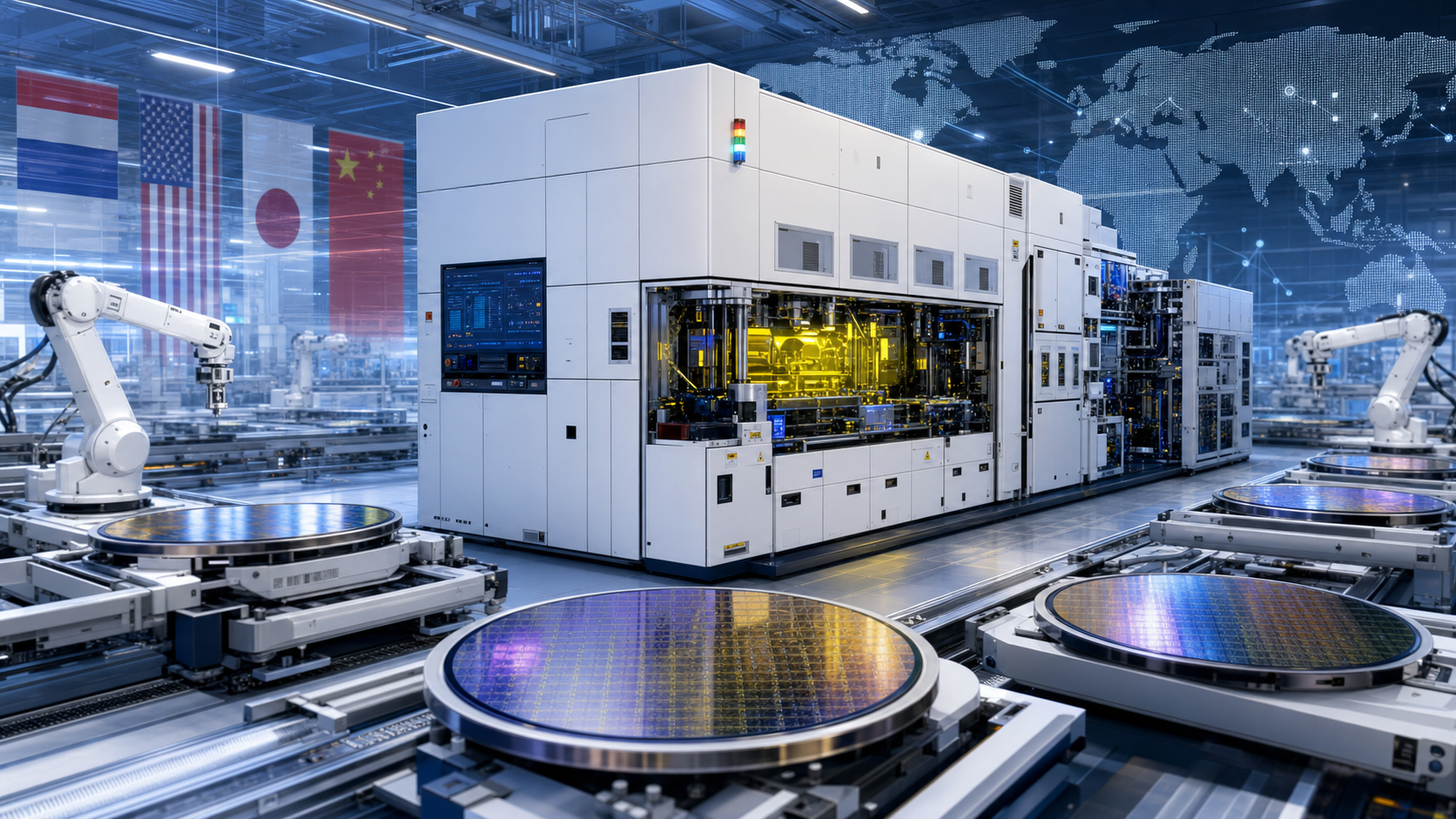
The secret monopoly: Why no chip works worldwide without this European company – Creative image on the topic, with AI: Xpert.Digital
The technological bottleneck: These 5 unknown companies hold power over the tech world
The real tech war: How three countries are dominating China's semiconductor dreams
Oil of the 21st century: Whoever builds these gigantic machines controls the global economy
Semiconductors are undoubtedly the oil of the 21st century – but by 2026, true geopolitical power no longer resides solely with the chip producers, but rather with the designers of the gigantic machines that make them possible in the first place. A look at the global market for semiconductor manufacturing equipment reveals an extreme technological bottleneck: Just a handful of companies from the USA, Japan, and the Netherlands, most notably the monopolist ASML, hold the key to the modern global economy. This unprecedented geographical and technological concentration has transformed these multi-ton precision machines into the sharpest weapon in the global technology war. While the West attempts to secure its dominance through increasingly stringent export controls, China is working with enormous financial resources to decouple and achieve its own independence. This analysis illuminates how the fiercely contested multi-billion-dollar market is distributed, why a single European company is shaking up global politics, and what tectonic shifts are inevitably imminent for the semiconductor industry in the coming years.
The chip as a workbench of world power: Whoever controls the machines controls the century
Anyone looking at the map of the global semiconductor industry in 2026 will quickly realize that the real question of power lies not with the chip manufacturers themselves, but with the companies that build their machines. Semiconductors have long been considered the oil of the 21st century, but unlike crude oil, chip production technology is extremely concentrated and virtually irreplaceable. Without the precision equipment of a handful of companies from the Netherlands, the United States, and Japan, no assembly line at TSMC, Samsung, or Intel could ever produce a functional processor. This analysis traces how the market for semiconductor manufacturing equipment will be distributed in 2025, why this distribution is so geopolitically significant, and what strategic shifts are on the horizon.
A market of astronomical importance with a manageable number of suppliers
The global market for semiconductor manufacturing equipment, often referred to in industry jargon as SME, reached a volume of approximately US$135 billion to US$166 billion in 2025, depending on the definition and methodology used. This range is due to differing definitions, such as whether backend test systems, frontend wafer fabrication equipment, or accessories and services are included. Regardless of the exact figure, the growth dynamic is clear: driven by the artificial intelligence boom, the expansion of data centers, and the global diversification of production sites, the market is growing at robust double-digit rates and could double to US$300 billion or more by the early 2030s.
What makes this market so special is its extreme concentration in the hands of a few companies with highly specialized technical expertise, built up over decades and virtually impossible to replicate in the short term. The five largest suppliers – ASML, Applied Materials, Tokyo Electron, Lam Research, and KLA – account for between 56 and 66 percent of the total market volume, depending on the calculation method. Adding the next ten to fifteen companies reveals that practically the entire global market is supported by about twenty companies from just four countries. This concentration is no accident, but rather the result of enormous research and development costs, long product cycles, and a network of specialized suppliers that has coalesced over decades in specific regions.
The exceptional Dutch case at the top of the value chain
At the top of this ranking, by a considerable margin, is ASML from Veldhoven in the Netherlands, which will hold a market share of 21.42 percent by 2025. This figure is remarkable because ASML focuses on a single product segment, lithography, while many competitors diversify their business across etching, deposition, purification, and metrology. ASML has succeeded in establishing a de facto global monopoly in extreme ultraviolet lithography, or EUV. No other company on the planet has yet been able to build commercially viable EUV exposure systems capable of exposing structures on silicon wafers in the nanometer range. These machines, each costing between 200 and over 400 million US dollars and requiring transport to customers via dozens of cargo planes and trucks, represent the technological bottleneck of the entire modern chip industry.
The path to this monopoly was long. ASML presented its first functional EUV prototype as early as 2001, but it took almost two decades and billions in research investment before the first commercially available systems could be delivered in 2019. Today, ASML is not only a technological pioneer but has also secured itself legally against imitators with more than six thousand patents. For chip designers like Nvidia, AMD, and Apple, and for contract manufacturers like TSMC, Samsung, and Intel, there is literally no way around ASML machines when it comes to the most advanced process nodes. This unique position makes the small Dutch company one of the West's most important geopolitical levers against China and, at the same time, one of the most vulnerable links in the global supply chain should sabotage, natural disasters, or other disruptions ever occur at its headquarters.
The American generalist with the broadest product range
In second place, with a 16.33 percent market share, is Applied Materials from Santa Clara, California. While ASML focuses on a narrow but essential segment, Applied Materials pursues the opposite strategy of broad diversification. The company offers equipment for material deposition, etching, chemical-mechanical planarization, and comprehensive process control, thus covering virtually every step of wafer manufacturing. This breadth makes Applied Materials less dependent on a single technological leap, but more susceptible to cyclical fluctuations in the overall semiconductor market, as the company profits from and suffers from virtually every manufacturing step.
Of particular interest is Applied Materials' positioning in the field of equipment for advanced packaging technologies and new memory technologies, which are gaining importance in the wake of the AI boom. While classic lithography scaling is reaching its physical limits, some technological progress is shifting towards three-dimensional chip integration and heterogeneous packaging solutions – a field in which Applied Materials has traditionally been strong. However, the recent year-on-year decline in sales, which some market observers are forecasting for 2025, suggests that the company is lagging behind more specialized competitors in certain areas during the current investment cycle, which is heavily driven by investments in memory chips and AI accelerators.
Japan's quietly growing etching and coating power
In third place is Tokyo Electron, or TEL for short, with a market share of 14.29 percent. The Japanese company has established a dominant position, particularly in the areas of coating and development systems, so-called coater-developer systems, as well as in wafer etching and cleaning. Tokyo Electron is considered virtually unrivaled, especially in coater-developer systems that work in conjunction with ASML's lithography machines, making the two companies a kind of symbiotic duo at the heart of every modern chip factory.
Tokyo Electron is also benefiting significantly from the shift to three-dimensional memory architectures such as 3D NAND flash memory, where precise etching is becoming a key technical challenge due to the increasing number of stacked layers. The company's growth rates in 2025 even surpassed those of Applied Materials at times, underscoring the growing importance of this niche segment. Japan has thus established itself as a second pillar alongside the US and the Netherlands, even if Tokyo Electron is often less prominent in the international consciousness than its Western competitors.
The specialist for the invisible details of chip manufacturing
Fourth place goes to Lam Research from Fremont, California, with a market share of 10.29 percent. Lam Research specializes in plasma etching and deposition technologies and is considered one of the most important equipment suppliers, particularly in the production of memory chips, both DRAM and NAND flash. The increasing miniaturization and ever more complex three-dimensional structures of modern chips require etching processes with a precision that is literally measured in individual atomic layers.
Lam Research's strong revenue growth in 2025, which several market analysts estimated was well over 20 percent year-over-year, reflects the enormous demand for storage capacity driven by the expansion of AI data centers. High-performance memory for graphics processors and AI accelerators requires entirely new manufacturing processes, and this is precisely where Lam Research has found its technological niche. The company exemplifies how, even in a highly concentrated market, specialized providers can disproportionately benefit from individual technology trends.
The inconspicuous guardian of the error-free status of every chip
KLA Corporation ranks fifth among the top global providers with a 7.74 percent market share. While less well-known than its four larger competitors, KLA plays an equally indispensable role, dominating the field of process control and metrology. Every wafer passing through a modern chip factory is inspected at numerous stations using inspection and measurement systems to detect defects early, preventing costly subsequent processing steps from being carried out on a faulty wafer.
The smaller the feature sizes and the more complex the three-dimensional chip architectures become, the more important this quality control function becomes, since even the smallest deviations, invisible to the human eye, can render entire batches unusable. KLA has carved out a position in this niche market that can confidently be described as a quasi-monopoly – comparable to ASML's position in lithography, only in a smaller, but equally indispensable, market segment.
The American power base beyond pure market share
If one considers the market not by individual companies but by country of origin, an even clearer picture of the global distribution of power emerges. The United States, with Applied Materials, Lam Research, KLA, and the test systems manufacturer Teradyne, has a total of four major suppliers, together accounting for approximately 36 percent of the global market share. This American dominance explains why Washington has been able to enforce export controls against China so decisively and effectively in recent years, as a significant portion of the critical manufacturing technology is directly subject to American legal jurisdiction or at least American regulatory influence through international agreements.
Teradyne, which appears in the ranking with a 1.95 percent market share, is particularly interesting because it does not primarily focus on wafer manufacturing itself, but rather on the test systems used to verify the functionality of finished chips before delivery. This segment is often underestimated, but given the steadily increasing complexity of modern processors and the growing importance of quality assurance, it is an increasingly important component of the entire value chain.
Japan's broad bank of specialists in the shadow of the big players
No other country is as deeply and broadly represented in the ranking of semiconductor equipment suppliers as Japan. Besides the aforementioned industry giant Tokyo Electron, a total of eight other Japanese companies appear in the extended top twenty list: Advantest, Screen, Canon, Disco, Hitachi, Kokusai Electric, Ebara, and Nikon. This sheer number is a testament to Japan's historically deep industrial expertise in precision manufacturing, which began as early as the 1980s, when Japanese corporations even held global market leadership in semiconductor production itself for a time, before value creation shifted more towards equipment and materials.
Advantest, with a 2.68 percent market share, specializes in test systems, similar to the American company Teradyne, and is considered one of the world's leading providers, particularly for memory chips and increasingly for complex AI accelerators. Screen Holdings is strongly positioned in the cleaning equipment sector, while Canon and Nikon, both traditionally from the optics industry, operate in the lithography market as smaller competitors to ASML, primarily in the area of less advanced manufacturing nodes. Disco specializes in wafer cutting and grinding technologies, Ebara in polishing systems, and Kokusai Electric, which spun off from Hitachi a few years ago, focuses on thermal processes and deposition technologies. This multitude of small to medium-sized specialists makes Japan a country whose overall importance to the semiconductor supply chain is significantly greater than the market shares of individual companies would suggest.
🎯🎯🎯 Data-driven B2B industry hub as a quasi-in-house solution

The quasi-in-house solution: How Xpert.Digital closes operational gaps in B2B marketing and sales – Smart Content-Driven Business - Image: Xpert.Digital
Xpert.Digital is a data-driven B2B industry hub led by Konrad Wolfenstein . The company acts as an external, quasi-in-house solution for industrial partners, closing operational gaps in marketing, content, and sales – without requiring additional resources on the client side.
More information here:
Why the chip industry is becoming a geopolitical instrument of power
The dwarf with the greatest leverage
The Netherlands is represented globally by only two significant companies: ASML and the smaller provider ASM International, which specializes in deposition technologies and, with a 2.22 percent market share, appears in the broader field of the top twenty. Measured by the number of employees and overall economic size, the Dutch presence in this market is vanishingly small compared to the USA or Japan. And yet, through ASML, this small country wields geopolitical leverage that is disproportionate to its size.
This asymmetry is a textbook example of modern economic geopolitics. A single company with around 40,000 employees can, through its technological dominance, effectively determine how quickly or slowly the chip industry of a geopolitical rival like China can develop. The Dutch government, in turn, is under constant pressure from Washington to align its export licensing policy with American security interests, which has led to a gradual tightening of export regulations for ASML machines to China since 2018. As early as 2019, the export license for the most advanced machines to China was revoked; further restrictions on less advanced systems followed in 2023, and since then the network of controls has become increasingly stringent – now extending even to maintenance and spare parts deliveries for already installed machines.
China as the only serious challenger outside the Western bloc
Among the twenty largest suppliers, only one company from mainland China, Naura Technology Group, is found. With a market share of 3.79 percent, it ranks sixth, ahead of established Japanese names like Advantest and Screen. Naura specializes in oxidation and diffusion furnaces and is now so deeply integrated into the Chinese supply chain that, according to reports, the company is responsible for more than 60 percent of the corresponding equipment in the 28-nanometer production lines of SMIC, China's largest contract manufacturer.
This growth is no accident, but the direct result of a deliberate Chinese industrial policy. As part of its evolving strategy for technological sovereignty, Beijing implemented a regulation in early 2026 requiring that new manufacturing facilities and capacity expansions source at least half of their equipment from domestic suppliers. This quota specifically targets the less advanced, but widely used, 28-nanometer and 14-nanometer manufacturing nodes, which are perfectly adequate for many everyday applications—from automotive electronics to simpler consumer chips—thus guaranteeing a huge market for domestic equipment manufacturers like Naura. Reports indicate that Naura even surpassed SMIC's own profit growth in fiscal year 2025, a clear indication of the effectiveness of the government-mandated import substitution program.
At the same time, reports from 2025 show that Chinese engineers, some of them former ASML employees, are working on their own EUV prototype, built in a high-tech facility in Shenzhen, which can now generate extreme ultraviolet light, although no functional chips have yet been produced with it. Most independent industry experts estimate that, even under an optimistic outlook, China is still at least a decade away from achieving independent, industrially viable EUV capability. Nevertheless, the mere existence of such a program demonstrates how seriously Beijing takes its technological dependence and the determination with which it is working to circumvent Western control mechanisms.
Why geographical concentration is becoming a geopolitical weapon
The fundamental basis of this entire analysis is a simple yet consequential fact: The United States, Japan, and the Netherlands together account for the overwhelming majority of global sales of semiconductor manufacturing equipment, while China, with Naura, possesses a growing but, by international standards, still small and technologically lagging supplier. This concentration is the very reason why export controls against Chinese chip manufacturers can work at all. When three countries effectively control the entire critical infrastructure of modern chip production, a coordinated political decision by these three governments is sufficient to effectively deny every other country access to the most advanced manufacturing processes.
This very logic underlies the gradually tightened American export controls implemented since 2018, which now extend far beyond EUV lithography and also affect advanced deep ultraviolet lithography systems, so-called DUV immersion systems, as well as maintenance and service for machines already installed in China. In April 2026, the so-called MATCH Act was introduced in the US Congress, a bill intended to close precisely these remaining loopholes by explicitly prohibiting not only the export but also the maintenance of existing DUV systems in China. This development demonstrates that the geopolitical conflict over chip manufacturing technology is no longer limited to one-off export bans but has become a continuous regulatory war of attrition, in which every new legislative initiative attempts to close remaining avenues of circumvention.
For ASML itself, this means an increasingly precarious balance. As recently as the fourth quarter of 2025, the Chinese market accounted for the largest single share of the company's system revenue at 36 percent, far exceeding initial forecasts by its own analysts. However, for the full year 2026, the company anticipates a decline to approximately 20 percent, a direct consequence of the tightened restrictions. These figures illustrate the dilemma facing Western equipment manufacturers: China remains a commercially vital market, particularly for less advanced machine generations, while the prevailing geopolitical climate is forcing companies to systematically reduce their dependence on China in order to minimize regulatory risks and avoid jeopardizing political support in their home markets.
Structural vulnerabilities of a seemingly unassailable system
Anyone looking at market shares projected for 2025 might get the impression that Western dominance in chip manufacturing technology is unshakable for the foreseeable future. However, this assessment is too simplistic, as the market exhibits several structural vulnerabilities that are likely to become more significant in the coming years. First, the extreme geographic concentration itself is a risk factor. Should political upheavals, natural disasters, cyberattacks, or other disruptive events occur in the Netherlands, the United States, or Japan, this would have an immediate impact on global chip production, as there are simply no alternative sources of supply on a comparable scale.
Secondly, the Naura case demonstrates that state-subsidized import substitution is indeed effective, particularly in the technologically less sophisticated but economically crucial manufacturing segments below 28 nanometers. While these nodes may be irrelevant for high-end processors in smartphones or AI accelerators, they form the backbone of the global automotive, industrial, and consumer electronics industries, representing a vast and continuously growing market that China can increasingly serve itself without relying on Western technology.
Thirdly, despite all export controls, the question remains how long a technological monopoly like ASML's in EUV lithography can actually be maintained when a country with China's financial and human resources is systematically attempting to break it through reverse engineering and its own research. Reports of a working Chinese EUV prototype capable of generating extreme ultraviolet light may still be far from industrial-scale production, but they demonstrate that the seemingly impregnable fortress of ASML is indeed under pressure – even if this pressure is likely to materialize over years and decades rather than months.
Looking ahead to a shifting world order in chip technology
Several trends can be predicted with some certainty for the coming years. The overall market for semiconductor manufacturing equipment will continue to grow strongly, driven by the unabated demand for computing power for artificial intelligence, the global diversification of manufacturing locations due to geopolitical caution, and the sheer necessity of producing increasingly complex three-dimensional chip architectures. The established market leaders from the Netherlands, the USA, and Japan will most likely be able to defend their technological dominance at the most advanced manufacturing nodes throughout the decade, simply because of the enormous technical barriers to entry and the patent portfolios they have built up over decades.
At the same time, the market will increasingly split into two parallel ecosystems: a Western-dominated system for advanced manufacturing hubs and an increasingly independent Chinese system for less advanced but economically highly relevant manufacturing hubs. This decoupling, which some observers are already calling a technological Cold War, is likely to reduce the overall global efficiency of the semiconductor supply chain, as economies of scale are lost and duplicate investments in redundant technology arise, while simultaneously increasing the resilience of individual regions to external shocks.
For companies like ASML, Applied Materials, Tokyo Electron, Lam Research, and KLA, this means a continuing need to actively manage their revenue dependence on China while simultaneously developing new growth markets in the US, Europe, India, and Southeast Asia, where massive government support programs are available to build their own manufacturing capacities. For investors and corporate strategists in sectors such as industrial automation or electronics manufacturing, which rely on a dependable chip supply, this clearly necessitates greater regional diversification of supply chains and the explicit integration of geopolitical risk scenarios into their planning, rather than relying solely on the historical reliability of global supply chains.
Ultimately, the central finding of this market analysis remains that in an increasingly fragmented global economy, economic and political power is not solely determined by the size of a country or a company, but rather by control over indispensable technological bottlenecks. ASML, with its roughly 40,000 employees, may seem small compared to global industrial conglomerates, but its ability to help shape virtually every advanced chip in the world makes the company, and with it the entire Dutch economy, one of the most influential players in global economic geopolitics. This insight is likely to serve as a blueprint, far beyond the semiconductor industry, for how technological concentration will distribute political power in the future.
📈🚀 From visibility to trust 👀🤝 Your scalable path with Xpert.Digital

From visibility to trust: Your scalable path with Xpert.Digital - Image: Xpert.Digital
In industrial B2B, sustainable business relationships rarely emerge overnight. They develop step by step – through visibility, professional relevance, recurring touchpoints, and growing trust. Xpert.Digital's 4-stage model addresses precisely this: It offers a structured path that begins with a manageable entry point and can evolve into deeper collaboration in business development if needed.
Instead of relying on loud marketing promises, this model puts the relationship at the forefront. Companies start with clearly defined, easily calculable measures and then decide, based on their own experience, how far they want to expand the collaboration. A key factor for this undisturbed trust-building process: The platform completely avoids annoying advertising ads, so the editorial focus remains solely on the companies' expertise.
More information here:
Your global marketing and business development partner
☑️ Our business language is English or German
☑️ NEW: Correspondence in your native language!

Konrad Wolfenstein
I and my team are happy to be available to you as your personal advisor.
You can contact me by filling out the contact form here [email protected]:or simply call me at +49 7348 4088 965. My email address is
I'm looking forward to our joint project.










