
Nantong | Economically larger than many European countries: The secret of China's unknown super-city
Xpert Pre-Release

Available in 27 languages 📢
Prefer Xpert.Digital on GoogleⓘPublished on: August 7, 2026 / Updated on: August 7, 2026 – Author: Konrad Wolfenstein
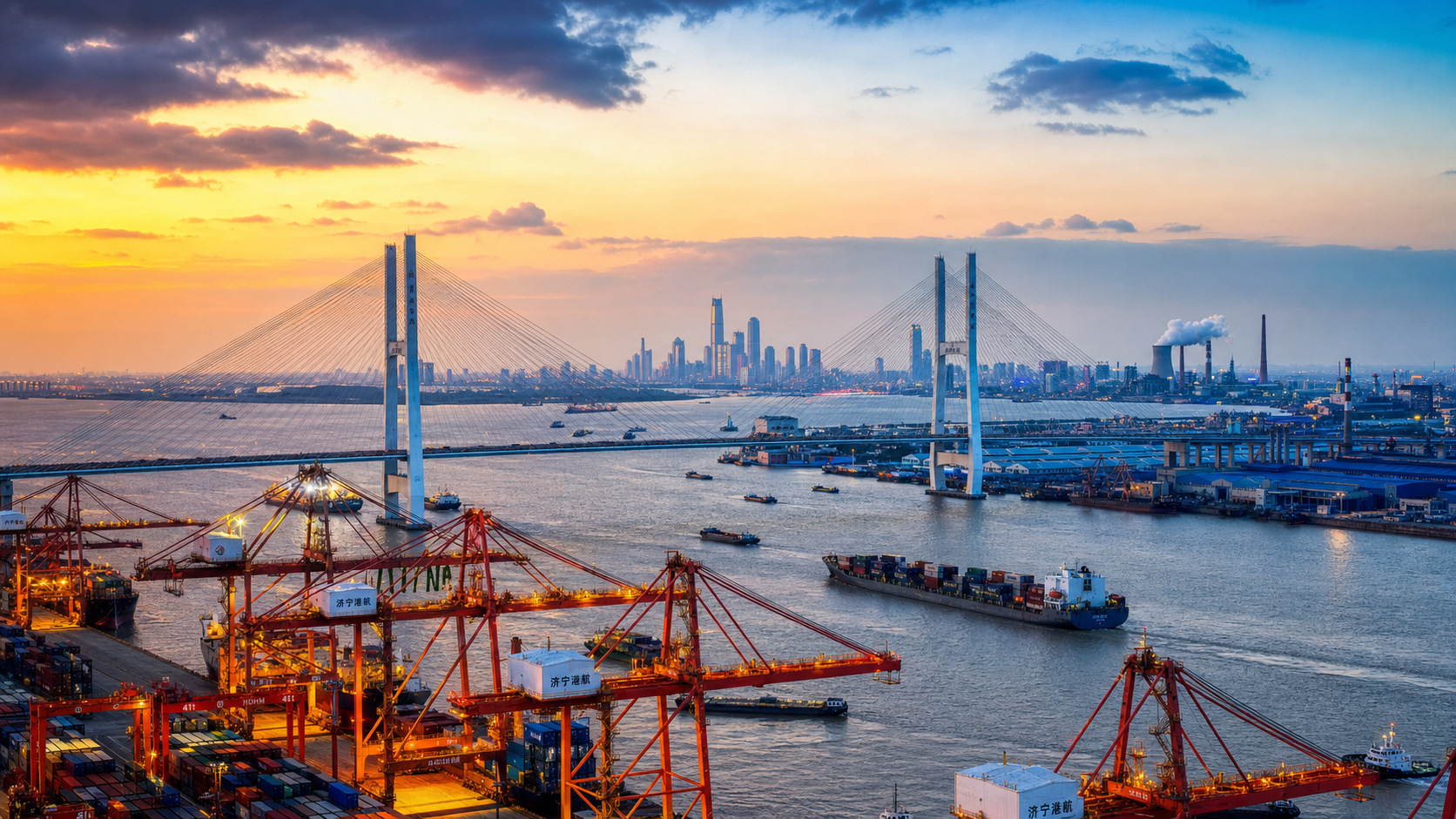
Nantong | Economically larger than many European countries: The secret of China's unknown super-city – Creative image on the topic, with AI: Xpert.Digital
In the shadow of Shanghai: How this metropolis of millions became a global economic power
From fishing village to high-tech giant: Shipbuilding, high-tech and a huge problem – The two faces of the Chinese metropolis Nantong
Nantong, a strategically perfectly situated metropolis at the mouth of the Yangtze River, is hardly known in the West – yet it is a gigantic economic engine of China. With a gross domestic product that easily rivals that of medium-sized European economies, the city, in the immediate shadow of Shanghai, has transformed itself from a traditional textile stronghold into a global high-tech and shipbuilding giant. Massive infrastructure projects, such as gigantic bridges, are increasingly connecting the burgeoning region with the economically powerful Yangtze Delta. But behind the glittering facade of rapid growth and enormous international investment lies a major challenge: Nantong has the highest rate of population aging in the country and is considered a demographic laboratory for China's future. The following article examines the rapid rise, the clever industrial policy strategies, and the structural risks of an industrial metropolis that exemplifies the future of the entire Chinese economy.
With a gross domestic product of around 1.28 trillion yuan or about 184.5 billion US dollars in 2025, Nantong surpasses the total economic output of numerous European countries – such as Croatia, Bulgaria, Lithuania, Latvia, Estonia or Slovakia, whose gross domestic products are all lower.
Nantong – China's underestimated industrial metropolis
From river to global market power: How a little-known city became China's key
At the mouth of the Yangtze River where it flows into the Yellow Sea lies a city that is hardly known outside of China, yet it ranks among the country's most economically significant metropolitan areas. Nantong, in Jiangsu Province, generated a gross domestic product of over 1.28 trillion yuan in 2025, equivalent to approximately US$184.5 billion, representing a real growth rate of 5.3 percent compared to the previous year. This figure alone would be enough to place Nantong on par with medium-sized European economies, but the city's true significance lies deeper: in its strategic location in Shanghai's commuter belt, its centuries-old industrial tradition, and its role as one of the world's leading shipbuilding centers. Anyone seeking to understand how China is diversifying its economic base and building regional growth engines beyond its well-known megacities cannot ignore Nantong.
Favorable geographical location as an economic lever
Nantong lies on the northern bank of the Yangtze River, directly opposite Shanghai, and is administratively part of Jiangsu Province, one of China's most economically powerful provinces. The city is unique in Jiangsu for its location on both a major river and the sea, boasting 66 kilometers of Yangtze River shoreline and 206 kilometers of Yellow Sea coastline. This dual access allows for both cost-effective inland transport via the river and direct access to international maritime trade routes, making Nantong a natural hub for imports and exports. After Taicang and Kunshan, Nantong is considered the third largest of the smaller cities in the immediate vicinity of Shanghai and currently generates nearly nine percent of Jiangsu Province's total GDP.
The geographical proximity to Shanghai, combined with significantly lower land and labor costs, has made Nantong a preferred alternative location for decades for companies that wanted to benefit from the metropolitan area's infrastructure without having to pay the prices there. This situation is no accident, but rather the result of a deliberate policy of Yangtze River Delta integration, which systematically brings Nantong closer to Shanghai.
Bridge structures as a symbol of integration
Few other Chinese cities have invested as heavily in Yangtze River crossings in recent years as Nantong. The Shanghai-Suzhou-Nantong Yangtze River Bridge, opened in 2020, spans 11,072 meters and reduced travel time between Nantong and Shanghai from 3.5 hours to just over an hour. The Hutong Bridge, a double-deck road and rail bridge completed in 2021 with a main span of 1,092 meters, connects Nantong with Zhangjiagang and is one of the most technically sophisticated structures of its kind in the world. In total, the city now boasts a transportation network comprising 17,524 kilometers of highways, 428 kilometers of railway lines, and 3,207 kilometers of waterways.
Since 2021, Nantong has invested approximately ten billion yuan annually in transportation infrastructure, reaching 41 billion yuan in 2023 – more than one-seventh of the province's total spending in this sector. Further major projects, such as the Haitai Yangtze Tunnel and the Zhangjinggao Yangtze Bridge, are currently under construction and are intended to complete the so-called Eight River Crossings structure, which will further integrate Nantong with the rest of the Yangtze Delta. This infrastructure initiative is more than just transportation policy; it is a deliberate effort to transform Nantong from Shanghai's shadow into an equal partner within the economic region.
Shipbuilding as an industrial crown jewel
No other sector shapes Nantong's global reputation as much as shipbuilding. In 2025, the city's shipbuilding and offshore engineering industry achieved a total output of over 220 billion yuan, an increase of 6.6 percent compared to the previous year. This places Nantong in a Chinese success story that extends far beyond the city limits: In 2025, Chinese shipyards secured 1,421 new ship orders worldwide, totaling 35.37 million gross tonnage compensated, thus holding a global market share of 63 percent, significantly ahead of South Korea. As early as 2022, China's market share in shipbuilding, at 47 percent, had already surpassed the combined share of Japan and South Korea for the first time.
Within this national rise, Nantong plays a pioneering role. The Qidong-based shipyard Nantong CIMC Sinopacific Offshore and Engineering specializes in the construction of tankers for liquefied natural gas (LNG), liquefied ethylene (LNG), and liquefied petroleum gas (LPG), achieving a leading global market share in this specialized segment. Its parent company, China International Marine Containers, a major player in the industry, has also held a leading global position since 1996, with over 40 percent market share in the international container business and 56 percent in the dry cargo container market. This concentration of world market leaders clearly demonstrates that Nantong is not only regionally but also globally competitive.
From textile town to high-tech production base
Nantong's industrial history stretches back much further than the reform policies of the 1980s. As early as 1899, the renowned Chinese industrialist and educational reformer Zhang Jian founded a cotton mill in the city, laying the foundation for a textile tradition that continues to shape the city today. This historical depth gives Nantong an industrial culture that many of China's more recent boomtowns lack. Today, the city produces 1,350 bedding sets, 670 blankets, and 340 pillows every minute, totaling over 1.2 billion home textile products annually. Approximately 70 to 80 percent of all bed sheets, blankets, and mattresses sold online in China originate in Nantong.
At the same time, over the past two decades, the city has consistently shifted its focus from purely light industry to technology-intensive manufacturing. Between 2012 and 2021, the number of high-tech companies in Nantong rose from 390 to 2,370, while an industrial system emerged that established shipbuilding, high-quality textiles, and electronic information technology as its mainstays, complemented by smart manufacturing, new materials, new energy sources, and electric vehicles as emerging growth areas. ZTT Group, specializing in information communication, smart grids, and precision industrial equipment, is now the city's largest manufacturer. The former textile city has thus transformed itself into a diversified industrial metropolis without completely abandoning its traditional strengths.
Six billion clusters as a growth engine
Nantong's economic planning focuses on six industrial clusters, each with a production value exceeding 100 billion yuan: shipbuilding and marine technology, high-end textiles, new materials, next-generation information technology, high-end equipment technology, and new energy. From January to November 2023, these six clusters collectively generated 982.51 billion yuan in revenue, a 10.5 percent increase over the same period of the previous year, while the total value of these clusters is projected to exceed 1.2 trillion yuan in 2024.
This cluster strategy follows a clear industrial policy pattern: The city is strategically focusing on combining the revitalization of traditional industries, the expansion of established growth sectors, and the cultivation of entirely new future industries. For the period up to approximately 2029, Nantong has defined six future industries, including aerospace, marine technology, energy, materials science, communications technology, and healthcare. Particular attention is being paid to niche fields such as the so-called low-altitude economy, deep-sea equipment, new energy storage solutions, third-generation semiconductors, general artificial intelligence, and cell and gene technology. To finance these future sectors, the city plans to establish more than ten investment funds with a total subscribed capital of over five billion yuan.
The NETDA economic zone as an investment magnet
A key institutional component of Nantong's success model is the Nantong Economic and Technological Development Area, or NETDA, which was established in December 1984 as one of China's first 14 national development zones. The zone ranks 21st nationwide among nearly 300 comparable economic zones, according to the Chinese Ministry of Commerce's ranking. Despite comprising only 2.1 percent of Nantong's land area and four percent of its population, NETDA generates approximately 7.8 percent of the city's gross domestic product, ten percent of its tax revenue, and 35 percent of its foreign direct investment.
International investors have already invested more than US$30 billion in over 900 manufacturing or research facilities in this zone, focusing on biomedicine and life sciences, electronic information technology, new materials and green chemistry, and advanced services. NETDA aimed for economic growth of around 6.8 percent by 2025, coupled with an increase in research and development spending to over 4.1 percent of total output. This concentration of capital, tax incentives, and administrative efficiency in a clearly defined zone is a typical element of Chinese industrial policy, which has been implemented particularly consistently in Nantong.
🎯🎯🎯 Data-driven B2B industry hub as a quasi-in-house solution

The quasi-in-house solution: How Xpert.Digital closes operational gaps in B2B marketing and sales – Smart Content-Driven Business - Image: Xpert.Digital
Xpert.Digital is a data-driven B2B industry hub led by Konrad Wolfenstein . The company acts as an external, quasi-in-house solution for industrial partners, closing operational gaps in marketing, content, and sales – without requiring additional resources on the client side.
More information here:
This is how Nantong is coping with structural change in the Chinese industrial belt
Foreign trade and international networking
Over the past four decades, Nantong has transformed from an insignificant fishing port into an internationally connected trading hub. Cargo throughput at the Port of Nantong increased from 3.06 million tons in 1978 to 340 million tons in 2023, while container throughput first exceeded one million TEU in 2017. Today, the port maintains shipping routes to 312 ports in 96 countries and regions. In the first three quarters of 2025, Nantong's foreign trade grew by 17.3 percent to 333.98 billion yuan, with exports increasing by 23.9 percent to 230.62 billion yuan.
Also noteworthy is the dynamism of cross-border e-commerce, whose transaction volume exploded by 63.4 percent to 7.89 billion yuan during the same period. The city also symbolically underscores its technological ambitions: In 2025, a satellite manufactured in Nantong was successfully launched for the first time, while value creation in strategically emerging service industries increased by 14.4 percent. This combination of traditional port trade, growing e-commerce, and emerging high-tech exports demonstrates that Nantong is continuously broadening its economic base rather than relying on individual sectors.
The aging trap as a structural risk
Behind the impressive facade of growth, however, lies a demographic challenge that makes Nantong a harbinger of China's future as a whole. The city already achieved the status of a deeply aging society in 1983, defined by a population of at least 14 percent aged 65 or older, 17 years ahead of the Chinese national average. The 2020 census showed that 30.1 percent of Nantong's population was 60 or older and 22.67 percent was 65 or older, while the national average was only 18.7 and 13.5 percent, respectively. This makes Nantong the most aging city among all 149 Chinese cities now classified as having a deeply aging population.
The causes of this development lie deep in past population policies: Nantong's cumulative one-child rate reached 78.6 percent, the highest in all of Jiangsu Province, while at the same time large numbers of young, working-age people and students are migrating to other regions or abroad. Average life expectancy in the city reached 82.61 years at the end of 2019, 5.3 years above the national average. While this reflects social and medical progress, it also significantly exacerbates the strain on social welfare and long-term care systems. In Rudong County, which is part of Nantong, the proportion of people over 60 is even higher, at 39 percent, a figure that further underscores the region's extreme demographic situation.
Social policy responses to demographic change
Given this situation, Nantong was chosen as one of the first pilot cities for a long-term care insurance system. By the end of 2019, 7.5 million people were already covered by this system, with 25,727 actually receiving benefits. The number of care facilities in the city increased from just six homes with fewer than 1,000 beds in 2016 to 254 facilities in 2020. This represents a significant quantitative expansion, but it still seems insufficient compared to other pilot cities like Qingdao, which has over 850 care facilities.
All new housing developments in Nantong are now required to include buildings for elderly care, while older neighborhoods are encouraged to provide at least 20 square meters of care space for every 100 households. The city currently has 2,331 elderly care facilities with a total of 92,000 beds, designed to ensure a seamless transition between institutional, community, and home-based care. These measures demonstrate that Nantong is not only an economic laboratory but also a socio-political testing ground for all of China, whose population is projected to develop similarly to Nantong's current trends by 2035.
Growth rate compared to other billion-plus cities
In a nationwide comparison of China's so-called trillion-yuan cities—metropolises with a gross domestic product exceeding one trillion yuan—Nantong exhibits solid, though not spectacular, growth. The city surpassed the trillion-yuan mark in 2020, positioning itself as one of 24 Chinese cities of this size at that time. Between 2013 and 2021, Nantong's economy grew by an average annual rate of 8.4 percent, a pace that exceeded the national average by 1.9 percentage points and the provincial average by one percentage point.
More recently, however, the growth rate has slowed considerably and is now in the middle range of China's growth landscape. During the first half of the 14th Five-Year Plan, between 2021 and 2025, the economy grew by an average of 5.4 percent annually. The discrepancy between real and nominal growth in 2025 is also noteworthy: while real growth reached 5.3 percent, nominal growth was only 3.1 percent, the lowest among all 13 cities in Jiangsu Province. This suggests persistent price pressures or weak deflationary effects in the local economy. Per capita GDP reached approximately 166,000 yuan in 2025, an increase of 5.5 percent year-on-year, while per capita disposable income rose to 57,242 yuan.
Skilled workforce and educational infrastructure
Nantong's industrial transformation would be virtually inconceivable without a corresponding education and training infrastructure. The city now boasts six universities and thirty vocational training centers, specifically designed to train skilled workers for its growing industrial clusters. This investment in human capital is particularly important given the city's aging population, as Nantong must simultaneously contend with a shrinking pool of young workers and a continuing exodus of well-educated young people to more economically attractive regions like Shanghai.
The focus on innovation is also evident in concrete infrastructure investments: The city has established ten provincial-level laboratories and fifteen public technology service platforms, also at the provincial level. In 2023, more than 1,600 local scientific and technological innovation projects were implemented, while the value creation of industrial enterprises above a defined size threshold was among the highest in Jiangsu Province. This systematic integration of education, research, and industrial application explains why Nantong has been able to maintain its position as a leading industrial center despite a shrinking and aging workforce.
Assessment of economic prospects
Nantong's economic success story rests on a rare combination of locational advantages, historical industrial depth, and consistent government governance. However, the city's future prospects are by no means without risks. On the positive side, it boasts a highly diversified industrial structure, ranging from traditional textiles and world-class shipbuilding to emerging future-oriented sectors such as semiconductors and aerospace technology. This is complemented by one of the best transportation infrastructures in China and a strategic proximity to Shanghai, which is continuously being expanded. The enormous international investment activity in the NETDA zone, coupled with its global leadership in shipbuilding and certain container segments, gives the city a resilience to economic fluctuations that many other medium-sized Chinese cities lack.
On the risk side, however, lies the demographic reality of a city that already exhibits the age profile that China as a whole is not expected to reach until around 2035. This pioneering role in aging brings with it rising social costs, a shrinking proportion of the working-age population, and increasing competition for skilled workers, while at the same time the nominal slowdown in growth in 2025 points to structural price pressures that can also be observed elsewhere in China. Nantong thus exemplifies a dilemma shared by many mature Chinese industrial centers: The transition from a growth model based on mass production and cost advantages to one based on innovation, value creation, and services must succeed precisely when the demographic base is already beginning to shrink noticeably. Whether the massive investment in future industries such as artificial intelligence, semiconductors, and aerospace technology will be sufficient to successfully manage this transition will be decided in the coming years and is likely to have a far-reaching impact on the overall development of the Chinese economy, extending well beyond the borders of this one city.
📈🚀 From visibility to trust 👀🤝 Your scalable path with Xpert.Digital

From visibility to trust: Your scalable path with Xpert.Digital - Image: Xpert.Digital
In industrial B2B, sustainable business relationships rarely emerge overnight. They develop step by step – through visibility, professional relevance, recurring touchpoints, and growing trust. Xpert.Digital's 4-stage model addresses precisely this: It offers a structured path that begins with a manageable entry point and can evolve into deeper collaboration in business development if needed.
Instead of relying on loud marketing promises, this model puts the relationship at the forefront. Companies start with clearly defined, easily calculable measures and then decide, based on their own experience, how far they want to expand the collaboration. A key factor for this undisturbed trust-building process: The platform completely avoids annoying advertising ads, so the editorial focus remains solely on the companies' expertise.
More information here:
Your global marketing and business development partner
☑️ Our business language is English or German
☑️ NEW: Correspondence in your native language!

Konrad Wolfenstein
I and my team are happy to be available to you as your personal advisor.
You can contact me by filling out the contact form here [email protected]:or simply call me at +49 7348 4088 965. My email address is
I'm looking forward to our joint project.





