
The opportunistic expert Daniel Stelter – Germany's energy future between data reality and consultant narratives
Xpert Pre-Release

Available in 27 languages 📢
Prefer Xpert.Digital on GoogleⓘPublished on: April 26, 2026 / Updated on: April 26, 2026 – Author: Konrad Wolfenstein
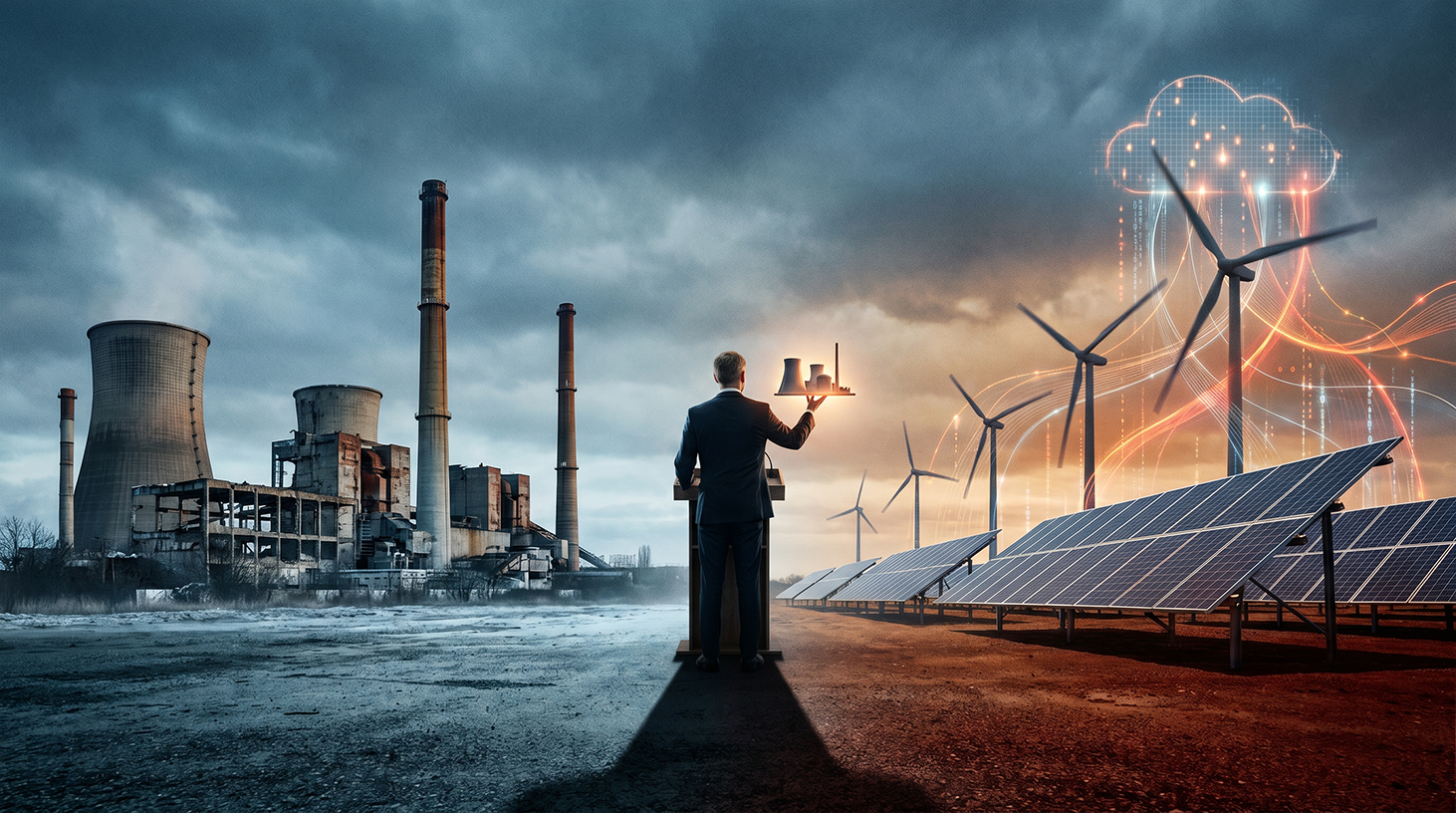
The opportunistic expert Daniel Stelter – Germany's energy future between data reality and consultant narratives – Image: Xpert.Digital
"Crash – How we save Germany" – Those who make their living from complexity like to simplify it
Daniel Stelter warns of the “crash” – but his rescue plans have a huge flaw
The nuclear power illusion: Why "top consultants" are misleading us in the energy crisis
In his book "Crash," Daniel Stelter paints a dramatic picture of the German economy—a plane in freefall that can only be saved from impact by radical course corrections such as a return to nuclear power. But does this crowd-pleasing rhetoric from a former top management consultant stand up to a real data check? While the structural challenges facing Germany as an industrial location are undoubtedly real, ranging from exploding energy prices to neglected infrastructure, populist pseudo-solutions fall short. Those who reduce the complex structural transformation to catchy bestseller theses not only ignore the gigantic costs and construction times of European nuclear projects, but also reveal the mechanisms of a consulting market that thrives on sensationalism. This is a critical analysis of the business of fear, the limits of economic simplification, and the question of what Germany's energy future truly needs.
The image of the airplane and its rhetorical function
Daniel Stelter, founder of the forum "Beyond the Obvious" and former senior partner at the Boston Consulting Group (BCG), published a new book in April 2026 entitled "Crash – How We Save Germany." In it, he describes Germany's economic situation using the image of an airplane that has been losing altitude since 2018. The image is rhetorically effective – and precisely for that reason, it deserves critical examination. Because powerful metaphors are no substitute for data, and dramatic titles sell better than nuanced analyses.
This isn't a random observational error. It's a structural pattern in the German expert community: Anyone who wants to be successful as a consultant, author, or podcast host has to generate visibility. Visibility arises from clarity, conciseness, and a recognizable thesis. The thesis "Germany is collapsing – and I'll explain why" is more commercially appealing than "Germany has complex structural challenges for which there are no easy solutions." Stelter himself is now co-host of a podcast with the programmatic title "MEGA – Make Economy Great Again" and has been producing his BTO podcast weekly since autumn 2019, which regularly appears in the German charts. Books like "The Fairy Tale of the Rich Country" made it onto the Spiegel bestseller list. This is the grammar of a media economist, not a neutral analyst.
When the "black zero" is declared an illusion
Stelter describes the so-called balanced budget as an "illusion" because infrastructure deteriorated and long-term commitments were made under its auspices. This is partly true – and partly an oversimplification intended to support his fundamental position. The balanced budget did indeed come at a price: The backlog of investment in schools, railways, bridges, and broadband is well-documented and has been the subject of serious economic policy criticism for years. Between 2010 and 2023, Germany neglected net public investment while simultaneously increasing social spending.
What Stelter largely overlooks, however, is that the balanced budget policy also guaranteed fiscal leeway in times of crisis. When the coronavirus pandemic hit in 2020 and the Russian attack on Ukraine shook the energy supply in 2022, Germany was able to respond with enormous fiscal stimulus packages precisely because it had no excessive legacy debt to service. This connection is not a contradiction to the criticism of the investment backlog, but rather its necessary complement. Anyone who views policy through only one lens reduces the analysis to mere polemics.
Recession in numbers – but which numbers?
Germany's economic situation is serious – that much is clear. According to revised data from the Federal Statistical Office, gross domestic product (GDP) shrank by 0.9 percent in 2023 and by 0.5 percent in 2024. After two years of recession, the German economy recorded minimal growth of 0.2 percent in 2025. The German Economic Institute (IW) had even predicted a further contraction for 2025, while other institutes were somewhat more optimistic. GDP per capita in 2024 was below the 2018 level. This is not a period of weakness; it is a structural decline that has been ongoing for years.
The industrial sector lost an average of 392 jobs per day in 2025 – a total of 143,000 manufacturing jobs. At Volkswagen, ZF Friedrichshafen, Thyssenkrupp, Audi, Siemens, Ford, Bosch, Schaeffler, and numerous other companies alone, hundreds of thousands of job cuts were announced in 2025. Company insolvencies rose by 21 percent in April 2025 compared to the same month of the previous year. These are dramatic figures that cannot be downplayed.
However, it must also be noted that the manufacturing sector's share of real gross value added has remained largely stable since 2010, despite all these crises. The structural shift towards a service-based economy is an international phenomenon affecting all advanced economies. The narrative of a "free fall" is therefore more dramatic than a precise diagnosis – even if the need for action is real.
Energy prices as a structural problem – but not a nuclear one
The core problem for Germany as a business location lies to a significant extent in its energy price structure. In 2024, the average industrial electricity price in Germany was 14 cents per kilowatt-hour – higher than the European average of 12 cents. In France, industry pays an average of 8 cents, in Spain 9 cents, and in Norway only 5 cents. Industrial customers in North America pay only half as much as German companies. According to the Bruegel think tank, industrial electricity tariffs in the EU were 158 percent higher than those in the US in 2023. This is not a marginal discrepancy; it is a competitive problem of systemic importance.
The consequences are visible: According to the DIHK Energy Transition Barometer 2025, 41 percent of all companies and 63 percent of industrial companies see their competitiveness at risk. Investments in core processes, climate protection, and research are being postponed. Energy-intensive sectors – steel, chemicals, glass, paper – are facing a decision: maintain their locations or relocate production. Stelter warns that there are only about 24 months left to save these energy-intensive industries. This sounds dramatic, but it has a basis in reality.
The question, however, is not whether energy prices are a problem – they are – but rather what the right solution is. And it is precisely at this point that Stelter abandons the groundwork of a complete analysis.
The nuclear energy argument – a simplification with an expiration date
When Stelter and like-minded voices present a return to nuclear energy as the essential answer to Germany's energy problems, it's a thesis that, while effective in attracting public attention, doesn't stand up to serious cost scrutiny. The historical and current data on nuclear construction projects in Western Europe is unequivocal.
The Flamanville 3 reactor in France started construction in 2007, was originally scheduled for completion in 2012, and was built at a cost of €3.3 billion. It finally went online at the end of 2024 – twelve years later – at a cost of €23.7 billion, according to EDF. The French Court of Auditors even estimated the total costs, including financing, at up to €19.1 billion – other sources cited even higher figures. The Finnish Olkiluoto 3 power plant ultimately cost around €11 billion instead of the planned €3.2 billion and took 18 years to build instead of four. The British Hinkley Point C – a two-reactor project – is expected to cost the equivalent of around €50 billion; that's about €25 billion per reactor unit. Commissioning is now expected no earlier than 2029, instead of the original 2025. The British Court of Auditors criticized the project as "risky and expensive, with uncertain strategic and economic benefits.".
France's energy giant EDF is planning six new EPR2 reactors. The costs are estimated at €72.8 billion – in 2020 prices, i.e., without current inflation – and the first reactor is not expected to go online until 2038 at the earliest. The reactor design is not even fully finalized when the final investment decision is to be made in 2026.
What does this mean for Germany? A country that has dismantled its nuclear infrastructure would not only have to build new reactors, but also rebuild its knowledge, supply chains, licensing authority, and personnel capacity from scratch. The decommissioning of Germany's nuclear power plants will continue for decades: The Greifswald power plant near Lubmin, originally planned to be dismantled by 2028 at a cost of 3 to 5 billion euros, now costs at least 10 billion and will not be completed until 2045 at the earliest. The dismantling alone is costing several times the original estimates – and that's without building a single new reactor.
Anyone calling for a nuclear energy transition in Germany in 2026 must explain when the first new reactor would be connected to the grid – at the earliest in 2045 – and what will happen to the 20-year energy supply gap until then. They must explain where the 25 to 50 billion euros per reactor unit are supposed to come from when household budgets are under pressure. And they must explain why a technology whose large-scale projects in Europe have led to 100 percent cost overruns and delays lasting several years or even decades should be feasible under better conditions in Germany.
The energy transition – expensive, but already on track?
This question deserves an honest answer, one that can do without either sugarcoating or apocalyptic rhetoric. A study conducted by the research institute Frontier Economics for the DIHK (Association of German Chambers of Industry and Commerce) concludes that the total costs of current energy transition policies could amount to between 4.8 and 5.4 trillion euros between 2025 and 2049. Grid infrastructure alone accounts for approximately 1.2 trillion euros, and energy imports for 2.0 to 2.3 trillion euros. From 2030 onward, annual system costs for generation, grids, operation, and imports will rise to between 212 and 257 billion euros. This is undoubtedly an enormous economic burden.
At the same time, electricity generation from renewable sources reached a new high in 2024, accounting for 59.4 percent. According to Fraunhofer ISE, ground-mounted photovoltaic systems and onshore wind turbines, with levelized costs of electricity (LCOE) ranging from 4.1 to 9.2 cents per kilowatt-hour, are not only the cheapest renewable energy technologies, but also the most cost-effective of all power plant types in Germany. These costs are expected to decrease further by 2045. Fossil fuel alternatives had LCOE ranging from €109 to €326 per megawatt-hour in 2024 – significantly more expensive than renewable sources.
In 2024, Germany imported 26.3 billion kilowatt-hours more electricity than it exported – almost three times the amount imported in 2023. The main supplier was France, followed by Denmark and Switzerland, which rely heavily on nuclear power. This demonstrates that the lack of baseload power is a real problem. However, it is a problem of storage and system design – not one that can be solved solely with nuclear power. The import surplus did not arise from supply shortages, but because electricity was cheaper to generate abroad than domestically. This is a different problem – and requires different solutions.
Our EU and German expertise in business development, sales and marketing

Our EU and German expertise in business development, sales and marketing - Image: Xpert.Digital
Industry focus areas: B2B, digitalization (from AI to XR), mechanical engineering, logistics, renewable energies and industry
More information here:
A thematic hub offering insights and expertise:
- Knowledge platform covering global and regional economies, innovation and industry-specific trends
- A collection of analyses, insights, and background information from our key areas of focus
- A place for expertise and information on current developments in business and technology
- A hub for companies seeking information on markets, digitalization, and industry innovations
Consultants, billions, bubbles: Who benefits from the SMR debate?
Small Modular Reactors – Future Project or Billion-Dollar Bet?
Small Modular Reactors (SMRs) are gaining attention in the international energy debate. Proponents of nuclear power often point to SMRs as a more cost-effective and faster-to-build alternative to large reactors. The picture is enticing – but considerably more complex upon closer inspection.
Canada launched its first commercially viable SMR program in 2025: Ontario Power Generation began site preparation for four SMR units in Darlington. The program is estimated to cost 21 billion Canadian dollars – the first unit alone cost around 5.5 billion dollars. In Germany, with current construction costs and regulatory requirements, this would be significantly more expensive. SMR projects announced for Microsoft in the US anticipate capital costs of up to 15,000 US dollars per kilowatt of installed capacity for first-of-a-kind units. Optimistic estimates for next-of-a-kind units project costs to drop to 6,000 dollars per kilowatt – but this assumes mass production, which currently doesn't exist anywhere in the world. An analysis shows that entering SMR production only becomes economically viable at around 3,000 units. Globally, fewer than ten commercial units are currently in the planning stages.
The levelized cost of electricity (LCOE) for SMRs is also uncertain: estimates range from 50 to 120 US dollars per megawatt-hour. In the best-case scenario, this would be competitive with existing systems – but worse than wind power and photovoltaics, which already generate less than 10 cents per kilowatt-hour. SMRs are technologically interesting and could be useful in specific contexts – however, at their current stage of development, they are not suitable as a general solution to Germany's energy problem.
What really needs to be built
If Germany's nuclear power infrastructure has already been effectively dismantled – the power plants are shut down, decommissioning is underway, and expertise and supplier industries have largely disappeared – then the relevant question is not a return to the past, but shaping the future. Germany faces an epochal investment challenge: The necessary annual investments in energy, industry, buildings, and transportation must increase from around €82 billion (average for the years 2020 to 2024) to at least €113 to €316 billion by 2035. This corresponds to an increase in total private investment of 15 to 41 percent.
These investments could flow into storage technologies – battery systems, pumped storage, power-to-X – the further expansion of renewable energies, grid stabilization, smart load management, and energy efficiency. Studies show that German industry could save up to 44 percent of its final energy consumption through economically viable efficiency measures – without any production restrictions. This would be an immediately effective lever that doesn't require decades of construction time and doesn't represent a billion-euro gamble on unproven technologies. Those who don't prioritize these options but instead promote nuclear power are wasting political energy that is needed for real solutions.
The economics of consultant presence
One aspect that receives too little attention in the public debate is the interest structure of those who present themselves as economic experts. Stelter spent 22 years at the Boston Consulting Group, rising to the position of Senior Partner and Managing Director, serving on the Executive Committee, and leading the Corporate Strategy and Finance practice from 2003 to 2011. Since 2013, he has been self-employed, advising companies, family offices, and high-net-worth individuals, writing books, producing podcasts, and giving lectures.
This isn't a personal attack. It's a sober description of a business model. Visibility is capital. Anyone considered THE economic critic in the German media landscape earns a good living. Books on the Spiegel bestseller list generate demand for lectures, consulting engagements, podcast listeners, and media appearances. This logic rewards sensationalism and penalizes nuance. The statement "Germany is collapsing" attracts more attention than "Germany has specific structural problems in energy, investment, and labor market policy that require differentiated sectoral solutions." This isn't a criticism of Stelter alone—it's the systemic logic of the expert market.
The German federal government and its ministries have spent billions on external consulting services in recent years: Between 2020 and 2023, this figure rose by 39 percent to almost €240 million annually. In 2017, it was even €722 million. McKinsey, BCG, Roland Berger, the Big Four – they all benefit from a system in which political decision-makers rely on external expertise because knowledge has been diminished within their own administrations. And the consultants have a structural interest in identifying new problems for which they can offer new solutions. This doesn't make their diagnoses wrong – but it does make independence an illusion.
The failure of the consulting culture as a contribution to the failure of Germany
The Federal Court of Auditors has repeatedly pointed to the systemic dependence of public administration on a small group of globally operating consulting firms and has seen the "integrity of the administration" as being at risk. Ministries, particularly the Federal Ministry of the Interior and the Federal Ministry of Finance, outsource core tasks to external consultants. The case studies are well-known: the consulting scandal at the Ministry of Defense, the car toll debacle, the chronic failures in the federal government's IT modernization. In 2024, BCG admitted to having paid approximately $4.3 million in bribes in Angola between 2011 and 2017 to secure government contracts. This is an isolated incident—but not one that should leave self-promotion about moral superiority and superior expertise unchallenged.
When consulting firms and former management consultants write a chapter on the "Agenda 2035" for Germany—as McKinsey, BCG, and Roland Berger did jointly for Handelsblatt—it's certainly not motivated purely by altruism. Rather, it's advertising: visibility generates follow-up contracts. And follow-up contracts secure the business model. The German consulting market reached €51.4 billion in 2025. Anyone who contributes relevant theses to the public debate in this market positions themselves as an indispensable interlocutor.
Related to this:

The energy system of the future does not have a simple blueprint
The honest assessment is this: there is no solution to Germany's energy problem that is fast, cheap, safe, and climate-neutral all at once. Every technological path has costs, risks, and time requirements. Given the dismantled infrastructure, the lack of capacity, and the documented cost explosions in all new European nuclear power plant projects, nuclear energy's window of opportunity for Germany has closed for the foreseeable future. This is not an ideological statement, but an economic reality.
Renewable energies are currently the most cost-effective form of electricity generation – but they do not produce a stable baseload profile. The gap between generation and demand during periods of low wind and solar power generation must be bridged by storage, load management, import capacities, gas-fired backup power plants, or a combination of all these elements. This is solvable – but it requires systems thinking rather than a purely technological approach.
Germany's situation in 2026 is fundamentally different from that of the 1960s and 1970s, when the existing nuclear power plants were planned and built. The starting conditions – regulatory, economic, technological, and social – are not comparable. Ignoring this might provide a catchy thesis for the book market, but it doesn't offer a sound basis for energy policy.
The cost of failure – and the cost of misdiagnoses
Stelter aptly titles his book "After Failure." The costs of failure in German energy policy are real: excessively high electricity prices, declining industrial competitiveness, reluctance to invest, and the relocation of energy-intensive production. These costs don't affect abstract corporations, but concrete people – workers, regions, and supply chains.
But there are also costs associated with incorrect diagnoses. When political debate is driven by simplistic narratives – nuclear power as a universal savior, the energy transition as an ideological project without a basis in market logic, consultants' self-promotion as expertise – then political energy is wasted on pseudo-solutions, while the actual problem areas remain unaddressed.
The truly urgent tasks are different: an ambitious energy efficiency program for industry that delivers immediate results; a massive expansion of storage and grid capacities; greater integration of the European energy market; targeted location subsidies for energy-intensive industries during a transitional phase; and an investment offensive in digital and physical infrastructure, which is urgently needed regardless of the energy pathway. For these tasks, Germany doesn't need advisors who dramatize its "failure" to position itself as a savior. It needs data, patience, and the political courage to defend complex solutions against simplistic messages.
Economic analysis requires epistemic humility
It is the hallmark of a true expert to know and communicate the limits of their own knowledge. Energy policy is not a field for business management checklists. It intertwines technology, infrastructure, geopolitics, social acceptance, access to capital markets, regulation, and temporal dynamics in a way that no single discipline can fully capture. Stelter has expertise in corporate strategy and macroeconomics. That is valuable. But it is not the same as expertise in energy systems.
The difference between an analyst with a sense of mission and a true energy expert lies not in the loudness of their pronouncements, but in their willingness to confront the complexity. Germany doesn't need simplifiers who sell old concepts as innovation. It needs people who have the courage to say: The solution is difficult, it will take a long time, it will be expensive, and there is no single lever that will fix everything at once. Anyone who can't or won't say that might be a good author. But that doesn't make them a good advisor for Germany's energy future.
Your partner for business development in the fields of photovoltaics and construction
From industrial rooftop PV to solar parks and larger solar parking lots
☑️ Our business language is English or German
☑️ NEW: Correspondence in your native language!

Konrad Wolfenstein
I and my team are happy to be available to you as your personal advisor.
You can contact me by filling out the contact form here or simply call me at +49 7348 4088 965. My email address is : [email protected]
I'm looking forward to our joint project.





