
Germany's missed solar revolution – yet again: Why 16 million roofs can deliver more than Europe's nuclear dreams
Xpert Pre-Release

Language selection 📢
Published on: March 11, 2026 / Updated on: March 11, 2026 – Author: Konrad Wolfenstein
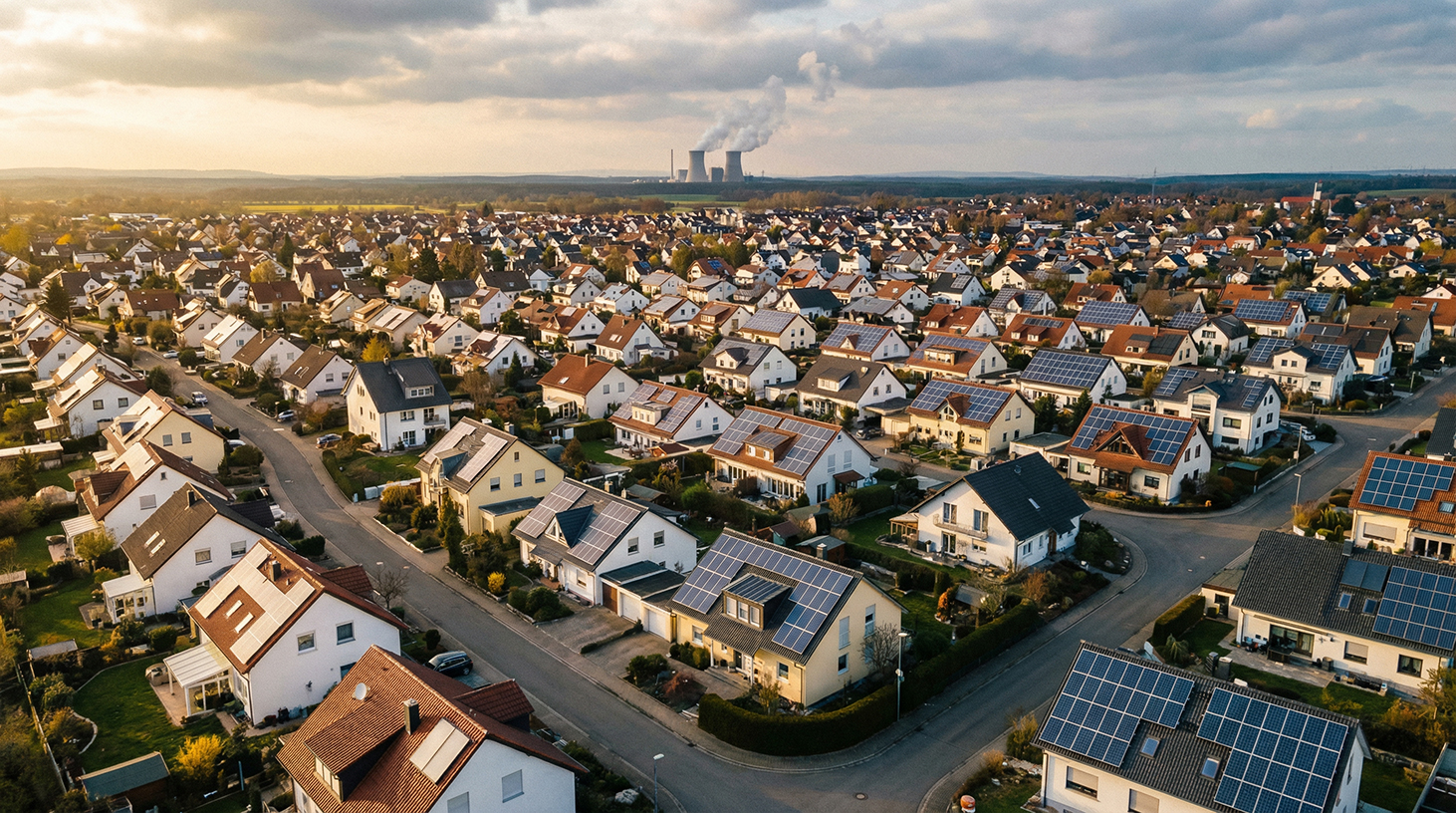
Germany's missed solar revolution – yet again: Why 16 million roofs can deliver more than Europe's nuclear dreams – Creative image: Xpert.Digital
Berlin is putting the brakes on the world's largest decentralized power plant, while Brussels is channeling 240 billion euros into a late nuclear renaissance
While the EU Commission plans to invest more than 240 billion euros in nuclear capacities by 2050, Germany could unlock its entire single-family and two-family house potential for significantly less
It's a political tragedy that fits seamlessly into the recent economic and technological history of the Federal Republic: Germany is once again tucking its tail between its legs. Instead of consistently and wholeheartedly pursuing bold and innovative developments to their conclusion, it capitulates halfway through out of sheer cowardice. This chronic timidity is systemic and underpins a worrying trend, for which there are numerous bitter examples in the recent past: Whether it was the reckless sell-off of Germany's once-flagship solar industry to Asian competitors in the 2010s, the constant hesitancy in expanding digital infrastructure, the sudden, panic-driven end to subsidies for electric cars, or the systematic burying of once-promising technologies like the Transrapid – as soon as the headwinds become a little rougher or major investments require genuine decisiveness, German politics caves in.
This same fatal pattern is now repeating itself with the decentralized energy transition. Instead of transforming the 16 million single-family homes into the world's largest, most efficient, and cleanest decentralized power plant, citizens are left to fend for themselves with inadequate subsidized loans and bureaucratic hurdles. The truly ambitious solution is failing to materialize. The absurdity of this German timidity is particularly evident when contrasted with the European landscape
240 billion euros for reactors that will not deliver electricity for at least another decade, but no coherent funding program for rooftops that could produce electricity tomorrow
On March 10, 2026, at the Paris nuclear summit, European Commission President Ursula von der Leyen declared Europe's move away from nuclear energy a strategic error and presented a new EU strategy for so-called Small Modular Reactors (SMRs). At the same time, Germany has approximately 16.3 million single-family homes, the vast majority of which have roof areas suitable for photovoltaics, but which remain unused to this day. This discrepancy between the political attention given to a technology that is not expected to be ready for deployment until the early 2030s at the earliest, and the immediately available potential of decentralized solar energy, is an energy policy paradox that deserves thorough economic analysis.
The underestimated building stock: 16 million power plants on standby
Germany has one of the largest stocks of single-family homes in Europe. In 2023, the Federal Statistical Office counted approximately 16.3 million single-family homes, which includes residential buildings with one or two apartments. In addition, there are around 3.2 million two-family homes, bringing the total to approximately 19.5 million single-family and two-family homes. These buildings make up 83 percent of all residential buildings in Germany, while multi-family homes account for only 17 percent of the total number of buildings, but contain more than half of all apartments.
Despite the current construction crisis, the building stock continues to grow, albeit at a slower pace. In 2024, approximately 63,250 single-family and two-family homes were completed, representing a decrease of 22.7 percent compared to the previous year. However, between January and September 2025, 33,300 building permits were issued for single-family homes, an increase of 17.4 percent compared to the same period of the previous year. The trend is therefore upward again, even if the momentum of the pre-pandemic years has not been reached.
The decisive factor is not the rate of new construction, but the existing building stock. Each of these 16 million single-family homes has a roof area that could potentially be used for energy generation. While in rural areas, due to larger plots and less shading, a large proportion of buildings are suitable for photovoltaics, the potential in urban areas is limited to about half of the buildings. An analysis by EUPD Research has determined that a total of 11.7 million single-family and two-family homes in Germany are suitable for solar energy.
89 percent of potential untapped: The hidden reserve on Germany's roofs
Despite the considerable expansion of solar installations in recent years, the solar potential on Germany's private roofs remains largely untapped. According to EUPD Research, 89 percent of the 11.7 million suitable roof areas on single-family and two-family homes were still without a photovoltaic system. While this figure dates back to 2021 and has improved since then, the saturation level, even after the record year of 2024, remains far below the potential.
By the beginning of 2026, a total of approximately 5.7 million photovoltaic systems were installed in Germany, with a cumulative capacity of 117 gigawatts. In 2025, 16.5 gigawatts of new solar capacity were added, roughly half of which was rooftop installations. Of the approximately 869,000 new solar installations, 435,553 were building-integrated solar systems with a capacity of 7,817 megawatts. In addition, there were 431,281 balcony-mounted solar power systems with a capacity of 532 megawatts, which provide access to solar energy, particularly for renters.
At the end of 2024, solar installations with a total capacity of approximately 38 gigawatts were installed on private rooftops. While this sounds impressive, the technical and practical potential for rooftop installations under 100 kilowatts is estimated at 140 gigawatts. This leaves more than 100 gigawatts of potential untapped, solely on rooftops. For comparison, the total installed nuclear capacity in the European Union is approximately 100 gigawatts. Germany's rooftops alone could therefore theoretically provide more power than all European nuclear power plants combined.
What will the solar energy transition on Germany's rooftops cost?
An economic analysis of installing solar panels on all German single-family homes first requires clarifying current costs. In 2026, a complete package consisting of a solar system and battery storage for a typical single-family home will cost between €10,000 and €25,000 net, with the average price around €18,000 to €19,000. A photovoltaic system with a 10-kilowatt-peak output and a 10-kilowatt-hour battery currently costs around €18,000 including installation. Prices per installed kilowatt-peak range from €870 to €1,400, depending on the system size, while battery storage systems cost an average of €325 to €500 per kilowatt-hour of capacity.
The price trend is clearly positive. Module prices have fallen dramatically in recent years due to global manufacturing overcapacity. Bloomberg New Energy Finance forecasts that the levelized cost of electricity (LCOE) for photovoltaic power plants will fall to $35 per megawatt-hour in 2025, with a further decline to $25 by 2035. For battery storage, a decrease from $104 to $53 per megawatt-hour is expected by 2035.
To quantify the remaining potential: If approximately 3 million of the 11.7 million suitable roofs are already equipped with solar panels, that leaves roughly 8 to 9 million roofs. At an average cost of €18,000 per system, this would result in a total investment of €144 to €162 billion. This sum seems enormous at first glance, but it puts things into perspective: The EU Commission alone estimates the expansion of nuclear power in Europe will cost more than €240 billion by 2050. Equipping all suitable German single-family homes with solar panels would therefore cost less than the European nuclear phase-out and could be implemented within a few years instead of decades.
Dark doldrums as a bogeyman for the energy and fossil fuel lobby
Salt current in the basement: How sodium storage demystifies the dark doldrums
The usual scare tactic used to warn against solar energy strategies is the "dark doldrums" – but with the next generation of storage systems, this very specter is being gradually dispelled. While politicians are still debating gigawatt figures for nuclear power plants in 2040, manufacturers are already rolling out the first CE-certified sodium-ion and salt energy storage systems for the European market, specifically for single-family and two-family homes with photovoltaic systems.
Related to this:

These systems do without critical raw materials like lithium or cobalt, relying instead on sodium and salt, and according to current analyses, have already reached near cost parity with lithium-ion cells – with the prospect of significantly undercutting them in stationary applications. At the same time, studies show that battery storage can massively reduce the need for fossil fuel reserve power plants during periods of low wind and solar output if deployed nationwide. Applied to Germany's 16 million rooftops, this means: It's not a few centralized "miracle reactors" that will save the grid, but millions of decentralized solar modules in basements and garages. Periods of low wind and solar output will then remain a marginal problem for residual capacity – no longer the major excuse against the solar roof program.
While lithium-ion batteries still dominate home energy storage systems today, the next generation of decentralized storage solutions is already on the horizon, featuring sodium-ion and salt-based technologies. The first CE-certified sodium-ion-based home storage systems are already available in Europe and are specifically marketed for homes with photovoltaic systems because they do not require scarce raw materials like lithium or cobalt and instead use readily available materials such as sodium and table salt.
Related to this:
The crucial point: Current studies show that sodium-ion batteries are already approaching cost parity with lithium-ion cells, with the prospect of significantly undercutting them as further technological advancements are made. By 2050, energy system analyses predict storage production costs of only around 11 to 14 euros per megawatt-hour – cheaper than lithium-ion batteries at 16 to 22 euros – while offering high cycle stability and energy density perfectly adequate for stationary applications. At the same time, the first factories for salt-based energy storage systems are being built in Europe, specifically designed for stationary applications and long lifespans.
Related to this:

Combined with millions of rooftop solar arrays, this means that energy storage will no longer be confined to a few thousand large-scale battery parks, but will increasingly be installed in tens of millions of basements, utility rooms, and garages. With scalable home storage systems ranging from ten to over twenty kilowatt-hours of capacity per household, such as those offered by new sodium-ion systems, it is already possible to largely bridge evening and nighttime energy gaps using one's own rooftop solar array. The denser this decentralized storage network becomes, the less frequently fossil fuel power plants will need to step in – even during periods of low wind and sunshine.
System studies already show that battery storage can drastically reduce the need for conventional backup power during periods of low wind and solar output: Even moderately large storage capacities in the grid smooth out peak loads, reduce the need for expensive reserve power plants, and make the overall system more robust. Sodium and salt energy storage systems amplify this effect because their material base allows them to be installed in large numbers particularly cost-effectively and safely – ideal for a country with 16 million potential "mini power plants" on rooftops. In such a scenario, periods of low wind and solar output will never physically disappear, but from an energy policy perspective, they will lose their sting: They will transform from an existential risk into a rare residual problem that can be managed with a mix of decentralized storage, load management, and a few peak-load power plants.
Related to this:

KfW funding: Existing instruments and their limitations
Government funding for photovoltaics and storage systems in Germany is currently available through several channels. The central instrument at the federal level is the KfW Promotional Loan 270, which finances up to 100 percent of the investment costs for photovoltaic systems and battery storage as a low-interest loan. Combined projects consisting of a PV system, storage, and charging station are also eligible for funding, including planning and installation costs. The terms and conditions depend on creditworthiness, loan term, and location, with the effective annual interest rate most recently being around 5.21 percent.
Furthermore, since 2023, a zero tax rate has applied to the purchase of photovoltaic systems and battery storage, which corresponds to an indirect subsidy of 19 percent of the net costs. The feed-in tariff for systems up to 10 kilowatt-peak is 8.2 cents per kilowatt-hour fed into the grid and is guaranteed for 20 years.
What's striking is the lack of a nationwide direct subsidy program for photovoltaics and storage. While the government, through the KfW program 458, subsidizes heat pumps with direct grants of up to 70 percent of the costs, up to a maximum of €21,000 per single-family home, solar systems are only eligible for loan subsidies. Although some states and municipalities offer their own subsidy programs, these are regionally limited and often quickly exhausted.
The heat pump as a strategic multiplier
The combination of photovoltaics with a heat pump represents the real key to a decentralized energy transition. In Germany, 56.1 percent of all homes are still heated with gas and 17.3 percent with heating oil. Electric heat pumps account for only 4.4 percent of the existing building stock. While heat pumps already dominate new construction with a share of 69.4 percent by 2024, the decisive factor lies in existing buildings.
A heat pump for a single-family home costs between €25,000 and €40,000 including installation, depending on the type, before subsidies. Air-to-water heat pumps are the most affordable, with total costs ranging from €25,000 to €30,000. KfW funding through program 458 provides grants of up to 70 percent of eligible costs, with a maximum assessment basis of €30,000, which corresponds to a maximum grant of €21,000. The funding comprises a basic grant of 30 percent, a 20 percent climate speed bonus for replacing old fossil fuel heating systems by the end of 2028, a 30 percent income bonus for households with less than €40,000 in taxable income, and a 5 percent efficiency bonus for certain heat pump types.
After deducting the maximum subsidy, many homeowners are left with net costs of €9,000 to €15,000. Combined with a solar thermal system, the heating costs of a heat pump decrease significantly. While a heat pump without solar panels incurs heating costs of approximately €1,800 annually at an electricity price of 36 cents per kilowatt-hour, these costs drop to below €1,000 per year with 70 percent self-sufficiency through solar power. In comparison, a gas heating system for the same living space results in heating costs of approximately €2,000 annually, with an upward trend due to rising CO2 prices.
The overall calculation: What would a national solar roof program cost?
An honest overall calculation must consider various scenarios. For a medium-sized scenario, the following calculation can be made: If approximately 8 million of the roughly 11.7 million suitable single-family and two-family homes were equipped with a photovoltaic system and storage, this would result in a total volume of 144 billion euros, assuming average investment costs of 18,000 euros. If, in addition, a heat pump were installed in half of these homes, and the existing KfW subsidy of an average grant of 15,000 euros per system were applied, a further 60 billion euros in subsidies would be added for 4 million heat pumps.
However, a distinction must be made between the total investment and the actual subsidy costs. If the government were to offer a direct subsidy of, for example, 30 percent for photovoltaics, similar to the subsidy for heat pumps, the subsidy costs for 8 million solar installations would amount to approximately 43 billion euros. Together with the heat pump subsidy, this would result in a total subsidy requirement of around 100 billion euros. Spread over ten years, this would equate to 10 billion euros per year, a sum that seems quite manageable in the context of the federal defense budget or the planned European nuclear expenditures.
However, the offsetting investment must be considered: Every installed heat pump reduces gas imports. By 2025, the annual increase in heat pump installations will ensure that approximately €5 billion no longer flows to foreign gas suppliers but remains within the German economy. A photovoltaic system with storage pays for itself on average after about 10 years and generates a profit of around €27,000 over 25 years. With storage, the self-consumption rate increases to 60 to 70 percent.
Our EU and German expertise in business development, sales and marketing

Our EU and German expertise in business development, sales and marketing - Image: Xpert.Digital
Industry focus areas: B2B, digitalization (from AI to XR), mechanical engineering, logistics, renewable energies and industry
More information here:
A thematic hub offering insights and expertise:
- Knowledge platform covering global and regional economies, innovation and industry-specific trends
- A collection of analyses, insights, and background information from our key areas of focus
- A place for expertise and information on current developments in business and technology
- A hub for companies seeking information on markets, digitalization, and industry innovations
Nuclear power or solar? These figures prove which energy source will become unaffordable in the future
The European nuclear offensive: 240 billion euros for a distant future
On March 10, 2026, at the Paris nuclear summit, convened by French President Emmanuel Macron and IAEA Director General Rafael Grossi, von der Leyen presented a new EU strategy for small modular reactors. The stated goal: to have the technology operational in Europe by the early 2030s. To support private investors, von der Leyen announced €200 million in EU risk guarantees, financed from the revenues of the European Emissions Trading System.
The European Commission estimates the total investment required to expand nuclear power at more than €240 billion by 2050. This sum includes both extending the lifespan of existing reactors and constructing new large reactors and smaller modular plants. The Commission emphasizes that both public and private financing sources are necessary.
Von der Leyen's argument rests on two central pillars: firstly, geopolitical security of supply against the backdrop of Russia's war of aggression against Ukraine, and secondly, the decarbonization of the European energy system. According to the Commission's estimates, by 2040 more than 90 percent of the EU's electricity should come from decarbonized sources, with nuclear energy playing a role alongside renewable energies.
The reality of large-scale nuclear projects: Chronic cost explosions and delays
Experiences with large-scale nuclear projects in Europe paint a sobering picture that can be described as a systematic pattern. The EPR reactor in Flamanville on the French Channel coast was originally planned for construction costs of €3.3 billion and a construction period of five years. In reality, construction took 17 years, and costs rose to €13.2 billion. The French Court of Auditors even estimates the total costs, including financing, at €19.1 billion and puts the levelized cost of electricity at €110 to €120 per megawatt-hour. The Baden-Württemberg solar cluster puts the actual construction costs at €23.7 billion, with a construction period of 17 years instead of 5.
The British nuclear power plant Hinkley Point C tells a similar story. Construction began in 2017 with a planned commissioning in 2025 and estimated costs of £18 billion. In February 2026, EDF confirmed further delays: the first reactor is now expected to go online in 2030, meaning the construction time is at least 13 years. The costs could rise to as much as £46 billion, equivalent to approximately US$58.5 billion.
For the six additional EPR reactors announced by French President Macron, EDF now estimates the costs at €67.5 billion instead of the originally projected €51.7 billion. The pattern is always the same: the initial estimates are politically motivated and optimistic, but reality corrects them upwards by a factor of three to five.
Related to this:

Small Modular Reactors: The shattered promise of miniaturization
Small Modular Reactors (SMRs), promoted by the European Commission, are seen as the hope of a nuclear renaissance. However, the reality of what was previously the most ambitious SMR project worldwide tells a different story. NuScale Power, the only manufacturer to date with regulatory approval for an SMR design in the US, had to abandon its flagship project in Idaho in November 2023.
The reasons for the failure are telling. The estimated project costs rose from $5.3 billion to $9.3 billion for a capacity of only 462 megawatts. The electricity price, originally calculated at $58 per megawatt-hour, climbed to $89, despite a $30 per megawatt-hour subsidy from the US government. Without the government subsidies, the price would have been almost $120 per megawatt-hour. By comparison, in the same sunny region of the US, solar power was available for under $30 per megawatt-hour, or one-third of the subsidized SMR price.
The municipal energy providers in Utah, who were slated to purchase the electricity, simply refused to pay the high price. Developments in renewable energy had progressed faster than SMR technology, thus undermining the project's economic viability. The U.S. Department of Energy had invested approximately $600 million in subsidies in NuScale since 2014, with another $1.35 billion pending.
The City of Vienna and the initiative "Cities for a Nuclear Free Europe" have pointed out in a submission to the EU Commission that not a single commercially operated SMR plant exists worldwide and that previous trials have had to be discontinued due to technical and economic problems. To become economically viable, hundreds of SMR plants would have to be built in Europe, many of them in close proximity to residential areas, which poses a significant safety risk.
Cost comparison: Solar power versus nuclear power
The Fraunhofer study on levelized cost of electricity (LCOE) from 2024, which for the first time also included new nuclear power plants, provides arguably the most objective comparison. The LCOE for photovoltaic systems ranges from 4 to 14 cents per kilowatt-hour, depending on the type and location. Onshore wind turbines reach 4.3 to 9.2 cents per kilowatt-hour. According to Fraunhofer ISE, even PV battery systems could achieve LCOE between 7 and 19 cents per kilowatt-hour in the near future.
The levelized cost of electricity (LCOE) for potentially newly constructed nuclear power plants, on the other hand, ranges from 13.6 to 49.0 cents per kilowatt-hour. This wide range is due to differing assumptions regarding full-load hours and investment costs. In an energy system with a high share of renewable energies, the full-load hours of nuclear power plants would decrease, further increasing costs. The World Nuclear Industry Status Report projects average costs of US$182 per megawatt-hour for new nuclear power plants in 2024, compared to US$50 for wind energy and US$61 for solar energy.
These figures reveal a fundamental economic shift. While the costs of renewable energy have been steadily declining for a decade, the costs of nuclear power remain high and are even trending upward for new construction projects. Bloomberg NEF forecasts that the global levelized cost of electricity (LCOE) for photovoltaics will fall to $25 per megawatt-hour by 2035. Battery storage is expected to see a drop to $53 by 2035. There is no plausible path for nuclear power to close this cost gap.
Related to this:

Speed as a decisive factor
Besides cost, the time factor is the strongest argument for a decentralized solar strategy. A photovoltaic system with storage can be installed within a few weeks from order placement to commissioning. In 2025, 869,170 new solar power systems were connected to the grid in Germany. This equates to almost 2,400 new systems per day.
In contrast, all new European nuclear power plant projects have construction times of well over a decade. Flamanville took 17 years, Olkiluoto in Finland 18 years, and Hinkley Point C is heading for at least 13 years. The SMRs announced by von der Leyen are supposed to be operational by the early 2030s, which even in the best-case scenario means a timeframe of at least five years, but realistically more like ten to fifteen years.
Siemens Energy and Rolls-Royce aim to be among the first to commission a SMR in Europe, but the European Industrial Alliance for SMRs is targeting the early 2030s. Given the systematic delays in nuclear projects, skepticism regarding this timeline is more than justified.
In the meantime, assuming the current rate of expansion remains unchanged, another 40 to 50 gigawatts of solar power could be installed in Germany by 2030. The German government's expansion target is 215 gigawatts of photovoltaics by 2030, requiring at least 19.6 gigawatts of new installations annually. A target of 22 gigawatts is planned for 2026. Each individual gigawatt of solar power becomes available faster than the first megawatt of a new nuclear power plant.
The strategic dimension: Energy sovereignty through decentralized generation
The geopolitical arguments that von der Leyen puts forward in favor of nuclear power, upon closer examination, actually favor decentralized solar energy. Uranium fuel has to be imported, and the supply chains are global and partly dependent on politically unstable regions. While solar panels can also be imported predominantly from China, the fuel—sunlight—is free and inexhaustible.
A decentralized energy system distributed across millions of rooftops is also more resilient to attacks and outages than large, centralized power plants. Sector coupling—that is, the use of solar power for heating via heat pumps and for mobility via electric vehicles—will triple the electricity demand of private households in the long term. A significant portion of this increasing demand can and should be met by using one's own roof space.
The ongoing trend towards decentralized energy supply is evident in the figures: at the end of 2024, 38 gigawatts of installed photovoltaic capacity were located on private rooftops. Every household with a heat pump that partially generates its own electricity not only reduces CO2 emissions but also dependence on international energy markets.
Why political attention is looking in the wrong direction
The €200 million that von der Leyen announced at the Paris nuclear summit as an EU guarantee for SMR investments is symbolically remarkably small compared to the actual investment needs of nuclear technology. It also symbolically represents a prioritization that is economically questionable. The total investment of €240 billion that the EU Commission estimates for nuclear expansion would, at an average price of €18,000 per system, finance the installation of solar panels and storage systems in over 13 million single-family homes.
The political economy of this imbalance can be partly explained by industrial policy interests. France, with its 56 nuclear reactors and a nuclear sector employing around 220,000 people, has a strong economic vested interest in maintaining and expanding its nuclear fleet. The EU strategy clearly bears the imprint of French interests, even though it is presented as a pan-European project.
At the same time, the European renewable energy sector installed around 80 gigawatts of new capacity in 2024, bringing the total installed capacity to 850 gigawatts. In contrast, the entire EU nuclear sector comprises only about 100 gigawatts. The renewable energy industry is therefore already many times larger and is growing annually at a rate roughly equivalent to the total nuclear capacity.
The correct answer: A nationwide solar roof program
The economic analysis suggests a clear conclusion: Germany needs an ambitious, nationwide funding program for the solar installation of single-family homes, one that goes beyond the existing KfW loan program. The elements of such a program could include:
First, direct subsidies for photovoltaics and storage, similar to the subsidies for heat pumps, with a basic subsidy of 30 percent of the investment costs. With an average investment of €18,000, this would correspond to a subsidy of €5,400 per system. Second, combined subsidies for solar thermal systems plus heat pumps, reflecting the systemic benefits of sector coupling and reducing dependence on fossil fuels in the heating sector. Third, a simplification of bureaucratic hurdles, the reduction of which could accelerate further expansion, as demonstrated by the barrier analysis conducted by HTW Berlin, which identified 56 obstacles.
With an annual funding budget of 5 to 10 billion euros, around 1 to 2 million single-family homes could be equipped with solar panels each year. Within a decade, the entire suitable potential would be realized, while the first European SMR reactor may just be completing its approval process.
The economic argument: Value creation that remains in the country
The economic advantages of the solar strategy are not limited to mere production costs. Every installed solar system and every heat pump generates local added value through the tradespeople who carry out the installation. It reduces dependence on imported fossil fuels and strengthens household purchasing power through lower energy costs.
The amortization period for a typical PV system with storage is approximately 10 years. Over its 25-year lifespan, the system generates a profit of around €27,000. Extrapolated to 8 million potential installations, this corresponds to a total economic benefit of €216 billion over 25 years, which benefits homeowners and thus domestic demand.
At the same time, every installed heat pump reduces gas imports. With an annual heat consumption of 20,000 kilowatt hours and assumed gas import costs of 4 cents per kilowatt hour, a heat pump saves approximately 800 euros per year in import costs – money that no longer flows to Russian, Norwegian, or American gas suppliers, but remains within the German economy.
The energy policy misinvestment: nuclear power instead of solar
The comparison of these two strategies reveals a fundamental contradiction in European energy policy. On the one hand, there is a proven, market-ready, rapidly scalable, and continuously decreasing-cost technology whose potential on German rooftops remains 89 percent untapped. On the other hand, there is a technology that has suffered from chronic cost and time overruns for decades, whose latest variant (SMR) is not yet commercially operated anywhere in the world, and whose levelized cost of electricity is at least three to ten times higher than that of photovoltaics.
The decision to invest €240 billion in expanding European nuclear power while the readily available solar potential on millions of rooftops remains untapped is not only economically questionable but also counterproductive to climate policy. Every euro invested in a technology that won't produce electricity for at least another decade is a euro less available for a technology that saves CO2 from the day it's installed. Whether it's the climate crisis, the electricity price crisis, or whatever other arguments the warring political factions throw at them, they're not waiting for the next reactor to go online.
The stark economic truth is this: Germany's largest unused power plant isn't located in some planning office for modular reactors. It's spread across 16 million rooftops, all bathed in sunlight every day, whose energy is free and inexhaustible. The only investment needed is the political courage to finally unlock this potential.
Consulting - Planning - Implementation

Konrad Wolfenstein
I would be happy to serve as your personal advisor.
contact me at wolfenstein ∂ xpert.digital
Just call me on +49 7348 4088 965 (Munich) .







