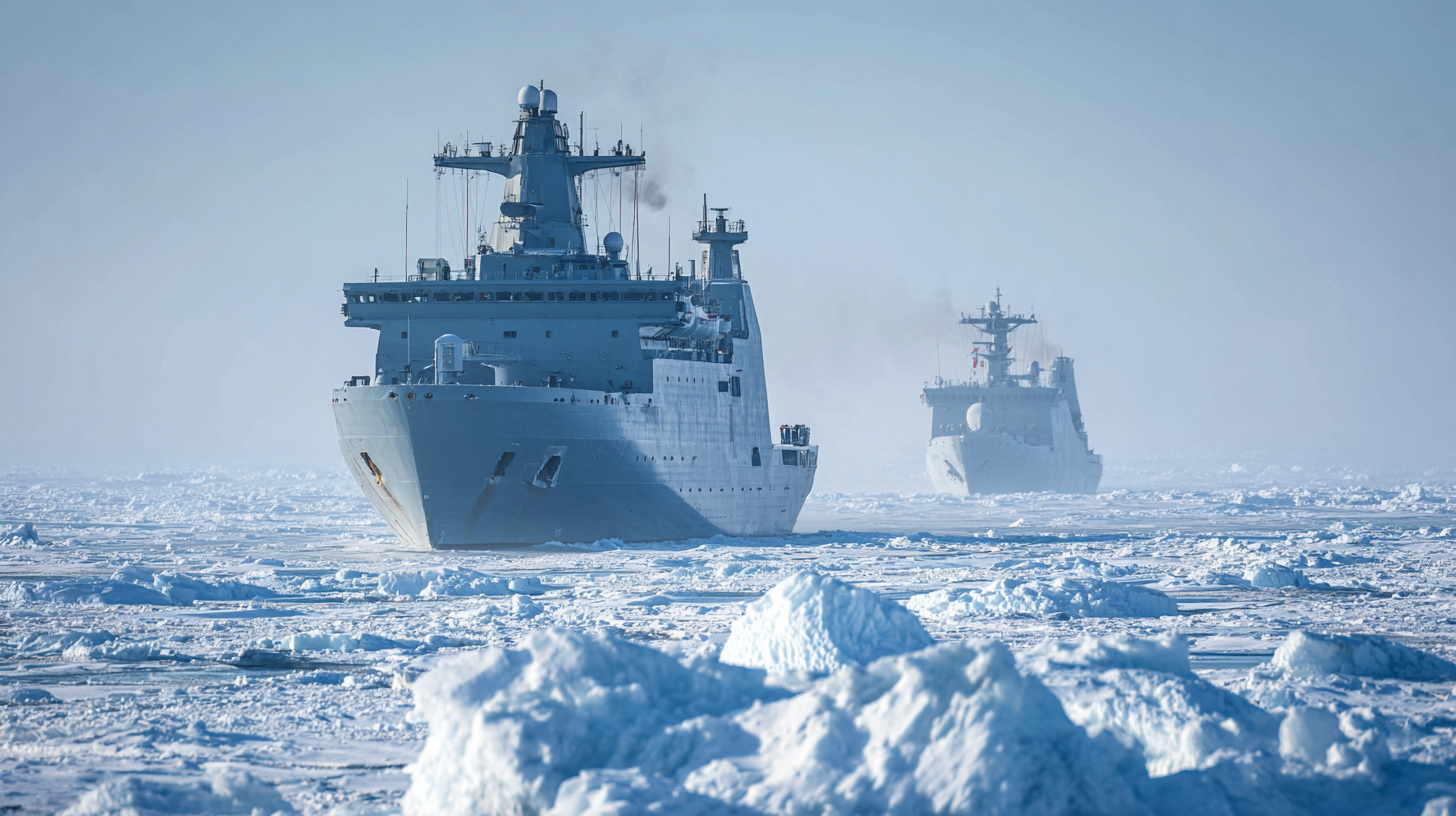
The new Cold War is taking place in the ice: the fight for Greenland is just one aspect – the 4 backgrounds – Creative image: Xpert.Digital
Arctic strategy revealed: Battle for rare earths, faster than the Suez Canal and China's "research vessels" in military focus
The new Cold War is taking place in the ice: While Donald Trump renews his ambitions for Greenland, a geopolitical reorganization of global significance is unfolding in the far north
The Arctic has transformed from a peripheral region of ice and snow into a central chessboard for the major powers. At the heart of this conflict lies the struggle between the strategic goals of the US and China's so-called "Polar Silk Road." While Trump's aggressive bids to purchase Greenland generate media attention, they are driven by cold calculation: Washington's strategy primarily aims to contain Chinese influence and secure critical resources such as rare earth elements, which are essential for modern high technology.
The analysis shows, however, that the struggle for Greenland is only one aspect. While the island is a coveted location for mining and infrastructure for Beijing, the true key to Arctic dominance lies elsewhere: in the Northeast Passage along the Russian coast. This route promises a revolution in global logistics. It drastically shortens transport routes to Europe and makes China less dependent on bottlenecks controlled by the West, such as the Suez Canal or the Strait of Malacca.
The following report sheds light on the complex frontal structures in the Arctic ice. It analyzes how the US is systematically blocking Chinese investments in Greenland, why NATO is warning against the military “dual-use” strategy of Chinese research vessels, and why the long-term success of Beijing’s plans depends less on Denmark’s island than on cooperation with Moscow and the melting ice itself.
Greenland Crisis: Analysis of the Power Struggle in the Arctic
American ambitions in Greenland disrupt China's polar Silk Road, but do not pose an existential threat. Whether China's Arctic strategy will succeed in the long term depends less on Greenland itself and more on the development of the Northeast Passage and Sino-Russian cooperation. Trump's Greenland offensive marks a further step toward systematically containing Chinese spheres of influence—a strategy that extends from Africa through the Indo-Pacific to the Arctic.
Sino-Russian cooperation refers to the close strategic partnership between China and Russia in politics, economics, military affairs and geopolitics, which has been systematically expanded since the 1990s.
"Sino-Russian" is so named because the word component "sino-" means "Chinese" in technical terminology and derives from the Latin "Sinae" for China. "Sino-Russian cooperation/relations" is therefore simply the technical abbreviation for "Chinese-Russian cooperation/relations.".
Political core
- The basis is the "Treaty on Good Neighbourliness, Friendship and Cooperation" of 2001. It establishes a long-term partnership, respect for sovereignty and mutual support in core interests.
- Both states see their cooperation as a counter-model to a US-dominated world order. They advocate for a world with multiple centers of power and a "democratization" of international relations.
Economy and Energy
- China is the most important buyer of Russian energy (oil, gas, coal) and a key partner in the development of Siberia and the Russian Far East.
- Despite a decline, bilateral trade still exceeded US$200 billion in 2025. It increasingly includes high technology, agriculture, and the digital economy.
Military and security policy dimension
- Both sides coordinate on security issues, conduct joint exercises, and deepen cooperation on information and armaments. However, they do not formally form a classic military alliance like NATO.
- In official documents, they emphasize that they will not enter into alliances directed against each other. Furthermore, they will not participate in initiatives that undermine the security or territorial integrity of their partner.
International Organizations and Regions
- China and Russia cooperate closely in formats such as the BRICS countries and the Shanghai Cooperation Organisation. The aim is to strengthen their influence in the Global South and in Eurasia.
- At the regional level, they cooperate primarily in the Russian Far East, in the border region, and increasingly in the context of the Arctic and Northeast Asia, for example on infrastructure, logistics and new shipping routes.
Nature of the partnership
- Experts often describe the relationship as a "strategic partnership with boundaries": It is close and important for both sides, but deliberately without a formal alliance and with their own, sometimes differing, interests.
- Cooperation is further deepened by Russia's conflict with the West and the systemic rivalry between China and the USA. However, it remains pragmatic and interest-driven, not ideologically fused.
China's Polar Silk Road under pressure from US interest in Greenland
Chinese ambitions in Greenland had already suffered several significant setbacks even before Trump publicly renewed his territorial claims. Major projects such as uranium mining in Kuannersuit and the construction of two airports by the Chinese state-owned construction company CCCC were thwarted by vetoes from Washington. As early as 2016, a Chinese company attempted to purchase a disused naval base in southern Greenland – a move blocked by Danish authorities on grounds of national security.
By 2021, Greenland had revoked all remaining Chinese access rights in the mining sector, citing environmental concerns and strategic security considerations. Of the 39 mining licenses active in Greenland in 2020, none were held by Chinese companies. Greenland's ban on uranium mining and its increasing control over foreign influence have further restricted Beijing's presence on the island.
This development was further intensified by growing American pressure on Greenland. US officials visited the Tanbreez mining project in southern Greenland twice in 2024. They repeatedly delivered a clear message to the cash-strapped company: Do not sell the large deposit to a buyer linked to Beijing. A competing project by Energy Transition Minerals, which also aims to mine rare earths and in which China's Shenghe is the largest shareholder, is stalled due to protracted legal disputes.
The sale of Tanbreez to the American company Critical Metals demonstrates that US officials have been more successful in Greenland than in Africa. There, too, they are attempting to counterbalance China's influence in the mineral-rich Central African Copperbelt. This systematic displacement of Chinese interests from Greenland already occurred under the Biden administration and will undoubtedly intensify under Trump.
Related to this:

The Northeast Passage as the actual core of the polar Silk Road
The crucial insight, however, is that Greenland is of secondary importance to China's Polar Silk Road. The true core of this strategy lies in the Northeast Passage along Russia's northern coast, not in Greenlandic resource projects. The Polar Silk Road primarily aims at three strategic objectives: significantly shortened trade routes to Western countries via the Northeast Passage, privileged access to Arctic resources through cooperation with Russia, and the development of the polar route as part of the "New Silk Road" (Belt and Road Initiative).
The Northeast Passage shortens the journey from Dalian to Rotterdam to approximately 33 days, while the route through the Suez Canal takes around 48 days. This route is considerably faster and could help Beijing reduce its heavy reliance on the Strait of Malacca and minimize the risk of a naval blockade by foreign powers. For China, the value lies in access to raw materials, such as those in Greenland, which would be transported to China, processed there, and then shipped back to Western markets as finished products.
Sino-Russian cooperation along the Northeast Passage is the linchpin. Since 2016, a subsidiary of the state-owned Chinese defense company China Poly Group has invested $300 million in a coal terminal in Murmansk and agreed to build a deep-sea port in Arkhangelsk. Chinese investors have also provided up to 60 percent of the capital for the liquefied natural gas (LNG) project on Russia's Yamal Peninsula.
An agreement signed in June 2024 between the Russian state-owned corporation Rosatom and the shipping company New New Shipping Company aims to make the Northeast Passage navigable year-round. Transit traffic through this passage reached record levels in the summer and autumn of 2024. The leading operator is the Chinese shipping company New New Shipping, which now operates eight vessels serving routes between China and St. Petersburg.
China is not only gaining more access, but in some cases even control over the Northern Sea Route. During the state visit to Beijing in March 2023, it was decided to create a joint umbrella organization for shipping in the Northeast Passage. The cooperation between the Chinese Coast Guard and the Russian Border Guard, agreed upon in Murmansk in April 2023, builds on this foundation.
NATO Supreme Commander sees threat from China
Military reconnaissance under the guise of science
The Supreme Allied Commander Europe, Alexus G. Grynkewich, has explicitly warned of Chinese activities in the Far North. The Chinese are sending research vessels to the region, which, under the guise of scientific research, are likely conducting military reconnaissance. During the recent ice-free season, ships remained unusually long off the northern coast of Alaska. Furthermore, there are joint patrols with the Russians.
These observations confirm the dual-use nature of Chinese Arctic activities. The Chinese fleet already possesses 50 icebreakers, while the US has only two. The Chinese navy has massively expanded its presence in the Arctic in recent years. This reinforces the concerns of NATO allies about China's growing military power in the region.
The strategic importance of the Arctic for NATO
The Arctic is gaining strategic importance for NATO as the geopolitical center of competition between the major powers shifts northward. The region offers the shortest air route between North America and Eurasia and is home to vital military infrastructure. Increased Sino-Russian cooperation in the Arctic poses a direct challenge to NATO's security interests.
NATO has intensified its focus on the Arctic and emphasizes the need for a stronger presence. The alliance recognizes that the Arctic has become an arena of competition and potential conflict and is working to strengthen its capabilities to defend against threats in this harsh environment.
Hub for Security and Defense - Advice and Information

Hub for Security and Defense - Image: Xpert.Digital
The Security and Defence Hub offers expert advice and up-to-date information to effectively support companies and organizations in strengthening their role in European security and defence policy. Working closely with the SME Connect Defence Working Group, it particularly promotes small and medium-sized enterprises (SMEs) that wish to further develop their innovative capacity and competitiveness in the defence sector. As a central point of contact, the Hub thus creates a crucial bridge between SMEs and European defence strategy.
Related to this:
New power center in the Arctic: How a race for routes and resources is rewriting the world order
Trump's Greenland strategy: "Something will turn up."
The demand for takeover
US President Donald Trump has reiterated his demand for the US to take over Greenland and questioned Denmark's ability to defend the island. "I think something will be found," Trump told reporters at the White House. "Greenland is very important for national security, including Danish security," he explained. "And the problem is, there is absolutely nothing Denmark can do if Russia or China wants to occupy Greenland, but there is everything we can do," Trump added.
These statements reflect a long-standing American strategy that views Greenland as a central hub for security in the Arctic. The US has been responsible for Greenland's defense since 1951. The Pituffik Air Base (formerly Thule) is of enormous importance for the US missile warning system and space surveillance. The base is currently undergoing a multi-billion dollar modernization.
Related to this:

The strategic limits of American containment
While Trump's Greenland offensive may further restrict China's presence on the island, it cannot undermine the fundamental logic of the Polar Silk Road. The Northeast Passage runs along the Russian coast, not through Greenlandic waters. As long as Moscow and Beijing deepen their cooperation, this corridor will remain accessible to China.
However, the increased American presence in Greenland creates strategic problems for China. An expanded US military presence would significantly strengthen US surveillance and defense capabilities in the Arctic. This would also allow for closer monitoring of Chinese activities in the region.
Nevertheless, current developments show that after many failed attempts in Greenland, Chinese companies have shifted their focus to projects in Russia's Arctic region. The number of Chinese companies operating there is said to have increased. This suggests a pragmatic adjustment of China's strategy: where direct investment is blocked, Beijing is shifting its activities to regions where it can gain access.
Battle for rare earth elements and faster container ship sea route
The Polar Silk Road as a logistical revolution
The Polar Silk Road is far more than just a prestigious project for Beijing; it is a strategic necessity for diversifying its trade routes. In 2025, the successful transit of the Northern Sea Route by Chinese container ships marked a turning point in global logistics. The voyage of the "Istanbul Bridge," a large container ship that completed the journey from China to the UK in just 20 days in October 2025, demonstrated the enormous time savings compared to the traditional route through the Suez Canal.
This route is approximately 7,000 kilometers shorter than the southern route. This not only reduces travel time by almost 40 percent but also significantly lowers fuel costs. At a time when conventional sea routes are threatened by geopolitical conflicts, such as in the Red Sea, the Arctic offers China a stable alternative. This route is largely beyond the control of the US Navy as long as the partnership with Russia remains in place.
Quantitative advantages of the Northeast Passage
The strategic advantages of the Polar Silk Road can be expressed in concrete figures. The Northeast Passage (NSR) reduces the distance from Shanghai to Hamburg from approximately 21,000 km via the Suez Canal to approximately 14,000 km – a saving of 7,000 km. The average travel time decreases from 35-50 days to 18-25 days, representing an acceleration of up to 50 percent. Fuel savings range from 20 to 40 percent, which not only brings economic benefits but also improves the environmental footprint.
| Key figure for transport routes | Northern Sea Route (NSR) | Suez Canal route | Difference / Advantage |
|---|---|---|---|
| Distance (Shanghai to Hamburg) | approximately 14,000 km | approximately 21,000 km | -7,000 km |
| Travel time (average) | 18 – 25 days | 35 – 50 days | up to 50% faster |
| Fuel savings | approximately 20% – 40% | Underlying value | significant cost reduction |
| accessibility | seasonal (summer/autumn) | year-round | NSR limited to ice-free conditions |
| Geopolitical risk | Russian sphere of influence | Piracy / Conflicts (Malacca/Suez) | NSR as an alternative |
These figures illustrate why the Polar Silk Road is indispensable for China's global trade strategy. A travel time reduction of up to 25 days not only means faster supply chains, but also significantly lower costs for tied-up capital and warehousing.
Dominance in infrastructure and icebreaker fleet
The expansion of Chinese activities in the Arctic includes the construction of new icebreakers. Construction began in 2025 on a fourth icebreaker, potentially nuclear-powered. This further enhances Beijing's operational capabilities in extreme northern latitudes. While officially dedicated to research, these vessels are versatile (civilian and military) and can be used for reconnaissance and to support merchant shipping.
China already possesses the world's largest fleet of icebreakers, with over 50 vessels, while the US has only two. This numerical superiority allows China to conduct scientific exploration of the Arctic while simultaneously demonstrating a military presence. The Chinese navy has significantly expanded its presence in the Arctic in recent years, heightening NATO's concerns about China's growing military power in the High North.
Battle for rare earths and critical raw materials
Greenland possesses significant deposits of rare earth elements and other critical raw materials essential for modern technologies. The Tanbreez project in southern Greenland is considered one of the world's largest rare earth deposits. The fact that this project was sold to the American company Critical Metals rather than to Chinese investors demonstrates the success of the US strategy to keep Beijing away from these strategic resources.
Historically, China's strategy in Greenland focused on three areas: uranium mining (the Kuannersuit project), infrastructure development (airport construction), and the acquisition of military sites. All three approaches failed due to political resistance and US influence. The systematic displacement of Chinese interests from Greenland began under the Biden administration and will undoubtedly intensify under Trump.
The vulnerability of the Northeast Passage
However, the long-term viability of the Polar Silk Road depends on factors beyond China's control. Russia currently controls the Northeast Passage and levies high tolls. Moscow invokes Article 234 of the UN Convention on the Law of the Sea, which grants countries with ice-covered coastlines extended rights to regulate shipping.
However, this legal basis could disappear as the ice melts. Climate models show that parts of the Arctic that were previously ice-covered year-round could be ice-free for months at a time within two decades. By 2065, navigability could increase to such an extent that entirely new routes will emerge in international Arctic waters. This would not only reduce emissions but also diminish Russian control over trade routes in the region. As the ice melts, shipping will shift from Russian territorial waters to international Arctic waters, shortening routes by 30 to 50 percent.
Paradoxically, this development could strengthen China's position in the Arctic, as access to Arctic sea routes would then be more open to all, weakening Russia's monopoly. However, this would also diminish the importance of Sino-Russian cooperation and raise new questions about who sets the rules in international Arctic waters.
The Arctic as a new arena for great power rivalry
The overall assessment of the Greenland crisis reveals a complex picture of geopolitical competition in which neither side holds an absolutely dominant position. American ambitions in Greenland damage China's Polar Silk Road, but do not destroy it. Greenland was never the central pillar of this strategy, but rather a desirable complement. The loss of direct access to Greenlandic raw materials is a setback for Beijing, but not a strategic collapse.
The actual polar Silk Road runs along Russia's northern coast, and China's position there remains secure for the time being. Sino-Russian cooperation in the Arctic is a partnership of convenience, born out of Western sanctions against Russia and China's hunger for alternative trade routes and energy sources. Russia is heavily dependent on China, especially for energy exports. China supports Russia with long-term investments. In return, Russia offers strategic advantages, such as access to the Northeast Passage, which is becoming increasingly navigable due to melting ice and could almost halve the transport time of Chinese goods to Europe.
This situation will not fundamentally change as a result of Trump's Greenland policy. What will intensify, however, is the geopolitical competition in the Arctic as a whole. The region is transforming from a remote ice desert into a central arena in the great power struggle. China's role in this competition remains significant, but increasingly contested.
The future of the Polar Silk Road ultimately depends on three factors: first, the stability of the Sino-Russian partnership; second, the pace of ice melt and the resulting shift of shipping lanes into international waters; and third, China's ability to permanently consolidate its presence in the Arctic despite Western resistance. Developments in all three areas remain uncertain, but China's strategic ambition to establish itself as a major polar power by 2030 is unwavering. Trump's Greenland offensive may delay this timeline, but it will not derail it.
The Arctic will become a crucial test case in the coming decades: for the US's ability to contain Chinese expansion and for China's ability to establish alternative power centers beyond the Indo-Pacific region. Greenland is merely one move—albeit a highly symbolic one—in a much larger game for control of the resources and trade routes of the 21st century.
Our global industry and economic expertise in business development, sales and marketing

Our global industry and economic expertise in business development, sales and marketing - Image: Xpert.Digital
Industry focus areas: B2B, digitalization (from AI to XR), mechanical engineering, logistics, renewable energies and industry
More information here:
A thematic hub offering insights and expertise:
- Knowledge platform covering global and regional economies, innovation and industry-specific trends
- A collection of analyses, insights, and background information from our key areas of focus
- A place for expertise and information on current developments in business and technology
- A hub for companies seeking information on markets, digitalization, and industry innovations