
The myth of the skills shortage: When jobs disappear before the demographic decline has even begun
Xpert Pre-Release

Available in 27 languages 📢
Prefer Xpert.Digital on GoogleⓘPublished on: May 10, 2026 / Updated on: May 10, 2026 – Author: Konrad Wolfenstein
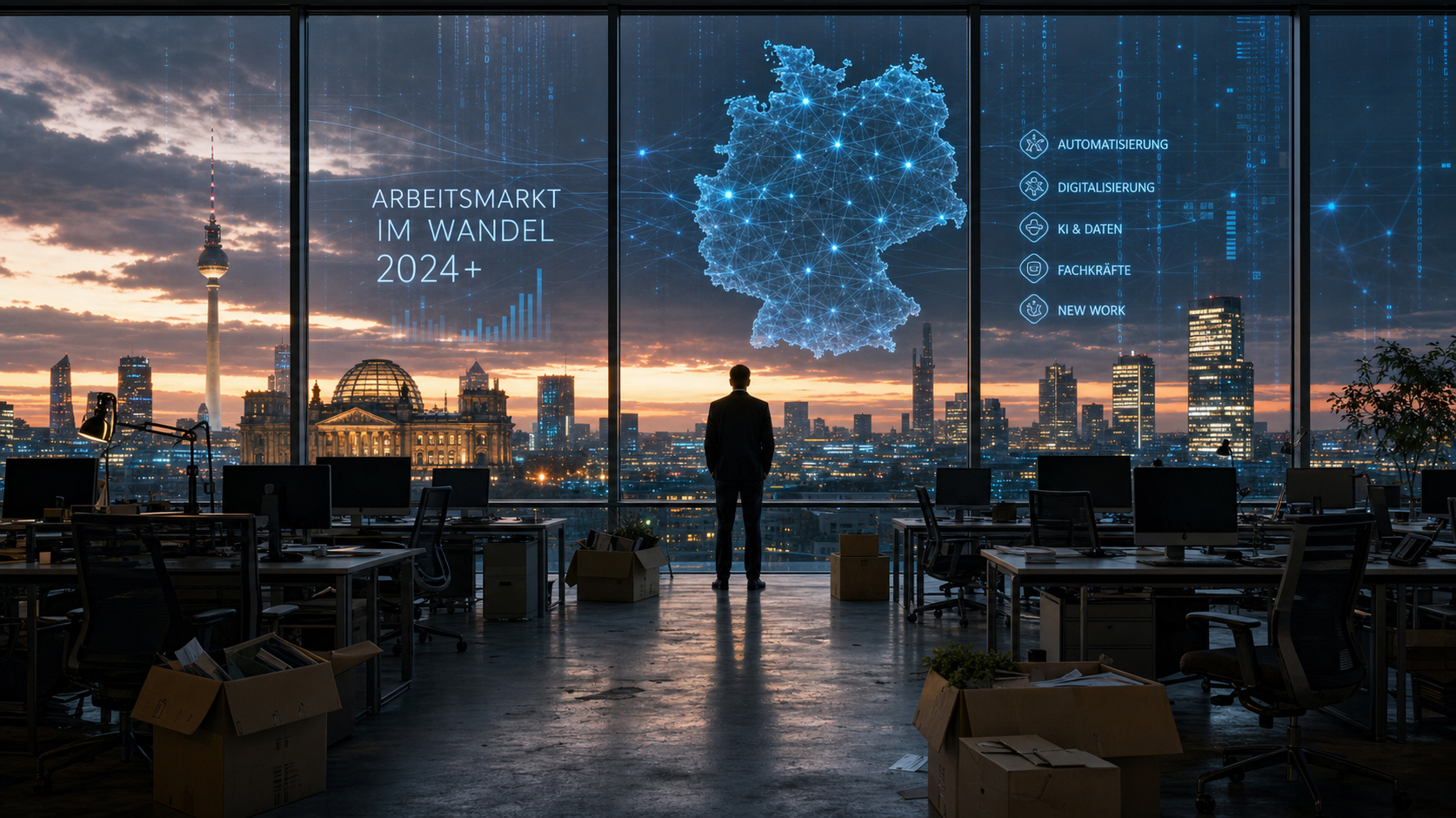
The myth of the skills shortage: When jobs disappear before the demographic decline has even begun – Image: Xpert.Digital
VW, Bosch & SAP are cutting thousands of jobs: Is the skilled worker shortage now a thing of the past? – A structural rift in the German labor market
The job revolution: Why jobs are disappearing – and skilled workers are still lacking
AI shock instead of job miracle: What the new labor market crisis means for you
For years, the economy and politics were dominated by one dire scenario: the pervasive shortage of skilled workers. But in 2026, the tide suddenly seems to be turning. Large, traditional German corporations like VW and Bosch are drastically cutting jobs, the number of vacant positions is plummeting, and artificial intelligence is taking over more and more tasks in offices. Has the major staffing problem thus been surprisingly solved? Anyone who believes so is making a fatal mistake. Germany is not currently experiencing a relaxation of the labor market, but rather a historic structural shift. While work is shrinking in industry and administration, the situation in systemically important professions is becoming drastically more acute. At the same time, the mass retirement of the baby boomers is beginning a demographic drain that dwarfs any short-term economic downturn. A thorough analysis shows: The shortage of skilled workers has not disappeared – it has transformed into a far more dangerous crisis that demands entirely new qualifications.
Related to this:

Fewer jobs, more unemployed: Is Germany facing a major labor market collapse?
No economic report, no industry conference, no government summit could do without this word. Companies complained, associations pressed for more immigration, and politicians around the world courted workers for the prosperous export champion. The narrative was clear and seemingly unshakeable: Germany needs people, more people, urgently more people. Now, the data for 2026 show that this narrative, at least in its previous form, is no longer tenable – and that a far more complex and worrying reality is taking its place.
When numbers destroy the narrative
According to the ifo Business Climate Survey, only 22.7 percent of German companies are reporting difficulties in finding suitable personnel – a five-year low. In October 2025, this figure was still at 25.8 percent. At first glance, this sounds like a relief, a well-deserved respite after years of strain. However, a look at the overall context contradicts this interpretation.
The ifo Employment Barometer, the most important leading indicator for the workforce planning of German companies, fell to 91.3 points in April 2026 – the lowest level since May 2020, i.e., since the first coronavirus lockdown. Klaus Wohlrabe, head of ifo surveys, summed up the situation: Geopolitical uncertainty is impacting companies' workforce planning, and more jobs are being cut than created. Even a slight recovery of the barometer in March to 93.4 points prompted Wohlrabe to caution that it is still too early to speak of a genuine trend reversal.
In parallel, the Institute for Employment Research (IAB) confirms with its job vacancy survey: In the first quarter of 2025, 1.18 million jobs were vacant in Germany – a decrease of 25 percent compared to the same period of the previous year. By comparison, the same survey recorded a record high of almost two million vacancies in the fourth quarter of 2022. This means that in less than three years, the demand for labor has plummeted by almost half. This decline is not a free fall, but it is steady, widespread, and structural.
Related to this:

The creeping fracture in the industrial heart
The transformation is particularly striking in those sectors that form the economic core of Germany. The automotive industry, for decades the epitome of German engineering excellence and employer quality, is undergoing a profound restructuring. Volkswagen has announced plans to cut around 50,000 jobs at its German locations by 2030 – a figure recently increased compared to the original plan of 35,000 job cuts agreed upon with the unions at the end of 2024. The reason: The group's operating profit plummeted by almost half in 2025 to €8.9 billion, and the profit margin shrank to 2.8 percent – the weakest result since the Dieselgate crisis of 2015/16.
Thyssenkrupp Steel plans to reduce its workforce from around 26,000 to 16,000 employees – a reduction of 11,000 jobs by 2031. ZF Friedrichshafen intends to cut 14,000 jobs, Bosch 13,000, and Deutsche Bahn 30,000. In total, the major corporations listed on the DAX and MDAX, as well as significant private companies, are cutting around 186,000 jobs. Even though these programs are spread over several years and in many cases rely on natural attrition and severance packages rather than layoffs, the structural trend is unmistakable: The demand for labor in German industry is systematically declining.
The wave of layoffs in the first quarter of 2026 was particularly noticeable in the technology sector: the global technology industry cut around 80,000 jobs during this period – a significant proportion of them at German companies or their subsidiaries. Almost half of these job cuts were officially attributed to the use of artificial intelligence and automation. The software company SAP reduced its workforce by up to 10,000 worldwide, including around 3,500 in Germany.
The paradox: scarcity and abundance at the same time
Anyone who concludes that the skilled worker shortage has simply disappeared is fundamentally mistaken – and that is the real analytical crux of this situation. Because at the same time as the number of job vacancies declined, the number of registered unemployed in Germany rose to 3.085 million, corresponding to a rate of 6.6 percent – an increase of 92,000 compared to the previous year. This means that, nationwide, there are an average of 251 registered unemployed people for every 100 job openings – 74 more than a year earlier.
At the same time, 36 percent of all German companies continue to struggle to fill vacancies. The DIHK Skilled Workers Report 2025/2026, based on a survey of 22,000 companies, shows that while this figure has fallen from 43 to 36 percent compared to the previous year, 83 percent of employers still expect negative consequences from the lack of skilled workers. In the IT sector, the digital association Bitkom recently reported around 109,000 unfilled positions. In the nursing sector, over 46,000 positions remained unfilled in 2024, and the gap continues to widen. According to current estimates, the skilled trades are lacking over 250,000 skilled workers.
What is emerging here is not a relaxation of the labor market, but a structural decoupling: On the one hand, the demand for medium and low-skilled jobs in industry, administration, and commerce is shrinking rapidly. On the other hand, the shortage is worsening in systemically important professions that resist technological substitution or are indispensable to society. The labor market is splitting – and this split is happening faster than any education system can react.
Related to this:

AI as both driver and gatekeeper
No analysis of the German labor market in 2026 can do without an honest examination of artificial intelligence. AI is no longer the vague future threat it was just five years ago – it is a productive player in day-to-day operations. According to the Jobs & Hiring Outlook Report 2026 by the job platform Indeed, AI is now making its way into all professional groups. In the data and analytics category, 34.4 percent of all job postings require or mention AI skills, and in software development, this figure is 20.8 percent. However, the strongest growth is found outside the traditional technology sector: In human resources, the proportion of job postings with an AI focus increased by 138.7 percent, in marketing by 123.2 percent, and in project management by 117.1 percent.
The McKinsey Global Institute's study calculated that up to three million jobs in Germany could be affected by AI-driven changes by 2030 – roughly seven percent of total employment. The scenario assumes an accelerated adoption of AI in companies, which could lead to the automation of almost a third of all working hours by 2030. By 2035, this figure could even rise to 45 percent in the EU. Office jobs in administrative sectors would be particularly hard hit: more than half of all AI-related job changes in Germany would fall into this category.
The Institute for Employment Research (IAB) does not necessarily predict mass unemployment, but rather a massive shift: AI could eliminate around 800,000 jobs and create approximately 800,000 new ones. The total number of jobs is likely to remain largely constant – but the underlying change would be enormous and, on an individual level, severe. For many employees, this would mean a forced reorientation, retraining, or simply the end of their current professional identity.
PwC has also investigated the impact of AI on job quality and compensation: Employees who use AI productively earn up to 56 percent higher salaries than those without AI skills. At the same time, formal educational requirements in AI-influenced professions have decreased – while 47 percent of AI-related jobs required a university degree in 2019, this figure had dropped to 41 percent by 2024. The traditional formula – good degree equals good job – is no longer valid. What counts is proven competence in using the new technologies.
The impact of AI transformation is also noticeable on a psychological level: A study by Pronova BKK shows that one-third of German employees believe their jobs are threatened by AI. 43 percent of employees planned to change jobs in 2026, with the fear of AI-related job loss explicitly cited as one of the main reasons. This uncertainty is not an irrational reflex – it is a rational reaction to real changes.
Our EU and German expertise in business development, sales and marketing

Our EU and German expertise in business development, sales and marketing - Image: Xpert.Digital
Industry focus areas: B2B, digitalization (from AI to XR), mechanical engineering, logistics, renewable energies and industry
More information here:
A thematic hub offering insights and expertise:
- Knowledge platform covering global and regional economies, innovation and industry-specific trends
- A collection of analyses, insights, and background information from our key areas of focus
- A place for expertise and information on current developments in business and technology
- A hub for companies seeking information on markets, digitalization, and industry innovations
Between AI boom and baby boomer exit: Germany's structural transformation in the labor market
Demographics: A Damocles' sword in slow motion
What further complicates the picture and makes the current debate about the "disappeared" skilled worker shortage seem particularly short-sighted is the demographic factor. The decline in reported labor shortages is not the result of a structural improvement in the supply of skilled workers. It is the result of an economic slowdown and falling demand. Germany's potential working-age population has been shrinking since 2026 for the first time ever – by around 40,000 people. From now on, this process will accelerate.
An IW study has calculated that by 2036, 19.5 million baby boomers will retire from the workforce. They will be matched by only 12.5 million younger people as a potential labor force. While almost 16.4 million baby boomers were of working age in 2022, this number will shrink to below ten million by 2028 and to zero by 2036. By 2040, there will likely be more than 41 people over 67 for every 100 people of working age – compared to just under 30 in 2022.
These figures mean that the structural labor problem is not solved. It has been shifted and compounded. The current decline in demand for labor—driven by economic weakness, AI automation, and industrial job cuts—is coinciding, in a historic turn of events, with a foreseeable and dramatic demographic decline. What appears to be a relief today could lead to an even more acute shortage in just a few years, once the baby boomer generation has completely retired from the workforce and the AI transformation has not yet compensated for all the jobs it has displaced.
The IAB confirms: Germany's potential workforce will shrink for the first time in its history in 2026. From 2026 onward, the retirement of the baby boomers will no longer be offset by immigration or younger workers. The demographic effect amounts to a loss of 300,000 people per year.
Sectors with no way out: nursing, skilled trades, infrastructure
While large-scale job cuts are taking place in industry, there are sectors where the shortage of skilled workers is not easing but rather increasing – and where AI is not a short-term solution. The health and social care sector is at the forefront of this problem. The Federal Statistical Office predicts that by 2049, Germany could be short up to 690,000 nursing staff. In 2024 alone, over 46,000 positions in hospital nursing remained unfilled, and the gap in elderly care has even widened compared to the previous year. The cause is not a lack of demand – it is demographic change, which is shifting supply and demand in the same direction: Society is aging, needs more care services, but is losing precisely the age groups that could provide these services.
Nationwide, there is a shortage of over 250,000 skilled workers in the trades and 109,000 in the IT sector. The Cologne Institute for Economic Research (IW Köln) predicts a nationwide shortage of approximately 22,941 childcare workers by 2026 – despite the fact that around 152,000 new professionals have been added to the workforce since 2021. Demand is simply growing faster than supply. These sectors cannot use AI to fill these staffing gaps, at least not to the same extent as in industry or the service sector. Physical presence, interpersonal interaction, and skilled craftsmanship – these activities are irreplaceable for the time being.
Interestingly, 48 percent of German companies are currently doing this: they are simply no longer reporting any staffing needs – an increase compared to 44 percent last year. This is the real statistical factor behind the decreased percentage of companies reporting a skills shortage. There are no longer enough qualified applicants available – fewer positions are being advertised at all. For the remaining companies that are still recruiting, the competition for scarce talent is therefore not getting any easier, but rather intensifying.
The new qualification currency
The structural transformation of the labor market is also changing the language of job requirements. Traditional diplomas and vocational qualifications are losing their significance as the sole criterion for qualification. What companies are truly seeking in 2026 can be seen in job postings: AI expertise has become the most sought-after skill for the first time – even surpassing traditional engineering qualifications. According to the ManpowerGroup's Talent Shortage Survey 2026, 72 percent of employers globally report significant staffing problems; in Germany, this figure is even higher at 83 percent. The discrepancy between 3.07 million unemployed individuals and 638,000 open positions is not due to laziness or poor work ethic, but rather to a massive gap in qualifications and skills: The people who are available do not match the open positions.
PwC documents that in professions with a high AI influence, formal entry barriers are decreasing, while the demands on practical digital skills are increasing. Conversely, this means that those who pursue further education and actively acquire AI skills significantly improve their market position – regardless of degrees or job titles. Those who wait for their existing job to somehow survive risk falling behind.
One in twelve German companies is already using AI to at least partially compensate for a lack of skilled human workers. This trend will continue. The next deadline is already known: In August 2026, a significant part of the EU AI law will come into force, which is already putting HR departments under regulatory pressure and further slowing down recruitment processes in tech-oriented sectors.
Related to this:

Structural change instead of economic pause
It would be convenient to interpret the current easing of the skilled labor market as a temporary economic downturn that will resolve itself with the next upswing. However, the data suggests a different conclusion: What is happening here is not cyclical noise, but a structural break.
Three forces are currently converging in the German labor market: First, the cyclical economic downturn, which has manifested itself in four years of economic stagnation and is significantly dampening companies' willingness to hire. Second, the technological disruption caused by artificial intelligence, which is rendering certain job profiles obsolete or fundamentally altering them to such an extent that existing qualifications are no longer sufficient. Third, the demographic decline, which is only in its initial phase and will gain momentum in the coming years.
The ifo barometer reading of 91.3 points in April 2026 – a six-year low, the last comparable value recorded during the 2020 coronavirus crisis – is not a sign of temporary paralysis. It signals a permanent realignment of HR strategies. The knee-jerk approach of filling every vacancy is a thing of the past in many companies. Instead, every role is subject to justification: Do we really need this function? Or can software handle it more efficiently? Is this a person or a process?
Volkswagen, Thyssenkrupp, ZF, Bosch, SAP – these companies are not outliers. They are indicators of a transformation that permeates the entire German economy. Suppliers are reacting to the plans of the major corporations. Retailers are continuing to reduce staff. The pressure to adapt industrially persists.
When two crises collide
The real challenge for economic and labor market policy lies in the simultaneous occurrence of these opposing trends. On the one hand, demand for certain job profiles is declining at a rate that is overwhelming many of those affected. On the other hand, a shortage is building up that is inevitable in the medium term and cannot be fully compensated for by any immigration policy in the world.
The KOFA (Competence Center for Securing Skilled Workers) of the German Economic Institute (IW) precisely demonstrated in its 2026 annual analysis that the overall decline in the skilled worker shortage is not the result of structural improvements, but rather of an economic slowdown. In nursing, education, and infrastructure professions, the shortage has even increased. This distinction is crucial because it means that as soon as the economy recovers—and it will, albeit at a different level than before—the skilled worker shortage in structurally in-demand professions will immediately return in full force, exacerbated by the already advanced demographic decline.
Germany is thus faced with a highly complex economic policy challenge: it must simultaneously integrate the workforce released in the short term into new fields of qualification, combat the medium-term shortage of skilled workers in systemically important sectors through training reforms and targeted immigration, and mitigate long-term demographic pressure through a combination of higher labor force participation, increased productivity through technology, and – where unavoidable – a reform of the pension system. The Skilled Immigration Act, which issued around 200,000 work visas in its first year, is a start – but given a net annual labor deficit of 300,000 workers due to demographic change, it is by no means a sufficient solution.
Between shock and opportunity: What change means
Those who see the current situation solely as a crisis are missing the bigger picture. This structural shift also creates opportunities for renewal. In industries and fields where AI significantly boosts productivity, new opportunities for value creation are emerging. Employees who view AI not as a threat, but as a tool and actively learn how to use it, can expect a significantly improved position in the job market. PwC demonstrates that those who use AI effectively are more productive, better paid, and more in demand than ever before. The demand for AI-savvy professionals is growing, even bucking the general hiring trend.
This is the crucial recalibration of economic logic in the German labor market: The question is no longer whether there are enough people. It is what skills these people possess – and whether the education system, corporate culture, and political framework can react quickly enough to shape the transition instead of simply being subjected to it. Anyone who reads the current figures and concludes that the skills shortage is a thing of the past is making a serious error. They are confusing the pause in an old shortage with the disappearance of the problem. What has truly changed is not the need – it is its nature.
New questions for a changing world of work
The German labor market in 2026 will be at a turning point that offers no easy answers. Neither the cliché of the desperate entrepreneur frantically searching for staff, nor the terrifying image of AI emptying offices en masse, adequately describes reality. What is actually happening is more complex and therefore more analytically demanding: An economy in a four-year cycle of stagnation is reassessing its priorities. Economic trends, technology, and demographics are converging like rarely before. And amidst this triple pressure, a quiet but profound transformation is taking place in what work means in Germany, who performs it, and with what resources.
The crucial question is no longer: Do we have enough workers? It is: What jobs are still needed – and are the right people with the right skills in the right place? The answer to this will determine whether Germany manages the demographic crisis of the next decade as a technologically advanced economy or as an economic power that has missed the boat on the transition.





