
The DAX is crashing, oil prices are exploding, and gold is falling in times of crisis? How the Gulf War is putting the global economy to the test
Xpert Pre-Release

Available in 27 languages 📢
Prefer Xpert.Digital on GoogleⓘPublished on: March 23, 2026 / Updated on: March 23, 2026 – Author: Konrad Wolfenstein
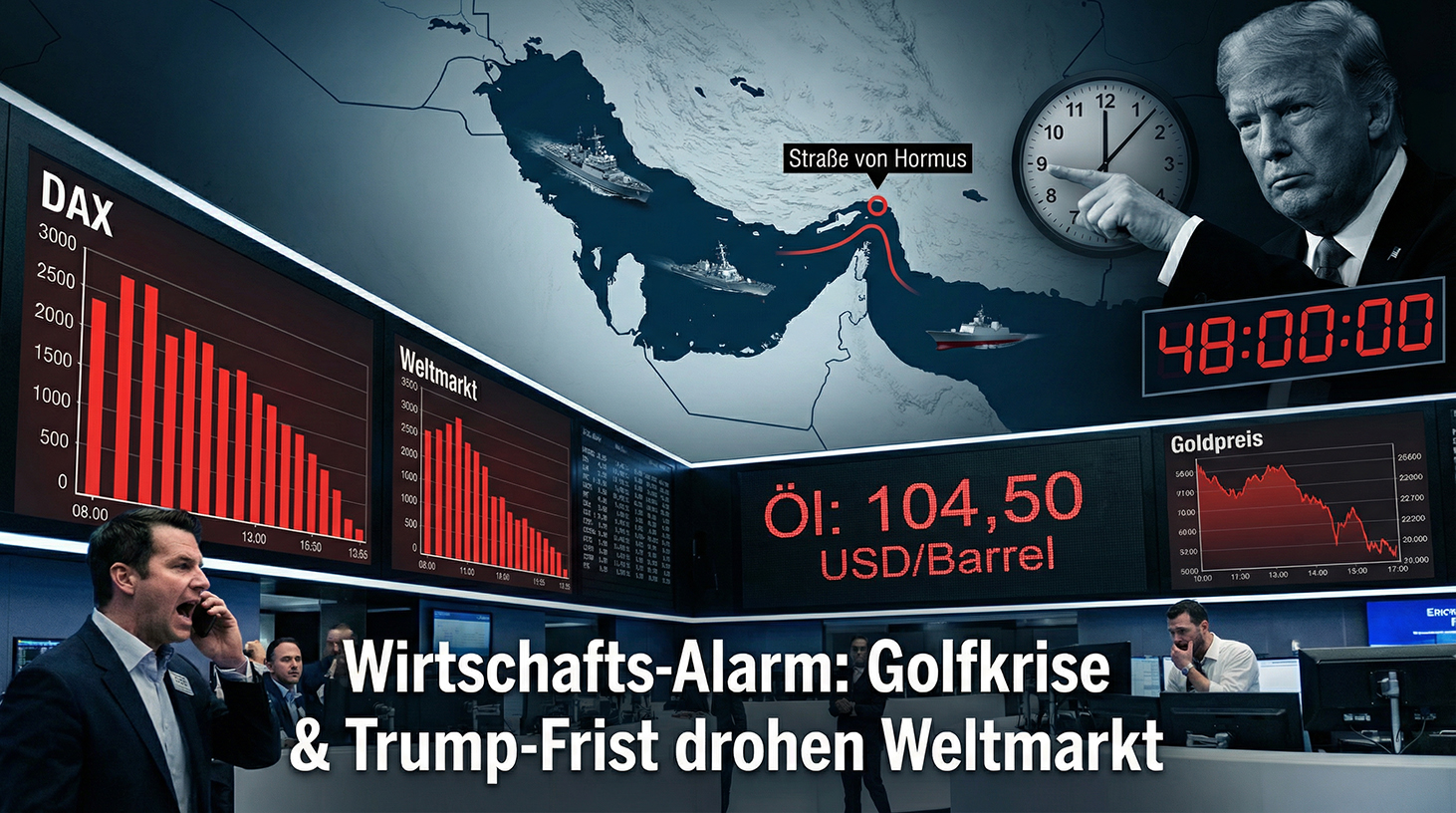
DAX crashes, oil price explodes, and gold falls in times of crisis? How the Gulf War is putting the global economy to the test – Image: Xpert.Digital
Stock market turmoil in the Persian Gulf: Why experienced investors are now extremely nervous
DAX, gold and oil in a state of emergency: The fatal consequences of the Gulf crisis for Germany
The geopolitical escalation in the Persian Gulf is hitting the global economy at its most vulnerable point and is developing into the ultimate stress test for global markets. While a looming oil price shock of over $100 per barrel acts like an invisible tax on global growth, the growing uncertainty is sending the DAX into a tailspin. To make matters worse, classic safe-haven assets like gold are suddenly losing their luster, and a strong US dollar, along with political ultimatums from US President Trump, are putting the system under further pressure. This toxic mix of exploding costs, interest rate fears, and fragile supply chains is proving particularly threatening for Germany's export- and energy-dependent economy. The following article examines why these developments represent far more than just a short-term market correction – and what strategic consequences investors, companies, and policymakers must now urgently draw.
Why high oil prices, a plummeting gold price, and a US president under time pressure are making markets more nervous than many investors want to admit
The current escalation of the conflict in the Persian Gulf is acting like a stress test for the global economy, with several known risk factors erupting simultaneously. Germany is particularly affected because its industrial business model is heavily reliant on energy, export markets, and open trade routes. The blockade, or even just the threat to the Strait of Hormuz, impacts one of the most critical bottlenecks in global oil and gas transport and exacerbates existing energy price effects that have been hanging like a sword of Damocles over energy-intensive economies for years. At the same time, the conflict is increasing uncertainty in the financial markets, which are already sensitive to interest rate reversals, high levels of public debt, and geopolitical tensions. The fact that these factors are now converging explains why even experienced investors are becoming nervous and why price movements are more pronounced than the fundamentals alone would suggest.
From a global perspective, the oil price shock acts like a hidden tax on growth, particularly noticeable in countries that import large amounts of fossil fuels and have limited fiscal and monetary policy flexibility. For commodity-exporting nations, the price increase can initially be advantageous, as it boosts their revenues. However, this comes with the risk of overvaluing their currencies and increasing their dependence on volatile commodity proceeds. Western industrialized nations thus find themselves in a dilemma: on the one hand, they need to secure supply chains and stabilize energy supplies; on the other hand, every increase in energy prices puts pressure on companies, wages, prices, and consequently, inflation. Germany, with its strong export industry and numerous medium-sized global market leaders, must absorb this shock while simultaneously undergoing a transformation towards a more climate-neutral economy. The current crisis is therefore also revealing structural vulnerabilities that extend beyond the acute phase of the conflict and require long-term adjustments.
DAX in freefall: Why markets are giving more weight to the oil price shock than expected
The DAX's sharp decline at the start of the week, with a drop of around two percent and a loss in the upper triple digits, is a clear indication of this shift in risk perception. Investors no longer view the recent rise in oil prices as a short-term overreaction, but increasingly as a sign of a prolonged scarcity and uncertainty shock that could put pressure on profit margins in numerous sectors. Energy-intensive industries, logistics companies, chemicals, steel, and parts of the automotive industry, whose cost structures are heavily dependent on fuel and raw material prices, are particularly affected. When investors factor in permanently higher energy costs and potentially lower demand due to weaker global growth in their valuation models, discounted future earnings—and consequently, justified share prices—decline. The fact that the DAX extended its losses from Friday demonstrates that the markets are no longer anticipating a short-term "geo-event," but rather a scenario that is deeply rooted in economic fundamentals.
Furthermore, geopolitical shocks such as the Gulf War not only affect the real economy but also trigger a general risk aversion. In such phases, institutional investors often reduce their exposure to cyclical and risky assets to position portfolios more defensively and increase liquidity. Technical factors also play a role: If a critical level in the index is breached, algorithmic trading systems and stop-loss orders trigger increased selling pressure, which can accelerate the downward movement. What is particularly problematic is that the current price slump is not occurring in isolation, but rather against a backdrop of already elevated valuations following the price increases of recent years, rising interest rates, and persistent uncertainty about Europe's economic resilience. The DAX crash is therefore less an emotional overreaction and more a corrective move that simultaneously adjusts key levers of valuation – oil prices, growth, interest rates, and geopolitical security.
The Trump ultimatum: Political escalation as an economic risk multiplier
The US president's 48-hour ultimatum to the Iranian leadership—to respond with attacks on power plant infrastructure if the Strait of Hormuz remains blocked—is economically relevant less for its military details than for the escalation signal it sends. Markets interpret such deadlines as an indication that diplomatic room for maneuver is shrinking and the likelihood of a direct military confrontation is increasing. This, in turn, increases the expected duration and intensity of supply disruptions, particularly for oil and gas, and reinforces the assumption of a longer-term supply shortage in investors' scenario planning. Furthermore, a US president under domestic pressure who wants to project a tough stance internationally appears less predictable to the markets, further raising risk premiums on geopolitical conflicts. Combined with the strategic importance of the Persian Gulf and the Strait of Hormuz, through which a significant portion of global oil trade flows, this creates an environment in which even a limited military intervention can have far-reaching economic consequences.
At the same time, experience from past conflicts shows that markets react differently to threats than to clear, binding agreements or to escalations that have already taken place. Threats create a spectrum of possible outcomes, ranging from diplomatic de-escalation to a full-blown conflagration, making accurate forecasting particularly difficult. For companies, this complicates investment planning, the calculation of procurement costs, and decisions regarding inventory levels, leading to cautious behavior—for example, in the form of postponed investments or delayed projects. In this environment, political ultimatums like Trump's act as a risk multiplier: they amplify existing uncertainties because they demonstrate that one side is prepared to accept the costs of escalation in order to achieve political objectives. This not only leads to short-term price reactions but can also influence the location decisions of international companies seeking to reduce their dependence on geopolitically sensitive regions.
Oil price above $100: The invisible additional tax on growth
The surge in oil prices to around $100 per barrel is, from a macroeconomic perspective, a classic supply shock with broad repercussions. For importing economies, any sustained rise in energy prices means that a larger share of economic output must be spent on purchasing energy, instead of being available for consumption, investment, or debt reduction. Companies face higher production and transportation costs, which they must either pass on to customers through price increases or absorb themselves through reduced margins. In both cases, real value creation suffers: If the higher costs are passed on in full, they reduce household purchasing power; if they are only partially passed on, profitability and thus investment capacity decrease. Historical experience with oil price shocks shows that those sectors that combine low margins and high energy consumption suffer particularly – for example, parts of the basic materials industry, certain logistics segments, or energy-intensive services.
For Germany, these effects are amplified by the structure of its economy: a large proportion of exports are industrial goods, the production and global delivery of which are energy-intensive. At the same time, the country is undergoing a transformation of its energy supply, which, while intended to lead to greater independence in the long term through the expansion of renewable energies, requires additional investments and adjustments in the short term. A persistently high oil price complicates this transition because, while it makes investments in efficiency measures more attractive, it also places a financial burden on households and businesses and can restrict political leeway for further climate protection measures. Moreover, global supply chains are already fragile following pandemic-related disruptions and geopolitical tensions, meaning that additional transport costs due to more expensive fuel have a particularly significant impact. In sum, the high oil price acts like an invisible additional tax, one that was not decided upon in any budget debate, but nevertheless dampens growth and exacerbates distributional conflicts within society.
Gold in free fall: When classic crisis protection suddenly becomes a disappointment
The simultaneous sharp decline in the price of gold has surprised many observers, as gold is traditionally considered a "safe haven" in times of crisis. A price drop of more than seven percent in a short period, the ninth consecutive losing session, and a double-digit percentage weekly decline mark an unusual phase in which gold is only partially fulfilling its role as a portfolio stabilizer. Since its record high at the end of January, the price has moved significantly downwards, and the current plunge is adding new momentum to this downward trend. The explanation lies less in an all-clear on the geopolitical front and more in the expectation that major central banks might respond to the inflation risk exacerbated by the oil price shock with higher interest rates. However, when the yields on safe bonds rise, the relative attractiveness of a non-interest-bearing precious metal, which generates no current income, decreases.
Institutional investors who have previously held gold as insurance against monetary policy errors or excessive liquidity must reassess their allocations in an environment of potentially rising real interest rates. In portfolio models where the expected return on gold primarily stems from price increases, weightings can shift rapidly when attractive coupon-linked alternatives become available again. Technical factors also come into play: After a strong rise to a record high, many speculative positions were built up, which are now being unwound in the downward movement, further increasing downward pressure. This can lead to self-reinforcing downward spirals in which not fundamental opponents of gold sell, but primarily short-term traders reacting to momentum. For private investors, the question then arises whether gold remains a sensible strategic hedge or whether – at least temporarily – it should be viewed more as a tactical investment with high volatility.
Our global industry and economic expertise in business development, sales and marketing

Our global industry and economic expertise in business development, sales and marketing - Image: Xpert.Digital
Industry focus areas: B2B, digitalization (from AI to XR), mechanical engineering, logistics, renewable energies and industry
More information here:
A thematic hub offering insights and expertise:
- Knowledge platform covering global and regional economies, innovation and industry-specific trends
- A collection of analyses, insights, and background information from our key areas of focus
- A place for expertise and information on current developments in business and technology
- A hub for companies seeking information on markets, digitalization, and industry innovations
Markets in a state of emergency: When fear, narratives, and geopolitics drive prices
Interest rate turnaround in the shadow of war: How central banks navigate between inflation and stability
Expectations of central banks have shifted noticeably in the wake of the ongoing conflict and rising energy prices. Where markets previously anticipated further interest rate cuts or at least a loosening of monetary policy, the risks of a renewed wave of inflation, potentially triggered by higher oil and gas prices, have now moved to the forefront. Central banks are thus facing a classic dilemma: on the one hand, they are expected to ensure price stability and contain inflation expectations, while on the other hand, they must avoid stifling the economic recovery with overly aggressive interest rate hikes. In a situation where financial markets are already unsettled by geopolitical risks and stock prices are plummeting, the pressure is mounting to send signals of stability without simultaneously being perceived as too lenient with regard to inflation. Every communicative nuance – whether in press conferences, minutes, or speeches – can trigger significant market reactions, as investors attempt to assess the medium-term interest rate trajectory as early as possible.
For Germany and the Eurozone, the European Central Bank's response is particularly important because it directly impacts the financing conditions of governments, businesses, and households. Rising key interest rates make loans more expensive, put downward pressure on stock and real estate valuations, and can lead to refinancing problems in highly leveraged segments of the market. At the same time, higher interest rates reduce inflationary pressures through several channels—such as weaker demand, a stronger currency, and falling asset prices—which is seen by many as a necessary counterweight in an environment of rising energy prices. Central banks must therefore carefully consider whether the current oil price shock is more likely to be temporary or could lead to permanently higher inflation, for example, through wage demands and pricing power in oligopolistic markets. Their decisions shape not only the short-term price movements of gold and stocks but also the long-term willingness to invest in productive assets, which are crucial for future growth.
The strong dollar: a beneficiary of raw material scarcity and a burden for Europe
The US dollar benefits from the current crisis in several ways. Firstly, oil and many other commodities worldwide are predominantly invoiced in dollars, so rising prices increase demand for the US currency as importers need to build up additional dollar reserves. Secondly, the dollar is traditionally considered a global safe haven in times of geopolitical tension, given the US's deep capital markets, high liquidity, and still considerable confidence in its institutional stability. Since the outbreak of the war, the dollar has appreciated noticeably against the euro, and this relative appreciation is shifting the balance of competition in global trade. For European companies, the stronger dollar makes raw material imports even more expensive, while at the same time their products tend to become cheaper on world markets. However, this can be offset by weaker demand in key sales regions.
This has contradictory effects for Germany: On the one hand, the currency situation can support exports because German goods appear more attractive when priced in dollars. On the other hand, the strength of the dollar makes purchasing oil and gas more expensive, which impacts the entire value chain via energy costs. Furthermore, the appreciation of the dollar affects international capital flows, as investors seek higher returns in US investments and withdraw capital from other regions, worsening their financing conditions. For the Eurozone, this means that it is also under monetary policy pressure during a period of structural challenges – such as high public debt in some member states, demographic change, and pressure for transformation. The strong dollar thus not only reflects the current crisis but also exacerbates existing imbalances in the global monetary system.
Germany in the spotlight: Vulnerabilities of an export-dependent industrial model
The combination of expensive oil, geopolitical uncertainty, a strong US dollar, and unsettled capital markets is hitting the German economic model at several vulnerable points simultaneously. For decades, the success of the German economy has been based on a high export share, a strong industrial base, and a tightly networked structure of medium-sized companies oriented towards international markets. This model presupposes stable supply chains, reliable energy supplies, and geopolitically predictable framework conditions – all factors that are under pressure in the current conflict. Energy-intensive industries are facing rising costs, while at the same time, demand prospects in key sales markets are becoming more uncertain because energy prices are also rising there, and consumers are becoming more cautious. In addition, many German companies have had to contend with rising labor costs, a shortage of skilled workers, and regulatory complexity in recent years, meaning that their resilience to crises is not unlimited.
Financial markets are anticipating these structural challenges and factoring them into the valuation of German stocks. The DAX's relatively strong reaction in the current situation is therefore not merely an expression of short-term panic, but also reflects concerns that Germany could lose relative attractiveness in global competition if it does not decisively address energy, digitalization, and location issues. At the same time, the country possesses considerable strengths that could be leveraged in an orderly adjustment process: high industrial expertise, a strong research landscape, sound public infrastructure, and continued high savings rates among private households. The challenge lies in designing short-term crisis interventions—such as energy price caps or liquidity assistance—in such a way that they do not crowd out, but rather complement, long-term investments in efficiency, digitalization, and decarbonization. Failure to do so risks exacerbating existing structural problems and permanently reducing the growth potential of the German economy.
Behavioral economics in real time: Why fear and narratives shape markets more than key figures
Current movements in the financial markets cannot be explained solely by classical models of rational expectations. In times of crisis, psychological factors gain importance because uncertainty about future developments is high and the information landscape is fragmented. Investors then orient themselves more strongly toward narratives—such as the idea of an "oil shock," a "war in the Gulf," or a "decisive president"—which can simplify but also distort complex realities. Such narratives spread rapidly through media, social networks, and analyst commentary, acting as coordinating signals that synchronize collective behavior. When many market participants simultaneously decide to reduce risk, price movements are amplified, even if the fundamental data changes only gradually.
Furthermore, many institutional investors are forced into procyclical behavior by internal risk models, regulations, and client expectations. If volatility indicators rise or valuations of certain asset classes fall below defined thresholds, these mechanisms trigger automatic adjustments, such as reducing positions or shifting to investments considered safer. Private investors are not immune either: those who entered the stock market during periods of sustained price increases in recent years are more easily unsettled by sudden losses and are more likely to sell at the wrong moment. The overall result is a market environment in which short-term sentiment and expectations dominate price formation, while the actual real economic data only become visible with a time lag. Economically, this means that markets process important information quickly during crises, but not necessarily efficiently, posing additional challenges for policymakers and businesses.
Strategic options for politics and business: Between crisis management and future investments
Against this backdrop, the question arises as to how policymakers and businesses should respond to the current shock without being driven solely by short-term panic. At the political level, the initial focus is on mitigating the immediate risks to security of supply and price stability, for example, through the targeted use of strategic reserves, temporary relief for particularly affected sectors, or international coordination to stabilize energy and financial markets. At the same time, every crisis measure must be examined to determine whether it weakens or strengthens long-term adjustment mechanisms. Subsidies that entrench inefficient structures can become more expensive in the medium term than the current crisis itself, while investments in energy efficiency, supply chain diversification, and digitalization increase resilience. Transparency in communication is particularly important: while markets react sensitively to bad news, they react even more strongly to ambiguity and contradictory signals.
Companies are faced with the challenge of reassessing their risk exposure with regard to energy prices, currencies, and geopolitical dependencies. In the short term, it may be advisable to intensify hedging strategies for energy and commodity prices, examine alternative suppliers, and manage inventories more strategically. In the medium and long term, investments in efficiency, automation, and technological innovation will take center stage to reduce dependence on volatile input prices. Companies should also seize the opportunities arising from the crisis, such as new business models in energy management, resilience consulting, or digital services that reduce physical dependencies. Those who focus solely on short-term cost reductions and freeze strategic future projects risk emerging from the crisis with outdated structures and lost market share.
Investor perspective: Between panic selling and selective opportunities
For private and institutional investors, the current market turmoil presents a significant challenge. The temptation is strong to react hastily to falling prices and dramatic headlines, liquidating positions for fear of further losses. However, historical experience shows that such panic selling often occurs at inopportune times, causing investors to miss the recovery phase that frequently follows pronounced corrections. A sober assessment of one's own risk tolerance, investment objectives, and time horizon is therefore crucial. Those with a long-term perspective and sufficient liquidity can use correction phases to acquire high-quality companies at more favorable valuations – provided the business models are robust enough to weather even energy-intensive and volatile periods.
At the same time, caution is advised regarding supposed "bargains." Not every sharp price decline signals an overreaction; in some cases, falling prices reflect realistic revaluations, for example, if a company is structurally dependent on high energy prices or operates in particularly conflict-prone regions. Diversification across sectors, regions, and asset classes remains more important than ever in this environment, especially since traditional correlations—such as between stocks and gold—can temporarily break down. For defensive investors, short-term bonds, money market instruments, or broadly diversified funds can offer a way to buy time and take a wait-and-see approach without completely exiting the market. Those who take a speculative approach and invest with high leverage, however, expose themselves to an increased risk of being forced out of the market by short-term fluctuations during such phases.
A sign of crisis, not the end of the world – but a warning call for the German business model
The current combination of the DAX crash, the oil price shock, the gold price slump, the strong dollar, and political escalation in the Gulf is not an isolated event, but rather the visible expression of deeper vulnerabilities in the global economic and financial system. For Germany, this means that its industrial model, based on fossil fuels, open markets, and geopolitical stability, is entering a phase of intense stress testing. Markets are not only reacting to the headlines of the past few days, but are also pricing in the possibility that the current conflict will be protracted, energy prices will remain permanently higher, and monetary policy options will narrow. In this sense, the stock market slump is less an isolated historical accident and more a convergence point where several global trends intersect: geopolitical fragmentation, the energy transition, the interest rate turnaround, and digital transformation. Those who ignore these trends reduce the crisis to a temporary storm; those who take them seriously recognize it as a warning signal for strategic realignment.
From a sober economic perspective, there is much to suggest that the global economy can withstand the current shock in the medium term, provided the conflict does not escalate significantly. Adjustment mechanisms such as substitution, efficiency improvements, technological innovations, and new trade patterns will take effect if policymakers and businesses set the right incentives. For Germany, the challenge lies in not pitting short-term crisis management—for example, regarding energy prices and security of supply—against the long-term renewal of its economic base, but rather in combining both. The provocative perspective is this: it is not the war in the Gulf alone that threatens the future viability of the German economy, but rather whether it uses it as an opportunity to finally implement long-overdue structural decisions or postpone them once again. The markets have delivered their preliminary verdict; whether this proves in retrospect to be an overreaction or a far-sighted warning depends largely on the decisions made today in politics, business, and investment committees.
Your global marketing and business development partner
☑️ Our business language is English or German
☑️ NEW: Correspondence in your native language!

Konrad Wolfenstein
I and my team are happy to be available to you as your personal advisor.
You can contact me by filling out the contact form here or simply call me at +49 7348 4088 965. My email address is: [email protected]
I'm looking forward to our joint project.
☑️ SME support in strategy, consulting, planning and implementation
☑️ Creation or realignment of the digital strategy and digitization
☑️ Expansion and optimization of international sales processes
☑️ Global & Digital B2B trading platforms
☑️ Pioneer Business Development / Marketing / PR / Trade Fairs
🎯🎯🎯 Data-driven B2B industry hub as a quasi-in-house solution

The quasi-in-house solution: How Xpert.Digital closes operational gaps in B2B marketing and sales – Smart Content-Driven Business - Image: Xpert.Digital
Xpert.Digital is a data-driven B2B industry hub led by Konrad Wolfenstein . The company acts as an external, quasi-in-house solution for industrial partners, closing operational gaps in marketing, content, and sales – without requiring additional resources on the client side.
More information here:










