
A push island in a pull ocean: Have traditional trade fairs lost their raison d'être? Those who wait for visitors are losing out
Xpert Pre-Release

Available in 27 languages 📢
Prefer Xpert.Digital on GoogleⓘPublished on: March 22, 2026 / Updated on: March 22, 2026 – Author: Konrad Wolfenstein
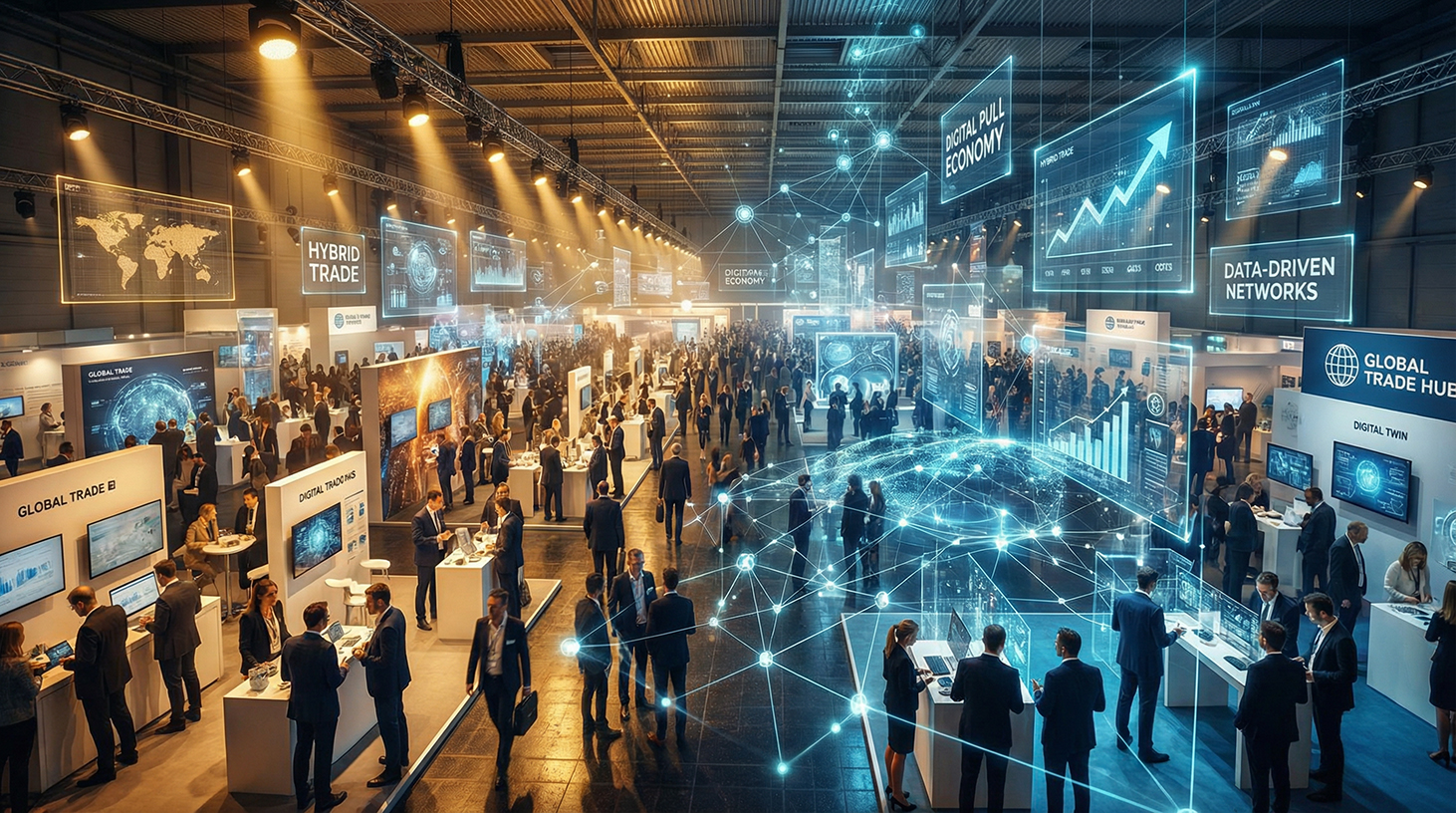
A push island in a pull ocean: Have traditional trade fairs lost their raison d'être? Those who wait for visitors lose out – Image: Xpert.Digital
The Great Lead Illusion: Why Your Trade Fair Appearance in B2B Marketing Often Falls Short
The purchase decision has already been made: This is how millennials are forcing the trade fair industry to rethink its approach
For decades, trade fairs were considered the gold standard for acquiring new customers in the B2B sector and an indispensable meeting place for industry. But in the digital age, the facade of this classic push marketing is crumbling. While exhibitors spend tens of thousands of euros building booths and waiting for visitors, modern B2B buyers – driven by the generational shift towards Millennials and Gen Z – have often already made their decisions online before even setting foot in a trade fair hall. The result: exploding costs, difficult-to-demonstrate ROIs, and the realization that the traditional trade fair booth as a pure acquisition tool is obsolete. But this by no means signifies the end of the trade fair industry, in which Germany holds an undisputed leading position worldwide. Rather, the changing purchasing behavior is forcing companies to undergo a radical strategic realignment. Learn why the isolated trade fair is an illusion, how to successfully combine the digital customer journey with building trust in person, and which hybrid concepts will determine future economic success or failure.
Related to this:

Trade fairs in the digital age: Push islands in a pull ocean
Those who are expecting visitors have already lost the buyer's intent
Trade fairs are among the oldest and most hotly debated instruments of B2B marketing. For decades, they were considered an indispensable hub of industrial economic life: the place where markets were created, prices negotiated, and innovations presented to the world. Today, they encounter a fundamentally changed purchasing behavior, with buyers who have already completed two-thirds of their decision-making process before even speaking to a supplier. The resulting structural question is not a sentimental one: What economic function does the trade fair still fulfill when purchasing behavior has long since migrated to the digital pull space?
Two logics clash
To understand the strategic tension, one must internalize the fundamental difference between push and pull marketing. Push marketing means that the company actively conveys its message to the potential customer – through advertising, trade fairs, field sales, and mailings. The initiative lies with the provider; the contact is initiated by the company. Pull marketing, on the other hand, means that the interested party actively searches for solutions, information, and providers – and finds them through search engines, content, review platforms, and social networks. The initiative lies with the buyer.
Trade fairs, in their basic structure, are a tool of push marketing. The exhibitor rents space, sets up an elaborate exhibit, presents their products, and waits for visitors to come to their stand. The event is limited in time and space, and the channel is highly controlled. This corresponds exactly to the logic of "pushing" information and offers into the market.
The problem: The ocean in which these push islands float has fundamentally changed. 66 percent of all B2B buyers now begin their procurement process with a Google search, 45 percent visit supplier websites directly – all before they have ever spoken to a single supplier. According to Gartner, 80 percent of all B2B sales interactions now take place in digital channels. By 2025/2026, 67 percent of all B2B buyers will explicitly prefer a purchasing process without sales representatives, and 45 percent already used AI tools for research in their last purchase.
The trade fair industry: Robust figures, silent erosion
Anyone looking solely at macroeconomic data might conclude that the trade fair industry is in excellent health. And indeed, the global figures for 2024 are impressive. 32,000 trade fairs took place worldwide – almost as many as before the pandemic. 4.7 million exhibiting companies welcomed 318 million visitors. The direct economic output of the industry and its exhibitors generated €150 billion in output; including indirect effects, this figure rises to €368 billion in total output and €215 billion in GDP contribution. 4.3 million full-time jobs worldwide are directly dependent on the trade fair industry.
For Germany specifically, AUMA recorded a total of 322 trade fairs in the 2024 trade fair year, with over 204,000 exhibitors and 11.7 million visitors. More than 230,000 jobs in Germany are linked to the industry, and two-thirds of all leading trade fairs worldwide take place in Germany. According to its own statements, the German trade fair industry is entering 2026 with cautious optimism: Over 60 percent of trade fair companies expect better results than in the previous year.
But behind this stable facade lie structural cracks. In Germany, visitor numbers at regional trade fairs fell by around 3 percent in 2024, even though the number of exhibitors rose slightly by 1.7 percent. The Hannover Messe 2025 recorded a slight decline compared to the previous year, with around 127,000 visitors. Globally, rented exhibition space is still 3.9 percent below the pre-crisis level of 2019. It is no coincidence that the AUMA annual publication "Trends 2025/2026" is titled "Change is our constant companion.".
The cost problem: Push has its price
The structural disadvantage of the push mechanism becomes particularly clear when one objectively analyzes the costs of participating in a trade fair. The rental of exhibition space at the Hannover Messe alone costs €295 per square meter. At the IAA Mobility in Munich, a simple in-line stand costs €315 per square meter, while an end stand costs €405. A typical 20-square-meter exhibition stand, including stand construction, staff, and marketing, quickly costs €14,500 or more – and that's for just a single event.
The total costs of professional trade fair participation extend far beyond the booth rental. Travel expenses, hotels, catering, logistics, booth construction, dismantling, marketing materials – all of these add up considerably. At the same time, 63.5 percent of event managers report that budget concerns represent their biggest challenge for 2025. Particularly troubling: 38.2 percent of event managers fail to demonstrate a return on investment (ROI) for their trade fair expenditures – even though 95 percent identify ROI as a top priority. This contradiction is telling: Trade fairs are perceived as necessary, but their impact is difficult to quantify.
Professionally managed trade fair appearances can indeed deliver solid returns: With systematic preparation and follow-up, as well as targeted lead qualification, an ROI of 4:1 to 5:1 can be achieved – with conversion rates of up to 39 percent compared to only 15 percent for unplanned, reactive approaches. The crucial point: This ROI requires that the trade fair is not viewed in isolation, but rather as part of a seamless, digitally supported customer journey.
🎯🎯🎯 Data-driven B2B industry hub as a quasi-in-house solution

The quasi-in-house solution: How Xpert.Digital closes operational gaps in B2B marketing and sales – Smart Content-Driven Business - Image: Xpert.Digital
Xpert.Digital is a data-driven B2B industry hub led by Konrad Wolfenstein . The company acts as an external, quasi-in-house solution for industrial partners, closing operational gaps in marketing, content, and sales – without requiring additional resources on the client side.
More information here:
The end of the trade fair? Why record visitor numbers only mask the real crisis
The buyer disappears from the trade fair channel
The real problem lies not in the costs alone, but in a structural shift in purchasing behavior that is undermining the fundamental mechanism of trade fairs. Gartner data shows that B2B buyers have already completed between 57 and 70 percent of their decision-making process before they even make direct contact with a sales representative. Already, 65 percent of B2B buyers state that they want to navigate the purchasing process independently and via digital channels. According to Gartner, three-quarters prefer a direct buying experience without intermediaries.
This shift has a demographic cause. Since 2023, 65 percent of B2B buyers have been between 18 and 40 years old – Millennials and Generation Z. This generation of buyers has developed its consumption habits in the digital space. They expect mobile-first experiences, real-time information, self-service tools, and transparent price comparisons. Visiting a trade fair booth every two years doesn't align with their information-gathering logic. Purchase decisions aren't made at the trade fair – they're made beforehand, through digital research, peer reviews, and comparative content.
The consequences for trade fairs as a push marketing tool are significant: If the purchase decision has already been made before the visitor even enters the hall, then the trade fair is no longer an acquisition channel – it's a confirmation channel. This isn't an insignificant function, but a fundamentally different one. Those who don't understand this are investing push marketing budgets in a phase of the customer journey that has already been completed in the digital world.
Related to this:

What trade fairs can actually achieve
Despite all the structural criticism, it would be a mistake to declare the trade fair obsolete across the board. Its specific strengths are real and can hardly be replaced by digital substitutes. For complex industrial goods and high-priced investments, physical contact – touching, experiencing, testing – remains a crucial factor in building trust. Anyone spending several hundred thousand euros on a machine doesn't want to have seen the device only as a CAD model on a screen.
The IAA Transportation 2024 in Hanover impressively underscored this thesis: around 145,000 trade visitors attended the fair, 10 percent more than in 2022. Over three-quarters of these visitors were decision-makers. The IAA Mobility in Munich even recorded a new visitor record in 2025 with well over 500,000 visitors. These figures demonstrate that the trade fair format is by no means dying – but rather that it is changing. The trade fair is becoming a platform for in-depth discussions, no longer just for initial contact.
Trade fairs also achieve something that content marketing cannot structurally generate: concentrated market presence. When an industry converges in one place, an information and networking pressure arises that cannot be simulated digitally. Competitors observe each other, trends become tangible and perceptible, and partnerships are initiated based on spontaneous personal encounters. According to a bvik study, almost 30 percent of all B2B lead generation is attributed to trade fair and event participation. This function does not automatically lose its value – but it must be framed strategically.
Lead generation: The great illusion of the isolated trade fair
A common strategic error is viewing trade fairs as a standalone lead generation tool. The reality of the modern B2B buying process is different: More than 90 percent of companies use email marketing for invitations and follow-up after their trade fair participation, and more than 70 percent consider virtual content offerings such as webinars, product presentations, or white papers to be relevant. In practice, trade fairs are no longer isolated – but the strategic awareness of this integration is often still lacking.
Digital channels for lead generation are more cost-effective and scalable than trade fair appearances. Mechanical engineering companies that rely on social media and content marketing quickly reach several hundred leads per month – at costs in the low to mid-double digits per lead. This is a structural cost advantage that is increasingly putting pressure on push-oriented companies to readjust their channel mix. The answer, however, does not lie in an either-or approach, but in the intelligent integration of both logics.
Digital B2B marketing is clearly moving away from a purely push-based approach towards data-driven, measurable impact – this was the unequivocal diagnosis of the Industrial Communication Day 2025, where 350 participants discussed the future of industry communication. Trade fairs will remain lead magnets, but only through professional digital marketing will brands be found permanently in competitive markets – as Kai Halter, Chairman of the Board of bvik, put it.
Hybrid formats: symbiosis instead of substitution
The strategic answer to the tension between push trade fairs and pull digital lies in the hybrid trade fair concept – not as a trendy term, but as a consistent integration of two complementary logics. Hybrid trade fairs combine the advantages of personal interaction with the reach and measurability benefits of digital extensions: lower costs for absent prospects, global reach beyond physical travel limitations, quantifiable success measurement, and lasting visibility beyond the day of the fair.
Crucially, digital extensions must fulfill a threefold function: they must enhance the physical trade fair, unlock new revenue streams, and simultaneously reduce costs. Anyone who simply adds a basic live-stream option to a trade fair has missed the point. True hybrid formats allow digital visitors to browse exhibitor profiles, participate in live presentations, and book appointments with contacts – all within a single app. This transforms the trade fair from a time-limited event into a permanently active platform.
57 percent of the surveyed trade fair companies worldwide expect that more hybrid events with more digital elements will take place in the future. Digital elements must be judiciously implemented – not every product presentation needs a VR headset, but interactive configurators, app-based lead capturing, and digital follow-up via personalized video summaries are no longer gimmicks, but essential.
Germany as a global trade fair power: Strength with gaps in protection
Germany's trade fair sector rests on a robust structural foundation. Two-thirds of the world's leading trade fairs take place here. Frankfurt, Hanover, Munich, Cologne, and Düsseldorf are the international top choice as exhibition centers. Global market leadership is a reality – but also vulnerable if structural change is not actively managed.
The AUMA Trends 2025/2026 soberly identify the main challenges: cost pressures meet geopolitical uncertainties – rising energy, travel, and stand construction costs, as well as volatile industry developments. Visa hurdles and trade conflicts affect international visitor flows. The digitalization of public administration and the reduction of bureaucracy are explicitly mentioned as structural prerequisites for competitiveness. At the same time, German trade fairs benefit from the fact that international markets yearn for trustworthy meeting places in times of uncertainty: Canada specifically used the Hannover Messe 2025 for market diversification after new US tariffs had burdened transatlantic trade.
Strategic repositioning: From location to platform
The crucial strategic shift for exhibitors lies in no longer viewing the trade fair as a standalone marketing event, but rather as the culmination of a continuous, digitally supported customer journey. The trade fair is most effective when the potential buyer has already been sensitized and qualified through pull content – and the physical encounter at the fair then takes the final step in building trust.
Specifically, this means that target groups should be warmly engaged with SEO-optimized content, expert articles, white papers, and LinkedIn communication well before the trade fair. The trade fair itself is then the conversion moment, where digital interest transforms into a personal connection. Follow-up via personalized content series, follow-up calls, and email sequences secures the lead. According to the AUMA exhibitor outlook, 99.5 percent of companies plan to continue their trade fair presence – but the quality of this presence, not its mere existence, will determine the ROI.
Change is not optional. B2B marketing is moving away from its secondary role and assuming an active shaping function on equal footing with sales. Trade fairs that embrace this change will remain central platforms for economic exchange. Those that continue to rely on the isolated push model will become increasingly expensive, complex, and harder to justify in terms of their effectiveness – in an ocean where the buyer has long since dictated the current.
Your global marketing and business development partner
☑️ Our business language is English or German
☑️ NEW: Correspondence in your native language!

Konrad Wolfenstein
I and my team are happy to be available to you as your personal advisor.
You can contact me by filling out the contact form here or simply call me at +49 7348 4088 965. My email address is: [email protected]
I'm looking forward to our joint project.










