
The Great Divergence – The global economy between record growth and looming stagnation, oil shock and the threat of war
Xpert Pre-Release

Language selection 📢
Published on: March 1, 2026 / Updated on: March 1, 2026 – Author: Konrad Wolfenstein
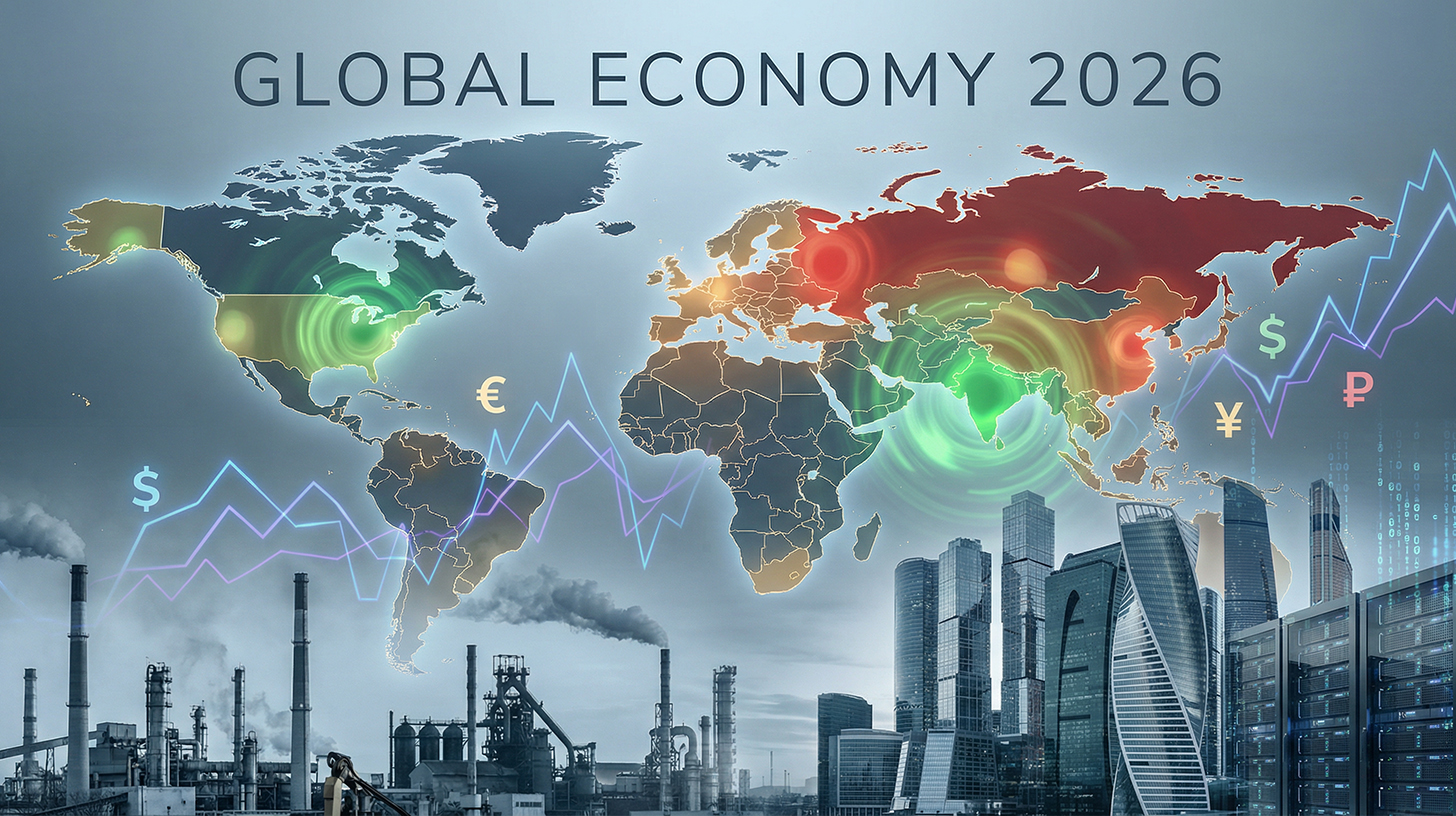
The Great Divergence – The global economy between record growth and looming stagnation, oil shock and the threat of war – Image: Xpert.Digital
Oil shock and the threat of war: Why the global economy faces the ultimate crash in 2026
Winners and losers of the mega-crisis: Why the global economy is brutally tearing apart
Operation Epic Fury: How a new war in the Middle East is crippling global supply chains
The global economy of 2026 resembles a powder keg. While countries like India celebrate record-breaking growth and Europe struggles out of stagnation with an unprecedented effort, the grand global structure is teetering on the brink. The US is noticeably cooling down, China is battling the specter of historic deflation, and Russia is feeling the painful limitations of its overstretched war economy. But these already tectonic shifts in global markets will be completely overshadowed in the spring of 2026 by an unforeseen shock event: With "Operation Epic Fury" and the rapid military escalation in the Middle East, the Strait of Hormuz – the most crucial bottleneck for the world's oil supply – will become the epicenter of an unprecedented crisis. When 20 percent of the world's oil is suddenly frozen, global supply chains collapse overnight, and freighters are forced to make wide detours around the crisis zone, the world faces an economic tsunami. Learn in this comprehensive analysis what this unprecedented divergence of the superpowers means and how the war for oil is fundamentally reshaping our financial future.
Why the global economy in 2026 will resemble a tectonic fault that no one can mend
The global economy in spring 2026 presents a picture of profoundly contradictory developments. While some economies are experiencing robust growth rates and leveraging structural strengths, others are mired in stagnation, deflation, or the consequences of a war-oriented economy. S&P Global forecasts global real GDP growth of 2.9 percent for 2026, matching the 2025 level and exceeding the market consensus. Goldman Sachs Research is similarly optimistic with a forecast of 2.8 percent. However, behind these aggregated figures lies a divergence between economic regions, the extent of which has not been seen since the 2008 financial crisis.
Europe: The arduous path out of stagnation
The eurozone experienced a surprisingly positive fourth quarter of 2025, with real GDP growing by 0.3 percent compared to the previous quarter, exceeding expectations. Spain and Portugal once again proved to be growth engines, with Spain standing out with 0.8 percent quarterly growth and an annual forecast of 2.1 percent for 2026. The eurozone unemployment rate fell to 6.2 percent, underlining the fundamental resilience of the labor market.
For 2026, most forecasting institutions have revised their expectations upwards. KBC Bank raised its eurozone forecast from 1.0 to 1.2 percent, while Morgan Stanley expects a more moderate 1.1 percent. The European Central Bank kept its key interest rate at 2.0 percent at its February meeting and considers its monetary policy positioning appropriate to respond to future economic shocks. Inflation in the eurozone fell to 1.7 percent in February, driven by lower energy prices, while core inflation eased moderately from 2.3 to 2.2 percent.
Germany is playing a key role in this European recovery, having endured two years of contraction and nearly three years of economic stagnation. The European Commission forecasts growth of 1.2 percent for 2026, driven by a significantly expansionary fiscal policy. The German government's infrastructure and defense package, estimated at one trillion euros over ten years, is intended to stimulate investment and revive the long-dormant construction sector. Industrial orders showed three consecutive months of growth at the end of 2025 for the first time in a long while, which ING analysts interpreted as a clear turning point for the industrial sector.
However, Europe's structural challenges cannot be solved by fiscal stimulus alone. Increasing competition from China, particularly in the electric vehicle sector, continues to weigh on the German automotive industry. France is grappling with an unfavorable budget for businesses and higher taxes that could stifle investment and job creation. Growth forecasts for France are a mere one percent, below the European average. Preparing the 2027 budget will be even more challenging, as no structural reforms have been undertaken.
The United States: Cooling down after the boom
The American economy is experiencing a noticeable slowdown. Real GDP grew by only an annualized 1.4 percent in the fourth quarter of 2025, following a robust 4.4 percent increase in the third quarter and falling well short of the expected 3 percent. The primary reason was the impact of the historic government shutdown, which hampered government spending and economic activity. For the full year 2025, the US economy expanded by 2.2 percent, below the 2.8 percent of the previous year.
The labor market showed marked weaknesses. In 2025, only 181,000 new jobs were created, the lowest number outside the pandemic since the Great Recession of 2009 and a dramatic decline from the 1.459 million jobs added in 2024. Consumer spending, which accounts for 68 percent of GDP, slowed from 3.5 percent in the third quarter to 2.4 percent, with spending on goods even falling by 0.1 percent.
At the same time, inflation accelerated. The Federal Reserve's preferred PCE price index rose to 2.9 percent year-over-year, its highest level since March 2024. The core PCE index climbed to 3.0 percent, also its highest level in nearly a year. Trump's tariffs on imported goods drove up prices for furniture, appliances, and toys. The federal funds rate hovered between 3.5 and 3.75 percent after Fed Chair Powell emphasized the dependence on data for future monetary policy decisions. With the designated new Fed Chair, Kevin Warsh, on the horizon, observers did not expect two interest rate cuts until the second half of 2026.
Uncertainty was further heightened by the Supreme Court ruling against the IEEPA tariffs. The abrupt shift from industry-specific tariffs of up to 145 percent on Chinese goods to a flat 15 percent surcharge under Section 122 presented companies with massive planning challenges. The positive news was that the elimination of the most aggressive tariffs could alleviate some of the inflationary pressure. Analysts estimated that without the tariff effects, core inflation would be close to or even below the Fed's two percent target.
China: The spectre of deflation and record exports
China's economy is caught in a remarkable but troubling balancing act. On the one hand, it is an export powerhouse that achieved a record trade surplus of $1.2 trillion in 2025, the largest ever recorded by a single country. On the other hand, the country is grappling with deflation, now in its third consecutive year – the longest such cycle since China's transition to a market economy in the late 1970s.
In January 2026, the producer price index fell by 1.4 percent year-on-year, marking the 41st consecutive month of declining producer prices. This trend is driven by massive overcapacities in key sectors such as electric vehicles, solar panels, and lithium-ion batteries. With domestic demand remaining weak, Beijing has encouraged its industrial giants to export their way out of the crisis, selling surplus goods on the global market, sometimes below cost.
The two-tiered economy is also reflected in the hard data: While industrial production grew robustly by 0.49 percent in December compared to the previous month, retail sales fell by 0.12 percent. The real estate market, which has been in a downward spiral for four years, has caused prices to plummet by over 20 percent since its peak in 2021, and this, along with weakened consumer confidence, is dampening spending. The International Monetary Fund criticized China for still not doing enough to combat deflation.
For 2026, most analysts expect growth of 4.5 to 4.8 percent, which, while respectable, is significantly below the more than five percent of previous years. The impact of the US trade war was less devastating than feared, as direct exports to the US, although falling by around 20 percent, were offset by China shifting its exports to other markets. However, the quality and profitability of this trade has deteriorated, and aggressive price cuts to maintain competitiveness under tariff pressure are squeezing profit margins in Chinese industry.
Our global industry and economic expertise in business development, sales and marketing

Our global industry and economic expertise in business development, sales and marketing - Image: Xpert.Digital
Industry focus areas: B2B, digitalization (from AI to XR), mechanical engineering, logistics, renewable energies and industry
More information here:
A thematic hub offering insights and expertise:
- Knowledge platform covering global and regional economies, innovation and industry-specific trends
- A collection of analyses, insights, and background information from our key areas of focus
- A place for expertise and information on current developments in business and technology
- A hub for companies seeking information on markets, digitalization, and industry innovations
Economic turning point: While India is booming, Russia is threatened with stagnation
Japan: Between full employment and a structural dilemma
Japan's economy is experiencing moderate growth, but this is overshadowed by a delicate balancing act between fiscal and monetary policy. The country boasts full employment, with a projected unemployment rate of 2.4 percent, a dynamic corporate sector, and a declining debt-to-GDP ratio. At the same time, inflation repeatedly exceeds the Bank of Japan's two percent target, driven by supply constraints over which the central bank has limited control.
The government forecasts real GDP growth of around 1.1 percent and nominal growth of a substantial 4.2 percent for fiscal year 2026. Analysts at BNP Paribas are more conservative, expecting quarterly growth of 0.2 percent, which would translate to an annual rate of 0.7 to 0.8 percent, close to the estimated potential growth. The challenge lies in reducing inflation without damaging the robust labor market and wage growth, while fiscal stimulus could exacerbate inflation risks and raise concerns about debt sustainability.
Positive signals are coming from the government's fiscal measures, which are providing around four trillion yen in direct fiscal support, with an estimated GDP growth effect of about 0.2 percentage points. Nominal GDP has already surpassed 600 trillion yen and is expected to continue rising. The Bank of Japan faces the difficult task of continuing its gradual normalization process without stifling the economic recovery.
South Korea: Recovery from the political crisis
South Korea's economy has recovered from the turmoil of a political crisis that led to negative growth in the first quarter of 2025. However, in the fourth quarter of 2025, the economy contracted again by 0.3 percent compared to the previous quarter, which analysts primarily interpreted as a correction after the strong growth of 1.3 percent in the third quarter. The return to normalcy under President Lee Jae-myung's government, which countered the crisis with stimulus measures and supplementary budgets, contributed to the stabilization.
For 2026, most forecasts converge around the two percent mark. The IMF slightly raised its growth expectation to 1.9 percent, the OECD forecasts 2.1 percent, while the Bank of Korea expects 1.8 percent. Hopes rest largely on the global boom in artificial intelligence and semiconductors, a sector in which South Korea is a world leader with companies like Samsung and SK Hynix. The central bank signaled that it has completed its interest rate-cutting cycle and is focusing on cautiously supporting the anticipated recovery.
India: The star of the global economy
India stands out as the world's fastest-growing major economy. The growth forecast for the current fiscal year 2025/26 was raised to 7.6 percent following a revision of the GDP calculation methodology, up from a previous estimate of 7.4 percent. The second quarter saw impressive growth of 8.4 percent, and the third quarter, at 7.8 percent, also exceeded most expectations.
Private consumption is expected to grow by seven percent, and government spending by 5.2 percent – a significant acceleration compared to the previous year. The Reserve Bank of India cut its key interest rate by 25 basis points and revised its inflation forecast downward to 2.0 percent, creating further room for economic easing. The Indian government expects the economy to comfortably exceed four trillion US dollars in nominal GDP in fiscal year 2026/27.
Despite these impressive figures, the environment is not without risks. The 50 percent US tariffs on Indian exports, in place since August 2025, are weighing on foreign trade, although an interim agreement negotiated in February reduced the effective tariffs to 18 percent. The services sector is showing strong upward momentum, particularly in labor-intensive segments, and the manufacturing sector has experienced double-digit growth. The IMF projects a growth rate of 6.5 percent for the coming years, which will continue to make India a global growth engine.
Russia: The End of the War Boom
Russia's economy is undergoing a fundamental transformation that is exposing the limitations of its war-driven growth model. After GDP growth of 4.3 percent in 2024, fueled by massive defense spending and rising domestic demand, the state development bank VEB expects a contraction of 0.8 percent in 2026. The government itself anticipates growth of no more than one percent, but analysts warn that the slowdown is not merely cyclical but reflects a period of structural stagnation.
The causes are multifaceted. Western sanctions, now in their fifth year, are having an increasingly profound impact. Oil and gas revenues plummeted to 8.7 trillion rubles in 2025, far below the originally projected 10.9 trillion rubles. The ruble appreciated by over 30 percent against the dollar in 2025, which paradoxically further depressed export earnings. Increased dependence on Asian customers, particularly China and India, has exposed Russia to steep price reductions and higher logistics costs.
Investment is expected to decline by 0.9 percent in 2026, a result of tight monetary policy and weaker corporate lending. Inflation is projected to reach 6.2 percent by the end of 2026, while the key interest rate remains at 16 percent. EU sanctions chief David O'Sullivan stated that the situation could become unsustainable by 2026, as the Russian economy has been massively distorted in favor of a war economy, at the expense of the civilian sector.
A particularly paradoxical risk is emerging: A potential end to hostilities in Ukraine could actually increase recession risks in the short term, as production in the defense industry would decline and household incomes would fall. The era of war-driven growth is drawing to a close, and the Russian economy faces a year in 2026 in which the sustainability of this model will be severely tested.
South America: Moderate growth under global pressure
Latin America is navigating an environment characterized by conflicting forces. After a surprisingly resilient 2025 with regional GDP growth of 2.3 percent, moderate growth of 2.1 percent is expected for 2026. Inflation remains elevated at a projected 8.3 percent, limiting the scope for monetary easing.
Brazil, the region's largest economy, faces a more subdued period. Growth forecasts for 2026 range from 1.6 to 2.0 percent, down from 2.2 percent the previous year. Adjusted for inflation, real interest rates remain high, dampening capital-intensive industries and the consumption of durable goods. The government aims to return to a primary surplus of 0.25 percent of GDP, but 2026, being an election year, makes achieving this target less likely. The expected trade surplus of US$70 to 90 billion is a positive sign, and Vice President Alckmin is optimistic about concluding a trade agreement between Mercosur and the European Union.
Mexico is expected to see gradual improvement with projected growth of 1.3 to 1.4 percent, although declining investment activity remains a significant obstacle. Colombia, with expected growth of 2.8 percent, will be among the more dynamic economies in the region, driven by an expanding manufacturing sector.
The tectonic divergence
The global economic situation in spring 2026 can best be described as a tectonic divergence. India is growing at over seven percent, while Russia is slipping into contraction. The Eurozone is recovering tentatively, while China's deflation is entering its third year. The US is grappling with a combination of slowing growth and persistent inflation, while Japan is attempting to maintain full employment and price stability simultaneously. These divergences are further exacerbated by the attack on Iran and the looming blockade of the Strait of Hormuz and could fundamentally alter the forecasts described here in the coming weeks.
Your global marketing and business development partner
☑️ Our business language is English or German
☑️ NEW: Correspondence in your native language!

Konrad Wolfenstein
I and my team are happy to be available to you as your personal advisor.
You can contact me by filling out the contact form here or simply call me at +49 7348 4088 965. My email address is: [email protected]
I'm looking forward to our joint project.










