
Bought Gross Domestic Product? The expensive trick with growth: How Germany is buying its economic growth
Xpert Pre-Release

Available in 27 languages 📢
Prefer Xpert.Digital on GoogleⓘPublished on: August 28, 2026 / Updated on: August 28, 2026 – Author: Konrad Wolfenstein
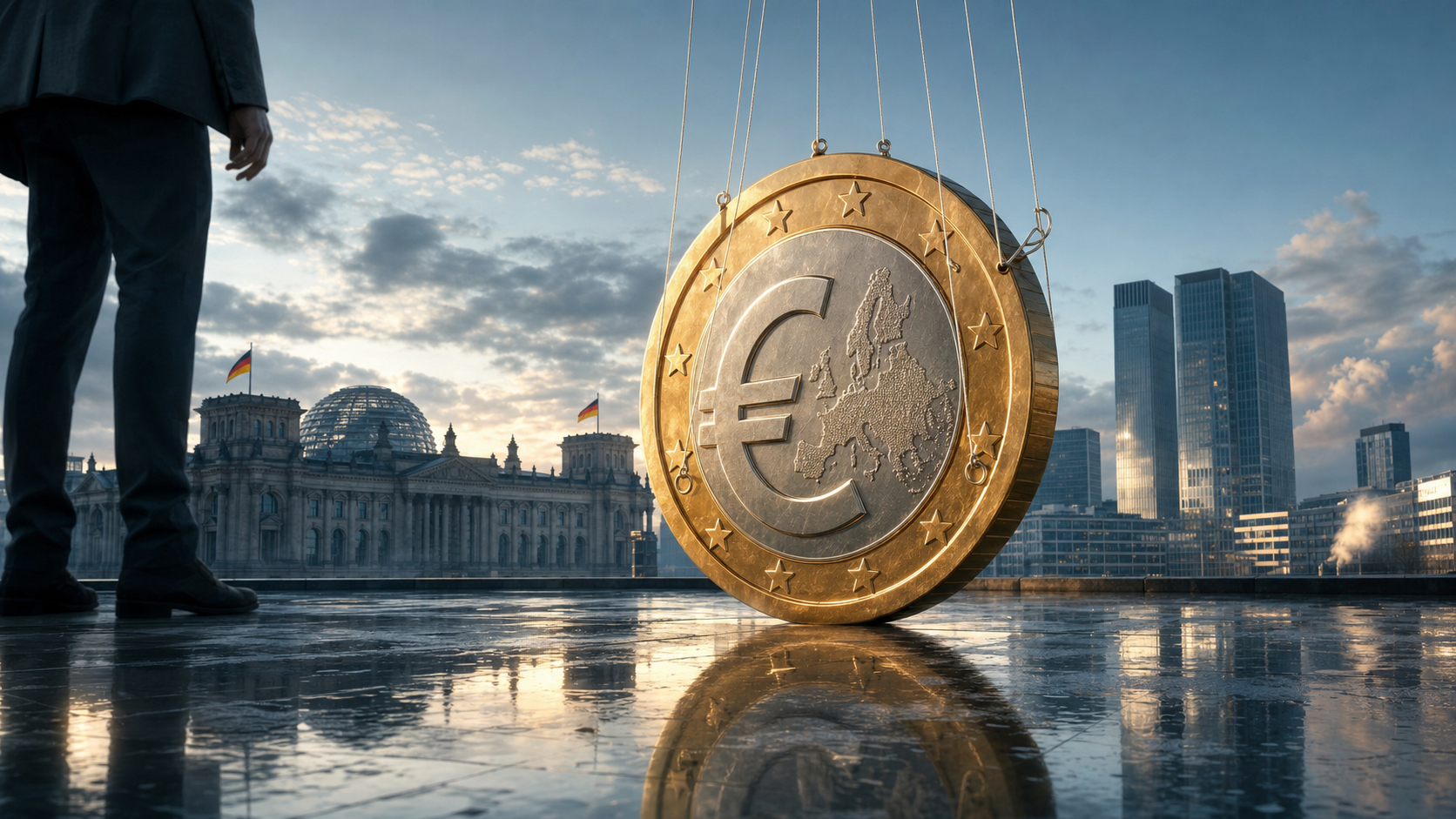
Bought Gross Domestic Product? The expensive trick with growth: How Germany buys its economic growth – Image: Xpert.Digital
Growth illusion exposed? The inconvenient truth behind the sudden upswing
Billions on credit: How the state is artificially inflating the current economy
The latest economic data initially sounded like the long-awaited breakthrough: the German economy is growing again. But a closer look at the figures for the first half of 2026 reveals an uncomfortable truth. As recent media reports pointedly put it, the government appears to have effectively "bought" growth with an unprecedented expenditure of billions. While private consumption stagnates and business investment declines noticeably, debt-financed government spending is artificially inflating the gross domestic product (GDP). Is this alarming narrative mere journalistic scaremongering – or a sound economic diagnosis? A detailed comparison of the official data from the Federal Statistical Office with the stark warnings of independent institutions such as the German Council of Economic Experts shows that the criticism of these misappropriated special funds is entirely justified. The apparent upswing turns out to be a dangerous illusory giant that doesn't solve the core of Germany's economic crisis, but merely obscures it with expensive statistical manipulation.
Between numbers magic and location crisis – why 0.9 percent growth shouldn't fool anyone who looks more closely
The report initially sounded like good news: Germany's economy grew more strongly in the first half of 2026 than it had in years. However, anyone who examines the composition of this growth will encounter an uncomfortable truth, which the Focus article "Dangerous Paper Giant: The State Buys Itself GDP" describes in a somewhat exaggerated, but essentially accurate, way.
What the article claims and what is actually behind it
The Focus article from August 27, 2026, calculates that nominal gross domestic product grew by €81.2 billion from January to June 2026. After adjusting for inflation, approximately €16.6 billion of this remained as real growth. The crucial finding: €13.8 billion of this, or about 80 percent, was attributable to increased government consumption, while total investment by the public and private sectors actually fell by €1.2 billion. These figures are taken directly from the official publications of the Federal Statistical Office and are therefore methodologically verifiable, not fabricated.
The official data from Destatis confirm the general finding, but also provide a more nuanced perspective. In the second quarter of 2026, GDP rose by 0.3 percent in real terms compared to the previous quarter, and by 1.0 percent compared to the same quarter of the previous year. President Ruth Brand explicitly emphasized that the increase was primarily attributable to strong export performance, not primarily to government spending. Merchandise exports increased by 2.6 percent quarter-on-quarter, corresponding to overall export growth of 2 percent. At the same time, both private and government consumption expenditure rose only slightly by 0.1 percent each quarter-on-quarter, while investment declined.
Why statistics and headlines seem to contradict each other
Herein lies the first important clarification: The Focus article refers to the entire first half of the year and a comparison with the previous year, while the Destatis figures cited last describe a pure quarterly comparison to the first quarter of 2026. The year-on-year comparison does indeed reveal a clear divide: Private consumption rose by only 0.1 percent, while government consumption in the second quarter of 2026 increased by a substantial 3.0 percent compared to the same quarter of the previous year. Destatis explicitly cites higher federal and social security expenditures as the cause, particularly increased social benefits in kind for statutory health and long-term care insurance. Thus, the official statistics essentially confirm the mechanism described in the article, even if the exact weighting varies slightly depending on the period under consideration.
At the same time, Destatis points out that GDP has now increased for the third consecutive quarter: by 0.3 percent at the end of 2025, by 0.4 percent in the first quarter of 2026, and by another 0.3 percent in the second quarter. This consistency somewhat mitigates the dramatic nature of the situation, as a purely government-driven, short-lived boom could hardly be sustained for three consecutive quarters without the statistics becoming massively contradictory.
Is this journalistic sensationalism or sound analysis?
To assess whether an article is sensationalist clickbait or a serious economic analysis, it is worth looking at three criteria: data source, level of interpretation, and contextual classification.
The data source shows that the article relies directly on official figures from the Federal Statistical Office, not on its own estimates or anonymous sources. The figures cited—81.2 billion euros in nominal growth, 16.6 billion euros in real growth, and the 1.2 billion euro decline in investment—are mathematically verifiable and correspond with what Destatis published in its detailed results for the second quarter.
The level of interpretation is more critical. The phrase "the state is buying" GDP" is a deliberately exaggerated, journalistically effective metaphor. Economically accurate would be to speak of a fiscally driven demand impulse that is automatically incorporated into the GDP calculation via national accounts. This exaggeration undoubtedly serves to generate clicks, but it does not unfairly distort the underlying facts because the basic principle is correct: The state can indeed generate growth on paper through increased spending, without any improvement in production capacity, private investment, or the international competitiveness of the economy.
In context, it's noticeable that the article doesn't fully address the positive contribution of exports during the same period. This omission makes the picture appear more one-sided than the overall data suggests. According to the president of Destatis, export growth was explicitly the main driver of quarterly growth, which contradicts the simple "state buys growth" narrative, provided one considers a quarterly comparison rather than a half-year comparison.
The classification by independent economic research
The crucial question, therefore, is: Is the criticism of state-driven growth a media exaggeration or a serious economic diagnosis? The answer lies in looking at the German Council of Economic Experts, which operates completely independently of daily news reports and, using considerably stronger language, arrives at a very similar conclusion.
In its 2025/26 annual report, the German Council of Economic Experts concludes that the constitutionally mandated additionality of funds from the Special Fund for Infrastructure and Climate Neutrality (SVIK) is being systematically undermined. Already in the 2025 federal budget and the draft budget for 2026, SVIK funds are replacing regular budget expenditures instead of providing additional investment incentives. The Council explicitly warns that without targeted and investment-oriented spending, growth opportunities could be squandered and long-term debt sustainability jeopardized.
The Council of Economic Experts goes into even more detail in its chapter on additionality: according to them, non-additional expenditures have no additional positive effect on GDP. For 2027, the Council calculates that the share of additional expenditures will be 50 percent, while for 2025 and 2026 the so-called additionality ratio is significantly lower. With the funds being used correctly, an additional five percent growth could be achieved by 2030, but based on current projections, it is not even two percent.
This assessment is shared by other research institutes, some of which express it even more drastically. In spring 2026, economist Martin Werding pointed to calculations showing that of the funds from the special fund that the federal government spent in 2025, only eight percent actually flowed into additional investments. The Cologne Institute for Economic Research (IW Köln) arrived at a figure of 86 percent misappropriated funds for 2025 in its own calculations, while the Ifo Institute, in an even more stringent analysis, reached 95 percent. The Institute for Macroeconomics and Business Cycle Research (IMK), which is affiliated with the Hans Böckler Foundation (close to the trade unions) and thus tends to be less critical of fiscal policy than the Ifo or IW, still arrived at a figure of 59 percent of funds not used for investment in 2025. The fact that three institutes with different political orientations, ranging from economically liberal to close to trade unions, arrive at the same fundamental diagnosis is a strong indication that this is not a politically motivated exaggeration, but rather an empirically well-supported finding.
The consequences for debt sustainability
A look at the financing side further reinforces the criticism. In the first half of 2026, the German government spent €71.3 billion more than it took in, with this deficit of the federal government, states, municipalities, and social security funds being €36.6 billion higher than in the same period of the previous year. Measured against GDP, this corresponds to a deficit ratio of 3.1 percent. Total government spending rose by 6.1 percent in the first half of the year to €1,144.5 billion.
This data shows that a significant portion of the additional government spending was financed not from current tax revenues, but through additional borrowing. Economically, this means that the observed GDP growth is not generated from the economy's own resources, but is pre-financed through future interest and principal payments. This is not inherently illegitimate, as countercyclical or investment-related borrowing can be economically beneficial if it increases productivity. However, this is precisely where the justified criticism arises, because a large portion of the funds is not flowing into productivity-enhancing investments, but rather into consumption-oriented social and healthcare spending.
The economic logic behind the debate
To put the debate into technical terms, it helps to look at the composition of gross domestic product (GDP) from the expenditure side. GDP is the sum of private consumption, investment, government consumption, and net exports:
( GDP = C + I + G + (XM) )
Here, (G) represents government consumption. Every increase in government spending on personnel, goods and services, or transfers directly increases this term, regardless of whether the underlying expenditure increases productivity or is purely consumption-based. This mechanism is not a statistical manipulation but follows the internationally standardized national accounts exactly. A country can therefore formally grow without the actual performance of its economy, as measured by productivity, capital stock, or competitiveness, actually improving.
The decisive factor for the quality of growth is therefore not the pure GDP figure, but rather how the additional funds are used. Current consumption, such as increased social benefits or personnel spending, has a short-term effect on demand, but no structural impact on future growth potential. Investments in infrastructure, education, research, or digitalization, on the other hand, can increase the economy's capacity and stimulate subsequent private investment, although usually with a significant time lag. Defense spending falls somewhere in between: it stimulates demand, but its productivity effect depends heavily on the import share and the level of industrial value creation.
What the current figures really show
The overall picture presented by the available data is nuanced, but the trend is clear. In the second quarter of 2026, exports were the primary driver of positive growth, while both private and government consumption showed only modest growth in a simple quarterly comparison. However, a year-on-year comparison reveals a clear shift in favor of the government, whose consumption expenditure rose by 3.0 percent, while private consumption remained virtually stagnant. At the same time, investment declined in both the private and public sectors. Real growth in 2025 as a whole was already extremely weak at just 0.2 percent, with consumption, rather than investment, playing the dominant role even then.
This data supports the central thesis of the Focus article, namely that the main growth impetus in the first half of 2026 did not stem from a broad private-sector recovery, but primarily from government consumption. At the same time, it puts this exaggeration into perspective, because export performance, when comparing quarters directly, actually made the largest single positive contribution, thus demonstrating that there are indeed private-sector growth impulses, albeit fragile ones that are highly dependent on global demand.
Why the criticism is nevertheless more than just sensationalism
A key argument that the core of the article is not merely media attention-grabbing lies in its agreement with institutional economic research. The German Council of Economic Experts, the Ifo Institute, the Cologne Institute for Economic Research (IW Köln), and even the IMK (Institute for Macroeconomics and Business Cycle Research), despite differing methodological approaches and political stances, all arrive at a structurally similar diagnosis: A significant portion of the additional government funds is not spent on additional or investment-related expenditures, but rather replaces existing budget items or flows into consumption-based spending.
Particularly revealing in this context is the statement by Monika Schnitzer, chair of the German Council of Economic Experts, who stated at the IMK forum that it is blatantly obvious that Germany's infrastructure is no longer functioning properly. This statement by one of Germany's most renowned economists demonstrates that criticism of the current handling of special government funds cannot be reduced to sensationalist tabloid exaggeration, but is shared by the scientific policy advisors themselves and supported by concrete figures.
At the same time, a direct comparison of estimates from different institutes reveals considerable uncertainty in the detailed assessment. While the Ifo Institute assumes 95 percent of funds were misappropriated, the IMK arrives at only 59 percent for the same period. This range illustrates that even among experts there is no consensus on the exact magnitude, although all estimates point in the same direction: a noticeable, but not complete, misappropriation of special fund assets.
What the article omits or simplifies
While the fundamental criticism is valid, the Focus article remains incomplete in several respects. It fails to adequately address the fact that, according to the president of Destatis, the positive export development in the second quarter of 2026 was the primary driver of GDP growth compared to the previous quarter. Furthermore, it does not differentiate between current government spending on consumption, such as for health and long-term care insurance, and the investment components of the special fund, which may increase productivity in the long term and whose additional expenditure ratio, according to the Council of Economic Experts, is projected to rise to at least 50 percent from 2027 onward. Finally, a clear distinction between structural and cyclical deficits is lacking, even though this distinction is crucial for determining whether the current debt should be considered a temporary investment in the future or a persistent fiscal mismanagement.
Critical review
Overall, the Focus article is neither pure sensationalism nor a fully reliable expert analysis, but rather occupies a middle ground, journalistically heightened yet fundamentally data-driven. The central figure, according to which around 80 percent of real GDP growth in the first half of 2026 can be attributed to increased government spending, can be verified using official statistics and, in its basic trend, aligns with the far more rigorous and methodologically sophisticated assessments of the German Council of Economic Experts and economic research institutes. The sensationalist phrase about the "purchase" of GDP is a deliberate media exaggeration, but it does not significantly distort the underlying economic reality, as long as it is understood as a figurative description of a real fiscal mechanism and not as a literal accusation of statistical manipulation.
For a reliable economic policy assessment, the German Council of Economic Experts' analysis is significantly more informative than a snapshot of a single quarter because it systematically examines the structural dimension of the additionality problem over several years. The crucial question for the coming years is therefore not whether the state is currently financing a portion of growth, but rather whether it will be possible to actually achieve the planned additionality rate of 50 percent for the coming years and to channel special fund resources more effectively into productive infrastructure and future-oriented investments, instead of continuing to use them to compensate for regular budget shortfalls.





