
Farming village versus Silicon Valley: The escalating battle for America's AI future
Xpert Pre-Release

Available in 27 languages 📢
Prefer Xpert.Digital on GoogleⓘPublished on: July 19, 2026 / Updated on: July 20, 2026 – Author: Konrad Wolfenstein
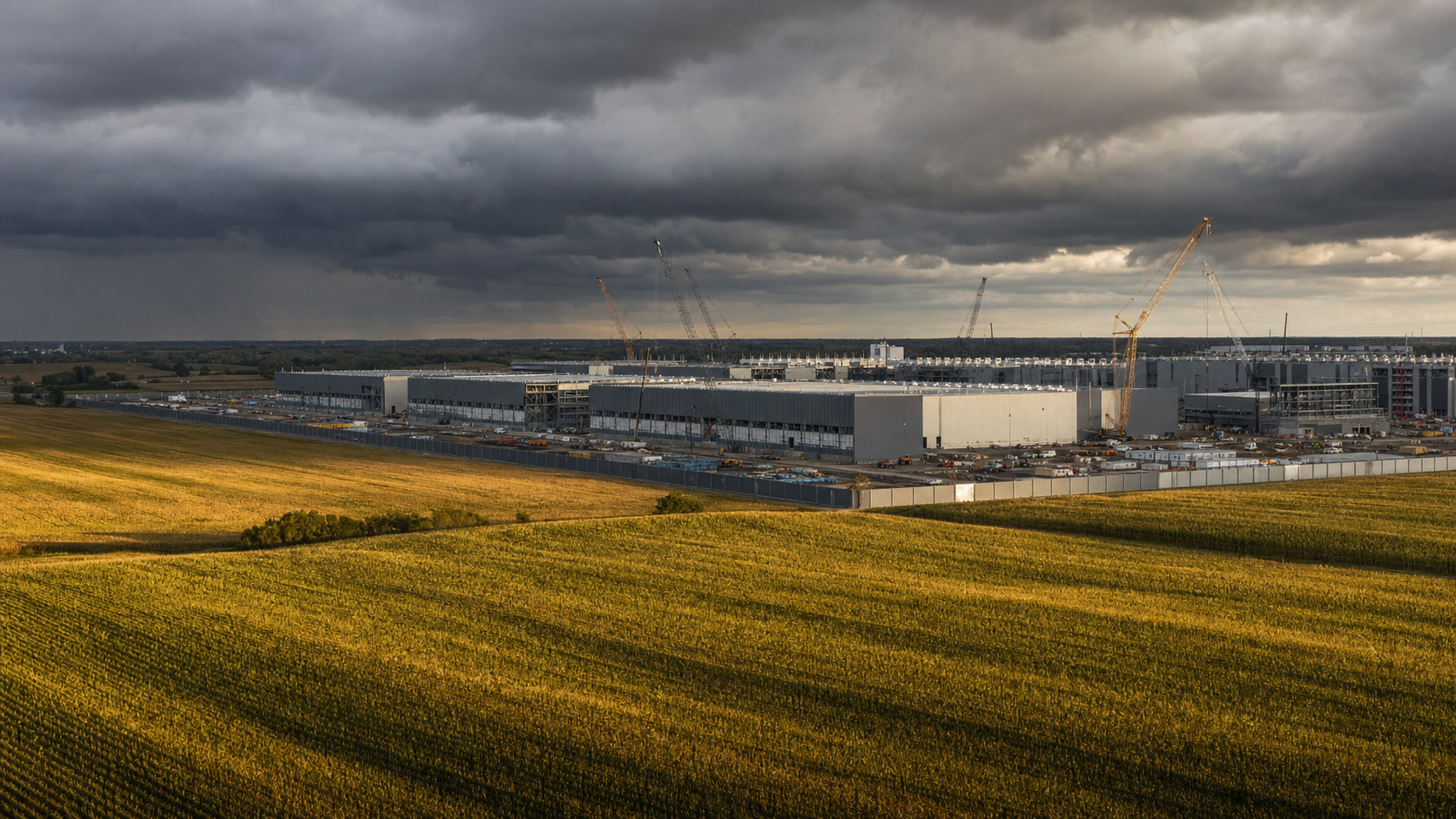
Farming village versus Silicon Valley: The escalating battle for America's AI future – Creative image: Xpert.Digital
AI shockwave: Why all of America is suddenly rebelling against mega data centers
The $56 billion project: How a village in Michigan became an AI battleground
Electricity, water, farmland: The hidden and frightening price of the global AI boom
Artificial intelligence doesn't just devour data – it devours land, water, and gigantic amounts of electricity. What began as an abstract technological arms race between the superpowers has long since arrived in the front yards of rural America and is massively impacting the lives of its citizens. At the heart of this escalating conflict is Saline Township, a tranquil community of 2,400 residents in the state of Michigan. Here, the boundless ambitions of Silicon Valley are clashing mercilessly with the tenacious resistance of local farmers and residents.
The $56 billion project by tech giants Oracle and OpenAI, part of a national infrastructure program, is exposing the deep cracks in America's energy and legal systems. Exploding electricity prices, looming water shortages, and the loss of thousands of acres of prime farmland have sparked an unprecedented, bipartisan wave of protests nationwide. The following analysis examines the true cost of the AI boom, the powerlessness of local democracy in the face of all-powerful corporations, and the pressing question: Who ultimately pays the price for technological progress?
Related to this:

A $16 billion project in a community of 2,400 residents
AI data centers vs. the common good: America's most expensive infrastructure battle
Driving along Michigan Avenue, one initially sees only what one has always seen in this area: cornfields, soybean fields, silos, and grain elevators. Saline Township is not a place that appears on any political map in Washington. Yet since the summer of 2026, it has become one of the most frequently cited symbols of the conflict between the accelerating expansion of AI infrastructure and the right of local communities to self-governance. This was triggered by a single project: the construction of a data center campus, known as "The Barn," for Oracle and OpenAI as part of the $500 billion Stargate program, which US President Donald Trump launched in early 2025 with one of the most spectacular technology policy appearances in recent American history.
The sheer scale of the project is almost incomprehensible: Originally announced as a $7 billion investment, the facility initially ballooned to $16 billion for construction and development alone – with an additional $40 billion that Oracle will spend on equipping the buildings, bringing the total project value to as much as $56 billion. Three single-story data center buildings with a total capacity of over one gigawatt of power are planned – equivalent to the output of a medium-sized nuclear power plant, making the facility one of the largest data centers in the United States. Construction is taking place on approximately 250 hectares of former agricultural land near Ann Arbor.
What makes this case particularly explosive is that the Saline Township Council rejected the construction by a vote of 4 to 1. The planning commission also rejected it. The residents protested, posting "No Data Center" signs in front of their homes, gathering at public hearings—and still lost. Two days after the rejection, the developers filed a lawsuit alleging "exclusionary zoning." The township, facing a costly, years-long legal battle and advised by lawyers that the project could ultimately be enforced through legal channels anyway, reached a settlement. Governor Gretchen Whitmer and OpenAI CEO Sam Altman held a ceremonial groundbreaking on June 1, 2026—against the backdrop of ongoing, vocal protests.
The topography of a national conflict: terrifying figures
Saline is not an isolated case—it is the most visible manifestation of a tectonic conflict running through the entire United States. The scale of the dispute is surprisingly intense, even for observers who have long followed the growing skepticism toward Silicon Valley.
In the first quarter of 2026 alone, according to Data Center Watch, a research initiative by the analytics firm 10a Labs, at least 75 data center projects with a total value of approximately $130 billion were blocked or delayed—more than in any other three-month period since data collection began in 2023, and roughly the same as in the entire previous year. The number of active opposition groups doubled within a few months to 833 groups in 49 of the 50 US states. By 2025, a total of $156 billion worth of projects were slowed or stopped by organized resistance.
Public sentiment reflects this trend. According to a Gallup poll from spring 2026, 70 percent of Americans oppose the construction of an AI data center in their neighborhood—48 percent strongly oppose it. A Reuters/Ipsos poll from June 2026 found that only a third of Americans approve of the current pace of data center construction, and only 14 percent would approve of a new one in their own community. These approval ratings are lower than those for nuclear power plants—a finding that surprises even seasoned pollsters. Particularly revealing is the fact that while opposition is strongest among Democrats—56 percent of them strongly oppose it—almost half of independent voters also clearly reject data center projects near their homes.
Electricity, water, land: The ecological and infrastructural pressure wave
The resistance is not merely a sentimental reaction to the loss of farmland. It stems from a number of concrete economic and infrastructural concerns that have proven justified in recent years.
Perhaps the most immediate point of contention is the impact on electricity prices. In the PJM grid, the largest electricity grid in the US, serving 13 eastern states and the District of Columbia, capacity prices have risen from $28.92 per megawatt-day in 2024 to $329.17 in 2026/27 – an increase of approximately 1,038 percent in less than two years, primarily due to the massive increase in demand from data centers. PJM's independent market monitoring puts the cost increase caused by data centers since 2024 at a total of $29 billion, which is passed on to customers in the PJM service area. The most recent capacity auction on June 30, 2026, is projected by the market monitor to add another $6.3 billion in costs for households and businesses.
For residential consumers, this translates to the following: Pepco customers in Washington, D.C., paid an average of $21 more per month starting in June 2025—roughly half of that increase was due to rising capacity market prices. In states like Pennsylvania and Ohio, where old industrial production and new data centers overlap, industrial electricity prices rose by 31 and 26 percent, respectively, year-over-year in 2025, while the national average was 7 percent. Belden Brick, a 141-year-old brick manufacturer in Ohio, saw its capacity charges jump from $1,600 per month to $12,000—a 650 percent increase. Nationwide, average electricity prices at the end of 2025 were 19 cents per kilowatt-hour, about 27 percent higher than in 2019. Analysts expect a further increase of up to 40 percent by 2030.
Low-income households are particularly affected: Around 21 million US households are behind on their electricity bills, with total debts to energy providers reaching $25 billion in June 2025. Power and utility disconnections rose to 3.5 million in 2024 and could exceed 4 million by 2025. Resistance to data centers is therefore by no means just a NIMBY (Not in My Backyard) phenomenon among wealthy suburbanites – it carries significant social implications.
Added to this are water resources. AI data centers are estimated to have consumed over 264 billion gallons of water for cooling by 2025. In water-scarce regions of the West, where drought is chronic, these massive facilities compete directly with agriculture and municipal drinking water supplies. While Oracle and Related Digital's use of a "closed-loop cooling system" for their saltworks project, which the companies claim uses about as much water as a typical office building, represents a technological improvement, fundamental distrust of such promises runs deep, and not every project offers similar guarantees.
Arable land as a strategic resource: The overlooked problem
One aspect that is still underestimated in the public debate is likely to gain importance in the medium term: the loss of agricultural land. Between 2017 and 2022, the agricultural land in the US shrank by an area the size of the state of Maine – and the expansion of data centers is accelerating this trend. In the case of Saline Township, around a third of the previously farmed 700 hectares was seized for the project. Individual projects in other states are claiming over a thousand hectares of prime farmland.
The president of the Illinois Farm Bureau, Phillip Nelson, publicly warned that some of the nation's most productive farmland could be permanently taken out of agricultural production—with the potential risk of industrial wasteland should the AI boom subside and data centers remain empty. Cargill executive Jerrod Gillig also expressed concern about the long-term erosion of production capacity. The organization Food & Water Watch counters that small and medium-sized farmers, already under competitive pressure from agribusiness corporations, will be further squeezed by the expansion of data centers.
The tension lies in the fact that short-term financial incentives are tempting for landowners – especially for older farmers without a successor. The Guardian reported in February 2026 on numerous families who rejected offers worth millions because their identity is inextricably linked to owning their land. What appears to be a rational market decision on an individual level can, on an aggregate level, lead to irreversible shifts in national food production.
Michigan as a magnifying glass: Democrats between the narrative of progress and voter anger
Nowhere is the political sensitivity of the issue more evident than in Michigan, where 13 data center projects are currently in various stages of planning. In this state, known for its industrial history and its importance as a swing state in election campaigns, the construction of AI data centers is already having real consequences for the election campaign.
In the race for the Democratic Senate nomination, whose primary election on August 4, 2026, will help determine the composition of the US Senate, two opposing viewpoints are clashing. Haley Stevens, a congresswoman since 2019, positions herself as a tech-savvy optimist: AI is a "revolutionary technology," and Michigan should be at the "forefront of innovation and manufacturing." Her demand that technology companies cover their own water and infrastructure costs is intended to demonstrate that she is not ignoring the concerns of the population—but is ultimately defensive in its approach. Her progressive rival, Abdul El-Sayed, on the other hand, demands that AI companies operate as public-benefit corporations with stronger government oversight. He considers local moratoria justified but opposes national construction moratoriums, as he sees the primary responsibility lying with the federal legislature.
Democratic voters like Jeff Samoray from Huntington Woods succinctly capture the dilemma: The candidates' rhetoric sounds right, but no one believes it will translate into real action. The analogy of a "runaway train" expresses the fundamental lack of trust in political institutions. Lisa Wozniak of the Michigan League of Conservation Voters observes that politicians from both parties are "all over the place" on this issue—in other words, there is no consistent, principled stance, only tactical maneuvering.
The White House between competition with China and consumer protection
The Trump administration, which defined the rapid development of American AI infrastructure as a geopolitical necessity in competition with China, faces its own domestic dilemma. As recently as January 2025, President Trump presented the Stargate program at the White House, linking it to national strength and economic reindustrialization. However, public sentiment in the country has since shifted.
On July 13, 2026, Reuters reported that the White House was working with utility companies and data center developers on a voluntary pledge to ensure that taxpayers would not bear the costs of AI expansion. Trump had already invited leading AI company representatives to the White House to sign a "Ratepayer Protection Pledge." In the PJM region, the federal government has also issued directives stipulating that new power plants should be financed by the technology companies themselves—a sign that the shift in public opinion is being recognized.
At the same time, proponents of AI close to Trump, such as Kevin O'Leary, who is promoting a $100 billion data center in Utah, are pushing a counter-narrative: that the coordinated opposition to data centers is receiving support from China, which has an interest in slowing down American AI infrastructure. Experts, however, consider this claim largely unfounded; research shows that the resistance has grown organically. The narrative game of "patriotism versus local self-determination" demonstrates how ideologically charged the discourse has become.
🎯🎯🎯 Data-driven B2B industry hub as a quasi-in-house solution

The quasi-in-house solution: How Xpert.Digital closes operational gaps in B2B marketing and sales – Smart Content-Driven Business - Image: Xpert.Digital
Xpert.Digital is a data-driven B2B industry hub led by Konrad Wolfenstein . The company acts as an external, quasi-in-house solution for industrial partners, closing operational gaps in marketing, content, and sales – without requiring additional resources on the client side.
More information here:
More electricity, fewer jobs: The hidden costs of AI infrastructure
The Economics of Promises: What Data Centers Actually Deliver – and What They Don't
The proponents have compelling arguments. The saltworks project alone is projected to create over 2,500 construction jobs in the union sector, 450 permanent jobs at the site, 1,500 more in the county, and around 1,000 indirect jobs. The project is expected to generate $1 billion in tax revenue over its lifetime, compared to roughly $500,000 if the land remained farmland—a ratio of 2,000 to 1. Sandy Baruah, president of the Detroit Region Chamber of Commerce, openly describes the criticism as "puzzle-filled"—for him, the project is simply an economic opportunity that cannot be understood if one opposes it.
The community benefits in Saline include $4 million for a community farmland conservation fund, $8 million for fire services, and $10 million for the Saline Recreation Center. OpenAI is also providing up to $45 million in Codex credits for over 400,000 college and vocational school students in Michigan. These are not insignificant sums for a community of this size.
Nevertheless, a purely economic calculation falls short. The promised jobs – 450 permanent positions for a facility consuming 1.4 gigawatts of electricity – are modest compared to the project's economic power. Data centers are considered exceptionally labor-intensive infrastructure by international standards: they consume enormous amounts of energy, water, and land, yet create comparatively few permanent, highly skilled jobs locally. For traditional industrial sites, a significantly higher number of directly employed workers would be required to generate similar income tax revenue. This is not an argument against data centers per se, but it does call for a more sober assessment.
Related to this:

Legal architecture of powerlessness: When democratic decisions count for nothing
The Saline case touches upon one of the most structurally significant aspects of the entire debate: the question of what legal instruments local communities actually have to defend themselves against megaprojects that are supported by state-wide economic policy backing.
The sequence of events in Saline is exemplary. The population organized itself, the elected representatives voted against the project by a clear majority – and that wasn't enough, because the developers' legal options in federal courts exceeded the resistance capacity of the 2,400-resident community. The consent judgment that codifies the settlement does contain stipulations regarding water use, noise, and farmland preservation, as well as the aforementioned community benefits – but it did not arise from a free democratic decision, but rather from the economic pressure calculations of a legally and financially superior opposing side.
Abdul El-Sayed has clearly identified the structural problem: Local communities often simply lack the capacity to withstand the pressure from giant corporations. This finding aligns with what Data Center Watch documents as "institutional pressure": As soon as projects exceed a certain size, the balance of power shifts irreversibly—even if local authorities formally retain planning authority. The fact that Miquel Vila of Data Center Watch is already predicting a shift in conflicts from council chambers to the courts demonstrates that resistance will have to become more professional in order to remain effective.
Legislation and moratoria: A political patchwork
The legislative vacuum at the federal level has spawned uncoordinated, patchwork legislation at the state level. In the first six weeks of the first quarter of 2026 alone, more than 300 data center-related bills were introduced at the state level, including moratoria in 14 states—from both sides of the political spectrum. Maine narrowly missed becoming the first state with a statewide data center ban; New York passed a one-year moratorium on large data center permits; and Prince George's County in Maryland issued a complete halt to new construction.
In South Carolina, a state with a Republican government and legislature, a Republican-initiated bill to restrict tax breaks for data centers is currently before committee. The issue has thus reached a place where it would be least expected: the Republican South, where skepticism towards Big Tech is traditionally based less on environmental concerns than on economic protectionism and distrust of national corporate power. The observation that protests are increasing, particularly in rural areas that have no prior experience with large-scale data center development, aligns with this assessment.
At the federal level, the Federal Energy Regulatory Commission (FERC) has proposed that companies with their own power generation should also pay for its transmission fees – a regulatory measure ostensibly aimed at data centers, but which could also affect smaller manufacturers who are likewise classified as large consumers. This illustrates the collateral damage of poorly calibrated regulation that, in the quest for political points, ultimately harms the actual users.
The counter-calculation: What the industry actually gives and takes
A complete economic analysis must weigh the industry's promises against the documented external costs. Two sides of the same equation that are rarely presented together in a single document.
On the benefits side: According to the developers, the saltworks project is expected to generate one billion dollars in tax revenue over its lifetime, create more than 2,500 union construction jobs during the construction phase, and minimize water consumption through the use of a closed-loop cooling system. Oracle states that all energy and infrastructure costs will be borne internally, without burdening local consumers. JPMorgan Chase estimates that the necessary global network expansion over the next ten years will require 5.8 trillion dollars—a significant portion of which is earmarked for the US, where infrastructure has been largely neglected since World War II. From this perspective, the data center expansion is accelerating long-overdue investments.
On the cost side: The PJM capacity market alone has imposed a cumulative $29 billion in additional costs on consumers since 2024. The total environmental and health costs of AI infrastructure expansion are estimated at $25 billion annually. Coal-fired power plants are being reactivated or their closure delayed—with direct impacts on air quality and CO₂ emissions. The average cost of building a new gas-fired power plant has tripled since 2022, further increasing costs for consumers. While the narrative that data centers pay for their own infrastructure may be true in some cases, at a systemic level the externalities are substantial and have so far received little systematic internalization.
The bipartisan anomaly: Where America agrees – and why that is politically significant
In a country where political polarization permeates nearly every aspect of public life, the widespread opposition to data center construction projects is a political anomaly. The data reveals a breadth of consensus rarely seen in American politics.
Democrats are primarily concerned about the environmental impact, the concentration of economic power, and the social consequences of the AI transformation. Republicans cite the loss of local identity, declining property values, rising electricity prices, and a lack of transparency from corporations. Beverly Kincaid, a Republican resident of Saline Township, puts it simply: "Big money has just taken over here." Jeff Samoray, a Democrat from a suburban Detroit neighborhood, sees the tech companies as a force that treats citizens "like a steamroller.".
This semantic convergence from different ideological directions is politically significant: it shows that resistance is not a fringe phenomenon, but a core concern for both progressive and conservative voters—a signal that cannot be ignored in an election year like 2026, with Senate majorities at stake. Data Center Watch describes the transition from local zoning disputes to national politics as a “fundamental shift.” Opposition has become part of the “general narrative, the general discourse of American politics.”.
The global dimension: AI competition and the cost of being ahead
Behind the local debate lies a global geopolitical reality that cannot be ignored. The Stargate program is not the whim of techno-enthusiastic billionaires—it is a state-coordinated infrastructure offensive explicitly aimed at securing America's AI lead over China. Since September 2025, hyperscalers have issued approximately $240 billion in investment-grade debt to finance its expansion. By 2030, trillions of dollars are estimated to be flowing into global AI infrastructure.
The issue is not whether these investments make economic sense – that is largely undisputed. The issue is the distribution of the burden: Who pays? Who bears the risks? Whose living environment is altered? And whose interests prevail when they conflict with the interests of those who own the land on which the infrastructure is being built?
Laura Dennison from Royal Oak perfectly encapsulates the true societal complexity: She worries about the impact of data center expansion on agriculture – while simultaneously benefiting from researchers using AI to better understand her son's rare disease. At the micro level, this tension is almost impossible to resolve: Technological promises and local costs exist side by side for many people. No candidate, no politician, no regulator has yet presented a convincing model for reconciling them.
Structural challenges and perspectives
The fundamental question that emerges from this analysis is not technological, but political-economic: Can American democracy keep pace with the speeds and concentrations of power triggered by the AI infrastructure boom?
The facts suggest that current institutional arrangements are overwhelmed. Local communities formally have planning authority, but no financial or legal counterweight to corporations that invest billions in a single project. State legislators respond with a heterogeneous patchwork of moratoria and restrictions. The federal level acts ad hoc with voluntary pledges and press releases. Systematic regulation that codifies public welfare standards, cost allocation, and participatory rights is lacking.
Several possible directions are emerging: The creation of separate tariff categories for large consumers like data centers—so that households and manufacturers don't subsidize the infrastructure costs of AI expansion—is already under discussion and has been implemented in some states. The requirement that new capacity be fully funded by developers has already been designated as standard practice by both the White House and OpenAI in the case of Saline. Transparency obligations for water and energy consumption, environmental offsets, and mandatory community benefits would channel public pressure without fundamentally blocking investment.
What's lacking is political will and institutional speed. Miquel Vila of Data Center Watch predicts that conflicts will be fought less in local councils and more in courts—a scenario that prolongs resistance but doesn't lead to structural solutions. As long as this remains the case, Saline Township won't remain an isolated case. It will become one of many.
Your global marketing and business development partner
☑️ Our business language is English or German
☑️ NEW: Correspondence in your native language!

Konrad Wolfenstein
I and my team are happy to be available to you as your personal advisor.
You can contact me by filling out the contact form here [email protected]:or simply call me at +49 7348 4088 965. My email address is
I'm looking forward to our joint project.
☑️ SME support in strategy, consulting, planning and implementation
☑️ Creation or realignment of the digital strategy and digitization
☑️ Expansion and optimization of international sales processes
☑️ Global & Digital B2B trading platforms
☑️ Pioneer Business Development / Marketing / PR / Trade Fairs
📈🚀 From visibility to trust 👀🤝 Your scalable path with Xpert.Digital

From visibility to trust: Your scalable path with Xpert.Digital - Image: Xpert.Digital
In industrial B2B, sustainable business relationships rarely emerge overnight. They develop step by step – through visibility, professional relevance, recurring touchpoints, and growing trust. Xpert.Digital's 4-stage model addresses precisely this: It offers a structured path that begins with a manageable entry point and can evolve into deeper collaboration in business development if needed.
Instead of relying on loud marketing promises, this model puts the relationship at the forefront. Companies start with clearly defined, easily calculable measures and then decide, based on their own experience, how far they want to expand the collaboration. A key factor for this undisturbed trust-building process: The platform completely avoids annoying advertising ads, so the editorial focus remains solely on the companies' expertise.
More information here:









