
Europe's dangerous dependence: Why the raw materials trap is now snapping shut (and how we can escape)
Xpert Pre-Release

Language selection 📢
Published on: June 3, 2026 / Updated on: June 3, 2026 – Author: Konrad Wolfenstein
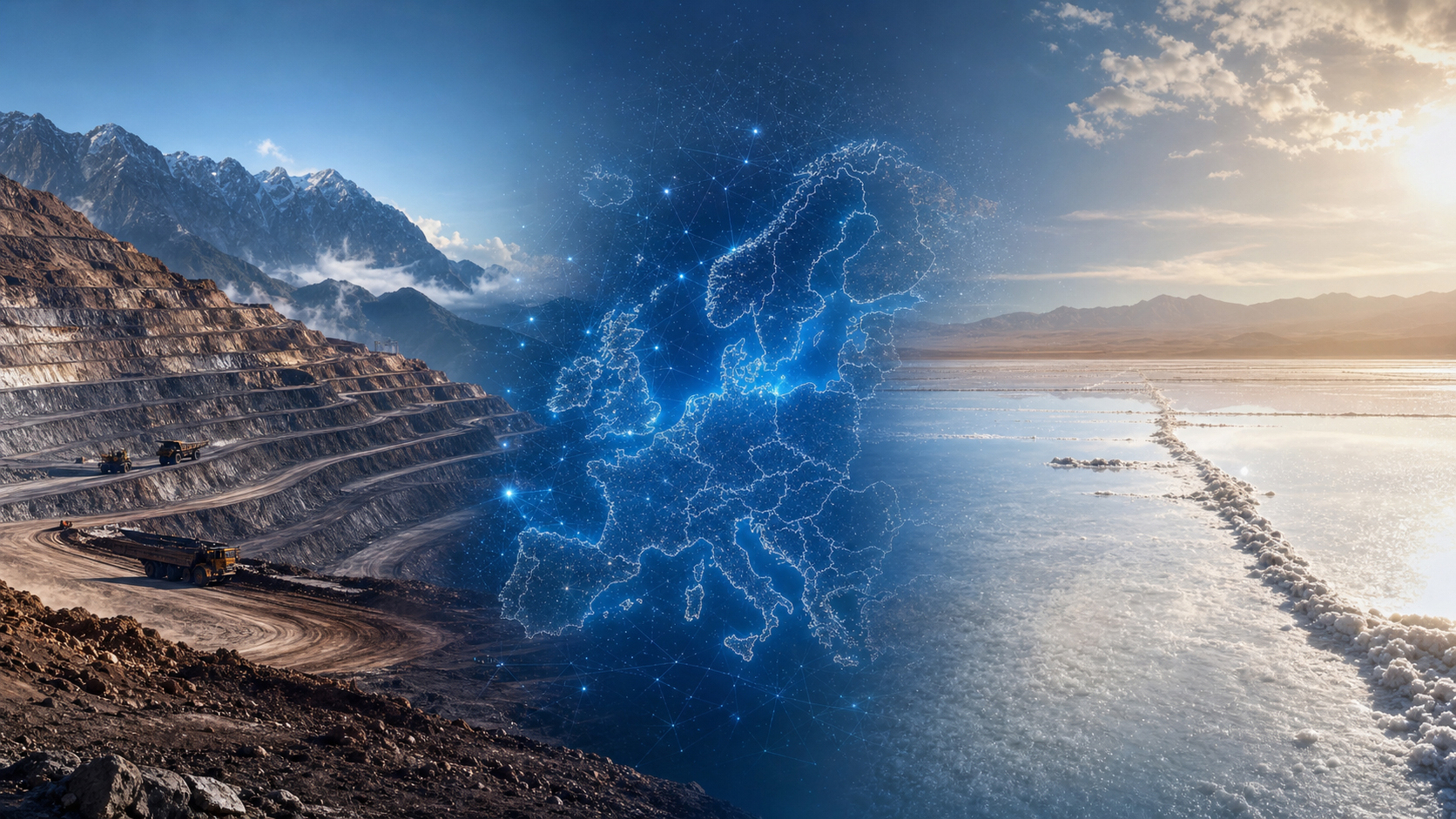
Europe's dangerous dependence: Why the raw materials trap is now snapping shut (and how we can escape) – Image: Xpert.Digital
The end of naivety: Why the dream of green steel bursts without these raw materials
Europe is sitting on treasures it isn't unlocking – and in the meantime, it's buying its dependence at a high price
For decades, Europe relied on a convenient illusion: raw materials could be bought most cheaply on the global market, while the environmentally damaging extraction was left to other regions of the world. But with today's geopolitical upheavals, China's targeted export controls, and the exponential demand of the energy transition, this market-liberal strategy has failed spectacularly. From forgotten mineral resources in Scandinavia and Central Germany to controversial lithium projects in Serbia and the untapped billions in potential in our own scrap yards – Europe stands at a historic turning point. This article illuminates the true extent of Europe's dependence on raw materials and unflinchingly reveals the massive efforts and uncomfortable decisions now urgently required to save the continent's industrial sovereignty.
From the Erzberg to the salt lake: Which raw materials could truly make Europe independent?
For decades, a tacit credo prevailed in Europe: raw materials are cheapest bought on the world market; domestic production is too expensive, too dirty, and economically inefficient. This approach seemed rational—as long as supply chains functioned, trade relations were stable, and geopolitical risks could be dismissed as abstract concerns about the future. Reality has refuted this credo with increasing brutality. Since China imposed export restrictions on gallium, germanium, and heavy rare earth elements, since Russia's invasion of Ukraine tore apart energy markets, and since the US and China extended their technological conflict to the raw materials level, Europe faces an uncomfortable truth: its industrial base, its energy transition, and its defense capabilities depend on a fragmented, highly concentrated, and politically vulnerable supply of raw materials.
The figures starkly illustrate the scale of the problem. The German economy sources roughly 90 percent of its raw materials, measured by their value, from abroad. For certain strategically crucial materials, the dependence is even more drastic: the EU relies on Chinese imports for 98 percent of its rare-earth magnets, and China concentrates around 90 percent of global magnet production. China also dominates the global market for gallium and germanium – two key materials for semiconductors, solar cells, and radar systems – with shares well over 80 percent. These figures are not mere academic statistics; they represent leverage points that geopolitical adversaries can exploit. And they already are.
When Beijing pulls the lever: The weapon of export control
In the summer of 2023, China imposed an export licensing system for gallium and germanium – officially justified by national security concerns, but in reality a direct response to Western restrictions on chip exports to Beijing. In December 2024, an export ban on several semiconductor metals to the US followed, which was only temporarily suspended in November 2025 in the context of trade negotiations, with a deadline of November 27, 2026. In April 2025, China extended its export restrictions to include heavy rare earth elements – with immediate consequences: the first production lines in Europe ground to a halt because supplies were no longer arriving.
The pattern is unmistakable. For decades, China has strategically built a position in which it controls the supply chains for key future technologies. It is the success of an industrial policy strategy that Europe, with its market-liberal convictions, simply did not consider possible. The situation is particularly precarious for Europe with regard to heavy rare earth elements: outside of China, there is currently no large-scale refinery for these materials, only a few pilot projects. Even if Europe were to develop the necessary deposits tomorrow, the processing capacity would be lacking – the entire value chain would have to be rebuilt, a process that would take ten to fifteen years.
The economic damage from a sudden supply disruption would be enormous. A study by Roland Berger and the Federation of German Industries (BDI) estimates the potential loss of added value for Germany alone in the event of a disruption to lithium imports from China at up to €115 billion. The automotive industry alone could lose up to €42 billion in added value. And lithium is just one of many critical materials.
The legal framework: Ambitions of the Critical Raw Materials Act and its real limitations
The European Union recognized the urgency and responded. On May 23, 2024, the Critical Raw Materials Act (CRMA) entered into force – a regulatory framework designed to secure the long-term supply of 34 critical and 17 strategic raw materials. The legislation defines binding benchmarks for 2030: at least 10 percent of the annual demand for strategic raw materials must be extracted within the EU, at least 40 percent processed within the EU, and at least 25 percent sourced from the European circular economy. Furthermore, the EU may not source more than 65 percent of its annual demand for any single strategic raw material from any one non-EU country.
These targets are not revolutionary – they are the minimum needed to address the most acute vulnerabilities. The CRMA envisages accelerated permitting processes for strategic projects, easier access to financing, and the establishment of a network of strategic resource partnerships with third countries. By March 2025, an initial list of 47 strategic projects within the EU had been adopted, 18 of which relate solely to lithium. In June 2025, a second list followed, comprising 13 strategic projects outside the EU, in countries such as Canada, Greenland, Kazakhstan, Norway, Serbia, Ukraine, Zambia, and Brazil – with a total investment requirement of €5.5 billion.
Nevertheless, the structural limitations of the law must be clearly defined. New mines and refineries don't spring up by decree. Lengthy permitting processes, public resistance to mining projects in Europe, high energy costs, and the lack of refining infrastructure remain real obstacles. The regulation sets targets, but no guarantees. There is a gap between ambitious benchmarks and industrial reality that cannot be closed by regulatory means alone.
The Styrian Erzberg and the legacy of the European mining industry
To understand where Europe stands today, it's worth looking at what once was. The Styrian Erzberg in the Austrian municipality of Eisenerz is considered the largest iron ore deposit in Central Europe and the world's most significant siderite deposit. Iron ore has been mined at the Erzberg since at least the 11th century, a continuity that is unparalleled. With 250 employees, around 12 million tons of rock are extracted there annually and processed into 3.2 million tons of fine ore, which is transported by rail to the voestalpine steelworks in Linz and Leoben-Donawitz.
The Erzberg is more than just a mine – it's a symbol of a European mining tradition that has given rise to prosperity, industrial capacity, and regional identity. Important institutions owe their existence to it, including voestalpine and the University of Leoben. As early as the 14th century, the sovereign, through iron ordinances, regulated the division of labor between the mining areas and meticulously controlled where the iron could be sold – from Innerberg to the north, from Vordernberg to the Mediterranean region. This early medieval raw materials policy operated according to essentially the same principles that the European CRMA strives for today: strategic control over value chains.
The story of the Erzberg also tells of structural tensions that continue to shape Europe today. The mountain, once a symbol of industrial growth, is now located in an economically disadvantaged region. Mining creates prosperity, but it also creates dependencies – on global market prices, technological leaps, and geopolitical constellations. Voestalpine is continuously modernizing the Erzberg: The conversion of heavy transport to diesel-electric vehicles with trolley operation saves around three million liters of diesel per year and reduces CO₂ emissions by approximately 4,200 tons annually. This demonstrates that domestic mining and climate goals need not be mutually exclusive – if it is actively modernized instead of being abandoned.
The Lithium Triangle and the Salar de Atacama: Europe as a consumer, not as a creator
While Erzberg embodies continuity for Europe, the Salar de Atacama in Chile represents the raw material dynamism of the 21st century. Beneath the dazzling white salt flats of the Chilean highlands lies lithium – the material without which no battery for electric cars, no storage for renewable energies, and no modern drone would function. The Lithium Triangle between Argentina, Bolivia, and Chile is estimated to hold around three-quarters of the world's lithium reserves.
Chile is the world's largest lithium producer and pursues an explicitly nationalist raw materials strategy. In 2023, President Gabriel Boric announced a national lithium strategy that stipulates the state will hold a majority stake in the development of strategic saltworks projects through state-owned companies like Codelco and Enami. In the Salar de Atacama itself, Codelco has an agreement with SQM to increase lithium production; the state is slated to hold a majority stake by 2031. Chile aims to increase its overall lithium production by approximately 70 percent.
For Europe, the geopolitical implications are clear: The countries of the Lithium Triangle are increasingly striving for state control over their deposits, for national value creation, and for conditions that reflect their own development agendas. They are no longer simply willing suppliers of raw materials in the traditional sense, but rather active players with their own interests. According to estimates by the German Mineral Resources Agency (DERA), total demand for lithium will increase four to eightfold by 2030. At the same time, scientists from East China Normal University and Lund University in Sweden warn that neither in Europe, nor in the USA, nor in China will the supply be sufficient in 2030 to meet the growing demand.
The social and environmental costs of lithium mining in the Atacama Desert are considerable. The water-intensive extraction process threatens the region's already scarce water resources and jeopardizes the livelihoods of indigenous communities living in the desert. Europe cannot, therefore, rely indefinitely on South American lithium – neither for ecological nor geopolitical reasons. Dependence on the salt flats is a structural risk, not a sustainable business model.
Europe's own lithium treasures: Serbia's Jadar Valley between hope and resistance
Europe's largest known lithium deposit is not located in an EU member state, but in Serbia's Jadar Valley, about 150 kilometers southwest of Belgrade. There, jadarite, a newly discovered clay mineral containing both lithium and boron, is found, and its extraction is planned by the Anglo-Australian company Rio Tinto. The mine could produce up to 58,000 tons of battery-grade lithium carbonate per year – enough to supply the batteries for around one million electric cars.
The political history of the project is convoluted and instructive. Rio Tinto initially received a mining permit, which the Serbian government revoked in 2022 under pressure from mass protests. The Constitutional Court overturned this decision in July 2024, whereupon the government once again cleared the way for mining. In the same month, the then German Chancellor, the EU Commissioner for the Green Deal, and the Serbian President signed a memorandum of understanding regarding lithium mining. In June 2025, the European Commission officially declared the Jadar project a strategic raw materials project.
The resistance of the Serbian population is neither irrational nor merely reactionary. Independent scientists have pointed out that test drilling has already contaminated water and soil with arsenic, boron, and lithium. Tens of thousands of Serbs have repeatedly taken to the streets, fearing that fertile farmland could be destroyed and some 18,000 people displaced. This tension—Europe's hunger for lithium versus local environmental protection and the will of the people on the ground—is not a minor issue. It is the core problem of any strategy that seeks to achieve resource independence through new mining areas without honestly considering the social costs.
Scandinavia as Europe's raw material hub: The discovery near Kiruna and the potential of the North
While the view of South America is often characterized by dependence and risk, a potential turnaround is emerging in northern Europe. In January 2023, the Swedish state-owned company LKAB announced the discovery of the largest known rare earth deposit in Europe to date, located in the region around Kiruna in northern Sweden. Named "Per Geijer," the deposit, based on updated exploration data from spring 2025, comprises approximately 1.2 billion tonnes of mineral resources, including 2.2 million tonnes of rare earth oxides – an increase of almost 30 percent compared to 2023 and a doubling compared to 2022. The European Commission has already classified Per Geijer as a strategic project under the Critical Raw Materials Act.
The discovery is enormous – but it cannot be assessed without limitations. The concentration of rare earth elements in the ore is less than 0.2 percent by weight, which is less than a fifth of typical deposits where production is already underway. While the deposit is large, it is geologically less productive than the main Chinese deposits. Furthermore, the ore lies deep beneath existing iron ore mines, making extraction technically complex and expensive. Experts estimate that it will be another ten to fifteen years before commercial production can begin.
Scandinavia's potential extends far beyond Per Geijer. In 2023, Norwegian authorities reported a significant discovery on the seabed containing, among other things, 45 million tons of zinc, 38 million tons of copper, as well as magnesium, cobalt, and rare earth elements. Norway is also planning to develop one of Europe's largest copper mines, the Repparfjord copper deposit in Finnmark – a project recognized as a strategic EU raw materials project in June 2025. In a 2025 survey by the renowned Fraser Institute, Finland was ranked the most attractive mining location worldwide – ahead of Nevada, Alaska, and other established mining regions. This combination of geological wealth and legal certainty makes Scandinavia perhaps the most important European raw materials region for the coming decades.
🎯🎯🎯 Global Sourcing & Commodity Trading with integrated logistics

Raw materials, global procurement & trade - Image: Xpert.Digital
State-of-the-art cargo planes, optimized transport routes, and multimodal logistics chains are interchangeable—they can be bought, leased, or outsourced. What money can't buy are direct contacts with producers in Peruvian mines, reliable supply relationships in the CIS countries, and years of built-up trust in markets that are unfamiliar to outsiders. The decisive competitive advantage in global commodity trading lies not in transporting the good from A to B, but in knowing where the good comes from, who produces it, and how to gain access before others even know the market exists. Whoever owns the network sets the price. Everyone else pays it.
More information here:
Threatened sovereignty: The invisible dependencies behind tech metals
The forgotten raw materials: Phosphorus, gallium and the invisible dependencies
Lithium and rare earth elements dominate the public debate. However, there are at least two other resource dependencies that are fundamentally important for Europe's long-term sovereignty and receive far less attention.
Phosphorus is the first of these underestimated problems. This element is not some exotic, high-tech ingredient, but rather the material foundation of global food production: around 90 percent of the world's phosphorus is used for fertilizers. Without phosphorus, there is no fertilizer; without fertilizer, there is no agricultural yield security. Europe is almost entirely dependent on imports of phosphate rock. The reserves are concentrated in just a few countries – primarily Morocco, China, and Russia. The EU has included phosphorus in its list of critical raw materials, but there is little awareness among the general public of the strategic dimension of this dependency. A promising solution is emerging: starting in 2029, wastewater treatment plants of a certain size in Germany will be required to recover phosphorus from sewage sludge. If all the sewage sludge produced in Germany were subjected to phosphorus recovery, around 50,000 tons of phosphorus could be recovered annually.
Gallium and germanium represent the second blind spot in the European raw materials debate. Both metals are essential for the semiconductor industry, solar cells, and military radar systems. China produces around 94 percent of the world's gallium and around 90 percent of its germanium. China's move to grant export licenses for these materials starting in August 2023 has vividly illustrated what strategic raw material control means in practice: prices rise, supply chains are thrown into panic, and Europe finds itself with no alternative suppliers for the technologies upon which its entire digitalization strategy is built.
Central Germany's mineral resources: What Saxony and Thuringia could contribute
Within Germany and Central Europe, there are raw material potentials that, after decades of neglect, are slowly coming back into focus. Saxony is home to the only known deposit of rare earth elements in Central Europe: In Storkwitz near Delitzsch lies a deposit that was already explored during the GDR era and potentially contains around 25,000 tons. That sounds like a lot – but it is moderate compared to European demand. The rare earth content in the ore is relatively low, which makes economically viable extraction difficult at current market prices.
Lithium deposits in Saxony-Anhalt and Thuringia are slated for future development according to current plans. However, given the global oversupply of lithium resulting from the expansion of South American and Australian production, extraction before 2030 appears unrealistic. Scientists advocate solving the problem at the European level, rather than just locally: Saxon deposits could contribute to security of supply as part of an EU-wide approach, without each small deposit needing to be economically viable on its own. This argument is compelling – but it presupposes that Europe significantly develops its industrial policy structures.
Battery raw material demand as a driver: Exponential growth, linear responses
Global demand for battery capacity for electric vehicles is rising from around 950 GWh in 2024 to a projected 5,600 GWh by 2035 – a sixfold increase in just eleven years. European demand is growing from 185 GWh (2024) to approximately 1,400 GWh (2035), at which point it is expected to account for around 25 percent of total global demand. This development is driving the demand for individual raw materials to astronomical heights: manganese up 550 percent, copper up 490 percent, lithium up 460 percent, graphite up 360 percent, nickel up 320 percent, and cobalt up 260 percent – all by 2035 compared to today's levels.
China dominates the entire battery value chain: The country's refining capacity accounts for 87 percent of graphite, 77 percent cobalt, and 47 percent copper. Europe faces the challenge of simultaneously increasing demand and diversifying supply chains—within a timeframe simply too short to develop new mines and refinery capacity. Only 15 countries worldwide dominate global battery raw material production, including Australia, Chile, China, the Democratic Republic of Congo, and Indonesia. For Europe, this is the starting point for a sober analysis: Complete self-sufficiency is unrealistic. Diversification and reduced concentration risks are the realistic goal.
Green steel and the hydrogen revolution: A transformation with reservations
Decarbonizing the steel industry is one of the most ambitious projects of European industrial policy and, at the same time, a magnifying glass for the tension between climate goals and economic reality. Green steel, produced through hydrogen-based direct reduction and further processing in electric arc furnaces using renewable electricity, promises climate-friendly steel production without fossil fuels. Projects at thyssenkrupp, Salzgitter, and ArcelorMittal, as well as European pioneers like HYBRIT in Sweden and H2 Green Steel, illustrate the path forward.
However, reality shows how fragile this path is. In June 2025, ArcelorMittal Europe announced the halt of its hydrogen-based steel projects in Bremen and Eisenhüttenstadt – despite promised billions in funding. The company's reasoning is revealing: green hydrogen is "not yet a viable energy source," and the lack of infrastructure and insufficient economic viability currently make the conversion unfeasible. At the same time, a core hydrogen network of over 9,000 kilometers is planned for Germany by 2032, which is intended to become part of a European network. The global market for green steel is estimated at around US$60.91 billion for 2025 and is projected to grow to US$129 billion by 2034.
The dilemma is real: Europe wants green steel, but the infrastructure for green hydrogen is not yet in place. The raw materials for direct reduction – high-quality iron ore, such as that from Erzberg – are available. What is lacking is an affordable and readily available energy carrier. This gap between climate ambition and technological reality shapes the entire raw materials debate and makes it clear that independence will not be achieved through legislation, but rather through massive investments in infrastructure, technology, and time.
Recycling and Urban Mining: The City as the Mine of the Future
One of the most realistic and most underestimated strategies for achieving resource independence lies not in mines, but in European living rooms, scrap yards, and industrial landfills. The concept of urban mining – the systematic recovery of raw materials from anthropogenic deposits such as buildings, vehicles, electronic devices, and infrastructure – could significantly alleviate Europe's structural raw material deficit.
The figures are both impressive and sobering. Around 700 million old mobile phones are lying unused in Europe alone – each containing small amounts of lithium, cobalt, and rare earth metals. The average European family owns 74 electronic devices, 13 of which are unused. Currently, however, only about 1 percent of the valuable materials consumed in the EU come from recycling. The EU Battery Directive sets progressively higher recycling quotas, up to 95 percent for cobalt, copper, and nickel from 2031. The International Energy Agency (IEA) estimates that a massive expansion of recycling could reduce the need for new mines by around 40 percent for copper and cobalt, and by about 25 percent for lithium and nickel by 2050.
In Germany, the anthropogenic stock – all materials bound in buildings, infrastructure, vehicles, and consumer goods – comprises approximately 50 billion tons. The German government has enshrined urban mining as a strategic pillar in its National Circular Economy Strategy. The challenges are well-known: the profitability of extracting the smallest material components, the low return rate due to hoarding behavior among the population, and the complexity of electronic waste streams. Nevertheless, recycling is the only strategy that is scalable in the short term, carries no geopolitical risks, and simultaneously reduces CO₂ emissions.
Strategic partnerships: Between real benefits and diplomatic symbolism
Europe has recognized that complete self-sufficiency is an illusion. The alternative to Chinese dependence is not autarkic self-sufficiency, but rather intelligent diversification with reliable partner countries. Strategic commodity partnerships already exist with Argentina, Australia, Chile, Greenland, Canada, and others. Canada is considered a particularly attractive partner: the country classifies 34 commodities as critical, 26 of which are mined domestically. Unlike Chile or the Democratic Republic of Congo, Canada operates within a stable, constitutional environment with comparable environmental and social standards.
Africa is another key area of European foreign policy regarding raw materials. Many of the NATO-listed defense-critical raw materials are found in significant quantities on the African continent: cobalt in the Democratic Republic of Congo, platinum group metals in South Africa, manganese also in South Africa, and gallium and aluminum in Guinea. Africa's role in the global value chain has so far been largely limited to the export of unprocessed or semi-processed raw materials, with a large share of the added value flowing to China. A collaborative partnership that combines European investment in local processing with guaranteed offtake agreements for Europe would benefit both sides – provided Europe is prepared to shape this partnership on an equal footing and not pursue it as a modernized form of resource extractivism.
The EU's Global Gateway program, which combines development financing with strategic infrastructure investments, provides an institutional basis for this. However, the Federation of German Industries (BDI), for example, criticizes the fact that Global Gateway in Africa needs a stronger focus on resource policy and that barriers to private investment must be dismantled more consistently.
The mathematics of independence: What is realistic and what remains wishful thinking
An honest analysis must distinguish between what Europe can achieve by 2030 and what is politically desired. The CRMA benchmarks – 10 percent domestic extraction, 40 percent domestic processing, 25 percent recycling – are not a guarantee, but a waypoint. Even if Europe implements all strategic projects, activates all partnerships, and massively scales up recycling, it will remain structurally dependent on imports for a number of critical raw materials.
The EU could potentially cover around 20 percent of its own rare earth demand by 2030. This would be a significant improvement over the current situation, but not an end to dependence. For graphite, cobalt, and many other battery raw materials, European reserves are currently insufficient to substantially meet the growing demand. China's market power is based not only on reserves, but primarily on decades of investment in refining capacity, supply chains, and price competitiveness – advantages that Europe cannot catch up to in just a few years.
What Europe can realistically aim for is reducing the risks associated with concentration in the market. Reducing dependence on China for rare-earth magnets from 98 percent to 30 to 40 percent would be a transformative step. This would mean ramping up domestic refining in Europe, developing production in Scandinavia and Serbia, massively expanding recycling infrastructure, deepening partnerships with Africa, building strategic reserves, and simultaneously reducing raw material requirements per product through technological innovation, improved design, and greater efficiency. This is not a heroic tale of total independence—it is a sober, multi-layered program for industrial sovereignty.
Political will and time: Europe's most pressing bottlenecks
Ultimately, the raw material question is not a question of geology. Europe sits on geological wealth, from Scandinavia's rare earth elements to Saxony's lithium, from Austria's iron ore deposits to Germany's anthropogenic deposits. The real bottleneck is something else: political will plus time.
Approval processes for new mining projects in Europe typically take ten to fifteen years. Public resistance to mining – as seen in the Jadar project in Serbia or the Nussir copper project in Norway – is democratically legitimate, but it comes at a price: it prolongs dependencies that, in turn, threaten democratic values by making European industrial policy vulnerable to blackmail by authoritarian raw material suppliers. This tension is not an anomaly; it is at the heart of the European raw materials debate.
The CRMA envisages accelerated permitting procedures. In practice, this means less bureaucracy, not less environmental protection. Europe must learn to achieve both simultaneously – fast procedures and high standards. This is more difficult than it sounds, but it is the only formula that reconciles political legitimacy and strategic necessity. Countries like Finland and Sweden demonstrate that this is possible: stable framework conditions, reliable legislation, and global attractiveness for mining investments.
Europe's dependence on raw materials is not a law of nature. It is the result of decisions made over decades – the decision to leave mining to others, to outsource processing, and to view the free market as the solution to all supply problems. These decisions can be reversed. The price is high: billions in infrastructure, years of permitting processes, public debates about mining and environmental protection, and the courageous willingness to assume industrial policy responsibility that Europe has long avoided. From the Erzberg to the salt lake – the raw materials for Europe's independence are readily available. What is lacking is the will to extract them wisely.
Your contact for raw materials ⛏️ Global sourcing 🚢🌐 & trading 📦

Dmitry Kovalenko
I would be happy to serve as your personal advisor.
Dmitry Kovalenko
Tel: +49 7348 4088 961
Your contact for raw materials ⛏️ Global sourcing 🚢🌐 & trading 📦

Konrad Wolfenstein
I would be happy to serve as your personal advisor.
Konrad Wolfenstein
Email: [email protected]
Our global industry and economic expertise in business development, sales and marketing

Our global industry and economic expertise in business development, sales and marketing - Image: Xpert.Digital
Industry focus areas: B2B, digitalization (from AI to XR), mechanical engineering, logistics, renewable energies and industry
More information here:
A thematic hub offering insights and expertise:
- Knowledge platform covering global and regional economies, innovation and industry-specific trends
- A collection of analyses, insights, and background information from our key areas of focus
- A place for expertise and information on current developments in business and technology
- A hub for companies seeking information on markets, digitalization, and industry innovations





