
China | The digital parallel universe: What the West urgently needs to learn about the super-app empire
Xpert Pre-Release

Available in 27 languages 📢
Prefer Xpert.Digital on GoogleⓘPublished on: April 30, 2026 / Updated on: April 30, 2026 – Author: Konrad Wolfenstein
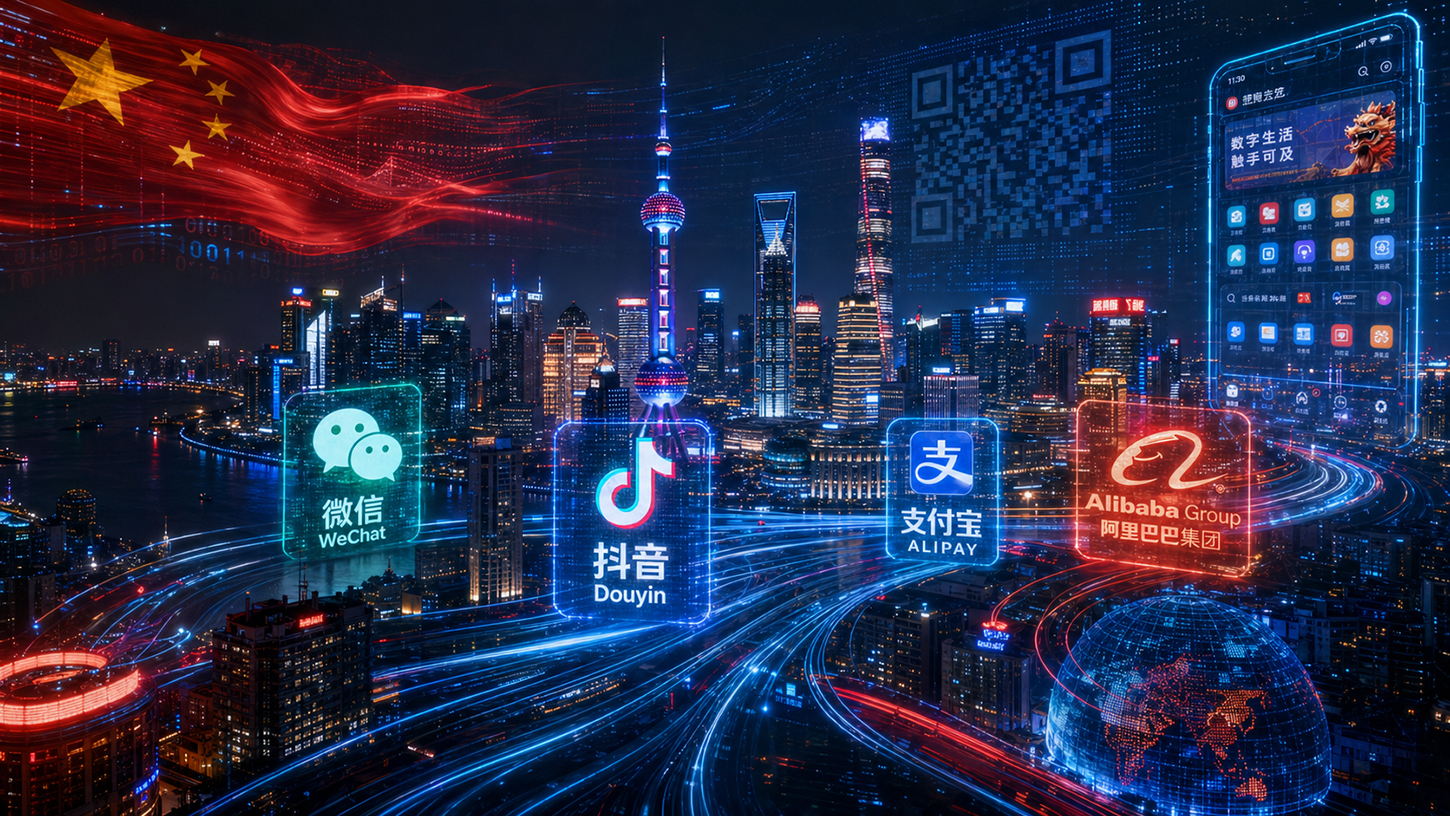
China | The digital parallel universe: What the West urgently needs to learn about the super-app empire – Image: Xpert.Digital
WeChat, DeepSeek & Co.: This is what digital everyday life in China really looks like
No cash, no Google: How 1.1 billion Chinese people have completely reinvented the internet
Anyone traveling to China today is not just entering a different country, but a completely different digital dimension. The Chinese internet is no longer a mere copy of Western models – it has evolved into a highly complex, self-contained parallel universe that far surpasses our Western understanding of connectivity. With well over a billion users who organize their entire private and professional lives through a few "super apps," the physical world and the digital realm merge in a way that is unique on a global scale.
While Western platforms like Google, WhatsApp, and Instagram remain consistently blocked by the Great Firewall, domestic tech giants have created an ecosystem that offers everything from a single source: from cashless payments in milliseconds to gigantic live commerce battles and groundbreaking artificial intelligence that has even put Silicon Valley on high alert. This article looks behind the digital curtain and uses fascinating figures and analyses to show how China truly uses the internet—and why it would be fatal for Western companies to continue underestimating this entirely unique digital civilization.
Digital China is not a reflection of the Western internet – it is an independent universe with its own rules, its own platforms and a density of integration that is unparalleled in global comparison.
A continent on the net: Numbers that shock and fascinate
The sheer scale of the Chinese internet is difficult to grasp. With 1.123 billion internet users, China reached a penetration rate of 79.7 percent of its total population in June 2025. That's more people than the entire population of Europe going online daily. At the same time, monthly active mobile internet users stood at 1.267 billion, with average daily usage reaching 7.97 hours per person and 117.9 sessions per day. These figures are not just impressive—they fundamentally change the meaning of the term "digital society.".
The technical infrastructure on which this usage is based is also world-leading. By November 2024, China had deployed a total of 4.19 million 5G base stations, and the number of gigabit broadband users had climbed to 209 million. Over 90 percent of administrative villages already have 5G coverage, driving digital inclusion even in rural areas. Median mobile connection speeds of over 161 megabits per second have become commonplace for hundreds of millions of users. Online retail reached a total value of 15.52 trillion yuan (approximately US$2.15 trillion) in 2024, an increase of 7.2 percent year-on-year. 974 million people shopped online. The core industries of the digital economy generated added value of 14 trillion yuan in 2024, equivalent to 10.5 percent of the gross domestic product.
Anyone who reads these figures as mere statistics misses the crucial point: In China, the internet isn't a tool that exists alongside analog everyday life. It is everyday life itself. Paying, communicating, shopping, booking doctor's appointments, paying taxes, signing contracts, finding friends – all of this takes place via digital channels that are more deeply woven into the social fabric than in any other country in the world.
WeChat – when an app replaces an entire society
To understand how China uses the internet, one must first and foremost understand WeChat. Developed by Tencent, and known in China by its Chinese name Weixin (微信), the application launched in 2011 and has become perhaps the most influential software product in human history. It combines into a single ecosystem what is spread across dozens of applications in the West: messaging service, social network, payment system, email replacement, video telephony, online shop, appointment scheduling, government portals, and much more.
The usage figures are staggering. WeChat had an estimated 1.481 billion monthly active users worldwide in the first quarter of 2025. In China alone, over 810 million people use the platform daily. 45 billion messages are sent and 410 million video calls are made every day. The average daily usage time is around 79 to 82 minutes. This represents 35 percent of total mobile usage time in China. Over 25 million active official accounts exist on the platform. These figures don't describe an app – they describe an operating system for social life.
What makes WeChat special is the depth of its integration. A typical Chinese person wakes up in the morning, checks WeChat messages from family and colleagues, orders their morning coffee via a WeChat mini-app, pays for it with WeChat Pay, listens to podcasts on the way to work using the integrated audio function, reads articles on WeChat official accounts, coordinates meetings via WeChat groups, and books their doctor's appointment in the evening using an embedded mini-app. The smartphone practically never leaves their hand – and WeChat practically never leaves the smartphone.
The anatomy of the all-rounder: mini-programs and the ecosystem within the ecosystem
One of WeChat's most technically fascinating and economically significant features is its so-called Mini-Apps. These are lightweight applications that run within WeChat without requiring users to download them separately. Launched in 2017, the concept has evolved into its own ecosystem within the app. In September 2024, 954 million people used WeChat Mini-Apps monthly, representing over 90 percent of the total WeChat user base. Daily active users of Mini-Apps are projected to reach 764 million by 2025.
For daily services of unparalleled scale, mini-programs have become crucial: JD.com had around 360 million monthly active users via WeChat mini-programs, and Meituan (the leading food delivery service) around 310 million. Well-known international brands like McDonald's, KFC, and Volkswagen use mini-programs to interact with Chinese customers. The platform thus takes on functions that in other countries are covered by dedicated apps, company websites, booking platforms, and CRM systems. For companies that want to reach the Chinese market, a WeChat mini-program is now more important than their own website or a native app.
Alibaba's Alipay ecosystem operates a similar mini-program system, and Douyin, the Chinese version of TikTok, has also introduced one. In an environment where users organize their digital world within a few "super apps," mini-programs are the preferred interface between businesses and consumers.
Short videos and the real-time shopping frenzy: The entertainment machine
Anyone who equates China solely with WeChat is only grasping part of the reality. The short-video-based entertainment format has become the dominant form of consumption on the Chinese internet. The platform Douyin (抖音), the Chinese sister app of TikTok, is technically related, but its content is completely separate from the internationally known TikTok, which is not available in China. In 2024, Douyin had over 700 million daily active users in China and generated a gross merchandise volume (GMV) of approximately 3.5 trillion yuan that year, a growth of 30 percent. Kuaishou, the second major short-video platform, which focuses on more rural and less affluent populations, boasted over 400 million daily active users.
By summer 2025, China's short-video market had reached over one billion users, representing a penetration rate of 93.8 percent of all internet users. At the same time, initial signs of saturation are emerging: market growth slowed from 19 percent to 4 percent annually. However, market saturation does not mean it is losing revenue power – quite the opposite. The live commerce format, where products are sold in real time via video streams, has developed its own economic power. In December 2024, 833 million people in China used live streaming services, representing 75.2 percent of all internet users. On Singles' Day (November 11, 2025), live commerce alone generated a gross merchandise volume (GMV) of over 620 billion yuan within 24 hours on major platforms. Conversion rates in live commerce range between 8 and 12 percent, while traditional e-commerce browsing achieves only 1 to 3 percent. This difference explains why virtually every consumer goods company in China now maintains its own live streaming teams.
Another significant player in the social media landscape is Xiaohongshu (小红书), internationally known as "Little Red Book" or "RedNote." The platform combines elements of Instagram, Pinterest, and Amazon to create a community for lifestyle content and social commerce. By 2024, Xiaohongshu had reached over 300 million monthly active users, of whom approximately 79 percent were female and over 70 percent were under 35 years old. Xiaohongshu is now considered a particularly valuable channel for premium and lifestyle brands because 40 percent of users actively use the platform to search for products, and 37 percent read reviews before making a purchase decision.
WeChat as office infrastructure: The digital B2B backbone of the domestic market
The contrast to Western business practices could hardly be greater. While European or American managers structure their workday with emails, LinkedIn, Slack, and conference calls, a significant portion of business communication and information flow in China takes place via WeChat. Over 70 percent of Chinese professionals and decision-makers cite WeChat as their primary tool for business communication. Emails play a marginally smaller role in Chinese companies than in the West, and LinkedIn, with around 60 million users, is far less prevalent in China—and is also occasionally blocked or throttled.
For B2B companies, this means that WeChat isn't just another marketing channel among many, but rather essential infrastructure. A 2025 survey by Kantar revealed that 84 percent of Chinese B2B decision-makers use WeChat to research suppliers and vendors before making contact. Purchasing managers send requests for questions (RFQs) via WeChat, sales teams close deals through WeChat messages, and after-sales customer service takes place in WeChat groups. The WeChat Official Account article format, a blog-like long-form article within the app, is considered the most trusted content format for B2B discovery in China—ahead of search engines, trade publications, and other social platforms like Douyin.
Chinese B2B culture relies more heavily on the concept of guanxi – personal relationships and mutual trust – than Western business models. WeChat is the ideal medium for this because it enables gradual trust building through constant, private interaction. Procurement managers, who by European standards might expect a formal tender or a conference, in China initially expect a personal connection via WeChat, followed by informal discussions in WeChat groups. Foreign companies without a WeChat account and a Chinese-language content strategy for the platform are simply invisible to a significant portion of the Chinese B2B market.
Our Asia expertise in business development, sales and marketing

Our Asia expertise in business development, sales and marketing - Image: Xpert.Digital
Industry focus areas: B2B, digitalization (from AI to XR), mechanical engineering, logistics, renewable energies and industry
More information here:
A thematic hub offering insights and expertise:
- Knowledge platform covering global and regional economies, innovation and industry-specific trends
- A collection of analyses, insights, and background information from our key areas of focus
- A place for expertise and information on current developments in business and technology
- A hub for companies seeking information on markets, digitalization, and industry innovations
China's Export Power 2.0: B2B, Live Commerce and Super Apps
The BAT triumvirate: Baidu, Alibaba and Tencent as state infrastructure in private hands
China's digital economy rests on three pillars known as the BAT conglomerate: Baidu (search and AI), Alibaba (e-commerce and cloud), and Tencent (social media, gaming, and payments). These three companies are estimated to directly or indirectly control over 70 percent of China's entire internet economy and transactions. Their power extends far beyond their core businesses: Tencent holds stakes in hundreds of companies, Alibaba operates China's largest cloud platform alongside its e-commerce empire (Taobao, Tmall, 1688.com), and Baidu is now primarily an AI company with a dominant search engine at its core.
The most important strategic resource all three possess is data. Baidu processes search queries from hundreds of millions of users and uses them for AI and predictive search. Alibaba has the deepest insights into the consumer behavior of the Chinese middle class. Tencent monitors the social communication network of one billion people. Taken together, the BAT trio sits on a treasure trove of data that would be almost unimaginable by Western standards, a treasure that is both restricted by government regulation and massively facilitated by the protection against Western competition. Programmatic advertising, data management, and media buying in China are so heavily controlled by the BAT system that no meaningful digital marketing activity can bypass these corporations.
Cashless and data-driven: China's payment revolution
When a visitor from Europe or the US comes to China for the first time, one of the most striking experiences is the virtual absence of cash and physical payment cards in many everyday situations. China is the world's most cashless economy: 87 percent of all consumer transactions were conducted digitally in 2025. The volume of digital payments reached over 500 trillion yuan (around 70 trillion US dollars) that year, which is roughly 3.5 times China's gross domestic product.
Alipay (Ant Group, Alibaba Group) and WeChat Pay (Tencent) dominate the mobile payment system with a combined market share of 94 percent. Alipay holds approximately 54 percent of the market share with 900 million users, while WeChat Pay holds around 40 percent, also with over 900 million users. Anyone wanting to shop, visit a restaurant, or buy a coffee in a major Chinese city in 2026 will either scan a QR code or have their own QR code scanned – the entire transaction will take less than a second. The universal QR code system has proven to be a key technology: it requires no NFC chips, no special POS terminals, and no significant capital investment. A street vendor with a printed QR code sticker is fully integrated into the payment system.
Furthermore, the Chinese central bank is pushing forward with the digital renminbi (e-CNY), which was already available in 26 pilot cities in 2025 and recorded cumulative transactions of 7 trillion yuan. Over 100 million digital wallets have been opened, although daily usage still lags far behind Alipay and WeChat Pay. The digital renminbi serves to control financial flows and is intended to play a role in cross-border payments in the medium term.
From factory nation to digital export powerhouse: China's international B2B weight
China's digital economy is no longer limited to the domestic market. In the first half of 2024, China's cross-border e-commerce imports and exports reached a value of US$180 billion (1.3 trillion yuan), a year-on-year increase of 15.7 percent – during a period in which overall foreign trade grew significantly more slowly. China operates 105 cross-border e-commerce pilot regions that accelerate logistics through bonded warehouses and simplify customs procedures.
At the heart of international B2B trade is Alibaba.com, serving over 40 million active buyers in more than 190 countries. As China's leading B2B e-commerce platform, Alibaba generated nearly US$130 billion in revenue in 2023. While Alibaba.com targets international buyers, 1688.com, the largest domestic B2B marketplace, caters to Chinese manufacturers and distributors, enabling bulk purchasing for small and medium-sized enterprises. DHgate, Global Sources, and Made-in-China.com complete the spectrum, with the latter two placing particular emphasis on supplier verification and quality assurance to build trust with international buyers.
WeChat is playing an increasingly important role in international B2B. For European and American companies seeking to enter the Chinese market, having a presence on WeChat is no longer optional—it's essential. Procurement managers in Chinese companies prefer to research potential foreign partners on official WeChat accounts, not via Google or LinkedIn. Platforms like Temu, Shein, and AliExpress are, in turn, bringing the Chinese model of price-aggressive, algorithmically optimized e-commerce experience to the West, changing consumer expectations regarding delivery speed, product selection, and pricing.
Older users, rural regions: Digital inclusion as a government project
A little-noticed but economically and socially significant phenomenon is the rapid digitalization of previously neglected groups. By 2024, over 157 million people aged 60 and over in China were using the internet. Nearly 70 percent of all internet users over 60 used their smartphones daily. The Chinese government and major platforms have systematically invested in age-appropriate technology, simplified user interfaces, and digital literacy programs. Over 2,000 websites and apps have been redesigned to be accessible specifically for older users. In rural China, internet penetration rose to 69.2 percent by 2025, after having been well below 60 percent just a few years earlier. WeChat is also the most popular app among rural residents and older users – in studies with retirees in rural areas, the vast majority of respondents used WeChat or Kuaishou as their primary digital application.
This expansion of the user base is no coincidence. With its strategy for a digital China, the Chinese government explicitly aims to bridge the digital divide and integrate as many population groups as possible into the digital ecosystem – also because broader digital inclusion enhances the state's capacity for control and surveillance. The Smart Village initiative, which provides digital infrastructure and services to rural communities, is as much a part of this economic policy strategy as a social housing program in the analog sense.
AI as a quantum leap: DeepSeek and the digital China of tomorrow
No picture of the Chinese internet would be complete without a look at the AI revolution that caused a global sensation in 2025. With the release of DeepSeek-R1 on January 20, 2025, a Chinese startup demonstrated that world-class AI models could be developed, models whose performance rivaled that of top American models—and at a fraction of the usual training costs. The shock in Silicon Valley was real: For a moment, the assumption that America's technologically superior chip advantage would guarantee its continued leadership in AI was shaken. DeepSeek has been widely described as the "Sputnik moment" of technological history.
In China itself, DeepSeek has brought generative AI beyond tech circles into everyday life. China's generative AI user base doubled in the first half of 2025, reaching approximately 570 million users – a growth rate of 106.6 percent. Douyin's parent company, ByteDance, Alibaba with its Qwen model, Baidu with Ernie Bot, and numerous startups are vying to deeply integrate AI into super-app ecosystems. WeChat has introduced AI-powered features, Baidu has transformed its search system to provide AI-generated answers, and Douyin is using AI to personalize video streams at a level that Western providers are only now beginning to strive for. At the end of April 2026, DeepSeek unveiled further iterations with its V4 and V4-Flash models, which analysts say are highly competitive with their American counterparts.
The integration of AI into the Chinese digital economy has an accelerating effect: live commerce conversion rates continue to rise through AI-optimized recommendations, WeChat mini-programs are enhanced by AI-powered service robots, and B2B platforms such as Alibaba.com are using AI-powered product matching systems that connect international buyers with perfectly matched suppliers.
The Chinese model: What the West needs to learn about digital parallel worlds
China's digital reality is neither easy to copy nor to ignore. It is the result of a unique interplay of state control, demographic size, infrastructural resolve, and entrepreneurial dynamism. The West tends to dismiss China's internet either as an authoritarian anomaly or to misunderstand it as a mere copycat model. Both approaches are too simplistic.
What makes the Chinese model structurally different from the Western one can be summarized in a few key points. First: integration instead of fragmentation. While Western users spread their digital activities across a dozen platforms, Chinese users consolidate a significant portion of their digital lives into two or three super-apps. This creates seamless integration in everyday life and enormous platform power for the operators. Second: commerce-first instead of content-first. The Chinese internet was conceived as a trading platform from the outset. Social media, entertainment, and communication in China are always also vehicles for transactions. The convergence of entertainment and shopping in live commerce is not a Western invention—it is a Chinese one. Third: mobile-first as a non-negotiable foundation. 99.8 percent of Chinese internet users are online via smartphones. The interface design, user experience, and business logic of Chinese platforms are radically optimized for mobile—not as a reaction to a development, but as a premise from the very beginning.
For international companies aiming for success in China, this all means a fundamental recalibration of their digital strategy. Western web logic – company website, email campaigns, LinkedIn presence, Google Ads – is ineffective or barely effective in China. Anyone attempting to enter the Chinese B2B or B2C market without an official WeChat account, a Chinese-language mini-program, and a live commerce presence is barking up the wrong tree. At the same time, this very complexity creates lasting competitive advantages for companies that successfully navigate the market, because the barriers to entry for those who lag behind are substantial.
The question of whether China now functions solely through WeChat is an oversimplification that obscures more than it reveals. WeChat is the gravitational center of the Chinese digital ecosystem, but it is not its only star. Douyin is revolutionizing commerce, Xiaohongshu is defining lifestyle trends, Baidu is structuring information searches, Alibaba is organizing global trade, and the country's AI startups are beginning to shape the global technology agenda. What unites them is their embeddedness in a completely self-contained, technologically sophisticated, state-shaped, and commercially overwhelmingly successful digital civilization—the third billion people of humanity who have written their own version of the internet and are now increasingly exporting it to the rest of the world.
Consulting - Planning - Implementation

Konrad Wolfenstein
I would be happy to serve as your personal advisor.
me at wolfenstein∂xpert.digital contact
Just call me on +49 7348 4088 965 .
🎯🎯🎯 Sino-Cooperation

Sino-Cooperation is a platform based in China and Germany
Sino-Cooperation is a platform based in China and Germany that promotes exchange and cooperation between German and Chinese companies, especially through events, digital formats and an online cooperation exchange for market entry and partnerships.
More information here:





